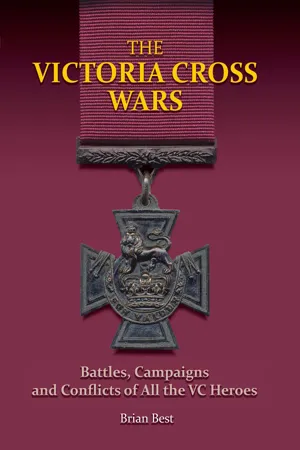
- 584 pages
- English
- ePUB (mobile friendly)
- Available on iOS & Android
eBook - ePub
About this book
The British Empire at its height stretched around the globe. From Asia to the Americas, scores of countries were conquered or assimilated into the greatest commonwealth of nations in history. Many of these countries were won, and held, at the point of the bayonet, and British soldiers and sailors fought long and hard campaigns in deserts, mountains and jungles to maintain and expand the Empire. Fighting, though, means bloodshed; it also means bravery. Victoria Crosses were awarded in operations against Persia, Abyssinia and China, in New Zealand, Burma and Sudan, in the Perak War, the Andaman Islands Expedition and the Mashona Rebellion to name but a few of the forty-four different campaigns of the colonial era.The Victoria Cross Wars explains Britains involvement in these little-known and forgotten campaigns and details the battles and engagements that resulted in the granting of the most highly regarded award for valor in the face of the enemy. The greater conflicts of the twentieth century receive due treatment as do more recent operations in the troubled parts of the world.A total of 1,358 VCs have been awarded since the cross of valor was first instituted in 1855, the latest of which was announced in February 2015. The stories behind the awarding of these medals have been repeated in countless anthologies but The Victoria Cross Wars explains not just what the men did, but why they were there and what they were fighting for.
Information
Chapter 1
Crimean War, 1854–56
| Number of VCs awarded | 111 |
| Number of VCs awarded to officers | 41 |
| Number of VCs awarded to other ranks | 70 |
| Total awarded to Royal Navy | 24 |
| Total awarded to Royal Marines | 3 |
| Total awarded to British Army | 84 |
Origins of the War
The Crimean War was caused by long-term tensions that had developed in Europe since the signing of the Treaty of Vienna in 1814 after Napoleon Bonaparte’s defeat at Waterloo. The objective of the Treaty was to restore old boundaries and preserve the status quo by upholding stable and orderly monarchies. The new Czar, Nicholas 1, reverted to an autocratic rule and an expansion of her empire.
Russia began nibbling away at the Ottoman Empire and fought a series of wars on her borders beginning with Georgia, Chechnya, Armenia and Azerbaijan. She also cast her eyes to the east, and had reached the northern borders of Persia and Afghanistan, something that unsettled British India.
In 1848, Europe was rocked by a series of revolutions which in the main affected France, the Netherlands, Germany, Austria, Denmark, Poland and Italy. Britain and Russia were unaffected by this upheaval, although they were considerably uneasy about any spread over their borders. It did little to alter Russia’s ambitions to further expand to the south into Europe. Czar Nicholas was again casting covetous eyes at the ‘sick man of Europe’, Turkey, and the declining power of the Ottoman Empire. His ambition was to gain control of the Straits – the Bosphorus, Sea of Marmara and the Dardanelles – to allow his Black Sea naval fleet access into the Mediterranean Sea. The most direct route was to advance through the Ottoman-ruled countries on the west of the Black Sea; Moldova, Rumania and Bulgaria.
One of the beneficiaries of the 1848 uprising in France was Louis Napoleon Bonaparte, who was elected President of the Second Republic. Within four years he felt strong enough to suspend the assembly and establish the Second French Empire, with himself as the new emperor, Napoleon III. As a usurper, he sought swift prestige to uphold his new ‘Second Empire’.
To maintain Papal support, he championed the Catholic cause wherever he could. One such place was the holy places in Ottoman-controlled Palestine. Napoleon put pressure on the Sultan and managed to secure concessions for the Catholic Church, which enabled the priests to have control of the keys to the Church of the Nativity in Bethlehem.
Russia reacted with a demand for the Orthodox Church to also have shared control of the keys. In a series of clashes, several Orthodox monks were killed and Czar Nicholas insisted that he be appointed protector of the Orthodox Christians in the Ottoman Empire, something to which the Sultan could not concede. This gave the Czar the excuse he was looking for. In July 1853, Russia occupied the Turkish Danubian provinces of Moldova and Walachia. In October, Turkey declared war and Russia responded by sending her Black Sea fleet to attack and destroy a Turkish flotilla in the port at Sinope.
Britain supported Turkey as a buffer against Russian expansion in the region, fearing any Russian presence in the Eastern Mediterranean could threaten her route to India. Although large, the Russian army was badly led, poorly equipped and tactically out-of-date but, because of her record against Napoleon, she was still regarded as militarily invincible.
Initially reluctant to get involved in a war, especially allied with France, Britain finally agreed to go to Turkey’s aid in the Danubian provinces. Along with France, Britain declared war with Russia in March 1854. After decades of peace, the British public was now in a mood for another war. Recruiting was brisk as young men were attracted by the colourful uniforms, the new weaponry and the chance to join the great adventure and ‘to give the Russian bear a bloody nose’.
The first regiments set sail for the Eastern Mediterranean and soon some 60,000 allied troops were camped on the Bulgarian coast around Varna. Very quickly it became apparent how especially unprepared the British were to conduct a war. Failures in the commissariat and medical department soon surfaced, exacerbated by a virulent outbreak of cholera that swept through the camps. As the allies suffered in their tented camps, the Turkish had inflicted a stunning defeat on the Russian army at Silistria, seventy-five miles north on the Danube River. Ten thousand Turks, who had been besieged by 90,000 Russians, had routed the invaders who completely withdrew from the Danubian Provinces.
Though the immediate cause of the war had been resolved, the French and British governments were reluctant to return home without inflicting some sort of punishment of the enemy. Without accurate maps and with no intelligence, the British and French commanders, Lord Raglan and General St. Arnaud, planned to cross the Black Sea, land their troops on the southwest coast of the Crimean Peninsula and destroy the Russian fleet at Sebastopol.
Leaving the Bulgarian coast on 7 September, the allied troops endured a terrible week-long voyage until they were deposited on an open beach in Calamita Bay, some 35 miles north of Sebastopol. Weakened by cholera and dysentery they had brought from Varna, the mighty army marched south and fought the first battle of the campaign at the River Alma.
With little in the way of leadership from Lord Raglan, other than an order to advance, the British marched under fire to the river, crossed it and steadily advanced up the steep slopes on the far bank, where the Russians were dug in. It was here that the first half dozen Victoria Crosses were awarded for this hard-fought battle. Four were awarded to the Scots Fusilier Guards for gallantry while carrying their colours into battle; Captain Robert Lindsay, Sergeant John Simpson Knox, Sergeant James MacKechnie and Private William Reynolds. Captain Edward William Derrington Bell of 23rd (Royal Welch) Fusiliers won his for capturing a Russian gun that was being withdrawn from a redoubt, while Sergeant John Park of 77th (Middlesex) Regiment won his VC for Alma and other gallant acts during his Crimean service.
Another member of a colour-party was Sergeant Luke O’Connor of 23rd (Royal Welsh) Fusiliers who is acknowledged as the first military Victoria Cross winner.
LUKE O’CONNOR VC (1831-1915)
Luke O’Connor is often cited as an example of how a common soldier could prosper in the nineteenth century British Army, rising from the rank of private to that of major general. In 1900, he wrote a magazine article about his recollections of his service and early life.
Early Life
‘I was born near Elphin, Co. Roscommon, in 1832 (he was actually born on 20th February 1831), and owing to the troubles in those days my parents, with a large portion of their numerous family, emigrated to Canada in order to go in for farming, and took me, being one of the youngest children with them. Crossing the Atlantic was a tedious business then, and we did it in a slow sailing vessel. During the long voyage my father died at sea. My widowed mother reached Quebec in the midst of a small-pox epidemic and fever, when she too, was taken ill and died, also one of my brothers, leaving me to the care of an elder sister, who brought me back to Ireland.
‘My first recollection in life is my return to Boyle, a military town containing barracks … Here I was handed over to an uncle, as my sister returned immediately to America, where many of my relations still are; some of them attained high positions during the American (Civil) War. It was not strange that my earliest ideas had a military tendency, for Roscommon is famous for giving soldiers to the service, and, indeed, many of my relatives have served in the Army all over the world … Little did I then think that later in life I should become a captain commanding a two-company detachment in the same quarters?’
The O’Connors were not without some financial standing in their homeland. This is confirmed by Luke’s description of how he came to enlist in the Army.
‘It was intended at first to make me a priest, and the notion sometimes took hold of my fancy. My uncle, however, wished me to return to Canada to join my people; but all at once he died. There was a first cousin of mine, however, in London in medical practice, who had served as a surgeon under Sir de Lacy Evans in Spain. (This would be the Carlist Wars of the 1830s in which British volunteers participated). I resolved to visit this relative, and see what he could do for me…In spite of this my wish to soldier became too strong for me, and shortly afterwards when again in Westminster I was struck by the gallant appearance of a fine-looking recruiting sergeant of the Royal Welch Fusiliers, a regiment I had never heard of before, and its title caught my fancy. I took the shilling once more, a few of my young friends followed my example, and we enlisted in the same regiment. I said nothing to my cousin this time, and in a few days found myself in the barracks at Winchester, where the Royal Welch were quartered in July 1849.’
Military Career
‘Within a fortnight of joining I had so mastered my drill that I was noticed by my adjutant and sergeant-major and called out to drill a squad in their presence to see if I could do it just as I had been taught. Proud of the opportunity, I repeated the necessary cautions and gave the words of command completely to their satisfaction.
‘Next day I was brought to the orderly-room before my colonel, Arthur Wellesley Torrens, a man well known in the service. Formally adjutant to the Guards, very much to the disgust of the older officers of the Royal Welch he had been promoted to command their regiment … To my great delight, on that day he gave me my stripe as lance-corporal, which I am always proud to remember. In June 1850, I was promoted full corporal and to lance-sergeant the same year, and twelve months later on, when the regiment was at Plymouth, I became a sergeant, just two years after joining it.’
O’Conner’s natural intelligence and ability had made him stand out amongst his comrades and the rate of his promotion was quite exceptional and a clear indicator of things to come. In 1853, he was detached from the regiment to drill and train three militia units before embarking with his regiment on SS Trent for bound for Turkey and the war with Russia.
Crimea Landing
Along with their comrades, the 23rd Regiment sat and suffered in the unhealthy camps around Varna, losing one officer and thirty-six other ranks to cholera. In August, the British and French governments issued directives that their armies in Bulgaria were to embark at Varna and then endeavour to capture the Russian naval base at Sebastopol in the Crimea. On 14 September, the British army began to land troops at Calamita Bay, north of Sebastopol and the first regiment ashore was the 23rd Regiment. The unopposed landings lasted four days and on 19 September the advance south began. Blocking their route to Sebastopol was a Russian force under the command of Prince Menchikov which was posted on high ground behind the River Alma. Early on the morning of 20 September, the French, who were on the right of the line between the British army and the sea, began their advance against the Russian positions, expecting to be closely supported.
The British Staff, however, due to generally poor organisation, failed to order the advance until 15.00 hours when Lord Raglan ordered the 2nd and Light Divisions, supported by the 3rd and 1st Divisions, to advance up the slopes directly in front of them. The Royal Welch formed part of the Fusilier Brigade of the Light Division. As they advanced towards the river they passed through vineyards and scrambled over stone walls, which broke up their formation and they became the target for a heavy bombardment from the Russian guns on the heights ahead of them. Crossing the Alma River, they trudged up the slope which had no natural cover.
VC Action
Almost immediately, the advance slowed and, in places, began to falter. General Codrington, commanding the Fusilier Brigade, ordered his men to fix bayonets and attack the Russian positions. The 7th Regiment (Royal Fusiliers) on the right of the line was forced to form to the right to repel a large Russian column that was attempting to outflank them. The Royal Welch and the 33rd Regiment were joined by a regiment from the 2nd Division and the 19th Regiment and pushed on up the hill.
In the lead as a member of the colour escort, Sergeant Luke O’Connor, who recalled the assault: ‘Early on the morning of 20th … the Light Division was deployed into line, and halted for some time. Our adjutant came to my captain and asked him to let me go as one of the escort for the colours. He replied I was wanted where I was. The adjutant returned with the colonel’s commands for me to be sent as directed. I went away delighted with the distinction of being with the colour party, and was appointed centre sergeant. On the line being told to advance, I took the usual six paces to the front as guide to the right brigade of which the Royal Welch was the battalion of direction.
‘The general, however, called me back, as we were now under heavy fire of shot and shell, and told me to take the usual place between the colours … We pushed through the river, which was very deep in some places … here the men began to drop very fast.’
As they reached the Russian line which was protected by an earthwork, the Colours of the Royal Welch were being carried by eighteen-year old Lieutenant Anstruther and Ensign Butler. Although this duty was deemed a great honour it drew much enemy fire and consequently heavy casualties. Garnet Wolseley later wrote that; ‘a general who could condemn anyone to carry a large silk colour under close musketry fire ought to be tried for murder’.
Just how dangerous it was can be judged by the sequence of killed and wounded members of the colour party. Within minutes, Ensign Butler was shot dead and the pole broken by a musket ball. The fallen Regimental Colour was then picked up by Lieutenant Colonel Chester and then passed to Sergeant Honey Smith, who carried it for the remainder of the day. Lieutenant Anstruther, carrying the Queen’s Colour, was urged by Sergeant O’Connor to move forward, believing that it was safer close to the earthwork than it was lower down the slope. Suddenly, the Russians began to limber up their artillery and Anstruther charged forward leading a number of men intent on foiling the enemy’s plan.
‘We then ran up the slope until about eighty yards from the redoubt when I remarked: “If we go further the colours may be taken, for we were far ahead of the men.” We halted; at that moment, the poor officer was killed and I was knocked over at the same time by a bullet striking me in the breast and breaking two ribs. Private Evans came up and helped me on my legs; I then snatched up the flag, rushed to the earthwork and planted it on the parapet…The silk standard was riddled with shot, but the redoubt itself sheltered my body.’
When O’Connor fell, the Queen’s Colour had been taken up by Private William Evans and he held it up to indicate that the Royal Welch were the first to reach the enemy positions, before passing it to Corporal Luby, who then relinquished it back to O’Connor. Captain Bevil Granville urged the wounded sergeant to relinquish the Colour and go to the rear for medical treatment but he refused until loss of blood forced him to pass it to the captain. Following further heavy fighting, the Russians finally withdrew, leaving the body-strewn battlefield to the Allies. The Royal Welch had eight officers and forty-four men killed and five officers and 154 men wounded, amongst whom was Sergeant Luke O’Connor, whose battlefield promotion to Colour-Sergeant was confirmed two days later. It was discovered that the Queen’s Colour carried by O’Connor had been pierced by twenty-six bullets.
Promotion
O’Connor was one of the fortunate men who, having been severely wounded in action, managed to survive the ministering in the field and the notorious Barracks Hospital at Scutari. On 19 October, he had been commissioned without purchase as an ensign in the 76th Regiment of Foot (2nd Battalion, Duke of Wellington’s) in recognition of his action at the Alma. It was normal to commission an NCO into another regiment as it was felt that such a promotion within the same regiment would place him in a difficult position with regard to his former comrades. Despite this the losses sustained by the Royal Welch meant that he was exchanged back into his old regiment on 5 November. A further promotion to lieutenant followed on 9 February 1855.
‘I reached Scutari Hospital on 26th (September) and discharged on 20th October. I again embarked for the Crimea but caught a fever on board, was landed at the Balaklava Hospital and sent back to Scutari, where I received much kind attention from Miss Nightingale and the Sisters of Charity... Meanwhile, in February, I received the good news I had been promoted to an ensign’s commission in the Royal Welch Fusiliers and this was subsequently antedated to 5th November 1854.’
On 8 September 1855, Lieutenant O’Connor took part in the second British assault on the Redan, one of the two major Sebastopol defensive works. With the Russians prepared to meet the attack, the storming party dashed across nearly 300 yards of open, fire-swept ground towards a twenty-foot wide and fourteen-foot deep ditch. Unfortunately, when they began their attack, the men of the 23rd Regiment who were in support were still some distance from the front line.
Lieutenant Boscawen Trevor Griffith wrote in a letter home: ‘We rushed madly along the trenches … Several officers we met coming back wounded said that they had been in the Redan and that the supports were only wanted to complete a victory … We gained the 5th parallel, our most advanced trench, and “On, Twenty Third! This way!” cried the staff officers. We scrambled out of the trench on to open ground. That was a fearful moment. I rushed across the space…shot striking the ground all the way and men falling down on all sides. When I got to the edge of the ditch…I found our men all mixed up in confusion but keeping a steady fire against ...
Table of contents
- Cover
- Title
- Copyright
- Contents
- Introduction
- Chapter 1 Crimean War, 1854-56
- Chapter 2 Persian War, 1856-57
- Chapter 3 Indian Mutiny, 1857-59
- Chapter 4 Third China War, 1860
- Chapter 5 Taiping Rebellion, 1851-64
- Chapter 6 Second New Zealand War, 1860-66
- Chapter 7 Umbeyla Expedition, 1863-64
- Chapter 8 Shimonoseki Expedition, 1863-64
- Chapter 9 Bhutan War, 1864-65
- Chapter 10 Fenian Raids – Canada, 1866
- Chapter 11 Gambia Expedition, 1866
- Chapter 12 Andaman Expedition, 1867
- Chapter 13 Abyssinian War, 1867-68
- Chapter 14 Lushai Expedition, 1872
- Chapter 15 First Ashanti War, 1873-4
- Chapter 16 Perak Expedition, 1875-76
- Chapter 17 Quetta Incident, 1877
- Chapter 18 Ninth Cape Frontier War, 1877-78
- Chapter 19 Second Afghan War, 1878-80
- Chapter 20 Anglo-Zulu War, 1879
- Chapter 21 Sekukuni Campaign, 1879
- Chapter 22 Basuto War, 1879-82
- Chapter 23 Naga Expedition, 1879-80
- Chapter 24 First Anglo-Boer War, 1880-81
- Chapter 25 Anglo-Egyptian War, 1882
- Chapter 26 Sudan War, 1883-5
- Chapter 27 Third Burma War, 1885-93
- Chapter 28 Manipur Expedition, 1891
- Chapter 29 Hunza-Nagar Expedition, 1891
- Chapter 30 Chitral, 1895
- Chapter 31 Gambia, 1892
- Chapter 32 Rhodesia, 1896
- Chapter 33 North-West Frontier War, 1897-98
- Chapter 34 Sudan Campaign, 1888-89
- Chapter 35 Crete, 1898
- Chapter 36 Second Anglo-Boer War, 1899-1902
- Chapter 37 China, 1900
- Chapter 38 War of the Golden Stool 1900–01
- Chapter 39 Somaliland, 1902-3
- Chapter 40 Kano-Sokoto Expedition, 1903
- Chapter 41 Tibet Campaign, 1903-4
- Chapter 42 First World War, 1914
- Chapter 43 First World War, 1915
- Chapter 44 First World War, 1916
- Chapter 45 First World War, 1917
- Chapter 46 First World War, 1918
- Chapter 47 North Russia Expedition, 1919
- Chapter 48 The Arab Revolt – Iraq, 1920
- Chapter 49 North-West Frontier, 1915-36
- Chapter 50 Second World War, 1940
- Chapter 51 Second World War, 1941
- Chapter 52 Second World War, 1942
- Chapter 53 Second World War, 1943
- Chapter 54 Second World War, 1944
- Chapter 55 Second World War, 1945
- Chapter 56 Korean War, 1950-53
- Chapter 57 Indonesia-Malaysia Confrontation, 1963-66
- Chapter 58 Vietnam, 1959-75
- Chapter 59 Falklands War, 1982
- Chapter 60 Afghan War, 2001-14
- Chapter 61 Second Iraq War, 2003-11
- Plate section
Trusted by 375,005 students
Access to over 1.5 million titles for a fair monthly price.
Study more efficiently using our study tools.
Frequently asked questions
Yes, you can cancel anytime from the Subscription tab in your account settings on the Perlego website. Your subscription will stay active until the end of your current billing period. Learn how to cancel your subscription
No, books cannot be downloaded as external files, such as PDFs, for use outside of Perlego. However, you can download books within the Perlego app for offline reading on mobile or tablet. Learn how to download books offline
Perlego offers two plans: Essential and Complete
- Essential is ideal for learners and professionals who enjoy exploring a wide range of subjects. Access the Essential Library with 800,000+ trusted titles and best-sellers across business, personal growth, and the humanities. Includes unlimited reading time and Standard Read Aloud voice.
- Complete: Perfect for advanced learners and researchers needing full, unrestricted access. Unlock 1.5M+ books across hundreds of subjects, including academic and specialized titles. The Complete Plan also includes advanced features like Premium Read Aloud and Research Assistant.
We are an online textbook subscription service, where you can get access to an entire online library for less than the price of a single book per month. With over 1.5 million books across 990+ topics, we’ve got you covered! Learn about our mission
Look out for the read-aloud symbol on your next book to see if you can listen to it. The read-aloud tool reads text aloud for you, highlighting the text as it is being read. You can pause it, speed it up and slow it down. Learn more about Read Aloud
Yes! You can use the Perlego app on both iOS and Android devices to read anytime, anywhere — even offline. Perfect for commutes or when you’re on the go.
Please note we cannot support devices running on iOS 13 and Android 7 or earlier. Learn more about using the app
Please note we cannot support devices running on iOS 13 and Android 7 or earlier. Learn more about using the app
Yes, you can access The Victoria Cross Wars by Brian Best in PDF and/or ePUB format, as well as other popular books in History & British History. We have over 1.5 million books available in our catalogue for you to explore.