"Superb . . . one of the most honest, candid, and truly delightful memoirs . . . the perfect memorial to one of the Fleet Air Arm's greats."—
Aircrew Book Review
A classic in every sense of the word, this book charts Commander R. "Mike" Crosley's service career in the Fleet Air Arm during the entire period of the Second World War. Part of his service saw him in action aboard HMS
Eagle, flying Sea Hurricanes on the Harpoon and Pedestal Malta convoys of June and August 1942. It was during this time that he shot down his first enemy aircraft and survived the dramatic sinking of HMS
Eagle. From there he graduated on to Seafires, (the Naval equivalent of the Spitfire), and flew this type in Combat Air Patrols over Norway and ramrod strikes from Operation Torch (the invasion of French North Africa in November 1942), through to D-Day in June 1944 in the European Theatre of Operations, and then in the Pacific abroad HMS Implacable as part of the British Pacific Fleet in 1945 until the end of the Pacific War, by which time he had command of his own combined squadron, 801 and 880.
They Gave Me a Seafire sets to bring the endeavors of Crosley to a whole new generation of enthusiasts, and it should appeal across the board to fans of aviation, naval history and families and friends of Armed Forces, past and present.
"The fascinating publication details Mike's incredible capacity for survival, and sheer skill as a pilot, which were remarked on at the time, securing him a number of decorations."—
Island Life Magazine
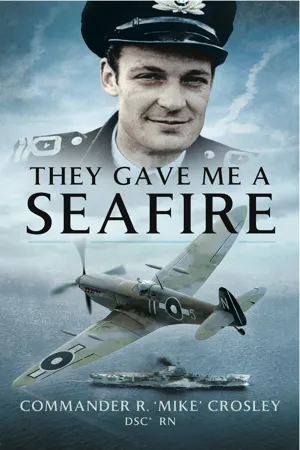
- 279 pages
- English
- ePUB (mobile friendly)
- Available on iOS & Android
eBook - ePub
They Gave Me a Seafire
About this book
Information
Topic
HistoriaSubtopic
Historia militar y marítimaChapter 1
Mediterranean Incident – August 1942
My soup plate flew up and hit me in the face — and all the lights went out. A second later the reason burst upon my senses in three or four shattering explosions.
Every one of us in the wardroom of Eagle was lifted off our seats and thrown onto the floor.
There was a small, grey shaft of light coming from one of the scuttles. By its light I could see shadows leaping over the tables and making for the door.
Perhaps it was only some idiot Stringbag (Swordfish) pilot dropping his depthcharges too near the ship. But the ship was already taking on a list and no depthcharge from a Stringbag could do that. We had obviously been hit by something big. Anyway, lunch was off for the moment and I joined the crush outside the wardroom in the darkness of the wardroom flat. By the light of the emergency lanterns which had switched on automatically when the power had failed, I searched amongst the lifejackets and Mae Wests hanging up, trying to remember where I had left mine. The slope of the deck was increasing by the second so I gave up looking and joined the surge aft towards the quarterdeck.
Smoke was coming up from the open hatchways as we passed them. The smoke smelt strongly of cordite and it was as black as hell. We must have had two or three torpedoes in the ship’s engine rooms. The old girl was obviously not going to last long.
As we shuffled along in silence we could hear dreadful sounds coming from below, crashes and shouts as the ship leaned over more and more. Out onto the quarterdeck and into the blessed daylight, I had time to think. I remembered where I had put my Mae West. It was in the pilots’ crewroom, a small caboose on the top deck of the Island between the funnels — six or seven decks up and miles away. I looked up to the forward ladders leading from the quarterdeck. They were jammed solid with men coming down and were totally impassable. How on earth was I going to get there in time?
On Board the German U-boat U73.
Kapitän Leutnant Rosenbaum had not had much luck in the Mediterranean — or anywhere else — so far, in the war. He had commanded U73 for over a year and his patrols had ranged from Greenland in the north to Freetown in the south, but nothing large had come his way.
Four months previously he had been chosen with 15 others to go across the Atlantic to the American coast and join in the fun there. He was just beginning to enjoy the thought of easy pickings and the chance to raise the spirits of his crew, when he was told to reverse course and make for the Mediterranean. He and his crew had always considered that the Med belonged to the Italians. It was Mare Nostrum, so they kept saying. They had 70 boats there, somewhere; but he had yet to hear of anything that they had done. Now, he supposed, the German Navy would have to help, just as Rommel had had to help their ridiculous army in North Africa. No sooner had he arrived with his boat at La Spezia on the north-west coast of Italy than he was ordered to run some urgent tank spares to Tobruk for Rommel. He duly unloaded these, and while he was feeling his way out of the harbour the following early morning, in very shallow water, he happened to look up just in time to see what looked like an old-fashioned biplane flying straight towards him. He could not dive in the shallow water, and in spite of his two machine gunners opening fire on it, it came steadily on and dropped a bomb or a depth charge right alongside the stern. It then flew off out to sea, leaving Rosenbaum to assess the damage. The diving gear aft had been bent out of all recognition. So he would have to run on the surface for the entire thousand mile journey back to La Spezia. This was something which no submarine had ever done before without being spotted, for the sky was relatively crowded with British aircraft in the Mediterranean, compared with what it was like anywhere else.
Mercifully, he made the five-day voyage without sighting any — a minor miracle — and entered La Spezia without further mishap. The boat took three months to repair. The crew had to eat more Italian food and, more disappointing still, were not allowed any leave back to Germany. By August, U73 was back at sea again. Rosenbaum was assigned to a patrol area about 80 miles north of Algiers. This was a fruitful area as it was smack in the middle of the British convoy route from Gibraltar to Malta. Last year, in November, the largest and best British carrier, Ark Royal, had gone down with just a single torpedo from U81 in the same area. The new, silent and wakeless electric torpedo had also surprised Galatea — a large cruiser — and she had turned over and sunk in two minutes, with a single hit as well. Apparently, none of these boats had been detected by the screen of British destroyers, either before or after the attack. He told his crew in U73 that they had every chance of glory. All they needed was a small share of good luck.
Every night, U73 surfaced to receive any special orders from La Spezia, by radio. On the night of 10 August Rosenbaum was told that the British were going to try to run a large convoy through the Gibraltar Straits to Malta. It was vital that this convoy should not get through with its 14 merchant ships, but, Admiral Kreish said, U73’s priority targets must be the aircraft carriers. Until they were out of the way, the German Air Force could not get at the merchant ships. He must not waste torpedoes on merchant ships at the start of the convoy, but hit the carriers.
Next morning, it all seemed too good to be true, for the hydrophone crew heard ships propeller noises approaching from the west. Fifteen minutes later and with U73 making her best speed submerged towards the noise, Rosenbaum raised the periscope as high as he dared. He could make out the masts of a destroyer about three miles to the north-west. Almost at the same time a carrier appeared, almost bow-on, a thrilling sight for the U-boat commander.
At her full eight knots under water, U73 came closer to the path of the two ships. Her skipper could now see six or seven destroyers ahead of the carrier in some sort of formation. The whole lot seemed to be in a continual alteration of course — a zigzag with at least 40 degrees change of course each time. Rosenbaum swung the periscope lens round in a complete circle, using the wide-angle lens. He saw a forest of masts, some of which were tripod masts and must surely belong to battleships. So this must be the convoy. There were smiles amongst the officers and men in the control room that morning.
Rosenbaum slowed to three knots — U73’s best silent speed. This was only just in time, for he had to duck quickly as two destroyers passed right overhead, their propeller noises deafening in his earphones.
Raising the periscope once more, he could now see a cruiser with a large radar aerial leading the nearest line of merchant ships. They were all within easy firing range and a spread salvo from all tubes would sink the lot. They would not even see them coming.
Sixty more seconds and the carrier — which Rosenbaum had identified as Eagle — came so close that it filled the viewfinder of the periscope camera. He could see fighters — and one old biplane — on her deck. One of the fighters had its engine running, but he could not see a single aircraft in the air.
He ordered 20 feet as the depth setting for the bow torpedoes, and a point aim, so that all four would hit where they hurt most — in the engine rooms. With the tip of the periscope just breaking surface occasionally, he hoped that the sailors he could see on Eagle’s deck would not look his way and spot the telltale bow wave. Eagle made a fine sight, he thought. He could even hear the rumble of her bow wave as she divided the water in a high, white curve, only a few hundred yards away.
U73 fired all four bow tubes together at a range of less than 300 yards. With Eagle beam-on and at this point-blank range, U73 could not miss. The time was 1315.
Aboard Eagle, at 1317, no one had yet thought of jumping over the side from the quarterdeck. Even with dead engines, Eagle’s 21,000 tons momentum still took her through the water at about four knots, two minutes after being hit. If anyone dived over now, they would fall astern and not be rescued. In any case I had no Mae West yet.
It was hopeless trying to get to the Island by the normal route. There was only one way. I had used it once before. This was the batsman’s escape route from the flight deck to the main deck, a vertical distance of about 50 feet. It was a pipeshaft, about three feet in diameter, with a rusty ladder fixed inside. It was entirely dark inside and as its lower level on the port side was by now under water and at about 40 degrees from the vertical, once I had started up the ladder, there would be no turning back. Just as I bent down to get into the tube, with my feet already in the water on the low side of the heeling ship, I looked above me. I could see an officer trying to organise the launching of the ship’s whaler. As the edge of the flight deck, above the whaler’s davits, was just about to touch the water, I thought that he would have to be fairly quick. Still, it was none of my business and I started going up.
At the top of the tube and in the sunlight once more I spoke to ‘Boris’ Morris, one of the Swordfish pilots. He warned me not to go onto the flight deck as he had just been missed by a passing Hurricane as it slid off the deck into the nets, just alongside. There it was, a lovely Hurricane, caught in the deck-edge netting like some huge fly and about to crash on the bodies in the sea below. But, of course, Boris was a wise virgin and already had his Mae West on and inflated. I could not stop, and continued onto the flight deck, regardless of the other four or five Hurricanes perched precariously above me. I pulled myself up the 45-degree heeling deck by the arrester wires, hand over hand.
The next ladder to climb was from the flight deck level to the first deck in the Island itself. I could get into the aft doorway all right, but the ladder was, of course, jammed with bods coming down. The only way to get up was to climb up their backs faster than they were coming down.
I found my Mae West exactly where I had so stupidly left it, hanging up alongside my flying gear in the Ready Room. What an honest lot the crew of Eagle are, I thought.
The next thing to think about was how to get into the water. Many already seemed to be taking flying leaps, and some were landing on hard objects in the water — including their messmates — and were getting hurt. The best way seemed to be by climbing down the ship’s side.
I took off my watch and put it above highwater mark in a pocket in my Mae West and climbed up the 45 degree sloping deck towards the door of the Ready Room. As I stood up by the doorway, I saw my HMV portable clockwork gramophone lying upside-down on the deck, surrounded with broken records. Outside again, I helped myself to some huge Admiralty Pattern gunnery-spotting binoculars by way of compensation, and placed the strap around my neck. I climbed over the rail opposite one of the funnels — the guys of which were bar-taut and obviously taking a strain for which they had not been designed — and studied the scene some 70 feet below. I could feel, as I waited, that the old ship was still slowly laying down on her port side exposing more and more of her weedy bottom. The angle of descent down her starboard topside was about the same as a barn roof. As I had often climbed down barn roofs at home, I thought I could manage Eagle’s
I had just stopped with my feet on the huge anti-torpedo blister, making up my mind to jump in, when there was a slithering sound from above and a bod hurtled past, taking me with him. The binoculars hit me in the face as I hit the water and they disappeared. I couldn’t have swum with them anyway.
There were about 50 sailors in the water round me. Many were singing, perhaps with relief at getting away and into the pleasantly warm Mediterranean water. But I could still hear the screams and the pitiful shouts of men’s voices echoing up the engine room ventilators as they lay trapped below in darkness. I thanked God, as all aviators did on that day in Eagle, that we could do our job in the sunlight and the fresh air and not in the bowels of the ship, 30 feet below the waterline.
Next the Commander came by. He had his brass hat straight and firmly on his head. He made a fine bow-wave. He had time to advise us to stop singing, as we “would need our breath later”. We hoped we wouldn’t need it all that badly as we expected to get rescued fairly soon. The destroyers, however, all seemed to be busy doing something else and some were dropping depth charges far too near for comfort.
Just before I fell in I had caught sight of the Captain’s motor boat — the pride of the Ship’s Boats Officer — with only a few feet of bow above water. ‘Spike’ King-Joyce, my flight leader, was balanced on top. He had shouted to me to come on board and do a bit of fishing — or something like that. Feeling a bit lonely, I had a look around for him and set off in the last direction that I had seen him.
I could hardly make any progress at all in my bulky Mae West — they were obviously not designed for swimmers — and I soon gave up the idea. In any case, the ship was, even now, still moving and he would have been miles astern.
As Eagle passed me in the water, she slowly turned completely upside-down, impaling the whaler on her port outer screw as she did so and tipping those in her into the boiling white foam as if they had been rag dolls. About 20 or 30 men walked round her bilges as she turned bottom up. I wondered why they stayed with her. She had 500 tons of high explosives somewhere inside her, only a few feet under them as they walked up and down her long straight keel.
The next time I looked in her direction all I could see was a cloud of white water vapour shooting skywards and, above it all, those four, huge, bronze propellers rising higher and higher as she took the final plunge. She went carefully. She never meant to hurt a soul.
At about this time I began to feel a terrible pain in the groin as if I had stopped a cricket ball. As the ship had now taken the noise with her below the surface, I could make out, in the comparative silence, the rumblings of underwater explosions. Perhaps these were the depth charges which may have slid off her deck or those of the destroyers looking for the U-boat which had sunk us. I hoped they would have the sense not to drop them too close to the hundreds of us in the water. Every time an underwater explosion concussed our vitals I could hear the most dreadful oaths coming from the bobbing heads, new words which I had never heard before. Then I came across two or three bods in the water who were not swearing at all —just afloat in their lifejackets. One had white foam around his mouth and I realised that he was drowning.
As I had so...
Table of contents
- Front Cover
- Dedication
- Title Page
- Copyright Page
- Contents
- Appendices
- Bibliography
- Acknowledgments
- Chapter 1 Mediterranean Incident — August 1942
- Chapter 2 Little Acorns Grow
- Chapter 3 Eighty-Two Charing Cross Road
- Chapter 4 Naval Airman, Second Class
- Chapter 5 24 EFTS, Luton
- Chapter 6 RAF Netheravon
- Chapter 7 RNAS Yeovilton
- Chapter 8 HMS Eagle
- Chapter 9 Operation ‘Harpoon’
- Chapter 10 Operation ‘Pedestal’
- Chapter 11 800 Naval Air Squadron
- Chapter 12 Operation ‘Torch’
- Chapter 13 804 Naval Air Squadron
- Chapter 14 RNAS Henstridge or HMS ‘Dipper’
- Chapter 15 Lee-on-Solent — June 1944
- Chapter 16 ‘D Day’ — 6 June 1944
- Chapter 17 880 Naval Air Squadron
- Chapter 18 HMS Implacable
- Chapter 19 Grimsetter
- Chapter 20 ‘Sydney, here we come!’
- Chapter 21 Truk
- Chapter 22 The Final Onslaught
- Chapter 23 Peacetime at Schofields
- Epilogue
- A Personal Postscript
- Notes
Trusted by 375,005 students
Access to over 1.5 million titles for a fair monthly price.
Study more efficiently using our study tools.
Frequently asked questions
Yes, you can cancel anytime from the Subscription tab in your account settings on the Perlego website. Your subscription will stay active until the end of your current billing period. Learn how to cancel your subscription
No, books cannot be downloaded as external files, such as PDFs, for use outside of Perlego. However, you can download books within the Perlego app for offline reading on mobile or tablet. Learn how to download books offline
Perlego offers two plans: Essential and Complete
- Essential is ideal for learners and professionals who enjoy exploring a wide range of subjects. Access the Essential Library with 800,000+ trusted titles and best-sellers across business, personal growth, and the humanities. Includes unlimited reading time and Standard Read Aloud voice.
- Complete: Perfect for advanced learners and researchers needing full, unrestricted access. Unlock 1.5M+ books across hundreds of subjects, including academic and specialized titles. The Complete Plan also includes advanced features like Premium Read Aloud and Research Assistant.
We are an online textbook subscription service, where you can get access to an entire online library for less than the price of a single book per month. With over 1.5 million books across 990+ topics, we’ve got you covered! Learn about our mission
Look out for the read-aloud symbol on your next book to see if you can listen to it. The read-aloud tool reads text aloud for you, highlighting the text as it is being read. You can pause it, speed it up and slow it down. Learn more about Read Aloud
Yes! You can use the Perlego app on both iOS and Android devices to read anytime, anywhere — even offline. Perfect for commutes or when you’re on the go.
Please note we cannot support devices running on iOS 13 and Android 7 or earlier. Learn more about using the app
Please note we cannot support devices running on iOS 13 and Android 7 or earlier. Learn more about using the app
Yes, you can access They Gave Me a Seafire by R. "Mike" Crosley in PDF and/or ePUB format, as well as other popular books in Historia & Historia militar y marítima. We have over 1.5 million books available in our catalogue for you to explore.