- 232 pages
- English
- ePUB (mobile friendly)
- Available on iOS & Android
eBook - ePub
About this book
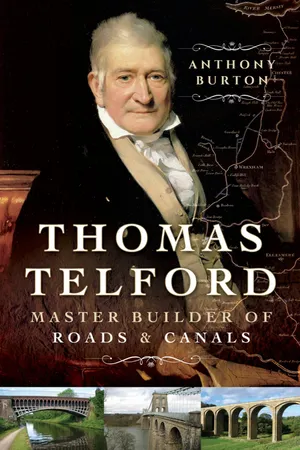
Thomas Telford's life was extraordinary: born in the Lowlands of Scotland, where his father worked as a shepherd, he ended his days as the most revered engineer in the world, known punningly as The Colossus of Roads. He was responsible for some of the great works of the age, such as the suspension bridge across the Menai Straits and the mighty Pontcysyllte aqueduct. He built some of the best roads seen in Britain since the days of the Romans and constructed the great Caledonian Canal, designed to take ships across Scotland from coast to coast. He did as much as anyone to turn engineering into a profession and was the first President of the newly formed Institution of Civil Engineers. All this was achieved by a man who started work as a boy apprentice to a stonemason. rn He was always intensely proud of his homeland and was to be in charge of an immense programme of reconstruction for the Highlands that included building everything from roads to harbours and even designing churches. He was unquestionably one of Britain's finest engineers, able to take his place alongside giants such as Brunel. He was also a man of culture, even though he had only a rudimentary education. As a mason in his early days he had worked alongside some of the greatest architects of the day, such as William Chambers and Robert Adams, and when he was appointed County Surveyor for Shropshire early in his career, he had the opportunity to practice those skills himself, designing two imposing churches in the county and overseeing the renovation of Shrewsbury Castle. Even as a boy, he had developed a love of literature and throughout his life wrote poetry and became a close friend of the Poet Laureate, Robert Southey. He was a man of many talents, who rose to the very top of his profession but never forgot his roots: he kept his old masons' tools with him to the end of his days. rn There are few official monuments to this great man, but he has no need of them: the true monuments are the structures that he left behind that speak of a man who brought about a revolution in transport and civil engineering.
Trusted by 375,005 students
Access to over 1.5 million titles for a fair monthly price.
Study more efficiently using our study tools.
Information
Chapter One
The Shepherd’s Son
Thomas Telford was born in a cottage by the Meggat Water, which gurgles down between grassy banks to Eskdale and the River Esk in the Scottish southern uplands. If you want to visit his birthplace, you take the minor road that winds up the valley of the Esk from Langholm, mimicking each turn of the river as it goes, until it reaches the little hamlet of Bentpath. There, at the roadside, are a pair of angular, not very comfortable stone benches with a somewhat severe Thomas Telford looking out from a plaque in between. Not an inappropriate memorial, perhaps, for a man who began his working life here as a stonemason, and there is a verse of Telford’s to provide further justification:
There ’mongst these rocks I’ll form a rural seat
And plant some ivy with its moss compleat
I’ll benches form of fragments from the stone
Which nicely pois’d was by your hand o’erthrown.
But you have not yet reached the actual birthplace. You must turn off this lonely road for one even lonelier, following Meggat Water, seemingly on its way to nowhere other than a vast swelling of hills, undulating away to the horizon. Just before it peters out at the tiny settlement of Glendinning at the foot of Kirk Cleuch Rig, the road passes a small oblong patch of conifers. In the darkness of the close-packed trees, now almost totally lost from sight, is a jumble of stones, all that remains of the cottage that was home to the shepherd John Telford and his wife, Janet.
This is a Scotland that few know, a region that the busy traffic bustles through on its way to Glasgow and Edinburgh. Tourists find little to detain them here, and even walkers tend to head for the more dramatic rocky peaks and crags of the Highlands. Those who do come this way, perhaps walking the long-distance Southern Upland Way path that passes a few miles to the north, find an amazingly empty, thinly populated landscape, where it is still possible to walk all day without meeting another human being. There have been changes, notably in the great blankets of forest thrown over the land, but elsewhere one finds a landscape scarcely changed in the two-and-a-half centuries since Telford was born here on 9 August 1757. If the area does not possess the stark grandeur of the Highlands, it has its own beauty in the steady recession of billowing hills. The area does not look like the Highlands, and it was not merely geography that was different two-and-a-half centuries ago.
Scotland at the start of the eighteenth century was a land of two parts. To the north were the Highlands, Gaelic-speaking, organised as they had been for centuries into clans who, when not actually fighting each other, lived in a state of mutual distrust. The richer lands to the south supported a more settled and certainly more prosperous community – though there remained the history of border raiders or reivers, among whom was a certain Jamie Telford. The Act of Union of 1707 which joined together England and Scotland brought calmer times and was generally accepted in the south. The north remained largely isolated and was only drawn on to the national scene when the clans disastrously rallied to the banner of Bonnie Prince Charlie. After that cause was finally lost on the bloody moor of Culloden, the English and their Scottish allies exacted their retribution and set in train a programme of vicious suppressions. The Highlanders were to pay for their part in the Jacobite rebellions with years of misery and impoverishment. This was the land into which Telford was born, just eleven years after Culloden.
The birth of Thomas must have been a particularly happy event for the Telfords, for there had been an earlier Thomas born who had not survived. There is no record of this child, other than the carving on a tombstone. The parents’ happiness was short lived, for John Telford himself died on 12 November 1757 and it is on his gravestone that the name of the other Thomas is recorded. The death of the father was a double blow. Not only had the wage earner been taken from the young family, but they now had to leave the house to make way for the new shepherd. In the summer of 1758, Janet and her young son moved a mile and a half down the valley to the cottage of Crooks. They no longer had a whole house to themselves, but just one room, and here Janet was to stay until her death in 1794. Inevitably, the family had to look for charity, and they were helped by her brother, Mr Jackson. This could not have come easily to Janet, seemingly a woman of stern principles, of whom her son was always rather in awe. In his later, more prosperous years, he regularly sent her money, but had to do so through a third party, an old friend, Andrew Little. Even then, it seemed she would rather struggle on with the little she had rather than accept gifts from her own son, a fact which grieved him greatly: ‘her habits of economy will prevent her getting plenty of everything especially as she thinks I have to pay for it which really hurts me more than anything else’.1 If she was unwilling to accept help from him, then one can reasonably assume that only real necessity allowed her to accept charity from her other relations. But she had no choice and some of the money went to providing her young son with a basic education at the village school. It was here that he met and became friends with the two brothers, William and Andrew Little.
Not very much is known about his boyhood. Like most children in his circumstances, hours not spent in the classroom were employed helping out local farmers. In the summer months in particular, this would have involved long hours out on the hills and unremitting hard work: good training for a future life, which was to be filled with both commodities. From casual references in his letters and notes to his autobiography, it is clear that whatever he felt at the time, he looked back on those days as a happy period in his life. After he had left the region, he kept in regular touch with the Littles and was always pleased to hear of the friends of his boyhood days, joking about ‘the glutton boy’ John Elliot and Jennie Smith – ‘tell her she is a canterrin sort of lassie’.2 He also celebrated his native Eskdale in verse, which presents a picture of a rather conventional rural idyll, expressed in equally conventional terms.3
Deep ’mid the green sequester’d glens below
Where murmuring streams among the alders flow
Where flowery meadows down their margins spread
And the brown hamlet lifts its humble head
There, round his little fields, the peasant strays
And sees his flock along the mountain graze.
Where murmuring streams among the alders flow
Where flowery meadows down their margins spread
And the brown hamlet lifts its humble head
There, round his little fields, the peasant strays
And sees his flock along the mountain graze.
Memory, as selective as ever, seems to have mislaid the days of wild winds and unrelenting rain, which anyone who has spent much time in these hills would recall all too vividly. The important point is that he wanted to celebrate the good days and the happy days, perhaps precisely because they could not last. It was a great good fortune for the children of the poor if they received any education at all – but once the rudiments had been hammered in, then it was time to start the serious business of earning a living. For many it was a transition to a life of drudgery as a farm hand or labourer, or perhaps a journey to one of the new textile mills being developed in the surrounding region. But for young Telford it was the start of a quite different journey, that was to set him on his way to learning a valuable trade. He became apprenticed to a stonemason in Lochmaben.
What a contrast Lochmaben must have seemed to the peaceful glen, even if it was only a day’s walk away. It seems a modest enough place today, but it was once a royal burgh, with a charter dating back to the thirteenth century. The medieval castle rose up on a rocky promontory above the broad main street, and there were tales enough to please a small boy. Robert the Bruce had lived there, and, even more excitingly, the old sixteenth-century tower house was said to have a chain-clanking ghost in the dungeon. Telford’s stay, however, was short; the boy was so badly mistreated that he returned home. It was not an auspicious start, but once again the Jackson family came to the rescue, this time in the form of Thomas Jackson, steward to the Johnstones of Westerhall, a man well placed to find a suitable niche, and one a good deal nearer to home. Now young Thomas was apprenticed to a Langholm mason, Andrew Thomson. He was doubly fortunate: he not only found a kind and skilled master, but he found himself in a bustling trade where important works were taking place.
The land around Langholm was mostly owned by the Duke of Buccleuch. Like so many Scottish landowners at that time, he was a great ‘improver’: unlike too many others, however, he believed in improving the lot of the people of the region and not simply increasing his own profits. In place of the old cottages of mud walls and heather thatch, he built houses of stone with slate roofs, boasting the previously unimaginable luxury of what Telford rather coyly referred to as ‘convenient offices’. The area is still shown on modern maps as ‘New Langholm’. There were other changes introduced, which meant more work for the local masons:4
Regular Roads were constructed for the old horse tracks and wheel carriages introduced. Bridges were made over the mountain screams, those, altho’ numerous, were generally small. They, however, furnished employment to the practical Artizans, and I was here early experienced in the several operations required in their construction.
It was not only that there was a good deal of work in hand, but it was just the sort of work that was to stand him in good stead for the future.5
In that Country therefore, convenience and utility only are studied – Yet by these some peculiar advantages are afforded to the young practitioner – there not being sufficient employment to induce a division of labour in the several building branches, he is under the necessity of making himself acquainted with many operations in procuring, preparing and using many sorts of material from the forest, the quarry and the forge.
The most important work in which Telford was involved was the new bridge across the Esk at Langholm. By the time it was built, around 1778, Telford’s apprenticeship had ended; he was now a fully fledged journeyman with his own mason’s mark. The bridge still stands, a handsome structure carried on three rather flat segmental arches, with piers of roughly dressed stone. It was widened in 1880 but remains substantially as it was, and the young Telford’s mason’s marks can be seen close to the water line under the western arch.
Samuel Smiles, the popular biographer of the great engineers6 and an enthusiastic collector of colourful anecdotes, had a number of stories about this stage of Telford’s life – some of which are, to say the least, more than a little dubious. They probably grew extra details over the years. One story told of Andrew Thomson’s wife Tibby, frantic with worry as flood waters swept down the Esk through Langholm with a roar and swirl of brown, peaty water. Her husband was away from home and, fearful that his newly completed masterpiece was about to be carried away by the floods, she dashed down to the river crying for help from Tammy Telford. The young mason trotted up to find her putting her back to the abutments as if by her own force alone she could keep the bridge standing. The young man, according to Smiles, found the whole episode hilariously funny. Smiles thought so too, but a modern reader cannot help thinking that laughing at the distracted woman was less than charitable and, as the lady happened to be his employer’s wife, less than sensible. There is also evidence to suggest that Thomson was not even involved with the bridge, and that it was actually the work of another local mason, Robin Hotson, for whom Telford was working at the time. It does, however, point up a side of Telford’s character that all who knew him seemed to note: his cheerful disposition and sense of humour. Another anecdote points to another aspect of his character: the great pride he took in the practical skills of the craftsman, skills which he had mastered after a long training. In 1795, he returned to Eskdale, already well established in a new career as an engineer and architect – but not so well established that he could be sure of keeping his new high status. Here he met an old friend and fellow workman Frank Beattie, who had abandoned masonry for the rather less arduous work of an innkeeper.7
‘What have you made of your mell and chisels?’ asked Telford.
‘Oh!’ replied Beattie, ‘they are all dispersed – perhaps lost.’
‘I have taken better care of mine,’ said Telford. ‘I have them all locked up in a room at Shrewsbury, as well as my old working clothes and leather apron: you know one can never tell what may happen.’
True or not, at least part of the story is in character. Even in his days of greatness, Telford never lost sight of the fact that what he knew, he knew from experience. He understood materials because he had worked them with his own hands, and worked them well. At this distance in time, it would have been difficult to assess the quality of his workmanship were there not examples still to be seen today. His father was buried in the churchyard at Westerkirk, now Bentpath, with a plain stone to mark the grave. Telford had taught himself letter carving, and as soon as he felt confident in his abilities he set to work to carve an inscription. This is a very different craft from squaring up blocks of stone for a bridge. The inscription itself is simple: ‘In Memory of John Telford who after thirty three Years as an unblameable shepherd died in Glendinning 13 Nov 1757: his son Thomas who died an infant’. The lettering is neat, with no great flourishes, but expertly executed with smooth curves emphasised by the varying thickness of the strokes and well-defined serifs. A few paces away is a second memorial by Telford. This commemorates the Pasley family, starting with James Pasley and ending with Elizabeth Pasley, who died in 1790, a lady to whom Telford owed a great deal. The family were wealthy and Elizabeth Pasley’s passion was literature, an enthusiasm she was keen to share with others. The young mason had an enquiring mind and ambitions of doing more with his life than remaining a journeyman in a quiet village. The Scots have always had a reputation for placing a greater emphasis on education than their southern neighbours, and Telford must have known that a good education eased the way forward in life. It was not merely a case of learning ‘useful’ skills, but also of being at one’s ease with other educated people. There is no record of why he decided to take advantage of the offer to read as widely as he wished in the extensive Pasley library, but we do know the results.
The first book he read, or at least the first book that profoundly interested him, was Milton’s Paradise Lost. This is an immense work in every sense: it contains over 10,000 lines of verse and deals with the greatest of themes, the battle between good and evil. It is a work that few people today open, let alone read from end to end, so what must it have meant to a young man, whose working life was concerned with the physical rather than the metaphysical? The first thing that strikes any reader is the extraordinary rhythmic power of the language: once you are captured by those rolling cadences, they carry you onward with an unremitting momentum. Some find themselves unmoved and give up, but for those with a natural disposition to enjoy words for their own sake and who respond to imagery and rhythm, it is all but irresistible. Telford found himself to be one of those who are enraptured by Milton. He could not say what it was, only ‘I read and read, and glowered, then read and read again.’ ‘Glowered’ is a good word, because there is that quality in Milton, rather as one might find in Beethoven: they are not there to be taken lightly.
The discovery of a delight in poetry is not essential for the life of an engineer, but it did help to awaken the young man to a wider world of ideas. His early enthusiasm for Milton gave way to a more conventional taste for his contemporaries, particularly those who had something serious to say, or an improving moral to impart – writers such as William Cowper and Robert Southey. He also began to write verse, not usually very well, and he seems to have known that himself. He was supremely confident when it came to his practical life, but only nervously sent off his efforts to friends and was quick to accept criticism. He wrote rather self-deprecatingly of his poetry that ‘it is to me, something like what a fiddle is to others, I apply to it in order to relieve the mind after being much fatigued with close attention to business’.8 Nevertheless, he thought highly enough of his ef...
Table of contents
- Cover
- Title Page
- Copyright
- Contents
- Acknowledgements
- Preface
- Introduction
- Chapter 1: The Shepherd’s Son
- Chapter 2: To England
- Chapter 3: The Shropshire Surveyor
- Chapter 4: The First Canals
- Chapter 5: A Busy and Varied Life
- Chapter 6: Back to the Highlands
- Chapter 7: The Caledonian Canal: The Beginnings
- Chapter 8: Building the Caledonian
- Chapter 9: Highland Roads, Bridges and Harbours
- Chapter 10: The Gotha Canal
- Chapter 11: False Starts and Disappointments
- Chapter 12: The Holyhead Road
- Chapter 13: Pro Bono Publico
- Chapter 14: London Days
- Chapter 15: Railways versus Canals
- Chapter 16: The End of the Road
- Gazetteer
- Notes
- Bibliography
Frequently asked questions
Yes, you can cancel anytime from the Subscription tab in your account settings on the Perlego website. Your subscription will stay active until the end of your current billing period. Learn how to cancel your subscription
No, books cannot be downloaded as external files, such as PDFs, for use outside of Perlego. However, you can download books within the Perlego app for offline reading on mobile or tablet. Learn how to download books offline
Perlego offers two plans: Essential and Complete
- Essential is ideal for learners and professionals who enjoy exploring a wide range of subjects. Access the Essential Library with 800,000+ trusted titles and best-sellers across business, personal growth, and the humanities. Includes unlimited reading time and Standard Read Aloud voice.
- Complete: Perfect for advanced learners and researchers needing full, unrestricted access. Unlock 1.5M+ books across hundreds of subjects, including academic and specialized titles. The Complete Plan also includes advanced features like Premium Read Aloud and Research Assistant.
We are an online textbook subscription service, where you can get access to an entire online library for less than the price of a single book per month. With over 1.5 million books across 990+ topics, we’ve got you covered! Learn about our mission
Look out for the read-aloud symbol on your next book to see if you can listen to it. The read-aloud tool reads text aloud for you, highlighting the text as it is being read. You can pause it, speed it up and slow it down. Learn more about Read Aloud
Yes! You can use the Perlego app on both iOS and Android devices to read anytime, anywhere — even offline. Perfect for commutes or when you’re on the go.
Please note we cannot support devices running on iOS 13 and Android 7 or earlier. Learn more about using the app
Please note we cannot support devices running on iOS 13 and Android 7 or earlier. Learn more about using the app
Yes, you can access Thomas Telford by Anthony Burton in PDF and/or ePUB format, as well as other popular books in History & Historical Biographies. We have over 1.5 million books available in our catalogue for you to explore.