- 144 pages
- English
- ePUB (mobile friendly)
- Available on iOS & Android
eBook - ePub
Portrait of a Bomber Pilot
About this book
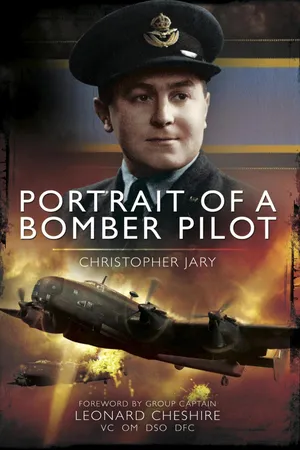
During the Second World War RAF Bomber Command produced a handful of remarkable pilots who won fame and high honors: Gibson, Cheshire, Martin, Tait, and Searby. The majority of aircrew, however, were young sergeants, many of whom did not survive to complete a first tour of thirty operations. Between the two extremes, there were, on every squadron, one or two senior captains who had survived one tour and whose experience, skill, courage, and example made a vital contribution to their squadron's life, training and operational success. This book is about one such captain, Flight Lieutenant Jack Wetherly, DFC. It traces his development from novice second pilot of a Wellington in the pioneering days of 1940 to senior captain of a Halifax in Wing-Commander Leonard Cheshire's squadron in what MRAF Sir Arthur Harris called his 'Main Offensive'. It deals also with his pre-war life and service, flying tiny bi-planes with the RAFVR, and with his career as a flying instructor at the RAF College Cranwell and as an instructor of instructors at RAF Montrose.Above all, it is a personal book, inspired by the sacrifice made nearly half a century ago by a young man of twenty-eight. Acclaim for the work:''Reading Portrait of a Bomber Pilot, I felt that I was living with Jack Wetherly through the last few years of his young life. He is a good man to be with honorable, selfless, and an exceptional pilot...Christopher Jary has written of Jack Wetherly carefully, unsentimentally, and very movingly. He has added a chapter to the brave, sad story of World War Two''.
Trusted by 375,005 students
Access to over 1.5 million titles for a fair monthly price.
Study more efficiently using our study tools.
Information
Chapter 1
Missing
At Bomber Command airfields throughout East Anglia, Lincolnshire and Yorkshire rumours had abounded since the groundcrews had been told the bombload and fuel requirements of their squadron aircraft. Tonight’s was clearly a distant target but only at briefing would the aircrews know if it would be Nuremberg, Munich, Stuttgart or Berlin.
76 Squadron, based near York at RAF Linton-on-Ouse, had bombed each of these targets in the past month: Nuremberg on the 8th, Munich on the 9th, Stuttgart on the 11th and twice to Berlin – on the 1st and, two nights ago, on the 27th. They had been lucky. In twelve operations in March they had lost only five aircraft but two of these, including one captained by one of their flight commanders, had been lost on the first trip to Berlin. The German capital, with its long haul across Germany and its active flak and many night-fighters, was the worst target of all. Many aircrew must have prayed hard that it would not be the ‘Big City’ again tonight.
It was. Their new Commanding Officer, Wing-Commander Don Smith, confirmed the target at briefing. Twelve 76 Squadron Halifaxes would be among the first wave of the 330 aircraft detailed for the raid. Take-off would be at 1900. Each Halifax would carry 5,000 pounds of high explosives and incendiaries and the Squadron would bomb between 2210 and 2231 from 18,000 feet. The briefing room was silent as all synchronised their watches on the Bombing Leader’s mark. The Squadron Bombing Leader was Flight-Lieutenant Bert Beck, who had often flown as bomb-aimer in the crew of the previous CO, Leonard Cheshire, who had become a good friend. Tonight, however, Cheshire was on leave awaiting posting on promotion to RAF Marston Moor and Bert Beck would take the place of the regular bomb-aimer in another crew, captained by Flight-Lieutenant Jack Wetherly.
Jack Wetherly was one of the Squadron’s most experienced captains. He had arrived seven weeks earlier after a happy two-year spell as a flying instructor in Flying Training Command, having already completed a tour of ops with 214 Squadron flying Wellingtons. Tonight’s would be the fifteenth op of his second tour and his fourth trip to Berlin. Another five ops would complete his tour and enable him to return to instructing for good.
At twenty-eight his maturity, experience and unflappable instructor’s temperament made Jack an obvious captain to take novice pilots on their first trip. When the new CO had joined the Squadron earlier in the month, after two tours of very different operations in the Middle East, Jack had taken him as ‘second dickey’ on his first raid over Germany. He had taken six other new pilots on ops and tonight he would take another, Sergeant Whittle. One of Cheshire’s last acts as CO had been to recommend Jack for the Distinguished Flying Cross. The recommendation had reached the desk of Air Vice-Marshal Carr, the Air Officer Commanding 4 Group, that morning: 29 March 1943.
Take-off was postponed by nearly three hours and Jack’s Halifax, ‘K-King’, finally took off from Linton at 2148 with its crew of eight. Only eleven 76 Squadron aircraft took off. The twelfth, Sergeant Sanderson’s ‘Q-Queen’, had technical trouble. They immediately climbed into thick cloud with violent hailstorms and much stronger winds than had been forecast by the Met reports. The persistent hail wore off the de-icing paste smeared on the leading edge of the wings, leaving them vulnerable to severe icing. Ice formed on the wings of some aircraft, making them unstable and unmanoeuvrable, and six of the eleven remaining Squadron aircraft turned back. Five crews, including those of Don Smith and Jack, pressed on in a bomber stream already depleted by the loss of seventy-six aircraft from other squadrons whose captains had also decided to turn back. Of sixty-five Halifaxes despatched by 4 Group from its Yorkshire bases, twenty-four turned for home.
The 247 crews who pressed on found that the weather cleared only as they reached the western coast of Schleswig-Holstein. Until then they flew on instruments, struggling to keep control of their ice-covered aircraft, aware of the presence of other aeroplanes only when they felt the buffeting caused by hitting the slipstream of another bomber. Over the German coast the weather cleared but it had delayed them and they were late bombing their target. The patchy and scattered bombing showed that few aircraft had got through and this depletion of the bomber stream, together with the clear weather over Germany, made them more vulnerable to the German flak and night-fighters.
The raid was not a success. The Pathfinders had dropped their Target Indicators too far south and many bombs fell in open country six miles south-east of Berlin. Twenty-one aircraft were lost, and a further twelve from another raid that night on Bochum.
Back at Linton, by dawn it was clear that, of the five 76 Squadron aircraft which had pressed on, two were missing. There would be no survivors from either crew. One was the Halifax of Sergeant Cursley, who was on the last but one op of his tour. The other was Jack Wetherly’s ‘K-King’.

A friend of his who often visited us during my childhood maintained that in our house Jack was still alive. I have always felt the same.
His photograph always stood – still stands – on the china cabinet in my parents’ dining room and, although inevitably there was an underlying sadness behind it, he was spoken of readily – often with humour, always with affection – as one might speak of a very close member of the family who has gone away for a while.
That this was so was very much to my father’s credit. Constitutionally unselfish, he was interested in and proud of Jack and saw it as a privilege to look after Jack’s widow and bring up his daughter. There was no place for jealousy. He had not known Jack. They had done equally well in the war in different but similarly dangerous jobs. He had been lucky; Jack had not.
Perhaps it was simply this atmosphere which made me feel he was there; I cannot know. But, if pressed, I feel there was more to it than that.
I remember two distinct scenes from my childhood. The first was a winter’s evening when I was about six. I had had my bath and was ready for bed but was brought down to the sitting room where, in pyjamas and woolly dressing gown, I sat beside my mother on the sofa while she showed me Jack’s and my father’s medals. I was struck particularly by the purple and white diagonally striped ribbon of the DFC in its black case. The case smelt of leather and perfume because my mother kept it in the glove drawer in her bedroom. It had been given to her by the Queen’s father, King George. Although Jack’s name was often mentioned by my parents, this was the first time I can recall my mother telling me about him directly. “He would have liked you,” she said.
The other memory is from some time later – a few weeks or months. My parents were out and I awoke late one night. The landing light was on but downstairs the hall was in darkness. My teenaged sister, who was baby-sitting for me, was in the sitting room watching television. Outside in the hall I could hear it through the closed door. I was loth to tell her I was there because I knew she would return me to bed. I switched on the hall light and it shone through the open door of the dining room, falling on the china cabinet on which stood Jack’s photograph.
I do not know how long I stood there and cannot recall how quickly my thoughts strayed to Jack. I do know that in that moment, in my pyjamas in the cold hall, the realisation of the scale and permanence of the tragedy hit me hard, suddenly and completely. I wept. A quarter of a century later I remember those tears vividly; perhaps because they were the first unselfish tears I had shed, evoked by the tragic death of a young man I never knew and a sudden understanding of the deep sadness it had given my mother.
A few minutes later my sister found me and asked what was the matter. “I had a nightmare,” I replied. She would not have understood.
The terrible casualties of the Great War had seared themselves into the nation’s consciousness. Even in my childhood, nearly half a century later, the echoes of its individual tragedies were still sometimes heard. Both my grandfathers had served in the Army in France and Flanders, where my grandmother had lost both her brothers. They were sometimes spoken of too, but differently. My grandmother’s sadness was tinged with a sense of the waste, even futility, of her brothers’ deaths.
There were no such feelings about Jack. Partly this was because the purpose and outcome of the second war were so much clearer than the first. My father’s battalion had been among the first troops to discover Belsen. What they found proved beyond all doubt that this country’s sacrifices had been fully justified. Such sacrifices were ‘a waste’ only in the sense that, had Germany rejected Hitler’s creed of aggression, greed and cruelty in the 1930s, they would not have been necessary.
But there was also a difference in our perception of them as people. My great-uncles had been pitched, very young and barely trained, into the horrors of trench warfare. Fifty years later they were still seen as innocent victims fed – however willingly and unavoidably – into a machine over which they had no control. Jack, on the other hand, was a mature, experienced officer with the attitudes of a professional. Although, unlike my father, he never saw the full extent of the Nazi evil, he knew exactly what he was fighting for. He enjoyed a fair degree of control over his own destiny and clearly understood his chances of surviving. A sense of waste or pity was inappropriate but the sense of personal loss was no less.
I do not know how it is possible to grieve for the death of someone one never met. I only know that I did then and I do now. Today, a few years older than Jack was when he was killed and with a wife and two young daughters of my own, I appreciate more fully the sacrifice he made and how much he had to lose. I marvel at his cheerful, dogged courage in continuing to do a dangerous and unpleasant job, knowing that the odds were heavily stacked against his survival. And it is made more complicated by the knowledge that, had Jack survived, I would not be here. I feel no guilt about this, but I do feel a great obligation to remember him often and to ensure that my children understand and do the same. I have written this for them and, in time, for their children to help them understand.
It was perhaps this feeling of kinship which prompted Lois, my wife, to suggest that I write this book. “You always speak of Jack as if you knew him,” she said. “You should write it down.”
But our vision is constrained within our individual horizons. I was not born until thirteen years after Jack was killed. I make no apology, therefore, for seeing the pre-war and wartime life of a man in his twenties through the eyes of a man in his thirties, half a century later.
Speaking to people who knew Jack at different periods of his life, I have been struck by the consistency of the picture their individual memories paint of him. He seems almost to represent a recognisable type of young man of his background and generation: honest, responsible, generous, intelligent but not intellectual, sociable and with a high-spirited sense of fun and a strong sense of duty. Those who find a subject’s contradictions or inconsistencies the interesting element in a biography must look elsewhere. If Jack had uncertainties or secret sorrows he kept them firmly to himself, facing the world with a cheerful smile and an even temper. Perhaps, not taking himself too seriously, he did not fall prey to many of the faults which attend the self-absorbed or personally ambitious. In this he stands for many apparently ordinary young men who, in answering the demands of war, showed themselves to have extraordinary qualities. It was as well for this country that they did.
I have drawn heavily upon the recollections of many people who knew Jack or served with him. These, together with the atmosphere I grew up in, my mother’s many memories and her collection of evocative photographs, have helped me to get much closer to my subject. Indeed, with a few of the photographs I have felt that, with a little more effort, I could step into them, back into a time I never knew.
Chapter 2
Prelude: Flying Training 1936/40
WHILE the rest of the family grow older, the photograph on the china cabinet remains the same. It is the face of a newly-commissioned RAF officer, fair-haired and round-faced, in his mid-twenties. It invites speculation and I have often scanned it for clues of what changes the passing years would have wrought and what the future might have held for that fresh-faced young man in his new uniform.
Jack would now be in his mid-seventies. Is it possible to guess from the evidence of the first twenty-five years what the next fifty would have contained? Ultimately such speculation is fruitless. Our fates are governed by the random interworking of chance and choice, and no one can guess at the opportunities and misfortunes which would have set the course of those fifty years and doubtless left their stamp upon the young man in the photograph. The elderly are not simply older models of their young prototypes.
But one picture repeatedly and persuasively recurs. It is of a short, stocky man of about fifty with blond hair turning grey. It is the early 1960s and he is a Wing-Commander or Group Captain – a senior and respected figure on the staff of a Flying Training School. Especially popular for his lack of pomposity with the pupils and groundcrews, with whom he always has time to chat, he flies whenever he can find an excuse. He played an enthusiastic game of rugger until recently deciding – with great reluctance – that he was past it. He stands in the mess, talking humorous shop with a couple of junior instructors and a few of the pupil-pilots. On his chest are the ribbons of the DFC and AFC. In one hand is a pint of beer, in the other a pipe. On his face a broad grin.

In January 1935 Peggy Faux was training as a secretary at a college in Croydon. Each morning she caught the train from Carshalton Beeches, where she lived with her parents. Often she would see on the train another girl of about seventeen who was attending the same secretarial college. A friendship developed and one morning Joan suggested that Peggy might join her, her brother and their friends, who often went skating together at the Purley rink on Tuesday evenings. Having until recently been at school in Southport and with no brothers or sisters, Peggy had few friends of her own age locally. She accepted.
Joan’s brother, Keith, was twenty and a junior officer in the Merchant Navy. Their father, Captain Barnett, was Commodore of the New Zealand Shipping Line and Keith was following in his footsteps. Keith had been at Whitgift School, where he had met the four other young men in the group. There was Ken Noble, who also had joined the Merchant Navy, and his tall twenty-three-year-old brother Henry, who was a chemist. Geoff Everest was the same age as Henry but about half his height! He worked for Shell as an industrial chemist. The fourth was Jack Wetherly, just past his twentieth birthday. He had always wanted to fly and was trying to get into the RAF, despite having been rejected for high blood pressure. He had temporarily given up smoking and was doing special exercises designed to reduce his blood pressure by the necessary couple of points.
Peggy enjoyed their company and soon became a regular member of the group. Often Geoff would bring his fiancée, Alma, and other friends would be included, so it was a while before Peggy got to know all their names and understood why they had all laughed when, in thanking Henry for driving her home that first evening, she had said: “It was very noble of you.”
Saturday evenings followed Saturday afternoons when, during the rugger season, Jack played for the Old Whitgiftians. Being short – five foot five – and powerfully built, he made an ideal scrum-half. Peggy hated watching him play because, whenever the massive forwards disentangled themselves from a collapsed scrum, Jack always seemed to be underneath it. He normally emerged battered but not seriously hurt and always with a cheerful grin. Saturday evenings – whether spent skating or at a tennis club dance – usually found Jack adorned with at least one bruise or piece of sticking plaster.
In the month that Jack met Peggy a junior Group Ca...
Table of contents
- A Lament
- Title Page
- Copyright Page
- Table of Contents
- Foreword
- Introduction
- Chapter 1 - Missing
- Chapter 2 - Prelude: Flying Training 1936/40
- Chapter 3 - Finding The Way: 214 Squadron 1940/41
- Chapter 4 - Interlude: Flying Training 1941 /42
- Chapter 5 - The Way to Berlin: 76 Squadron 1943
- Chapter 6 - Epilogue
- 29 March 1993: A Pilgrimage
- Acknowledgements
- Bibliography
- Index
Frequently asked questions
Yes, you can cancel anytime from the Subscription tab in your account settings on the Perlego website. Your subscription will stay active until the end of your current billing period. Learn how to cancel your subscription
No, books cannot be downloaded as external files, such as PDFs, for use outside of Perlego. However, you can download books within the Perlego app for offline reading on mobile or tablet. Learn how to download books offline
Perlego offers two plans: Essential and Complete
- Essential is ideal for learners and professionals who enjoy exploring a wide range of subjects. Access the Essential Library with 800,000+ trusted titles and best-sellers across business, personal growth, and the humanities. Includes unlimited reading time and Standard Read Aloud voice.
- Complete: Perfect for advanced learners and researchers needing full, unrestricted access. Unlock 1.5M+ books across hundreds of subjects, including academic and specialized titles. The Complete Plan also includes advanced features like Premium Read Aloud and Research Assistant.
We are an online textbook subscription service, where you can get access to an entire online library for less than the price of a single book per month. With over 1.5 million books across 990+ topics, we’ve got you covered! Learn about our mission
Look out for the read-aloud symbol on your next book to see if you can listen to it. The read-aloud tool reads text aloud for you, highlighting the text as it is being read. You can pause it, speed it up and slow it down. Learn more about Read Aloud
Yes! You can use the Perlego app on both iOS and Android devices to read anytime, anywhere — even offline. Perfect for commutes or when you’re on the go.
Please note we cannot support devices running on iOS 13 and Android 7 or earlier. Learn more about using the app
Please note we cannot support devices running on iOS 13 and Android 7 or earlier. Learn more about using the app
Yes, you can access Portrait of a Bomber Pilot by Christopher Jary in PDF and/or ePUB format, as well as other popular books in History & Military Biographies. We have over 1.5 million books available in our catalogue for you to explore.