- 160 pages
- English
- ePUB (mobile friendly)
- Available on iOS & Android
eBook - ePub
The Soviet-Afghan War
About this book
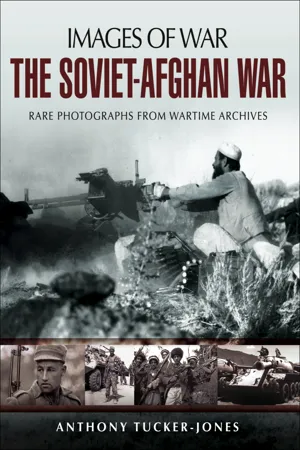
This photographic history of the Soviet-Afghan War of 1979 to 1989 gives a fascinating insight into a grim conflict that prefigured the American-led campaign in that country. In an unequal struggle, the mujahedeen resisted for ten years, then triumphed over Moscow. For the Soviet Union, the futile intervention has been compared to the similar humiliation suffered by the United States in Vietnam. For the Afghans the victory was just one episode in the long history of their efforts to free their territory from the interference of foreign powers. By focusing on the Soviet use of heavy weaponry, Anthony Tucker-Jones shows the imbalance at the heart of a conflict in which the mechanized, industrial might of a super power was set against lightly armed partisans who became experts in infiltration tactics and ambushes. His work is a visual record of the tactics and the equipment the Soviets used to counter the resistance and protect vulnerable convoys.It also shows what this grueling conflict was like for the Soviet soldiers, the guerrilla fighters and the Afghan population, and it puts the present war in Afghanistan in a thought-provoking historical perspective.
Information
Topic
StoriaSubtopic
Storia del XX secoloChapter One
Cold War Stand Off
Now a decade old, Operation Enduring Freedom, designed to oust the Taliban from power, is an echo of a much bloodier war that was fought in Afghanistan over thirty years ago.Those who recall how grim Kabul was in the late 1970s will know that it became even grimmer after the arrival of Soviet tanks, jets and helicopters. Once more, geography, as in the earlier Korean and Vietnam wars, was to preclude the effective use of armour in Afghanistan. It was as if the Russians never bothered to heed any of the lessons of these previous conflicts and proceeded to learn the hard way – from scratch.
The Soviet Union was at the height of its military power by the late 1970s. It was a vast monolith whose military resources were only rivalled by the world’s other Superpower – the United States of America. Every year during Moscow’s Red Square military parades the Soviet armed forces put on displays of equipment bristling with firepower, designed to impress the population and cow its enemies. These parades also served to tip off Western intelligence of the existence of new equipment.The Soviets could not resist showing off.
For the previous two decades the Warsaw Pact and NATO had been at military loggerheads, facing off against each other in armed confrontation across central Europe in what was known as the Cold War. It was largely the threat of mutually assured destruction, should conflict break out and escalate to a nuclear war, that kept the two sides from coming to blows.
In fact the Cold War was anything but cold, with both the Soviet Union and US fighting a series of long and bloody proxy wars around the world. Ever since the Cuban missile crisis in 1962 they had been constantly testing each other’s resolve on foreign battlefields.The Soviet Union also had a track record of intervening with its neighbours – it stamped out pro-democracy movements in Hungary and Czechoslovakia in 1956 and 1968 respectively, and on both occasions NATO had done nothing.
The Soviet intervention in Hungary was dubbed Operation Whirlwind. In response to calls for Soviet troops to leave the country, elements of two Soviet motor rifle divisions supported by tanks had rolled into Budapest and a further 75,000 troops streamed into the country. The Hungarian Army melted away and the revolutionaries were overwhelmed. In the fighting that followed, 3,000 Hungarians were killed. In total this invasion involved up to twelve divisions with 3,000 tanks.This was a conventional operation in which the Soviets employed the same tactics they had used during the Second World War.
In the case of Czechoslovakia, as part of Operation Danube, the 103rd Guards Air Assault Division (GAAD) arrived to seize Prague, followed by two motor rifle divisions. At the time the number of Warsaw Pact forces – including Bulgarian, East German, Hungarian and Polish units – committed to the invasion of Czechoslovakia was believed to be 250,000 troops and 2,000 tanks. This operation ran smoothly, mainly because of the minimal resistance offered by the surprised Czechs. The Soviets lost about 150 men, most as a result of accidents.
In the winter of 1979 Moscow was confident that a swift intervention in neighbouring Afghanistan to prop up the Marxist government would be a short-lived mission and probably go largely unnoticed. After all, Afghanistan was in the Soviets’ backyard and they were keen to aviod Islamic militancy spilling over into the neighbouring Soviet central Asian republics.
Despite Moscow’s vast and overwhelming array of military hardware, few of its troops had had any combat experience in recent years. While Soviet advisers had been posted to its client states, it was the Cuban Army that had often been called on to do Moscow’s dirty work in places such as Angola and Ethiopia. Nonetheless, Moscow had every reason to be confident that it could solve this problem on its doorstep and finally win the ‘Great Game’ by securing dominant influence in Kabul. (All the time that India (and modern-day Pakistan) was part of the British Empire, the ‘Great Game’ witnessed the British and Russians compete for control of Afghanistan as it formed a buffer between their respective empires.)
The Soviet Union certainly had the military muscle to pull off an invasion of Afghanistan. Although Moscow did not commit any armoured divisions to the invasion or subsequent occupation, the airborne and five motor rifle divisions involved were equipped with a wide variety of Soviet-designed armoured fighting vehicles (AFVs).
These formations deployed the T-54, T-55, T-62, T-72 and possibly a few of the newer T-80 main battle tanks (MBTs). Initially for the invasion the Soviets only used the older T-54/55 MBTs, but between 1981 and 1982 they were slowly replaced by the T-62, whilst some T-72s were possibly later used in the reconnaissance battalions of the motor rifle divisions. No confirmation exists of the T-80 MBT seeing combat, although it undoubtedly underwent trials in Afghanistan.
Tracked self-propelled artillery consisted of the 2S1 M-1974 (122mm), 2S3 M-1973, 2S5 M-1977 (both 152mm) and 2S9 (120mm mortar). Other tracked AFVs included the ASU-85 airborne assault gun, as well as the BMP-1/2 (Boevaya Mashina Pekhota – infantry fighting vehicle) and BMD (Boevaya Mashina Desantnaya – airborne combat vehicle). Wheeled AFVs were the BTR-60/70 armoured personnel carriers (APCs), BRMD-2 scout cars and 23mm gun trucks.
The BTR-60 was the standard Soviet amphibious eight-wheel APC of the day. The final model BTR-60PB was fully enclosed with a small turret armed with 14.5mm and 7.62mm machine guns. The BTR-60 and its successor, the BTR-70, were the standard APCs for three motor rifle regiments of a Soviet motor rifle division; the fourth was equipped with the tracked BMP-1 infantry combat vehicle. The newer BMP-2 infantry combat vehicle first saw service in Afghanistan in 1982 with the Soviet 70th Motor Rifle Brigade, which was later stationed in Kandahar.
The four-wheel BRDM-2 scout car had a similar turret to the BTR-60PB, carrying the same armament; minus the turret it was also used to carry Sagger and Spandrel anti-tank missiles and Gaskin surface-to-air missiles (although it is uncertain if the latter saw action in Afghanistan).
The airborne assault vehicles, the BMD and ASU-85, were only used by the airborne troops: principally the 105th Guards Air Assault Division followed by elements of the 103rd GAAD and the 38th Air Assault Brigade. Likewise the 2S9 airborne artillery assault vehicle entered service in 1981 and was deployed in Afghanistan with the Soviet airborne forces.
Two years later the Soviets began adding appliqué armour and smoke-grenade launchers to their tanks in an effort to combat the Mujahideen’s growing proficiency with anti-tank weapons. Some of the BMPs were also fitted with appliqué armour, while some BMPs and BTR-60/70s were up-gunned with a 30mm grenade launcher designed to provide suppressive fire.
The air-portable tracked SA-4 Ganef anti-aircraft missile carrier was deployed in Kabul, while the shorter-range wheeled rocket system, the FROG-7 (Free Rocket Over Ground), was first used operationally in Afghanistan in 1985 – a case of using a sledgehammer to crack a nut!
Soviet AFVs were normally finished in dark olive-green and in some cases used a white invasion cross on their upper surfaces, a precaution usually employed when the Soviets expected to be engaging Soviet-designed armour. The cross was seen occasionally during 1979 – 80. In this case Moscow could not be certain that the Afghan Army’s Soviet-supplied tanks would not resist the int...
Table of contents
- Title Page
- Copyright Page
- Table of Contents
- Introduction
- Photograph Sources
- Chapter One - Cold War Stand Off
- Chapter Two - The Bear Wakes
- Chapter Three - Kabul’s Armour
- Chapter Four - Mujahideen – God’s Warriors
- Chapter Five - Tank Killers
- Chapter Six - The Convoy War
- Chapter Seven - Death over the Mountains
- Chapter Eight - Moscow’s Last Stand
- Chapter Nine - Propping up Kabul
- Chapter Ten - The Taliban’s Tanks
Trusted by 375,005 students
Access to over 1.5 million titles for a fair monthly price.
Study more efficiently using our study tools.
Frequently asked questions
Yes, you can cancel anytime from the Subscription tab in your account settings on the Perlego website. Your subscription will stay active until the end of your current billing period. Learn how to cancel your subscription
No, books cannot be downloaded as external files, such as PDFs, for use outside of Perlego. However, you can download books within the Perlego app for offline reading on mobile or tablet. Learn how to download books offline
Perlego offers two plans: Essential and Complete
- Essential is ideal for learners and professionals who enjoy exploring a wide range of subjects. Access the Essential Library with 800,000+ trusted titles and best-sellers across business, personal growth, and the humanities. Includes unlimited reading time and Standard Read Aloud voice.
- Complete: Perfect for advanced learners and researchers needing full, unrestricted access. Unlock 1.5M+ books across hundreds of subjects, including academic and specialized titles. The Complete Plan also includes advanced features like Premium Read Aloud and Research Assistant.
We are an online textbook subscription service, where you can get access to an entire online library for less than the price of a single book per month. With over 1.5 million books across 990+ topics, we’ve got you covered! Learn about our mission
Look out for the read-aloud symbol on your next book to see if you can listen to it. The read-aloud tool reads text aloud for you, highlighting the text as it is being read. You can pause it, speed it up and slow it down. Learn more about Read Aloud
Yes! You can use the Perlego app on both iOS and Android devices to read anytime, anywhere — even offline. Perfect for commutes or when you’re on the go.
Please note we cannot support devices running on iOS 13 and Android 7 or earlier. Learn more about using the app
Please note we cannot support devices running on iOS 13 and Android 7 or earlier. Learn more about using the app
Yes, you can access The Soviet-Afghan War by Anthony Tucker-Jones in PDF and/or ePUB format, as well as other popular books in Storia & Storia del XX secolo. We have over 1.5 million books available in our catalogue for you to explore.