This book examines every aspect of The Royal Air Force, including organisation, statistics and operations during World War Two.
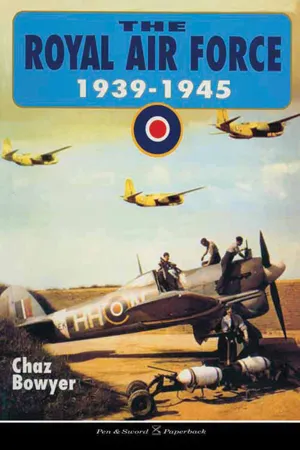
- 132 pages
- English
- ePUB (mobile friendly)
- Available on iOS & Android
eBook - ePub
The Royal Air Force, 1939–1945
About this book
Information
Contents
Prologue
RAF Command Structures and Organisation 1939–45
Squadrons
Ground Crews
Training
Bomber Command
No 8 (Path Finder) Group
Fighter Command
Coastal Command
Transport Command
Balloon Command
Photo-Reconnaissance
Middle East
Far East
Women’s Auxiliary Air Force
Princess Mary’s RAF Nursing Service
RAF Regiment
Air-Sea Rescue and Marine Craft
RAF Awards and Badges
Airborne Armament
RAF Commanders
Selected RAF Slang
RAF Personnel Awarded the Victoria Cross 1939–45
RAF Operational Code-names 1939–45
Glossary of Common Abbreviations
Selected Statistics and RAF ‘Firsts’
Select Bibliography
Prologue
When, in 1939, the Royal Air Force girded its loins for war with Germany for the second time, it was very much a junior’ Service when compared with the British Army and the Royal Navy, having only in that same year ‘come of age’ by celebrating its 21st ‘birthday’ on 1 April. Though young in years the ‘Third Service’ was certainly not lacking in traditions of loyalty, courage and superb devotion to duty; nor had those interim years 1919–39 been spent in idleness or lotus-eating. Every day of those 20 years of so-termed ‘peace’ had seen some element of the RAF engaged in operational warlike activities at one or more outposts of the British Empire or other areas of the globe; operations which were seldom publicised (even today) but which accumulatively claimed no small toll of RAF casualties. Yet for most of those years the RAF was much neglected by its political ‘masters’ — indeed, its very existence as a separate Service had been a bone of high contention between its brother fighting Services, and the RAF had been very much a ‘Cinderella between two great Ugly Sisters’ in terms of financial support and governmental comprehension of its huge potential significance.
For the first of those two decades the infant RAF, due solely to lack of adequate financing, had little option but to fulfil its many, varying duties with obsolete aircraft of 1917–18 vintage, and equally outdated equipment. At the Armistice of November 1918 it had been the world’s first independent (of Army and Navy control) air service, and incidentally the largest in numerical context. Reduced to a tenth of that overall strength by 1920, the ‘peacetime’ RAF remained virtually static as far as firstline aircraft and armament were concerned until the early 1930s, when the first serious moves were implemented by governments to rearm and modernise the Service. Though these ‘expansion’ plans continued to be modified from time to time, at least the basis of the future RAF was established, with plans for an eventual bombing force equipped with twin-and four-engined truly heavy bombers, and a metropolitan fighter defence to receive modern eight-gun monoplane designs. The other prime operational aspect, epitomised by Coastal Command’s role of protection of the UK’s vital import shipping supply ‘lines’, still remained glue-footed in the context of up-dating, however — sufficient financial provisioning was still unprovided. Thus, when Britain and other European countries tottered on the very brink of all-out war with Nazi Germany in September 1938, it was a sobering fact that the RAF’s operational strength and capabilities for engaging in any such conflict were, to put it mildly, ‘doubtful’ if not actually insignificant.
If their aircraft were patently outdated, or barely on a par with Luftwaffe counterparts then, the air and ground crews of the RAF were of high quality; thoroughly trained and deeply committed to their chosen professions. They were in the main products of Trenchard’s visionary proposals 20 years before for ‘his’ air force; men nurtured at Cranwell, Halton, Cosford, Flowerdown and Eastchurch et al mingled with direct-entry ‘regulars’, and all steeped in RAF lore and tradition. Every man had been a volunteer on enlistment — the prewar RAF had no ‘pressed men’ in its ranks. On their shoulders fell the onus of responsibility for prosecuting the RAF’s war during 1939–40 particularly, and thereafter leading and guiding the huge wartime influx of ‘duration-only’ airmen in RAF ways and means of waging war in the air. Inevitably, perhaps, such prewar stalwarts formed a high proportion of the Service’s early casualties in France and the epic Battle of Britain in 1939–40; men whose inculcated experience was to be sorely missed until wartime-trained men could fill the ‘gaps’. Fortunately, many of the latter quickly proved to be of equal quality and prowess, and even embellished the reputation of their forebears.
Of the RAF’s actual operational efforts throughout the war, the following chapters and statistics will, I hope, give ample evidence. Certainly, my overall intention in this book has been to provide a ready reference form of war record for the RAF during the fateful years 1939–45. Naturally, it would be impossible to include literally every facet and statistic of such a gigantic subject within the necessarily limited parameters of one slim volume. However, I have attempted, at least, to present the skeleton framework, with some of the more important ‘flesh and bones’ attached here and there. Equally, certain sections of this book have been included in the hope of recreating the authentic ‘atmosphere’ of those years. A third purpose in compilation has been hopefully to dispel the occasional myth or legend so firmly believed still by latter-day students, historians, and would-be authors of the overall subject. Perhaps now — a forlorn hope admittedly — writers and broadcasters will no longer refer to ‘hangers’ when they mean hangars, or aircraftsmen when the ‘gen’ title is aircraftman, etc.
One aspect should be emphasised. War is not glamorous, despite the efforts of novelists and Hollywood film writers to present it as such. Life in the RAF during 1939–45 certainly had no ‘glamour’; for the vast majority of men and women who served in RAF ‘blue’ it was a period of deprivation, separation from kith and kin, too often barely civilised living and working conditions, routine drudgery. For those men serving on a regular engagement it may have been a vocational life, a readily accepted epitome of their raison d’être as ‘defenders of the realm’; but to many wartime-enlisted men and women their ‘war’ was a period of hazard and, more usually, boredom and frustration. There were, of course, ‘high’ spots too — comradeship, occasional ‘triumphs’ over daunting circumstances, and the ever present morale-sustaining esoteric brand of RAF ‘twisted’ humour. Indeed, any summary of RAF life then might be contained in that classic RAF saying — ‘If you can’t take a joke, you shouldn’t have joined’ …
Chaz Bowyer
Norwich 1996

RAF Command Structures
and Organisation 1939–45
As a monarchy the United Kingdom of Great Britain has always invested ultimate command authority in its reigning sovereign. In 1939–45 this was HM King George VI, who held the ranks of Marshal of the Royal Air Force and Air Commodore-in-Chief, Auxiliary Air Force; both ranks in his particular case dating from 11 December 1936. To assist the King in RAF matters he had, in 1939, a Personal Aide-de-Camp (AVM HRH The Duke of Gloucester), a Principal Air Aide-de-Camp (ACM Sir Hugh C. T. Dowding), and two Air Aides-de-Camp (Grp Capt D. F. Stevenson and The Hon R. A. Cochrane). Immediately subordinate to HM The King was the Air Council, which in November 1939 comprised:
President
Secretary of State for Air (Sir Kingsley Wood, MP)
Vice-President
Parliamentary Under-Secretary of State for Air (Capt H. H. Balfour)
Members
Chief of the Air Staff (ACM Sir Cyril Newall) Air Member for Personnel (AM C. F. A. Portal)
Air Member for Development & Production (AM Sir Wilfrid R. Freeman)
Air Member for Supply & Organisation (AM W. L. Welsh)
Deputy Chief of the Air Staff (AM R. E. C. Peirse)
Director-General of Production (E. J. H. Lemon)
Additional Member (Sir Harold G. Howitt) Permanent Under-Secretary of State for Air (Sir A...
Table of contents
- Cover
- Full Title
- Copyright Page
- Contents
Trusted by 375,005 students
Access to over 1.5 million titles for a fair monthly price.
Study more efficiently using our study tools.
Frequently asked questions
Yes, you can cancel anytime from the Subscription tab in your account settings on the Perlego website. Your subscription will stay active until the end of your current billing period. Learn how to cancel your subscription
No, books cannot be downloaded as external files, such as PDFs, for use outside of Perlego. However, you can download books within the Perlego app for offline reading on mobile or tablet. Learn how to download books offline
Perlego offers two plans: Essential and Complete
- Essential is ideal for learners and professionals who enjoy exploring a wide range of subjects. Access the Essential Library with 800,000+ trusted titles and best-sellers across business, personal growth, and the humanities. Includes unlimited reading time and Standard Read Aloud voice.
- Complete: Perfect for advanced learners and researchers needing full, unrestricted access. Unlock 1.5M+ books across hundreds of subjects, including academic and specialized titles. The Complete Plan also includes advanced features like Premium Read Aloud and Research Assistant.
We are an online textbook subscription service, where you can get access to an entire online library for less than the price of a single book per month. With over 1.5 million books across 990+ topics, we’ve got you covered! Learn about our mission
Look out for the read-aloud symbol on your next book to see if you can listen to it. The read-aloud tool reads text aloud for you, highlighting the text as it is being read. You can pause it, speed it up and slow it down. Learn more about Read Aloud
Yes! You can use the Perlego app on both iOS and Android devices to read anytime, anywhere — even offline. Perfect for commutes or when you’re on the go.
Please note we cannot support devices running on iOS 13 and Android 7 or earlier. Learn more about using the app
Please note we cannot support devices running on iOS 13 and Android 7 or earlier. Learn more about using the app
Yes, you can access The Royal Air Force, 1939–1945 by Chaz Bowyer in PDF and/or ePUB format, as well as other popular books in History & Military & Maritime History. We have over 1.5 million books available in our catalogue for you to explore.