- 240 pages
- English
- ePUB (mobile friendly)
- Available on iOS & Android
eBook - ePub
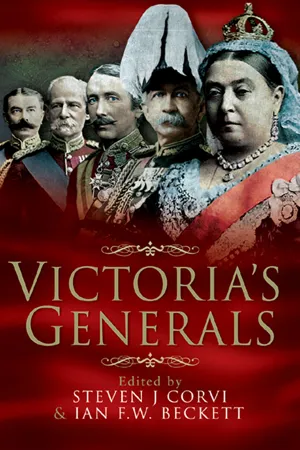
Victoria's Generals
About this book
The senior British generals of the Victorian era - men like Wolseley, Roberts, Gordon and Kitchener - were heroes of their time. As soldiers, administrators and battlefield commanders they represented the empire at the height of its power. But they were a disparate, sometimes fractious group of men. They exhibited many of the failings as well as the strengths of the British army of the late nineteenth-century. And now, when the Victorian period is being looked at more critically than before, the moment is right to reassess them as individuals and as soldiers. This balanced and perceptive study of these eminent military men gives a fascinating insight into their careers, into the British army of their day and into a now-remote period when Britain was a world power.
Information
Chapter 1
Garnet Wolseley
Steven J Corvi

‘I am the Very Model of a Modern Major General’ was the line from the famous Gilbert and Sullivan operetta, The Pirates of Penzance (1879). Some can draw the similarities between the Gilbert and Sullivan’s character Major General Stanley and Garnet Wolseley, who also permeated Victorian popular culture and slang with the then contemporary term ‘All Sir Garnet’, meaning everything is in good order. The Victorian Imperial period was dominated by two major military figures, Wolseley and Roberts. Where Roberts was the hero in the field, Wolseley was more of the reforming intellectual general. This of course does not discount Wolseley’s vast experience in Victorian campaigns: Crimea, China, Canada, Asante, Egypt and the Sudan. His productive association with Edward Cardwell (Secretary of State for War, 1868–74) proved to be an important step in producing a more professional and highly trained British army. Wolseley said of Cardwell, ‘no British war minister ever responded more readily to demands made upon him by his military advisers’.1 Wolseley was considered the most influential reforming soldier of the Victorian age, with his firm support of Cardwell’s reforms and his practical battlefield experiences, which left an indelible mark on the British army.
Garnet Wolseley was born on 4 June 1833 in Dublin. He was one of seven children, which included three brothers (Richard, Frederick and George) and three sisters (Matilda, Frances and Caroline). Garnet’s father died when he was only 7 years old and this profoundly affected his life. The family was forced to struggle on a meagre army pension. This poverty had an obvious immediate impact on Garnet’s life and it was also to cause hardship in his then future army career. Garnet Wolseley was forced by circumstances to excel by sheer ability and competency. Since he was not afforded a public-school education, his mother and then, later, tutors educated him. He was forced at 14 to leave school and become a land surveyor in a Dublin office. Garnet considered a life in the Protestant clergy, but could not afford the education to pursue such a career. He then turned to the army and sought commission via a nomination from the Commander in Chief, the Duke of Wellington. He was at first ignored, but finally was gazetted an ensign in the 12th Foot in 1852.
Chronology
4 June 1833 | Garnet Joseph Wolseley born at Golden Bridge House, Co. Dublin Educated in Dublin |
12 March 1852 | Commissioned as Ensign in 12th Foot |
13 April 1852 | Transferred to 80th Foot |
1852–53 | Service in Burma |
19 March 1853 | Severely wounded at Kyault Azein |
16 May 1853 | Promoted Lieutenant |
27 January 1854 | Transferred to 84th Foot |
24 February 1854 | Transferred to 90th Foot |
1854–56 | Service in Crimea |
26 January 1855 | Promoted Captain |
30 August 1855 | Severely wounded at Sebastopol |
1857–58 | Service in India |
24 March 1858 | Promoted Brevet Major |
26 April 1859 | Promoted Brevet Lieutenant Colonel |
1860–61 | Service in China |
15 February 1861 | Promoted Major (Unattached) |
6 August 1861 | Promoted Major in regiment |
11 January 1862 | Appointed AQMG, Canada |
5 June 1865 | Promoted Brevet Colonel |
4 June 1867 | Married Louisa Erskine |
1 October 1867 | Appointed DQMG, Canada |
5 April 1870 | Appointed to lead Red River expedition |
1 May 1871 | Appointed AAG, Horse Guards |
6 September 1873 | Appointed to command Asante expedition as Local Major General |
1 April 1874 | Promoted Major General, antedated to 6 March 1868 |
April 1874 | Appointed Inspector General of Auxiliary Forces |
16 February 1875 | Appointed High Commissioner and GOC, Natal |
25 November 1876 | Appointed Member of Council of India |
25 March 1878 | Promoted Lieutenant General |
22 July 1878 | Appointed High Commissioner and Governor General, Cyprus |
23 June 1879 | Appointed High Commissioner and Governor, Natal and Transvaal as Local General |
1 July 1880 | Appointed QMG, War Office |
1 April 1882 | Appointed AG, War Office |
4 August 1882 | Appointed C in C, Egyptian expedition as Temporary General |
13 September 1882 | Victory of Tel-el-Kebir |
18 November 1882 | Promoted General and created Baron Wolseley of Cairo and Wolseley |
1884–85 | Commanded Gordon Relief Expedition |
19 August 1885 | Elevated to Viscount |
1 October 1890 | Appointed GOC, Ireland |
26 May1894 | Promoted Field Marshal |
1 November 1895 | Appointed C in C of the British army |
30 November 1900 | Retired as C in C |
25 March 1913 | Died at Menton, France |
31 March 1913 | Buried in St Paul’s Cathedral |
Appointed CB, 1870; KCMG, 1870; KCB, 1874; GCMG, 1874; GCB, 1880; KP, 1885
The army that Wolseley was commissioned into was one that had seemingly declined since the Napoleonic Wars, though some reforms were underway by the late 1840s and early 1850s. The conditions of enlisted service remained substandard, however, and the ‘army life’ only attracted the man without means. Wellington referred to his army as the ‘scum of the earth’. This scum was what Wolseley would inherit and later greatly improve. Caught at a moment of transition, the army would be severely tested in the Crimea and forced to reform further under more modern lines. This was a fortuitous time for Wolseley to enter the army and be a formative edifice for reform.2
Garnet’s career began with active duty in the Second Burma War and he was badly wounded at Kyault Azein, leading an attack on a stronghold. This valorous act earned him a mention in dispatches and a promotion. Wolseley commented in his published biography, ‘I have never experienced the same unalloyed and elevating satisfaction, or known again the joy I then felt as I ran for the enemy’s stockade …’.3 He received, however, a fierce leg wound, which would take him out of action in Burma. He luckily recovered quickly, for he could have just have easily died from this wound or at least have lost his leg, which would have effectively ended his active military career. Wolseley was shipped home to convalesce, and this was just in time for the Crimean War.4
Garnet had transferred to the 90th Perthshire Light Infantry (later the Cameronians) in February 1854. Wolseley arrived after the major battles of the war, Alma, Balaclava and Inkerman, had been bungled by Lord Raglan: ‘The first object that greeted Wolseley’s eyes as he stepped out of the boat on to the inhospitable shores of the Crimea, was a firelock which lay half in and half out of the water.’5 This was an eerie precursor to the later siege of Sebastopol, the incompetent handling of troops and the use of archaic weapon technology by Wolseley’s regiment. Lieutenant Wolseley volunteered for dangerous duty with the Royal Engineers, which was the best opportunity for action and promotion. During his service with them in the trenches, he started a friendship with young Charles Gordon, whom he would later lead an expedition to save during Gordon’s ill-fated defence of Khartoum (1884–85). He served in ‘Gordon’s Battery’ on 4 January 1855, which inculcated a lasting relationship and earned him a promotion to Captain for his front-line duty.6 Wolseley was badly wounded while working on a sap trench with two other Sergeant Sappers, who were killed by the artillery fire. He slowly convalesced at a hospital near Balaclava. He stayed in the Crimea until the Peace of Paris was signed in April 1856.
The origins of the Indian Mutiny of 1857 had deep roots, but it stemmed from the basic principle that the British were trying to convert the Muslim and Hindu soldiers to Christianity. Rumours were circulated that cartridges were greased with beef and pork fat and that the powdered bones of pigs and cows were added to the ration flour, which of course offended both Muslim and Hindus alike serving in native Sepoy regiments. The Mutiny began in Meerut and spread rapidly across British military installations from Agra, Lucknow and the infamous Cawnpore. Wolseley participated in the relief of Lucknow and garnered admiration for his composure under fire in a few engagements. This was to mark Wolseley’s last service as a regimental officer, for he was to serve as a staff officer or commander on future campaigns. He was also promoted to Brevet Major in 1858 and served as Quartermaster General to Major General Sir Hope Grant. At the conclusion of the Indian mutiny campaign, Wolseley was promoted to Brevet Lieutenant Colonel, which made him the youngest colonel in the British army, and the most rapidly promoted officer of this time period.7
Wolseley was called upon for an expedition to China, which was initiated to ratify the Treaty of Tientsin that had been agreed after the siege of Canton in June of 1858. Sir Hope Grant commanded the expedition and Wolseley again served on his staff as Quartermaster General. The campaign was a joint venture between British and French forces, focussing on the Taku forts, which fell after a brief engagement. Wolseley was engrossed in logistical planning of the campaign and especially the aftermath.8 The peace treaty was finally signed in 1861, but there was another threat that was rising, the Taiping Rebellion, later crushed by Wolseley’s friend Charles Gordon.9
After China, Garnet took eighteen months’ leave, and took care of family affairs. He was then ordered to Canada by the War Office and given the duty of Assistant Quartermaster General. Wolseley reached Halifax on 5 January 1862. The American Civil War was raging in the United States and this interested Wolseley very much, especially in the prosecution of a modern industrialised war on such a large scale. Wolseley used his time wisely and took two months’ leave to observe the Confederate armies close up. He had a letter of introduction and travelled with The Times correspondent Frank Lawley, meeting up with the Confederate army at Fredericksburg. Wolseley visited Robert E Lee’s headquarters at Winchester, where he met Lee himself, and his two Corps commanders, ‘Stonewall’ Jackson and Longstreet. This made quite the impression on the young Colonel. He wrote an article for Blackwood’s Magazine about his visit to Lee’s army. This led to later biographical works on Union General William Sherman and Confederate General Nathan Forest. He learned many valuable lessons during his visit of American Civil War battles, which was the only major industrialised war that he witnessed in person. However, Garnet mistakenly still held his belief in the use of cavalry in large-scale operations on Civil War battlefields, a stalwart concept in the arme blanche school that prevailed in many quarters until the First World War.10 Wolseley himself later switched his ideas on cavalry and derived an immensely more practical idea on the use of horses on the modern battlefield, which was more in line with Havelock and Denison’s theories11 on mounted infantry.12 There was a scare that the Union forces would invade Canada after they defeated the Confederate forces. This was quickly dispelled when it was realised this was not the intention of the North.
Wolseley wrote the first edition of his The Soldiers Pocket Book for Field Service during his time in Canada, a work that was greatly improved by his new wife’s grammatical input, Wolseley having married Louisa Erskine in 1867. Wolseley was able to put his theories to practical work when he was given command of the Red River expedition on 5 April 1870. In November 1869 French-Canadian residents rose up in rebellion to British rule and the Hudson Bay Company in Fort Garry, Manitoba under the leadership of Louis Riel. This afforded Wolseley his first independent command. He commanded the British regular force of the 1st Battalion, 60th Rifles and a battery of Royal Field Artillery and the Canadian Militia, which consisted of the 1st Ontario Rifles and 2nd Quebec Rifles. The expedition was meticulously planned and it succeeded with the bloodless capitulation of Riel. This expedition was the origin of the first ‘Wolseley Ring’,13 which was to be a powerful clique in...
Table of contents
- Front Cover
- Dedication
- Title Page
- Copyright Page
- Contents
- List of Maps
- List of Plates
- Acknowledgements
- List of Contributors
- Introduction
- Chapter 1 Garnet Wolseley – by Steven J Corvi
- Chapter 2 Evelyn Wood – by Stephen Manning
- Chapter 3 Redvers Buller – by Stephen M Miller
- Chapter 4 George Colley – by Ian F W Beckett
- Chapter 5 Lord Chelmsford – by John Laband
- Chapter 6 Charles Gordon – by Gerald Herman
- Chapter 7 Frederick Roberts – by André Wessels
- Chapter 8 Herbert Kitchener – by Keith Surridge
- Appendix Chronology of Victorian Wars
Trusted by 375,005 students
Access to over 1.5 million titles for a fair monthly price.
Study more efficiently using our study tools.
Frequently asked questions
Yes, you can cancel anytime from the Subscription tab in your account settings on the Perlego website. Your subscription will stay active until the end of your current billing period. Learn how to cancel your subscription
No, books cannot be downloaded as external files, such as PDFs, for use outside of Perlego. However, you can download books within the Perlego app for offline reading on mobile or tablet. Learn how to download books offline
Perlego offers two plans: Essential and Complete
- Essential is ideal for learners and professionals who enjoy exploring a wide range of subjects. Access the Essential Library with 800,000+ trusted titles and best-sellers across business, personal growth, and the humanities. Includes unlimited reading time and Standard Read Aloud voice.
- Complete: Perfect for advanced learners and researchers needing full, unrestricted access. Unlock 1.5M+ books across hundreds of subjects, including academic and specialized titles. The Complete Plan also includes advanced features like Premium Read Aloud and Research Assistant.
We are an online textbook subscription service, where you can get access to an entire online library for less than the price of a single book per month. With over 1.5 million books across 990+ topics, we’ve got you covered! Learn about our mission
Look out for the read-aloud symbol on your next book to see if you can listen to it. The read-aloud tool reads text aloud for you, highlighting the text as it is being read. You can pause it, speed it up and slow it down. Learn more about Read Aloud
Yes! You can use the Perlego app on both iOS and Android devices to read anytime, anywhere — even offline. Perfect for commutes or when you’re on the go.
Please note we cannot support devices running on iOS 13 and Android 7 or earlier. Learn more about using the app
Please note we cannot support devices running on iOS 13 and Android 7 or earlier. Learn more about using the app
Yes, you can access Victoria's Generals by Steven J. Corvi,Ian F. W. Beckett in PDF and/or ePUB format, as well as other popular books in History & Military Biographies. We have over 1.5 million books available in our catalogue for you to explore.