- 288 pages
- English
- ePUB (mobile friendly)
- Available on iOS & Android
eBook - ePub
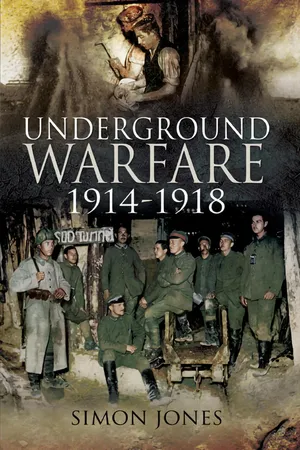
Underground Warfare, 1914–1918
About this book
Simon Joness graphic history of underground warfare during the Great War uses personal reminiscences to convey the danger and suspense of this unconventional form of conflict. He describes how the underground soldiers of the opposing armies engaged in a ruthless fight for supremacy, covers the tunneling methods they employed, and shows the increasingly lethal tactics they developed during the war in which military mining reached its apotheosis. He concentrates on the struggle for ascendancy by the British tunneling companies on the Western Front.But his wide-ranging study also tells the story of the little known but fascinating subterranean battles fought in the French sectors of the Western Front and between the Austrians and the Italians in the Alps which have never been described before in English. Vivid personal testimony is combined with a lucid account of the technical challenges and ever-present perils of tunneling in order to give an all-round insight into the extraordinary experience of this underground war.
Chapter 1
Military Mining Before 1914
The attack of a fortress by mining is recorded in the ninth century BC. A tunnel was driven beneath the walls and the soil replaced by timber props, which were then destroyed by burning, causing the walls to collapse. Mining was usually resorted to when artillery had failed and was a slower, but ultimately more certain, method of reducing a fortress. In the first century AD the Roman writer Vitruvius described methods of attacking fortress walls. At ground level covered protection, such as a ‘testudo’, or tortoise, was used against projectiles thrown from above to enable the walls to be attacked with hand tools or a battering ram. Where mining was employed he described the burnt-prop method to bring down walls and also the use of a tunnel to emerge inside the fortress or walled town, from which attacking soldiers issued to surprise the garrison. This technique was used by the Romans to end their nine-year siege of Veii in 396 BC.1 Sometimes the knowledge that the walls of a fortress were undermined was sufficient for the garrison to capitulate, as at Marqab in 1285 when the Knights of St John surrendered after being shown the extent to which Egyptian miners had tunnelled beneath their great tower.2 Defences against mining incorporated into fortresses included ready-dug countermines and a deep and wide water-filled ditch. A breach in the walls was so often decisive in breaking a siege that in medieval times it became a convention that the garrison of a castle or fortress might surrender with honour once their walls were breached, whereas if they continued to resist quarter would not be shown and the castle could be sacked.
In fifteenth-century Italy there occurred the only major technological change in military mining from antiquity until 1914, when gunpowder replaced the burning of props to bring down walls. This greatly increased the power and potential of mining, as walls would now not just collapse, but be hurled into the air along with the defenders. Gunpowder also enabled miners to engage in warfare beneath the ground, attacking their opponents’ tunnels by exploding charges, called camouflets, to collapse them, which did not break the surface of the ground. The increased danger to the user entailed by gunpowder saw the rise of regulations to cover mining and, during the seventeenth century, highly sophisticated and standardized forms of fortifications and the means of assault were developed. The French emerged as the masters of siege craft, with the engineer Vauban the dominant figure. The usual method of approach by the besieger was to dig a trench, known as the first parallel, 600 to 700m from the fortification. This was at a distance far enough away for the trench not to be enfiladed (i.e. fired along the length of) by the defenders and earthworks were then thrown up in front for siege artillery to begin firing. Under cover of these guns engineers began to dig approach trenches, known as saps (hence the term ‘Sapper’ for a military engineer), towards the fortress. These were in a zigzag pattern to reduce the effect of enfilade fire. At about 300m from the fortress, a second parallel was dug and new artillery emplacements prepared. From this range the guns could begin to batter a breach in the walls. The defenders might attempt sorties to spike the attackers’ guns. If the artillery assault was not successful, the besiegers continued sapping forwards, by now under small-arms fire, to within a few metres of the walls, or a ditch or moat surrounding the fortress, and constructed a third parallel. If the artillery was still unable to smash gaps in the walls, mining would begin.3
A well-designed fortress incorporated a system of tunnels surrounding its walls designed to detect the mines of the attackers, known as countermines (the term ‘mine’ being used for both the explosive charge and the tunnel from which it was laid). Camouflets would be used to destroy the attackers’ mines, but the defenders were restricted in the size of charge that they could use, for fear of destroying their own defences. The distance at which a charge was likely to damage an opponent’s tunnel was known as the ‘radius of rupture’. Mines that were powerful enough to break the surface of the ground to form a crater were known as ‘common mines’. The distance of a mine from the surface, used to calculate whether it would break surface, was the line of least resistance (LLR). To prevent the blast of a mine being directed down the tunnel in which it was laid, the tunnel would be extensively backfilled in a process called ‘tamping’. In the late seventeenth century formulae for the sizes of charges were developed by Vauban and Mesgrigny, followed by Belidor, who carried out trials in 1725. His calculations were not accepted in France, but were taken up by Prussia and used at the Siege of Schweidnitz in 1762, where the Prussians blew mines of up to 2,500kg. The Russians gained much experience during the Russo-Turkish War in 1828 and at Brailov fired two mines of 4,000kg, although with only partial success, as the huge quantity of debris thrown up buried the junction box, preventing the next set of mines from being blown and also ultimately hampering the Russian advance. It was thus not just size that mattered: mines also had to be coordinated with the attack. The Russians used this experience during the most significant mining of the nineteenth century, in the Crimean War during the Siege of Sebastopol. Against a Franco-British attack the Russian chief engineer, General Todleben, organized a system of countermines and some twenty mines were blown, varying in size from 550kg to 2,000kg. Mines were driven through a layer of clay beneath hard chalk. Todleben discovered a second layer at about 15m depth, which he used for a deep level system of countermines. He laid a charge of 4,000kg, which was discovered after the fall of Sebastopol; at that depth it would not have been great enough to break the surface.4

The French mining attack on the Mastbastion at Sebastopol between February and April 1855, launched from the third parallel about 190m from the Russian ditch. Todleben’s countermines surround the Mastbastion. (From Zschokke, Handbuch der militärischen Sprengtechnik (1911).

The French right attack gallery in the above plan, 0.8m high, has been driven through a clay layer beneath hard chalk at a depth of about 6m but has been broken by heavily overcharged Russian blows.
Protracted siege warfare and mining did not, however, play a major part in the Franco-Prussian War of 1870-71, during which the French fortresses were forced to surrender through containment or powerful bombardment. After 1870, the opinion of most artillery and engineer officers in the great military powers was that long-range, large-calibre artillery, especially mortars and howitzers with plunging fire, would always defeat fortresses that previously could be breached only by mining.5
By the 1880s it seemed that fortresses had become obsolete, along with the ancient means of assaulting them. There were, however, opposing trends. The Russo-Turkish War had involved a five-month siege of Pleva in 1877, conducted by Todleben. During the American Civil War mining was used against field works rather than a fortress at the siege of Petersburg. A 511ft gallery was driven by the 48th Pennsylvania Infantry, which was both commanded by and composed mainly of coal miners. The unit laid a charge of 3,600kg at 6m depth beneath a Confederate earthwork known as Elliott’s Salient, which was blown on 30 July 1864. The mine killed 250 to 350 Confederate soldiers, but in the resulting Battle of the Crater the Union attack was badly coordinated and many of the attackers were trapped in the crater by a counterattack.6
There was an unexpected revival of mine warfare during the Russo-Japanese War of 1904-05, especially during the siege by the Japanese of Port Arthur. The position was defended by a ring of concrete forts linked by strong points and entrenchments but, possibly believing that the ground was too hard for mining, the Russians failed to construct an adequate system of countermines. They also lacked tools and only began mining after the Japanese underground attacks had started. By the standards of the Crimean War the mining was unsophisticated and the lack of training of the Russians, who were to suffer defeat, demonstrated that skills could very quickly be lost. The first contact underground demonstrates the Russian lack of skill. A shallow Russian countermine at Fort II caved in beneath a shell crater and the tunnel was deepened with a shaft sunk to 4m. From the bottom of the shaft the Russians began a gallery inclined downwards and, on 20 October 1904, they heard noises of Japanese mining. On 26th, after determining the direction of the Japanese attack by listening, the Russians loaded the end of the gallery with 123kg of gunpowder, continuing picking until the last moment to deceive the Japanese. They blew the following day, destroying the Japanese gallery and killing several miners. However, they had miscalculated the weight of the charge, which was probably intended only as a camouflet, and broke surface to form a crater, as well as bringing down part of their own defences and effectively loosening the ground, facilitating the Japanese advance.
By December 1904 charges of 900kg to 1,300kg were used, and on 31 December the Japanese blew 5,000kg of dynamite.7 High explosives, such as TNT and dynamite, invented in the 1860s, were at least twice as powerful as gunpowder, but did not immediately replace it in mining owing to their high rate of detonation. The war also saw the construction of very strong field fortifications, involving earthworks, entrenchments and barbed wire, which were so resistant to attack that mining was also used against them. In the winter of 1904-05, when the opponents were facing one another on the banks of the Shaho river 100m apart, the Russians advanced by sapping and mining to capture the Japanese bridgehead. They also attempted this at the village of Li-chia-pu, where the positions were about 300m apart. In the final land action of the war, for three weeks in February to March 1905 until the Russians were forced to fall back, armies of over 300,000 on each side faced each other from entrenchments at Mukden on a forty-mile front.8

Japanese attack gallery and Russian countermine k, October 1904. The dotted line n shows the radius of rupture of a Russian charge l of 123kg. (From Zschokke, Handbuch der militärischen Sprengtechnik (1911).
The Russo-Japanese War led the armies of Europe to pay renewed attention to their ability to conduct a siege. The Germans held extensive siege exercises between 1908 and 1913 and that year issued new regulations. Moreover, the prospect of a war on two fronts against France and Russia led to an extension of the fortress system. Fortress battalions, and pioneer battalions in fortress areas, were given special training in siege operations and in time of war Fortress Pioneer regiments were to be formed. Interest in mining specifically, however, was more lu...
Table of contents
- Front Cover
- Title Page
- Copyright Page
- Contents
- Dedication Page
- List of Plates
- Abbreviations
- Glossary
- Preface
- Chapter 1 Military Mining Before 1914
- Chapter 2 Mining Operations 1914 — early 1915
- Chapter 3 French Mining Sectors: Carency, Oise, Les Eparges and Vauquois
- Chapter 4 British Mining operations 1915 — early 1916
- Chapter 5 Hohenzollern and St Eloi 1916
- Chapter 6 The Somme 1916
- Chapter 7 Vimy, Arras and Messines 1917
- Chapter 8 Miners and Technology
- Chapter 9 Tunnels and the Infantry Attack
- Chapter 10 Underground Accommodation and Communications
- Chapter 11 Conclusion
- Notes
- Bibliography
Trusted by 375,005 students
Access to over 1.5 million titles for a fair monthly price.
Study more efficiently using our study tools.
Information
Publisher
Pen & Sword MilitaryYear
2010Topic
HistoryPrint ISBN
9781473823044
Subtopic
Military & Maritime HistoryeBook ISBN
9781844684700
Index
HistoryFrequently asked questions
Yes, you can cancel anytime from the Subscription tab in your account settings on the Perlego website. Your subscription will stay active until the end of your current billing period. Learn how to cancel your subscription
No, books cannot be downloaded as external files, such as PDFs, for use outside of Perlego. However, you can download books within the Perlego app for offline reading on mobile or tablet. Learn how to download books offline
Perlego offers two plans: Essential and Complete
- Essential is ideal for learners and professionals who enjoy exploring a wide range of subjects. Access the Essential Library with 800,000+ trusted titles and best-sellers across business, personal growth, and the humanities. Includes unlimited reading time and Standard Read Aloud voice.
- Complete: Perfect for advanced learners and researchers needing full, unrestricted access. Unlock 1.5M+ books across hundreds of subjects, including academic and specialized titles. The Complete Plan also includes advanced features like Premium Read Aloud and Research Assistant.
We are an online textbook subscription service, where you can get access to an entire online library for less than the price of a single book per month. With over 1.5 million books across 990+ topics, we’ve got you covered! Learn about our mission
Look out for the read-aloud symbol on your next book to see if you can listen to it. The read-aloud tool reads text aloud for you, highlighting the text as it is being read. You can pause it, speed it up and slow it down. Learn more about Read Aloud
Yes! You can use the Perlego app on both iOS and Android devices to read anytime, anywhere — even offline. Perfect for commutes or when you’re on the go.
Please note we cannot support devices running on iOS 13 and Android 7 or earlier. Learn more about using the app
Please note we cannot support devices running on iOS 13 and Android 7 or earlier. Learn more about using the app
Yes, you can access Underground Warfare, 1914–1918 by Simon Jones in PDF and/or ePUB format, as well as other popular books in History & Military & Maritime History. We have over 1.5 million books available in our catalogue for you to explore.