- 272 pages
- English
- ePUB (mobile friendly)
- Available on iOS & Android
eBook - ePub
About this book
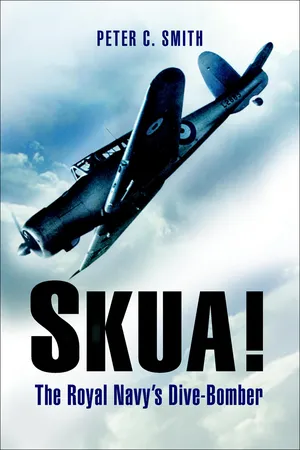
The Blackburn Skua was the first monoplane to be designed and built for the Royal Navy in the 1930s. As a result of continued debate, it became a compromise between the Navys desire for a carrier-based dive-bomber and RAFs preference for a fighter. Despite being the first to shoot down a Luftwaffe aircraft in World War II, early operations in Norway found the type woefully inadequate as a fighter.As a dive-bomber, the Royal Navy put the design to good use from the outset of WWII. It was involved with the hunt for the Graff Spee, sunk the major warship Koln, suffered with great loss in an attack on the Scharnhorst, helped to keep the German advance at bay during the Dunkirk evacuation and attacked the French rogue battleship Richelieu in the Mediterranean.This book relates how the final design was created, how the dive-bombing technique was developed and perfected by naval pilots and traces the wartime operational career of the type with many first-hand accounts.
Trusted by 375,005 students
Access to over 1.5 million titles for a fair monthly price.
Study more efficiently using our study tools.
Information
1
FORGING THE FIRST-STRIKE WEAPON
The two-decade period ‘between the wars’ (1919 – 39) was difficult for the Royal Navy. Long accustomed to being by far and away the largest and most innovative navy in the world, this great institution had just ended a titanic war during which it had seen its most recent rival totally eliminated with the scuttling of the German High Seas Fleet at Scapa Flow. From 1919 to 1921 the old order seemed destined to continue as before, but within 12 months 300 years of proud and unique naval heritage and superiority was sacrificed to the pressure from the United States and thrown away by uncaring and uncomprehending politicians at the Washington Naval Conference. The Royal Navy was cut to the bone, forced to accept parity with the new navy of America and its old alliance with Japan, now the third-ranking naval power, was also cast adrift to pamper to the whims and prejudices of senators in Wisconsin! Shaken to the core, and with a hostile Treasury under Winston Churchill seeking even further cutbacks, the Royal Navy retrenched and fought to maintain even a shadowy semblance of its former might.
One of the many ways in which the Royal Navy had led the world in the first decade of the twentieth century, had been in the origination, development and application of the newly fledged air power at sea. The development of the aircraft carrier had been a British innovation, but loss of control of all the aircraft that operated from carriers was another retrograde step. The Royal Navy fought long and hard to regain control, but it took almost 20 years, and those two decades cost the Fleet Air Arm (FAA) dearly. From being a leading exponent of aircraft at sea in 1918, by 1939 the Royal Navy had fallen far behind the two principal navies, the United States and Japan1, in this field, in both numbers of aircraft and in operating techniques.
Reconnaissance for the fleet had been the primary role envisaged for the aircraft carrier, followed by spotting for the battleship guns during the expected ‘set-piece’ battle. The development of the torpedo-bomber had proceeded apace during the final years of the First World War and plans had been made for a fleet of Sopwith Cuckoo aircraft to attack the reluctant German Fleet at its bases. The threat of aerial torpedo attack was always the principal threat that aircraft posed to the battleship during the period under discussion, despite spectacular claims by the proponents of high-level bombing. The slow progression of carrier-based torpedo-bombers began to bring the threat of such attacks on the enemy fleet closer to reality. At first, each carrier could only launch ‘penny packets’ of such aircraft, such was the limited capacity of the carriers themselves, but it was hoped these limitations could be overcome in time, when new ships became available.
During the 1920s, despite the fact that most British politicians considered a war with the United States ‘unthinkable’, many American politicians did not share that view, and among the United States Navy’s top brass there were many admirals eager to flex their newly found muscles also. This led to some tension between the two western nations, especially during naval limitation conferences. However, by the early 1930s, it was generally accepted that the most likely enemy the Royal Navy would have to face in combat would be their former pupil, friend and ally, Japan.
Britain’s far-flung empire was extensive, but very vulnerable because of that. With the main fleets maintained in home waters and the Mediterranean, the Indian Empire, including Burma and what was then Ceylon (now known as Sri Lanka), as well as Malaya, Borneo and Hong Kong, were left relatively undefended. Also at risk in that area were the Commonwealth countries of Australia and New Zealand and their many dependencies in the south Pacific.
Hong Kong was indefensible if war came with Japan, but Britain was permitted to construct a new naval base at Singapore Island. This was far enough from Japan to be classified as ‘defensive’ to guard the Indian Ocean. However, it would, of course, serve as an advance base for the ‘Main Fleet’ to move to in readiness for war, should events dictate it.2 Over the years this concept, the movement of the Main Fleet to Singapore, became a major war-game. However, it was all academic, for the base itself became a political shuttlecock and progress towards its completion dragged on and on. Until the base could be finished the fleet remained at home, gradually shrinking in numbers. As the First Sea Lord, Earl Beatty, once remarked, a naval base at Singapore, even if built, would merely be ‘a sentry-box without a sentry’.
There was never much doubt in British naval circles that it was Japanese aircraft carriers that would provide the main opponents for British carrier aircraft, despite this being discounted as a late development by many American historians.3 Indeed, as early as July 1931 the Royal Navy had begun operating its carriers in groups of two, three or more during tactical exercises, at the urging of the Rear Admiral, Aircraft, R. G. H. Henderson, with this view in mind.4 Tactical School planning for the Main Fleet to go out east in the event of war called for no fewer than four aircraft carriers as part of that force. So the Royal Navy was far more air-minded, within the parameters of possibility, than their many American critics have ever given them credit for.
Torpedo-bombers were vulnerable in their approach and it was expected that heavy losses would be suffered from both defending fighters and the enemy fleet’s anti-aircraft guns. New formations (flight attacks) and tactics (sector formations), both of which involved a diving approach to the target in order to break through these defences, were also evolved from 1933. In July of that year the Royal Navy’s Tactical Instructions stated quite clearly that the fleet’s best defence against an opposing fleet’s air attacks was ‘. . . offensive action against the enemy’s air forces at the earliest possible moment’.5 But what was needed was an aircraft that could achieve surprise, coupled with weight of ordnance, to launch a successful pre-emptive attack on the Japanese carriers, and this was not forthcoming with the small fleet fighter aircraft with their minimal bomb-carrying capacity. A fresh and radical approach was sought.
The dive-bomber concept revitalised
Although dive attacks had always been a feature of Fleet Air Arm procedures,6 in 1931 a visit to the USA by Lieutenant Commander St John Printice, RN, gave a fresh impetus to its development in the Royal Navy.7 Printice was impressed by the US Navy’s revitalisation of the old concept in the form of the much-publicised ‘Helldiver’ approach of near-vertical attacks, mounted without warning against an enemy fleet, and against which the anti-aircraft weaponry of the day was unable to cope. Although Printice advocated a ‘relatively steep’ dive approach (about 70 degrees) rather than the American method (which the British dubbed Terminal Velocity or T/V), the potential of such a delivery of ordnance against such a lightly protected target as an enemy aircraft carrier was attractive. The torpedo was always going to be the preferred method of airborne attack against a heavily protected armour belt of contemporary battleships. However, against carriers, a precisely delivered bomb would knock the flight deck out and a carrier unable to operate her aircraft was merely a floating target with no war capability whatsoever.
Once the concept was explained and analysed, the Royal Navy was, on the whole, enthusiastic about the dive-bomber concept. One of the pilots who served with No. 800 Squadron, flying nine Hawker Nimrod and three Hawker Osprey aircraft aboard the carrier Courageous at this time, recounted how the Nimrod, ‘. . . was a great advance; it had no flaps, a fixed undercarriage, but some dubious brakes. Top speed was about 120 knots and it was very strong, capable of being dived vertically ad infinitum!’8 Their role was defined as long-range air defence (outside the range of the Fleet’s anti-aircraft [AA] guns), strike escort and dive-bombing.
It was recognised that the small bombs capable of being carried on the biplane fighters of the day were inadequate. What was needed, as both the United States and Japanese Navies were also to conclude about the same time, was a specialised delivery system capable of delivering at least a 500 lb payload.9 However, unlike those two navies, which had retained complete control over their aircraft in every respect, the Royal Navy was hamstrung by the fact that a different service controlled the Fleet Air Arm, and had absolutely no interest in dive-bombing whatsoever. The RAF, following the heady predictions of the Italian prophet Douhert, Britain’s Lord Trenchard and the publicity-seeking ‘Billy’ Mitchell in the United States and their ilk, of victory through air power alone and unaided, were firmly committed to the heavy bomber and the high-level mass attack. Against warship targets, this method was also considered by its advocates to be supreme (Mitchell once proclaimed to the press that it was easier to hit a moving ship and than a stationary target ship), but while the Admiralty had rejected that premise for their own aircraft as early as 1930, the RAF never did. Thus, while the Naval Staff were eager to adopt a specialised dive-bomber, and the Rear Admiral, Aircraft (RAA)10 urged its introduction in November 1933, the Air Ministry remained uninterested11 and thus delayed each Admiralty attempt to introduce such an aircraft.
There was another factor that tended to hamper the development of naval aircraft development and this was the much smaller numbers required compared with their land-based RAF equivalents. While the Treasury between 1918 and 1937 starved all the services of funds, the ratio between RAF and FAA orders always remained disadvantageous to Royal Navy requirements. Military aircraft manufacturers would welcome any contract in those lean years of course, but short production runs were always going to be more restrictive, and less cost-effective, than longer ones. There was a tendency to either adapt existing RAF aircraft to a makeshift maritime role, or for orders to be placed with specialised firms, which, by definition, meant that they were smaller and less geared to speedy mass-production methods. This remorseless logic led in turn, through no fault of these specialised manufacturers, to much-extended production runs, and so a cutting-edge design could, by the time it finally appeared with the fleet, be outdated by the pace of aircraft development. The Skua was to be a classic example of this seemingly unavoidable chain of consequences.
Moreover, Royal Navy aircraft suffered from yet a further handicap, even when funds were finally released for rearmament, competing for priority against the RAF counterparts in the rush to make up for two decades of neglect. Having run down the whole defence infrastructure to an all-time low ebb, pressing the cash switch could not automatically provide the designers, test pilots, plant and other essentials overnight. In the jostling for priority, the Fleet Air Arm was always to take a back seat in the allocation of scarce resources. This meant that with aircraft engines, as much as with any other resource, the best would be demanded for home defence fighter aircraft, while the Fleet Air Arm, which was not expected to have to face the most modern types of opposition anyway, would have to make do with what was left over. Again, the Skua was one of the first, but by no means the only, naval aircraft to suffer in this manner.
The debate begins
The need to replace both the delicate but under-armed Hawker Osprey and Nimrod biplanes as the fleet’s principal interceptor was qualified by the need for the new aircraft to be fully strengthened and stressed for dive-bombing. The DNAD12 had, in 1933, pointed out that: ‘In general, sufficient evidence is available to indicate that dive bombing is likely to be far more effective than high level bombing against any target ....’ He continued, ‘So long as the FAA has no aircraft capable of really effective dive bombing attack with heavy bombs’, then only the airborne torpedo remained in the Navy’s armoury which would obtain results ‘commensurate with the effort and probable losses’. However, ‘the torpedo is not the most effective initial weapon of attack on enemy carriers, which will usually be our primary objective. At least in the first attack, which is designed to stop all flying operations, there is little doubt that dive bombing with SAP13 bombs should form the main part of the attack.’
The Admiralty’s requirements were based on the plain fact that the shipboard capacity for aircraft in the aircraft carriers it had in service in 1934, which had to meet both the defensive and offensive requirements of the fleet, were insufficient. What was wanted was an up-to-date aircraft that could not only provide the fleet with secure protection from air attack from enemy carriers, but which also had the capacity to mount a pre-emptive, or a retaliatory strike to gain air super...
Table of contents
- By the same author
- Title Page
- Copyright Page
- Dedication
- Table of Contents
- List of Tables
- FOREWORD
- ACKNOWLEDGEMENTS
- 1 - FORGING THE FIRST-STRIKE WEAPON
- 2 - BUILDING THE CONCEPT
- 3 - THE SAGA OF THE DIVE-BOMB SIGHT
- 4 - THE SKUA IS HATCHED
- 5 - AFLOAT AT LAST
- 6 - INTO BATTLE
- 7 - KILLING THE KÖNIGSBERG
- 8 - LONG ODDS
- 9 - LAMBS TO THE SLAUGHTER
- 10 - THE LAST DITCH
- 11 - NORTH AND SOUTH
- 12 - WARMER CLIMES
- 13 - LAST MISSIONS
- 14 - TRAINING, TRAGEDIES AND TARGETS
- Appendix 1 - SKUA ‘FIRSTS’
- Appendix 2 - SKUA COMBAT UNITS – COMMANDING OFFICERS
- Appendix 3 - FAA SQUADRONS WITH SKUA COMPLEMENT
- Appendix 4 - LOSSES IN NORWAY 1940
- Appendix 5 - DIAGRAMS
- BIBLIOGRAPHY
- INDEX
Frequently asked questions
Yes, you can cancel anytime from the Subscription tab in your account settings on the Perlego website. Your subscription will stay active until the end of your current billing period. Learn how to cancel your subscription
No, books cannot be downloaded as external files, such as PDFs, for use outside of Perlego. However, you can download books within the Perlego app for offline reading on mobile or tablet. Learn how to download books offline
Perlego offers two plans: Essential and Complete
- Essential is ideal for learners and professionals who enjoy exploring a wide range of subjects. Access the Essential Library with 800,000+ trusted titles and best-sellers across business, personal growth, and the humanities. Includes unlimited reading time and Standard Read Aloud voice.
- Complete: Perfect for advanced learners and researchers needing full, unrestricted access. Unlock 1.5M+ books across hundreds of subjects, including academic and specialized titles. The Complete Plan also includes advanced features like Premium Read Aloud and Research Assistant.
We are an online textbook subscription service, where you can get access to an entire online library for less than the price of a single book per month. With over 1.5 million books across 990+ topics, we’ve got you covered! Learn about our mission
Look out for the read-aloud symbol on your next book to see if you can listen to it. The read-aloud tool reads text aloud for you, highlighting the text as it is being read. You can pause it, speed it up and slow it down. Learn more about Read Aloud
Yes! You can use the Perlego app on both iOS and Android devices to read anytime, anywhere — even offline. Perfect for commutes or when you’re on the go.
Please note we cannot support devices running on iOS 13 and Android 7 or earlier. Learn more about using the app
Please note we cannot support devices running on iOS 13 and Android 7 or earlier. Learn more about using the app
Yes, you can access Skua! by Peter C. Smith in PDF and/or ePUB format, as well as other popular books in History & Military & Maritime History. We have over 1.5 million books available in our catalogue for you to explore.