- 132 pages
- English
- ePUB (mobile friendly)
- Available on iOS & Android
eBook - ePub
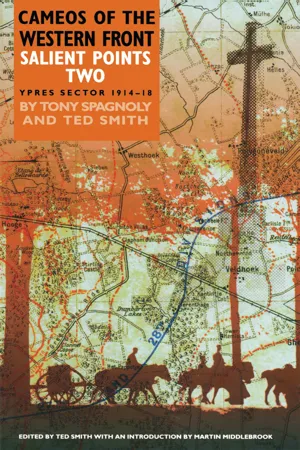
About this book
Another group of stories in the Salient Points series. A collection of stories of men, their units and the actions they took part in during the conflict of 1914–1918, together with stories other points of interest along the old Western Front. Each story is supported with photographs and maps showing the area of the action as it was then, and is today. The content feature-titles are: The Black Watch; Lord Worsley at Zandvoorde; The 1st Battalion Royal Welch Fusiliers at Zandvoorde; The Worcesters and the Welsh at Gheluvelt in 1914; The Youngest Soldier; Major Lanoe Hawker at Abeele Aerodrome; 16th Battalion (The Canadian Scottish) at Kichener Wood; Pond Farm; Fray Bentos at Hill 35; The Liverpool Irish at Schuler Galleries; The O'Donnell Twins; New Zealand at the village of Messines; Reconciliation at Broodseinde.
Information
CONTENTS
List of Plates
List of Maps
Dedication
Acknowledgements
Preface
Introduction
Author’s Note
Cameos
1. The Black Watch
2. Lord Worsley at Zandvoorde
3. The 1st Royal Welch Fusiliers at Zandvoorde
4. The Worcesters and the Welsh – Gheluvelt 1914
5. The Youngest Soldier
6. Major Lanoe Hawker at Abeele Aerodrome
7. 16th Battalion (The Canadian Scottish) at Kitchener’s Wood
8. Pond Farm
9. Fray Bentos at Hill
10. The Liverpool Irish at Schuler Galleries
11. The O’Donnell twins
12. New Zealand at the village of Messines
13. Reconciliation at Broodseinde
Bibliography
Index
PLATES
German sketch map of Lord Worsley’s grave position
Colonel James’ replacement cross for Lord Worsley’s grave
Household Cavalry Memorial
1st Royal Welch Fusiliers – road at Zandvoorde
The Charge of the Worcesters by Gilbert Holiday
Memorials of the Worcesters and South Wales Borderers
Sunken road at Gheluvelt
Military convoy in Abeele high street
Aerial view of Abeele Aerodrome
Abeele Aerodrome Military Cemetery
Mousetrap Farm
Memorial to the 10th and 16th Battalions, Kitchener’s Wood
Pond Farm bunker
Tank F.47 ditched at Spree Farm
Tank F.45 abandoned near Gallipoli strongpoint
Strongpoint Somme from Gallipoli
Jack and Tom O’Donnell
The upward slope to the village of Messines
Broodseinde crossroads with cemetery
Broodseinde crossroads today
German and British veterans in cemetery, 1931
MAPS
Kortekeer Cabaret
Zandvoorde – Household Cavalry
Zandvoorde – 1st Battalion Royal Welch Fusiliers
Gheluvelt
The situation at Gheluvelt, October 31st 1914
Counter-attack by 2nd Battalion Worcesters
St. Julien – Mousetrap Farm
Abeele Aerodrome
St. Julien – Kitchener’s Wood
Counter-attack at Kitchener’s Wood
St. Julien – Pond Farm
St. Julien – Fray Bentos at Hill 35
St. Julien – Schuler Galleries
Zonnebeke – The Old Mill
Messines
Messines trench map
Broodseinde crossroads
DEDICATION
To Mary Ellen Freeman.
“Remembrance is the theme of her life.”
“To live in the hearts
of those we leave behind
is not to die.”
of those we leave behind
is not to die.”
Headstone of Private Louis Rosenberg,
3rd Battalion Worcestershire Regiment,
killed in action 9th December, 1915, aged 27.
Prowse Point Military Cemetery
Warneton, Belgium
3rd Battalion Worcestershire Regiment,
killed in action 9th December, 1915, aged 27.
Prowse Point Military Cemetery
Warneton, Belgium
ACKNOWLEDGEMENTS
It is always the official institutions in these cases that merit a vote of thanks. Without the Commonwealth War Graves Commission, the Imperial War Museum the Public Record Office, and the Tank Museum at Bovington, modest military projects like this would never see the light of day. We are grateful for the patience and assistance of their respective staffs, for we know time is a valued commodity for them in this day and age when the interest in the years of 1914–1918 has been positively explosive!
Special thanks to Albert Ghekiere for his descriptions of the Institution Royale in the village of Messines as it was in 1914 and also his time spent in showing the crypt in the church as it is today. Again special thanks to Jack Patten for the amount of research he forwarded and the information taken from his private papers regarding the counter-attack of the 16th Battalion (The Canadian Scottish) on Kitchener’s Wood. Jack is a serving officer with today’s Canadian Scottish Regiment. Thanks are due to many other people, especially Mr & Mrs Joseph O’Donnell for permission to include the story of the O’Donnell twins (Joseph being the son of Jack O’Donnell), Mr P. W. Leigh for his permission to feature the exploits of his uncle Second-Lieutenant Hodson at Schuler Galleries, Kathie Willes and James Brazier for their assistance in bringing some professionalism to the proof reading, Calin Kilgour, always available to discuss the formation of the different Cameos, and Katie Nelson (now working in the Gulf) who was kind enough to type some of the early manuscripts.
Last but not least we must show gratitude to Corinne Smith who organised the typing of manuscripts, kept the budget down to reasonable proportions, organised computer supplies, and delivered and collected three children to and from their school while her husband made his frequent day trips to Ypres taking photographs, checking maps and generally enjoying himself.
Tony Spagnoly and Ted Smith, February 1998
PREFACE
A second edition of Salient Points is modestly presented in the hope that it will be enjoyed, if that be a suitable word to describe the reading of some poignant situations and the personalities involved in them.
This is not a guide-book nor an academic study of military actions and deeds which took place in some of the darkest, part-forgotten comers of the hallowed ground we collectively call the Immortal Salient.
What is this unseen emotional pull Ypres has on us, as year after year in increasing numbers, we succumb to this strange force that compels us to return?
Is it because we recognise perhaps that it was here in Flanders almost a century ago that the British professional army, once described as “a perfect thing apart”, drew that historic line in the sand to defy the mightiest army that the world had seen, keeping faith with her smallest ally and, in so doing, left a generation of her finest in soldiers’ graves around the little Flemish town of Ypres.
No matter how many times we stand at the Menin Gate Memorial to the Missing, winter or summer with attendant crowds or almost alone, the endless names carved upon this imposing edifice seem to send us a clear message not to forget. One of the age old truths of the church comes into its own, “In remembrance lies immortality” and that surely must be correct.
The unique evening ceremony of Last Post strikes at the hardest heart as those powerful notes sail out on the evening air over the old salient. We cherish the hope that those lying in the multitude of military cemeteries surrounding Ypres hear and acknowledge this nightly mark of the towns people’s respect.
It is difficult for the human mind to encompass all the pain and suffering that went on at Ypres, where every little hamlet entered the English military and domestic language as a byword for sacrifice, with perhaps Passchendaele the worst battlefield of all, way beyond our comprehension.
The poet, John Oxenham, after a visit here in 1917 wrote:
“The only way it seems to me to be able to view these fields of war and retain one’s own faith and sanity, and the elemental belief in the sanity of one’s fellows and essential goodness of God, is to regard them each in reverence as mighty altars on which for sake of a great ideal, mankind has proved itself equal to the most supreme of all sacrifices. Greater love hath no man than this.”
This profound sentiment would surely have appealed to a widowed mother who, in 1920, travelled alone to Ypres on a cold icy day to stand at Hooge Crater Cemetery before the grave of her only son. She recalls:
“I can write no more of your resting place, passionate weeping obliterates my every word. This piteous winter scene for me is Ypres. People coming after me in the endless years to come will see a tidy graveyard with crosses all in a row, and gently green undulating country, hummocky perhaps as uncultivated and uninhabited land often is, but they cannot, will not see what British soldiers fought for, lived in, and died in – tenaciously holding, sublimely, divinely for four long years!”
That grieving mother seems to have said it all. She and the great British armies of the time have now marched off the world stage, all we are asked in our turn, is to come and remember. A small price indeed.
Tony Spagnoly, 1998
INTRODUCTION
Why?
Why, more than 80 years after it ended, are more and more people visiting the battlefields of the First World War? Why are more and more books being published about that war? I have retired from my own writing career, but a study of my recent royalty returns show...
Table of contents
- Cover
- Half Title Page
- Full Title Page
- Copyright
- Contents
Trusted by 375,005 students
Access to over 1.5 million titles for a fair monthly price.
Study more efficiently using our study tools.
Frequently asked questions
Yes, you can cancel anytime from the Subscription tab in your account settings on the Perlego website. Your subscription will stay active until the end of your current billing period. Learn how to cancel your subscription
No, books cannot be downloaded as external files, such as PDFs, for use outside of Perlego. However, you can download books within the Perlego app for offline reading on mobile or tablet. Learn how to download books offline
We are an online textbook subscription service, where you can get access to an entire online library for less than the price of a single book per month. With over 1.5 million books across 990+ topics, we’ve got you covered! Learn about our mission
Look out for the read-aloud symbol on your next book to see if you can listen to it. The read-aloud tool reads text aloud for you, highlighting the text as it is being read. You can pause it, speed it up and slow it down. Learn more about Read Aloud
Yes! You can use the Perlego app on both iOS and Android devices to read anytime, anywhere — even offline. Perfect for commutes or when you’re on the go.
Please note we cannot support devices running on iOS 13 and Android 7 or earlier. Learn more about using the app
Please note we cannot support devices running on iOS 13 and Android 7 or earlier. Learn more about using the app
Yes, you can access Salient Points Two by Tony Spagnoly,Ted Smith in PDF and/or ePUB format, as well as other popular books in History & Military & Maritime History. We have over 1.5 million books available in our catalogue for you to explore.