"The 2013 edition . . . includes four articles on significant ships, respectively; French Navy, US Coast Guard, German Navy and Indian Navy."—Firetrench Reviews
Launched in 2009, this annual has rapidly established a reputation as an authoritative but affordable summary of all that has happened in the naval world in the previous twelve months. It combines the standing features of regional surveys with one-off major articles on noteworthy new ships and other important developments. Besides the latest warship projects, it also looks at wider issues of importance to navies, such as aviation and electronics, and calls on expertise from around the globe to give a balanced picture of what is going on and to interpret its significance.
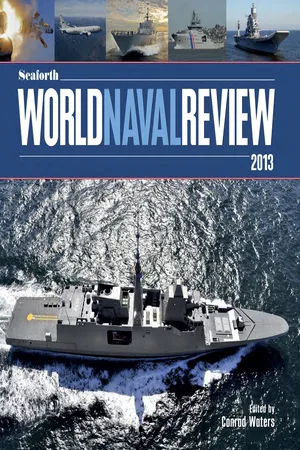
Special features for the 2013 edition include in-depth studies of the navies of Italy and Ireland, plus analyses of significant new warship classes: the French
Aquitaine class frigates, Indian
Shivalik class Project 17 frigates, German
Braunschweig class corvettes, and US
Bertholf class national security cutters.
Intended to make interesting reading as well as providing authoritative reference, there is a strong visual emphasis, including specially commissioned drawings and the most recently released photographs and artists' impressions.
This annual has become "a must for those wishing to keep up with world naval affairs" (Scuttlebutt).
- 192 pages
- English
- ePUB (mobile friendly)
- Available on iOS & Android
eBook - ePub
Seaforth World Naval Review 2013
About this book
Information
1 OVERVIEW
INTRODUCTION
‘He who knows when he can fight and when he cannot will be victorious,’ wrote the famous Chinese military strategist Sun Tzu, author of the influential The Art of War. This maxim appears to be exerting particular influence on ‘Austerity America’s’ military – and maritime – strategy as it embarks upon a period of retrenchment to rebuild government finances dented by the global financial crisis and drained by the long ‘war against terror’, most notably in Iraq and Afghanistan.
The United States defence budget continues to dwarf that of any other nation by a considerable factor, as demonstrated by the comparative data set out in Table 1.0.1. Equally, the country’s armed services face an underlying decline in defence spending at a time when that of likely rivals, particularly that of China and Russia, is displaying a markedly upward trajectory. Total US defence expenditure, including both base funding and war costs, is currently planned to drop by over 20 per cent from its 2010 peak after taking account of inflation.1 This holds out the prospect of a steady diminution of US military hegemony to an extent not seen since the height of the Cold War.
Whilst the United States’ response to this threat to its supremacy has been multi-faceted, the overall result has been a significant shift in priorities that will have considerable implications for the world naval balance in the years ahead. A common theme that is steadily emerging is a hard-headed focus on maintaining investment in defence assets which are most critical to US military superiority whilst giving priority to those potential theatres of operation that are paramount to the country’s global political interests. At the same time, missions where the US is unlikely to achieve ultimate success, and regions that are perceived as having only peripheral significance to its interests are being de-emphasised. This approach is most evident in the rapid drawdown of US Department of Defense supplemental funding for ‘Overseas Contingency Operations’, as the expense and impracticality of imposing a military solution on countries such as Afghanistan gives rise to alternative approaches. This is being accompanied by a more fundamental realignment of force structures away from the land-based forces required for protracted stabilisation operations.
Table 1.0.1: COUNTRIES WITH HIGH NATIONAL DEFENCE EXPENDITURES – 2011

The overall reduction in US defence resources means that the traditional ‘two-war’ force structure that had shaped post Cold War force levels has been abandoned in favour of a configuration which is designed to deter conflict in one region whilst the military is actively engaged in another. This places a premium on power projection type assets that are capable of rapid deployment. Consequently, the US FY2013 defence budget request largely protects investment in air and naval assets with these attributes, such as aircraft carriers, large deck amphibious ships, submarines and long-range bombers. These are seen as being essential in ensuring US victory in any future conflict.
Although the US military will continue to contribute to security globally, the new US Presidential Strategic Guidance issued in January 2012 makes it clear that the rebalancing of its capabilities towards the Asia-Pacific region, which is already well underway, will continue.2 This clear statement of priorities followed President Barack Obama’s November 2011 address to the Australian Parliament, when he declared that ‘the United States will play a larger and long-term role in shaping this region and its future’. Indeed, the last twelve months have seen a steady stream of initiatives designed to counter the perceived threat to US regional interests posed by an emergent China. These have doubtless been given added impetus by the Chinese People’s Liberation Army Navy’s (PLAN’s) progress in refurbishing the former Soviet carrier Varyag. The ship’s lengthy progress towards completion took a major step forward in August 2011 when she finally embarked on initial sea trials.
Prominent amongst recent US moves to reinforce its Asia-Pacific presence has been the arrival of an initial contingent of US Marines at Darwin in Australia’s Northern Territory in April 2012. This forms part of a plan that could eventually see up to 2,500 troops being based there on rotational training deployments by 2017. Meanwhile, the first US littoral combat ship, Freedom (LCS-1) will arrive in Singapore in spring 2013 for berthing trials that could herald four of the new warships being assigned to work with the island republic’s navy. There have also been discussions with the Philippines about an enhanced American presence, whilst Australia’s Cocos Islands have been mooted as a base for unmanned surveillance drones. Most of these initiatives – involving comparatively modest force levels – have limited military significance in their own right. Instead, they should be seen more as confidence-building measures in respect of US commitment amongst key regional partners.3 Transfers of military technology, such as former US Coast Guard cutters to the Philippines, as part of measures to build partner capacity, can be regarded in a similar light. The true blueprint underlying US war-fighting potential in Asia-Pacific remains the development of integrated air and naval forces that underpins the Air-Sea Battle concept and its ability to counter Chinese anti-access/area-denial (A2/AD) capabilities.4

The first US Navy nuclear-powered aircraft carrier, Enterprise (CVN-65) pictured with other ships of her carrier strike group whilst transiting the Atlantic Ocean on 22 March 2012 during her final deployment. Whilst Enterprise will be withdrawn from service at the end of 2012, recent US defence decisions continue to place heavy emphasis on the importance of carrier strike groups. (US Navy)


The United States’ steady increase in focus on the Asia-Pacific region could see littoral combat ships such as Fort Worth (LCS-3) – pictured left during pre-commissioning sea trials – forward deployed to Singapore. In addition, friendly navies are being strengthened through the transfer of surplus equipment such as the Philippines’ Gregorio del Pilar, formerly the Coast Guard’s high endurance cutter Hamilton (WHEC-715). Both measures are intended to encourage confidence in US commitment to the region rather than impacting the military balance in their own right. (Lockheed Martin, Mrityunjoy Mazumdar)
Table 1.0.2: MAJOR FLEET STRENGTHS 2011-2012

Elsewhere, Iran’s nuclear ambitions and their potential to lead to a conflict impacting freedom of navigation in the Persian Gulf have continued to exert considerable attention on the maritime thinking of the United States and its allies. This is also a region where deployment of the new littoral combat ships is being considered. News reports suggest that up to eight of the vessels are being earmarked for operation from the troubled island state of Bahrain in due course. By way of contrast, Europe is becoming steadily less significant from a maritime perspective. This reflects both a low level of imminent threat and the region’s diminishing influence as the Eurozone crisis continues to impact both its economic and naval potential. Efforts to reconfigure European naval forces to the post Cold War environment have been making progress. However, there is ongoing reliance on the United States for the provision of certain key capabilities, as NATO’s involvement in the Libyan conflict demonstrated. Confirmation in November 2011 that four Aegis-equipped US Navy warships will be forward deployed to Rota in Spain by 2015 as part of plans to develop a European-wide theatre ballistic missile defence (TBMD) network provide further evidence of this dependency. It seems unlikely the situation will change any time soon given ongoing pressure on European defence budgets that is even more severe than that experienced by the United States.

The US Navy’s Los Angeles (SSN-688) class nuclear-powered attack submarine Tucson (SSN-770) pictured berthing at Polaris Point, Guam on 31 May 2012. The island’s naval and air force facilities are becoming increasingly important for US forces as the so-called ‘Pivot to the Pacific’ and development of the Air-Sea Battle concept places added emphasis on secure bases in the region. (US Navy)

The Asian navies continue to grow in numerical strength and technological capability. India, particularly, is benefiting both from the delivery of long-delayed indigenous construction and the fulfilment of previous orders from Russia. This is the newly delivered Russian Project 971 ‘Akula II’ type nuclear-powered attack submarine Chakra, seen off the Indian Coast in April 2012. (Indian Navy)

The US Coast Guard national security cutter Waesche (WMSL-751) operating with the US Navy destroyer Lassen (DDG-82) and Royal Thai Navy ships in May 2012. Whilst less sophisticated than front-line warships, the Coast Guard’s new national security cutters provide a useful complement to US warships in lower intensity missions. (US Navy)

Developments in fixed wing aviation over the past year have been dominated by the US Joint Strike Fighter programme, which seems to be making some headway in spite of numerous problems. F-35B short take off and landing (foreground) and F-35A carrier (background) variants are pictured in this line up at Naval Air Station Patuxent River in February 2012. (Lockheed Martin)
FLEET REVIEWS
The current estimates of fleet strengths for the leading navies that are set out in Table 1.0.2 reflect the decline in the naval strength of the traditional ‘Western’ maritime powers compared with that of many of the developing nations. Whilst the prior year’s comparative data is not sufficient to show longer term tre...
Table of contents
- Front Cover
- Title Page
- Copyright Page
- Contents
- Section 1: Overview
- 2-1 Regional Review – North and South America
- 2-2 Regional Review – Asia and The Pacific
- 2-3 Regional Review – The Indian Ocean and Africa
- 2.4 Regional Review – Europe and Russia
- 2.4A Fleet Review – Ireland: The Irish Naval Service: A Model Constabulary Navy
- 2.4B Fleet Review – Italy: The Marina Militare: A Well-balanced Force in Time of Crisis
- 3.1 France’s Aquitaine: First French FREMM heralds a Renaissance for its Surface Fleet
- 3.2 US Coast Guard Legend Class Cutters: ‘Our Highest Priority for the Twenty-First Century’
- 3.3 Braunschweig Class Corvettes: Eagerly awaited by the German Navy
- 3.4 Shivalik Class Frigates: An Overview of India’s P17 and P17A Stealth Frigates
- 4.1 World Naval Aviation An Overview of Recent Developments
- 4.2 Ballistic Missile Defence and the USN
- Contributors
Trusted by 375,005 students
Access to over 1.5 million titles for a fair monthly price.
Study more efficiently using our study tools.
Frequently asked questions
Yes, you can cancel anytime from the Subscription tab in your account settings on the Perlego website. Your subscription will stay active until the end of your current billing period. Learn how to cancel your subscription
No, books cannot be downloaded as external files, such as PDFs, for use outside of Perlego. However, you can download books within the Perlego app for offline reading on mobile or tablet. Learn how to download books offline
Perlego offers two plans: Essential and Complete
- Essential is ideal for learners and professionals who enjoy exploring a wide range of subjects. Access the Essential Library with 800,000+ trusted titles and best-sellers across business, personal growth, and the humanities. Includes unlimited reading time and Standard Read Aloud voice.
- Complete: Perfect for advanced learners and researchers needing full, unrestricted access. Unlock 1.5M+ books across hundreds of subjects, including academic and specialized titles. The Complete Plan also includes advanced features like Premium Read Aloud and Research Assistant.
We are an online textbook subscription service, where you can get access to an entire online library for less than the price of a single book per month. With over 1.5 million books across 990+ topics, we’ve got you covered! Learn about our mission
Look out for the read-aloud symbol on your next book to see if you can listen to it. The read-aloud tool reads text aloud for you, highlighting the text as it is being read. You can pause it, speed it up and slow it down. Learn more about Read Aloud
Yes! You can use the Perlego app on both iOS and Android devices to read anytime, anywhere — even offline. Perfect for commutes or when you’re on the go.
Please note we cannot support devices running on iOS 13 and Android 7 or earlier. Learn more about using the app
Please note we cannot support devices running on iOS 13 and Android 7 or earlier. Learn more about using the app
Yes, you can access Seaforth World Naval Review 2013 by Conrad Waters in PDF and/or ePUB format, as well as other popular books in History & History Reference. We have over 1.5 million books available in our catalogue for you to explore.