This groundbreaking work of military history reveals the unsettling truth about British Army executions during WWI.
The issue of military executions during the war has always been controversial, and embargoes have long kept historians from researching it. Julian Putkowski has spent decades uncovering the stories of mutinies and soldiers accused of desertion, and of the executions that followed.
In
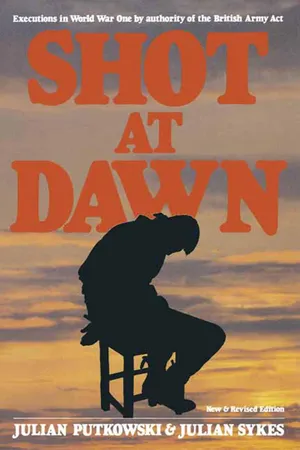
Shot at Dawn, Putkowski and co-author Julian Sykes shed light on a practice that for too long has been shrouded in secrecy. They show that trials were grossly unfair and incompetent. Many of the condemned men had been soldiers of exemplary behavior, courage, and leadership who cracked under the dreadful strain of trench warfare. This acclaimed book is the authority on this shameful legacy.
eBook - ePub
Shot at Dawn
Executions in World War One by Authority of the British Army Act
- 304 pages
- English
- ePUB (mobile friendly)
- Available on iOS & Android
eBook - ePub
Shot at Dawn
Executions in World War One by Authority of the British Army Act
About this book
Information
Contents
Foreword
Introduction
Chapter One. 1914–15. Regular blood
Chapter Two. 1915–16. Lead us not into temptation
Chapter Three. 1916. Kitchener’s men.
Chapter Four. 1916. And the meek shall inherit the earth
Chapter Five. You can’t get away from the guns
Chapter Six. 1917. Far, far from Wipers I long to be
Chapter Seven. 1917. There is a limit to the number of good men
Chapter Eight. 1918. With our backs to the wall
Chapter Nine. 1918–20. Lord let us now thy servants depart in peace
Acknowledgements
Bibliography
Appendix
Place of Burial or Commemoration of Executed Men
Executions in Regimental or Unit Order
Executions on the Western Front
Executions in ‘Other Theatres’
Index. Alphabetical list of all those executed
British firing squad in action. The shooting is that of a spy in Belgium early in
the war. [Penalty not inflicted by authority of the Army Act.]
the war. [Penalty not inflicted by authority of the Army Act.]

Foreword
In 1974 the publication of William Moore’s book The Thin Yellow Line confirmed suspicion that the punishment meted out to soldiers in the Great War for offences like cowardice and desertion had been ruthless. Since as early as Christmas 1914 speculation and rumour had been rife that this was the case.
A more learned account of these events was published in 1983, when His Honour Judge Anthony Babington was permitted to examine the court martial transcripts which during the war were required to be kept, provided that he did not name the individuals concerned nor their units. The Judge’s [findings confirmed the worst misgivings that anyone had expressed. Army procedures had seriously jeopardised the prospects of a fair trial, and after conviction the defendant could not expect to be treated sympathetically. As well as legal irregularities Judge Babington also highlighted the absence of informed medical opinion, further prejudicing a soldier’s prospects of justice.
However, he did not enquire deeply into the background of individual soldiers – tasks that had engaged our attention for some time prior to the Judge being granted access to the court-martial files. Some of the facts that emerged from our collaborative research were horrifying, and we consider their disclosure a necessity.
Judge Babington wrote a factual account of those questionable proceedings, based on access to official records. What his book accomplished was to let the actual records factually testify to the inequity of what happened. However, we are prepared to advance public awareness one step further, by the complete disclosure of the names of all individuals, their units, and the often appalling way in which they were sentenced to death. The elucidation of this information was not easy, but we have breached no rules of confidentiality, nor have we been granted access to any secret government archives. (Often referred to as closed records.)
After very careful consideration, a decision was reached (just prior to publication) to press for the complete exoneration of these men. Convictions should be quashed and the men pardoned. We are aware that a small number of these men whose cases we chronicle were desperate and worthless individuals – and a few were prone to violence. However, they were treated with contempt and did not receive even the rudiments of a just hearing.
We feel that it is redundant to complain that the setting aside of these convictions in any way devalues the memory of soldiers who served and died with honour, for many of those who faced the firing squads had long and sometimes distinguished service records. For example, author Desmond Morton points out that one of the executed Canadians (whom unfortunately it has not been possible to identify) had been awarded the Military Medal for a previous act of gallantry.
The cases described in this book relate only to soldiers who were subject to the British Army Act. They do not include men executed under the authority of the Indian Army Act. Nor does our work feature the execution of civilians, German prisoners-of-war, spies and foreign nationals sentenced by military courts abroad.
The predicament that confronted many of these condemned men was quite pathetic. In such cases it begs the question, were these the worst offenders that could be found of which to make purported examples? The suggestion is made here that in very many cases they were often unfortunate helpless victims, least able to help themselves. Often in poor physical health these ill-educated, inarticulate individuals were frequently exhausted through the strains of constant horrific trench warfare which drained their resolve – and ultimately their life blood. It is staggering, in an army numbering millions of soldiers that amongst those arraigned were so many from tragic backgrounds.
In a number of cases we know that the next-of-kin were never officially notified about the execution of their relative. Consequently, this book may be the first intimation they may receive. We regret if this is the case, but we hope that now the details have been publicly disclosed they and others will gain a better understanding of one of the most disgraceful episodes in British military history. These were the men who were shot at dawn.
Introduction
In the early morning of 8 September 1914 a nineteen year old British Army deserter was shot by firing squad. He had been convicted just two days previously, in one of the swiftest disposals of a capital case during the war.
Just over four years later, on 7 November 1918, two London-born deserters faced separate firing squads. One was a 23 year old Jew who, after volunteering in March 1915, had been rejected as medically unsuitable for the army. However, the Londoner had been conscripted in April 1916, when medical requirements were lowered. The other victim, a conscript aged 32, was alleged to have a history of mental illness that similarly affected his family. Although these two offences and ultimate punishments occurred in different locations, in neither case did the soldier’s medical record prevent him from being shot. The two were the last men executed on the Western Front before the Armistice.
The aforementioned men shared the same fate as no less than 312 men who were executed for military offences. Official statistics indicate, however, that they were only a minority, as 3,080 men subject to the Army Act had been sentenced to death between 4 August 1914 and 31 March 1920. In the region of 90 per cent of the death sentences passed during this six year period were commuted, including some which involved murder, which in any case carried a mandatory death penalty upon conviction. It would be wrong to suggest that even the total number of soldiers sentenced to death was large – it was not. In what proved to be ever-escalating carnage the daily average casualties were 2,000, including 400 fatalities.
The rationale, generally assumed to lie behind the army’s use of capital punishment, related to the deterrent effect that the victims’ fate had on their fellow soldiers. The dictum pour encourager les autres, that theoretically rationalised this practice was the subject of Judge Anthony Babington’s book – For the Sake of Example – and merits critical evaluation.
The pour encourager les autres thesis, as it applied to the men of the British army during the Great War, presupposed that the structure and process of military discipline was universally consistent and predictable. The fate of those who were convicted and sentenced to death, if the deterrent aspect of the punishment worked, ought to have dissuaded other potential offenders from transgressing orders. However, if the punishment was effective then it was characterised by flawed judgements, inconsistent decisions and class bias.
During the war it was customary for details of recent offences and subsequent executions to be announced on parade. The very unpleasantness of an execution tended to ensure that it remained a very private affair. Enforced audiences, by order of a senior officer would seem to have been rare. The effect of such participation sometimes proved counter-productive. One assistant provost-marshal concluded that a mutiny was a likely outcom...
Table of contents
- Cover
- Half-Title
- Title
- Copyright
- Author’ Statement
- Contents
Trusted by 375,005 students
Access to over 1.5 million titles for a fair monthly price.
Study more efficiently using our study tools.
Frequently asked questions
Yes, you can cancel anytime from the Subscription tab in your account settings on the Perlego website. Your subscription will stay active until the end of your current billing period. Learn how to cancel your subscription
No, books cannot be downloaded as external files, such as PDFs, for use outside of Perlego. However, you can download books within the Perlego app for offline reading on mobile or tablet. Learn how to download books offline
Perlego offers two plans: Essential and Complete
- Essential is ideal for learners and professionals who enjoy exploring a wide range of subjects. Access the Essential Library with 800,000+ trusted titles and best-sellers across business, personal growth, and the humanities. Includes unlimited reading time and Standard Read Aloud voice.
- Complete: Perfect for advanced learners and researchers needing full, unrestricted access. Unlock 1.5M+ books across hundreds of subjects, including academic and specialized titles. The Complete Plan also includes advanced features like Premium Read Aloud and Research Assistant.
We are an online textbook subscription service, where you can get access to an entire online library for less than the price of a single book per month. With over 1.5 million books across 990+ topics, we’ve got you covered! Learn about our mission
Look out for the read-aloud symbol on your next book to see if you can listen to it. The read-aloud tool reads text aloud for you, highlighting the text as it is being read. You can pause it, speed it up and slow it down. Learn more about Read Aloud
Yes! You can use the Perlego app on both iOS and Android devices to read anytime, anywhere — even offline. Perfect for commutes or when you’re on the go.
Please note we cannot support devices running on iOS 13 and Android 7 or earlier. Learn more about using the app
Please note we cannot support devices running on iOS 13 and Android 7 or earlier. Learn more about using the app
Yes, you can access Shot at Dawn by Julian Putkowski,Julian Sykes in PDF and/or ePUB format, as well as other popular books in History & Military & Maritime History. We have over 1.5 million books available in our catalogue for you to explore.