- 300 pages
- English
- ePUB (mobile friendly)
- Available on iOS & Android
eBook - ePub
About this book
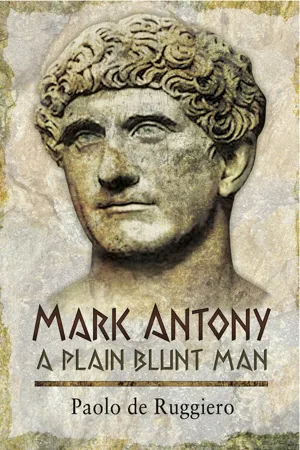
Mark Antony was embroiled in the tumultuous events of the mid-1st century BC, which saw the violent transformation from the Roman Republic to the Roman Empire. After being defeated by Augustus he has often been characterized by hostile historians as a loyal henchman of his uncle Julius Caesar but without the guile and vision to attain greatness in his own right (hence Shakespeare casts him as a 'plain, blunt man' whom Caesar's assassins don't think it worthwhile to kill). In his infamous alliance and love affair with Cleopatra of Egypt he is also often seen as duped and manipulated by a sharper mind. Despite this there is no doubt Antony was a capable soldier. He first saw action leading a cavalry unit in Judaea, before giving valuable service to Julius Caesar in Gaul. He again served with distinction and led Caesar's right wing at the climactic battle of Pharsalus, and he was decisive in the defeat of the conspirators at Philippi which ended 100 years of Civil wars. But Paolo de Ruggiero re-assesses this pivotal figure, analyses the arguments of his many detractors, and concludes that he was much more than a simple soldier, revealing a more complex and significant man, and a decisive agent of change with a precise political vision for the Roman world.
Information
Chapter One
The Making of a Roman Hero
Marcus Antonius (Antony or Mark Antony hereafter) was born to a distinguished yet plebeian family, on an unknown date that general consensus places in 83 BC. In Rome, at that time, the distinction between patricians (families constituting the historical nobility) and plebeians (all others) did not necessarily indicate a particular level of wealth or privilege, but rather served purpose only to demonstrate access to public offices, such as the tribunatus plebis or tribunate of the plebs, the magistracy in charge of defending the interests of the lower class, or other largely symbolic legacies of the old days when Republican Rome had faced class struggle.
The Antonii did not sport a cognomen, the given name that, if it stuck with the person, passed from generation to generation and ended up identifying a branch in a large clan’s (or gens) family tree. With little imagination, the first born family members were mostly – or all – called by the praenom Mark, and their nomen, Antony. Whereas the praenom served the same purpose that it does in today’s society, the nomen identified the clan or gens to which the person belonged, and the cognomen further distinguished lineage within a clan as it branched out, whether it was attributed by merit, anecdotes, or because it pointed to physical characteristics of a family member. Romans wore their cognomen with great pride, no matter how obscure its origins or how odd its meaning.
For example, the Claudii’s two main branches went either as Claudius Pulcher (pretty or handsome) or, in the case of the branch that became the imperial clan, Claudius Nero (most likely “brave” although the exact translation is still not sure). The nose of Marcus Tullius Cicero (chick pea) was not marked by any wart or excrescence of sorts, but most likely that of one of his ancestors was. Caesar, a name that was to become a synonym for absolute rule, is probably a derivation from the Punic word for “elephant”, since an ancestor of Gaius Julius fought at the Trasimene battle and allegedly killed or wounded one of Hannibal’s pachyderms. Less originally, a long list can be made with the various “red beard”, “blue eyed”, “the quick”, “the slow”, “the farmer”, “big nose”, and so forth, not to mention all the cognomen that we cannot easily interpret because of their origins in Etruscan or some other provincial, or indeed even foreign, language.
For an especially distinguished individual, a fourth part – the agnomen – could be added to the name. Ultra-conservative political leader Lucius Cornelius Sulla (Sulla) thanked the Gods his way, and attributed to himself the indicative of Felix, “the fortunate one” or “the one favoured by the Gods”, after a life exposed to peril but crowned by great success, to indicate the Gods’ favour to his cause. Later in this work there will be more examples of Roman onomatology. As the clans grew, and new branches could make their individual claim to fame, full names became longer.

The Roman world in 44 BC
The Antonii, however, in spite of their very respectable lineage, sadly never did manage to add that third name to their business card.
Nor did they ever pretend to descend from divinity, a claim which was not ridiculed in Rome, as long as it was made by senior leaders. The Julii boasted direct descent from Venus. The Pompeys asserted their origins from Hercules, which was considered to be a lesser deal, as it was well known that Hercules never did abide by the laws of Lykurgos, was somewhat of a ladies’ man, with the result that his progeny was scattered all over the Earth, and so subsequently many could claim to be related to the famous hero without surprising anyone.
In a show of originality, Antony’s first biographer Plutarch has them descend from Anton, a son of Hercules himself, of whom nobody else had ever heard. Neither did anybody in the clan, as far as we know, ever claim family ties with the promiscuous mythological hero. But Plutarch probably saw a good character fit in many ways and ventured the association. Rather, we know that later in his life Antony welcomed or even encouraged some association with another God, Dionysos, but we know that it was for contextual reasons and as part of a specific propaganda project, as we shall see in Chapters 6–8. The association also fitted his late lifestyle preferences, and it might have been a way to ridicule other high profile deifications, including Julius Caesar himself and its reflection upon his adoptive son Octavian. All other godlike symbolism stems only from his association with Cleopatra and Egyptian court tradition.
If the Antonii never found a true family cognomen that stuck with them, and the first born had invariably Marcus for a given name,1 their contemporaries and historiography at large had to find ways to distinguish them, which is why Mark Antony’s grandfather Marcus Antonius is commonly referred to as Marcus Antonius Orator (MA Orator hereafter).
MA Orator’s two sons (Marcus and Gaius) both earned nicknames which they gladly would have done without. The older one was referred to as Creticus, for having suffered a tough defeat at the hands of the pirates, who backed the hostile King Mithridathes of Pontus, and who he was supposed to destroy in the waters of Crete. Giving him this name was a cruel mockery, as places or people names would be given to generals that had won a war and subjugated a nation. For example Emperor Trajan was called Dacicus and Particus when he beat the Dacians and the Parthians (modern day Rumanians and Iranians), and the Senate gave Emperor Claudius the name of Britannicus when Britannia was ably conquered and subdued.
Unfortunately for our man, “the Conqueror of Crete” did not carry the same panache, as everyone knew that he had to make a financial arrangement with the Cretese in order to take the remainder of his fleet back after being routed. Furthermore, translating literally from Latin, Creticus also can mean “man of clay” or “man of chalk”, thus making the mockery double edged and even crueller.
The second born, Gaius, was called Hybrida (half-beast) behind his back, supposedly for the various atrocities that he had committed against the Greek population as he plundered the land during the Mithridatic war, when he served under Sulla as a cavalry commander. And, unluckily and maybe undeservedly for them, his two daughters, both called Antonia, found themselves referred to as Antoniae Hybridae – something that might have cooled off more than one suitor.
It is important that we resist the temptation to plunge directly into Mark Antony’s life without considering the wider context around the two preceding generations of his family because, as we will see, his heritage of family allegiances and feuds played a fundamental role in the making of Antony’s destiny.
So, let’s take a step back to the year 99 BC, which marks the first (and only) consulship of MA Orator, grandfather of our protagonist Mark Antony.
Oratory was a big deal in ancient Rome and in the classic world at large. It was considered almost a prerogative of the upper classes, and especially cultivated in a certain intellectual milieu, notably the famous “Scipionic Circle”, under the patronage of the prominent Scipio family, who had given Rome the conquerors of Carthage, and a tradition of leadership that had lasted for over a century.
MA Orator’s rhetorical skills must have been of the highest grade. His style was that of the so called Asian school, which called for a more ornate and flamboyant delivery. At the other end of the spectrum was the so called Attic style, simple, concise, and unequivocal. It seems Julius Caesar, a powerful public speaker, was an attic speaker, which was akin to his writing style: logical, consequential, with a few sudden surges of energy and punch, but without ever getting carried away in emotional or otherwise spectacular speeches. The most famous public speaker of Roman antiquity, Marcus Tullius Cicero (Cicero), is associated with the Rhodiensis school, from the island of Rhodes, which was a happy compromise between the two, crisp and clear but with some changes of pace, inflammatory highs, and the introduction of more elaborate imaging. Considerations of style, however, did not get in the way of Cicero’s appreciation of true excellence: his De Oratore is dedicated to Quintus Hortensius Hortalus (Hortensius), who was the most important representative of the Asian school at their time, and MA Orator is one of the protagonists of the essay, which follows the characteristic format of an imaginary dialogue between contemporary and non-contemporary characters.
MA Orator was not only an esteemed public speaker and admired member of Rome’s cultural scene: his career led him to cover all the main Republican offices, from praetorship2 all the way to consulship3 and onwards to censorship.4 He even marked some successes in naval warfare, as he fought the Mediterranean pirates. He must have fared better than his son Creticus later did, and obtained a victory of some scale, if the Senate awarded him the rare honour of a Naval Triumph. As far as more traditional campaigning is concerned, we know that he fought in the Social Wars, which, as we will see, pitted Rome to the other central Italian populations, which were seeking political status and recognition, as well as a role in Roman policymaking, in return for the human capital they had invested, as allies in Rome’s foreign and domestic belligerent undertakings.
Mark Antony’s illustrious grandfather reached the height of his political career in 99 BC when he was made Consul, the summit of the Roman cursus honorum or political and military career. The contingent political situation could hardly have been more difficult.
Without ever degenerating into full armed conflict, the class struggle was still very present in Rome, only based on census rather than patrician or plebeian birth. Traditionally the two opposing factions are referred to as optimates (the landowners and senatorial establishment), and populares (working class and the other), with a third intermediate social layer called the equites or equestrians (knights, so called because in the early days of the Republic upon military levy they were called to supply an armed horseman to the republican army, as opposed to a foot legionary).
The Rome of the late Republic could only be in a state of permanent turmoil. A City-State of almost one million souls, Rome had quickly expanded to control all of the Mediterranean basin, which the Romans had taken to calling “mare nostrum”, our sea; the entire Spanish peninsula; southern France, which was referred to as Transalpine Gaul; the Tunisian tip of the Maghreb region; the Greek peninsula and the Balkans including Macedonia; most of modern day Turkey and the rest of the near east, including Syria all the way to the river Euphrates, which marked the border with the Parthian empire; and, of course, the whole of Italy. In addition, the reach of Rome’s power covered most of the other regional independent states, including Egypt, which were de facto vassals of the Republic and created a natural buffer from the outside world.
Geographic expansion had outpaced the creation of infrastructure for effective governance. One of the weak points in the organization of the State was the absence of a professional and permanent body of civil servants, or bureaucrats if the reader prefers, vital to govern the overseas territories. When a Proconsul or Propraetor (Governor) was appointed to a provincial office, he would be followed by his own staff, who would support him for the short duration of the mandate. The mechanism, designed to prevent abuse, did not foster any stability or continuity, and in some cases had the reverse effect of stimulating near sighted policies.
As the military conquests had brought a huge inflow of wealth to the State, the Romans had never bothered to develop a proper fiscal policy and taxation system. Roman citizens residing in Rome were largely exempt from taxes, while in the provinces the collection of tributes was auctioned out to independent professionals.
But other profound mutations were accentuating the mismatch between the existing institutions and the true condition of Roman society. The Rome of the early Republic had thrived on the concept of the citizen-farmer-soldier, where each and every individual was a true stakeholder in the State. Faced with a threat to the Republic, the citizen would leave his field and take up arms, to return to his property once his military duties were done. But when the scope and size of the conflicts escalated, General Gaius Marius (Marius) saw best to transform this tradition and enrol, on a permanent basis, legionaries that would be paid with cash during their service and with land at the end of their term. At the same time, the second century BC had seen the fast growth of a class of land owners who farmed the land and raised cattle and sheep on a totally different scale from the traditional family-sized enterprise, mainly with the use of the slave labour that abounded as a result of the many prisoners of war captured and brought back after one conflict or another. These two effects combined put huge pressure on traditional rural society, and many families started migrating to the city to constitute an underprivileged urban proletariat, constantly struggling to make a living in overcrowded slums, incurring substantial debt from ruthless and usury uncontrolled moneylenders, and well positioned as a reservoir for insurrectional or at least rioting hands, over the basics of land and debt. At the other end of the social spectrum, the landowners and the nobility thrived in this polarized society, and in time were able to consolidate power thanks to an elitist Senate and Tribunes of the plebs left toothless by conservative policies.
The bloodstains of the Gracchi brothers, populist leaders killed by their optimates opponents a few years apart from each other, during riots over the land distribution agenda, were still fresh. In the last decade of the second century BC a certain Thorius tried to introduce some form of real estate tax for the benefit of the urban masses, but the attempt fell through and the situation returned to where it had been two decades earlier. At this particular time, the agitator on duty on the side of the populares was an Appuleius Saturninus, who had a dubious sidekick named Glaucia. They enjoyed the backing of Marius, the populist general, who had a coarse style but an impressive military resume, and was at the end of his sixth consular mandate. The senatorial establishment and the optimates fielded Quintus Caecilius Metellus, a man of noble family origins and high standards. Metellus was politically outmanoeuvred and forced into exile, leaving Appuleius and Glaucia in charge. When it became clear that the second Consul elect, who was to be MA Orator’s partner, was not going to be Glaucia, Appuleius armed a mob with clubs and knives and marched through town, to make the point that oratory was not the only means to move forward a political career.
They did indeed find a solution for the electoral rivalry: they sought out the other candidate, and clubbed him to death on the spot. It seems that public opinion forced Marius to react against his own political faction, given the blatancy of the illegal action. What happened next is a famous page of Roman history: after a brief siege and capture on the Capitol, rather than kill the rogues on the spot, Marius locked them in the courtyard of the Senate house. Exhausted by the constant fighting and intolerant of the prospect of more street combat, the populace took the matter into its own hands by climbing on the roof and hurling tiles onto the captives, until they were dead.
This was the situation in Rome when MA Orator was called to co-hold executive power as a Consul.5 This is clearly a testament to his balance, wisdom, and moral strength. He received what a rugby man would call a hospital pass, and signed up for the job.
But the civil strife over land distribution was not the only source of instability with which Republican Rome had to contend. The various Italian populations which, over the decades, had helped Rome establish itself in Italy and in the Mediterranean, were increasingly vocal about their subordinate status under Roman rule, and were demanding full Roman citizenship, political rights, and more clout in Rome’s political agenda in return for their past and present military allegiance. This soon led to a bloody war between the Italian League and the Romans, known as the Social War. During this period, the intestine struggle was not centre stage, but it was almost certainly an issue nonetheless. The populares leader, Marius, was fighting the Italian tribesmen, and then took sick for a while, while the optimates strongman Sulla was besieging the cities of Samnium, but the axe between the two was all but buried. And the career of MA Orator continued, this time as Censor. This was an extremely delicate role, in so much as it was the gatekeeper of the Senate in terms of extending or denying senatorial seats. Judging from the outcomes a few years later, we can only doubt that he took advantage of the position to make friends in the opposite political faction. The civil struggle was about to degenerate from city alley riots into fully-fledged war, with opposing Roman armies faced in pitched battles.
The catalyst for the outburst was the high profile ruler Mithridates VI, King of Ponthus, a small state in modern day northern Turkey. Mithridates was a decisive and ambitious man, but also cr...
Table of contents
- Cover
- Dedication
- Title Page
- Copyright
- Contents
- List of Maps
- List of Plates
- Introduction
- Chapter 1: The Making of a Roman Hero
- Chapter 2: East!
- Chapter 3: The Civil War
- Chapter 4: Enemy of the State
- Chapter 5: Triumvir
- Chapter 6: Prince of the East
- Chapter 7: The New Alexander
- Chapter 8: The End of the New Dionysos
- Chapter 9: The Aftermath, the Offspring, and the Legacy
- Bibliography
- Notes
Trusted by 375,005 students
Access to over 1.5 million titles for a fair monthly price.
Study more efficiently using our study tools.
Frequently asked questions
Yes, you can cancel anytime from the Subscription tab in your account settings on the Perlego website. Your subscription will stay active until the end of your current billing period. Learn how to cancel your subscription
No, books cannot be downloaded as external files, such as PDFs, for use outside of Perlego. However, you can download books within the Perlego app for offline reading on mobile or tablet. Learn how to download books offline
Perlego offers two plans: Essential and Complete
- Essential is ideal for learners and professionals who enjoy exploring a wide range of subjects. Access the Essential Library with 800,000+ trusted titles and best-sellers across business, personal growth, and the humanities. Includes unlimited reading time and Standard Read Aloud voice.
- Complete: Perfect for advanced learners and researchers needing full, unrestricted access. Unlock 1.5M+ books across hundreds of subjects, including academic and specialized titles. The Complete Plan also includes advanced features like Premium Read Aloud and Research Assistant.
We are an online textbook subscription service, where you can get access to an entire online library for less than the price of a single book per month. With over 1.5 million books across 990+ topics, we’ve got you covered! Learn about our mission
Look out for the read-aloud symbol on your next book to see if you can listen to it. The read-aloud tool reads text aloud for you, highlighting the text as it is being read. You can pause it, speed it up and slow it down. Learn more about Read Aloud
Yes! You can use the Perlego app on both iOS and Android devices to read anytime, anywhere — even offline. Perfect for commutes or when you’re on the go.
Please note we cannot support devices running on iOS 13 and Android 7 or earlier. Learn more about using the app
Please note we cannot support devices running on iOS 13 and Android 7 or earlier. Learn more about using the app
Yes, you can access Mark Antony by Paolo de Ruggiero in PDF and/or ePUB format, as well as other popular books in History & Military Biographies. We have over 1.5 million books available in our catalogue for you to explore.