A military logistics expert analyzes the detailed coordination employed by the British during the Falklands War in 1982.
While many books have been written on the Falklands War, this is the first to focus on the vital aspect of logistics. The challenges were huge: the lack of preparation time, the urgency, the huge distances involved, and the need to requisition ships from trade to name but four.
After a brief discussion of events leading to Argentina's invasion, the book details the rush to re-organize and deploy forces, dispatch a large task force, the innovative solutions needed to sustain the task force, the vital staging base at Ascension Island, the in-theatre resupply, the set-backs, and finally the restoring of order after victory.
Had the logistics plan failed, victory would have been impossible and humiliation inevitable, with no food for the troops, no ammunition for the guns, no medical support for casualties, etc.
The lessons learned have never been more important with increasing numbers of out-of-area operations required in remote trouble spots at short notice. The Falklands experience is crucial for the education of new generations of military planners and fascinating for military buffs, and this book fills an important gap.
"With inadequate training, little intelligence, no contingency plan, a politically driven rush and at 8,000 miles, it is not surprising that logistics during Op CORPORATE were confusing and challenging. It has taken a US Army general to explain why. We should all be grateful." —Michael Clapp, Commander Amphibious Task Force
"A timely book that explores the logistical challenges of projecting decisive combat power across transoceanic distances." —
Marine Corps Gazette
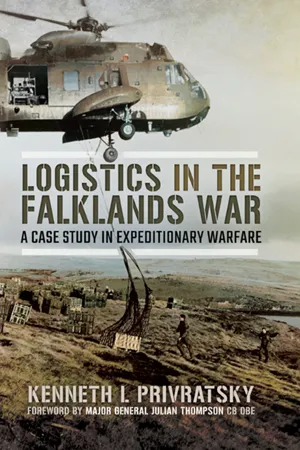
eBook - ePub
Logistics in the Falklands War
A Case Study in Expeditionary Warfare
- 256 pages
- English
- ePUB (mobile friendly)
- Available on iOS & Android
eBook - ePub
About this book
Information
Chapter 1
Prelude to War
On 28 March 1982, an Argentine naval task force left its base at Puerto Belgrano, about 300 miles south of Buenos Aires, allegedly to take part in a joint exercise with Uruguay. Few Argentines noticed. Most were more concerned about the sad state of affairs in their country: high unemployment, annual inflation exceeding 100 per cent and a repressive new military Junta led by General now President Leopoldo Galtieri, the latest in a series of military dictators who had suppressed and often brutalized the population. These successive regimes had imprisoned, tortured, or murdered an estimated 30,000 journalists, union workers, students, academics, and others who voiced contrary opinions, including some foreigners. There had been demonstrations recently on streets of Buenos Aires. If the general public had noticed the task force heading toward the Atlantic, they might have sensed something of importance, particularly if they considered that the ships were supposed to be joining a naval exercise focused on anti-submarine warfare procedures (as the exercise had been billed). For the composition of the task force leaving Puerto Belgrano that day hardly fitted the role of training for such procedures. Rather, it consisted of an aircraft carrier, two destroyers, three frigates, an icebreaker, a tanker, and an amphibious landing ship. On board was a marine battalion augmented by platoons of infantry. Inside the tank landing ship were sixteen amphibious, tracked landing craft. An Argentine submarine waited for them below the surface further out at sea. Together they comprised Task Force 40. Those on board were not thinking of a joint exercise with Uruguay but set on executing Operation Azul (‘blue’) to retake the Falkland Islands. In its planning stages, the operation had taken the name Operation Rosario (‘rosary’). Now that execution was underway, the name had changed to Azul to signify the blue robe of the Virgin Mary, in what one historian believes was an effort to compare the impending invasion to a semi-religious crusade.1 The people of Argentina could have been as passionate about their country’s sovereign rights to the Malvinas, their name for the Falklands, as they were about their religion.
By 1 April the Argentine naval task force had arrived off the coast of the main islands. Had they seen the ships that evening, British inhabitants on East Falkland might have regarded their presence as some type of April Fools Day joke. They did not, however, and the task force was anything but a hoax. Falklanders went to bed that night as free people loyal to Britain. Much to their dismay, to that of countrymen and relatives in Britain and also to the rest of the world, they awoke the next morning to find themselves captives of Argentina. The following day, Argentine forces overpowered another small group of Royal Marines on the island of South Georgia further out in the Atlantic. The streets of Buenos Aires filled again with citizens, this time not protesting about dire economic conditions but cheering that their country’s flag finally was waving over their Malvinas.
When word of the invasion hit news channels around the world, it is doubtful that many outside the immediate area even knew of the archipelago in the South Atlantic called the Falklands. It consists of hundreds of small islands starting 350 miles off the present coastline of Argentina and extending nearly three times further out into the Atlantic with the islands of South Georgia and South Sandwich. The primary islands of East and West Falkland provide the name for the whole archipelago, as well as homes and livelihood for the vast majority of residents. In 1982, the total population was about 1,850, with 1,200 concentrated around the capital of Stanley on East Falkland. The few hundred others lived in settlements scattered about the islands, where life went on largely out of touch with the rest of the world. There was no road network over the treeless, boggy terrain. Communication was limited to short-wave radio transmissions. Residents sometimes lived their whole lives in isolated settlements. It was a tough environment inhabited by penguins, sea lions, about a half a million sheep, and the world’s largest population of black-browed albatrosses.
Life in the Falklands would not appeal to many. There was no private industry after whaling stations on outer islands closed earlier in the twentieth century. Most residents had become employees of British companies exploiting resources on the islands over the years, had taken employment with the British government or now just raised sheep in the settlements. Inhabitants owed both their way of life and much of their livelihood to continued British sovereignty. They often withstood brutal conditions in the winter months as gale force winds buffeted coastlines. Those winters normally started in June.
Falklanders, however, were proud of their surroundings and content with their lifestyle. They were not pleased in the least when Argentines hoisted their flag over Stanley that morning. And although the invasion might have surprised them and countless others around the world, it remained the result of decades of frustration brought to a head by both desperation and missed or confused signals. Britain never anticipated that those frustrations had deepened so much that Argentina would invade. It did not realize that its decreasing interest in the Falklands and planned cuts in military capability would actually be another cause of the invasion, even as intelligence started revealing such a possibility. And Argentina never believed that the British would develop sufficient resolve to respond. It doubted British capability to wage war that far from their homeland given the immense logistics difficulties of doing so. Even senior government officials in Britain doubted their country’s ability to project power into the southern hemisphere and then sustain it logistically over such vast distances. Both countries would learn they were wrong.
Britain and Argentina had been on a collision course over this group of islands for about 150 years. British sea captain John Davis discovered the islands on 14 August 1592, but the first recorded landing was not until 1690, also by the British. They named the channel between the two principal islands Falkland Sound in honour of the Treasurer of the Navy, Viscount Falkland. The bordering islands would later take on the names of East and West Falkland. Over the years following the first landing, the islands would see Spanish, French and Dutch occupants as well as British, and they would assume various names, including Las Malvinas for the Spanish. The Spaniards forced out the British in 1769, but the British returned in 1833, expelled some of the settlers and then proceeded to maintain a continuous presence. At the time, the area had become an important foothold for protection of British shipping interests. Cape Horn, at the tip of South America, cornered the busiest trading routes in the world. Hundreds if not thousands of ships transited these treacherous waters between Europe, the Far East and both sides of North America each year as they moved everything from food and spices to furs and gold. The Falklands offered one of the few places where ships could receive some service, supply and medical care. Over a century later, with the rise in Argentina of Colonel Juan Peron, a fascist dictator who took power after a coup, ownership of the islands came into dispute. Britain proposed at one point that the International Court of Justice at The Hague hear claims from the two countries. Argentina refused.
In more recent years, the two countries had cooperated in limited ways to improve services for East Falkland. They reached agreement in the early 1970s for Argentina to operate a weekly air service to Stanley as a convenience to both countries and to install fuel tanks on the island to sustain the service and also supply residents. The British had agreed to assist in building an airstrip on the outskirts of Stanley and to establish a sea service from the Argentine mainland. Neither happened. Eventually, Britain coordinated a plan for the United States to provide steel matting for an airfield, and Argentina constructed the airfield using this material without further British assistance. The British even permitted Argentina to institute procedures for white travel cards to circumvent the need for passports for Falkland Islanders and Argentines flying between Argentina and the islands. Some Argentines had become residents of Stanley; a few were teaching Spanish to students. And yet talks remained at a standstill regarding transfer of sovereignty. It is not difficult to understand why Argentine angst was increasing in the second half of the twentieth century. Discussions had occurred between the two countries about a possible leaseback arrangement of the islands to Argentina, but the Islanders remained entrenched in their desire to maintain ties with Britain, even though they were not granted British citizenship. Argentina was getting tired of what it perceived to be half-baked answers over sovereignty.
Argentina was not misinterpreting the appearance of diminishing British interest in the Falklands. That decline was a fact, part of an overall decision to reduce overseas commitments. With the opening of the Panama Canal in 1914, the strategic importance of the islands had declined as shipping lanes shifted toward Central America. In the mid 1970s, Lord Edward Shackleton, son of the famed British explorer of Antarctica, developed an extensive report for Parliament, which recommended bolstering British investment to exploit Falkland resources ranging from seaweed and fisheries to oil. His report fell on deaf ears. Meanwhile, economic pressures were mounting in Britain to reduce military budgets and commitments around the world. The Falklands seemed to some to be a very expensive obligation and thus a likely opportunity for savings. A platoon of Royal Marines was stationed at Stanley, as well as a small Royal Navy vessel, the HMS Endurance. Their presence posed little threat to any credible military force. Consequently, midway through 1981, British Secretary of Defence John Nott signed the order to retire the Endurance by the end of 1982 without replacement. That order was not a secret. Nor was the fact that retirement of Endurance would terminate British naval presence in the area. The closest British military base to the Falklands was 5,000 miles away in Belize; it was simply a training area, hardly capable of projecting any meaningful response if something happened in the Falklands. The British mainland was a whopping 8,000 miles away, three weeks sailing time in the best of weather. Proximity clearly worked in favour of Argentina. Secretary Nott himself believed the time had come to rethink British commitment to the Falklands. He had recently joined with other key Cabinet members to support a proposal to negotiate a long-term lease of the Falkland Islands to Argentina, but the ‘proposal had been sabotaged by a cross-party alliance in the House of Commons’.2
Such was the situation when Galtieri assumed leadership of the new military Junta in Buenos Aires in late 1981. Frustrated with lack of British resolve to take sovereignty negotiations seriously, and seeing signs of a diminishing overall commitment to the islands, the Junta declared that 1983 would be ‘the year of the Malvinas’, 150 years since the British had established their presence on East Falkland. The Junta probably was bolstered to some extent by the successful occupation by Argentine scientists of Thule in the British South Sandwich Islands in 1976, which had provoked concerns in Britain but no actual response. Now, on 15 December, Admiral Jorge Anaya, Commander-in-Chief of the Argentine Navy and ardent proponent of Argentine rights to the Falklands, attended a change of command ceremony at Puerto Belgrano for Vice Admiral Juan Lombardo, the new Chief of Naval Operations. As head of the Navy, Anaya had spearheaded large procurements of ships, planes, helicopters and other military equipment in the late 1970s, significantly enhancing Argentine military prowess and probably contributing significantly to the economic problems now plaguing his country. After the ceremony, Anaya met with Lombardo privately and instructed him to prepare a plan to take control of the Falklands. Anaya stressed that this was contingency planning only and that Lombardo should work secretly with his flag-level counterparts in other military services. He advised Lombardo that the Junta was looking to select an option and execute if necessary before the end of 1982. By then the British vessel Endurance would be gone, and the Argentine military would be in receipt of additional French Super Etendard aircraft and Exocet missiles, significantly bolstering its air combat and overall defence capabilities.3
The next month, the Junta formalized their intention in National Strategy Directive 1/82, declaring:
The Military Committee, faced with the evident and repeated lack of progress in the negotiations with Great Britain to obtain recognition of our sovereignty over the Malvinas, Georgias and South Sandwich Islands; convinced that the prolongation of the situation affects national honor, the full exercise of sovereignty and the exploration of resources, has resolved, to analyse the possibility of the use of military power to obtain the political objective. This resolution must be kept in strict secrecy and should be circulated only to the heads of the respective military departments.4
On 24 January, an Argentine journalist writing in La Prensa stated, ‘a military attempt to resolve the dispute cannot be ruled out when sovereignty is at stake.’5A month later, Argentine marines were already practising amphibious landings in Patagonia.
Galtieri and his Junta were confident that Britain would not have the political will or the overall ability to respond to the invasion. There were no indications of strong British resolve to demonstrate otherwise. They were well aware that Britain had been taking steps to downsize its force projection capability. The logistics challenges of getting a credible force 8,000 miles south simply seemed insurmountable, particularly since the notoriously rough South Atlantic winter would arrive by June. The last time Britain had tried to project its power was during the Suez crisis in the 1950s; and that deployment had proven disastrous for the proud Brits. The Falklands were much further away than the eastern Mediterranean. Mounting and sailing a large force such a vast distance with winter only a few months away, overcoming Argentine defences, simply executing an amphibious assault against a larger, established defensive force, and sustaining forces both at sea and on land for weeks and most likely months – all of it just seemed like a bridge too far. Moreover, if Argentines controlled the sea and air sufficiently to attack ships and interdict supply lines around the Falklands, they could make the position untenable for the British. Argentina was bargaining on the belief that the British would be intimidated by the many challenges of regaining the Falklands and that an Argentine invasion would compel earnest negotiations between the two countries, eventually producing a change in sovereignty of the islands. With a quick surprise invasion, it also hoped to avoid casualties to the Royal Marine garrison and civilians, perhaps garnering greater support in the United Nations.
In Britain, information started circulating about Argentina’s emerging bellicosity. It did not gain much attention from the government, though, until early March when Prime Minister Margaret Thatcher received information about articles circulating in the Argentine press. On 3 March, she told her advisers, ‘we must make contingency plans’,6 although she was not expecting any plan to include a full-scale British invasion to regain the islands. By then Argentine planning was well underway. The Junta received the first draft of its invasion plan a week later on 9 March and advised military service chiefs to continue their focus for execution toward the end of the year.7
The catalyst hardening resolve of both the Argentines and British occurred over the next two weeks on the island of South Georgia, 900 miles out in the Atlantic from East Falkland and a dependency of the Falklands. It was a rugged place, uninhabited except for its famous three-foot tall King Penguins and some British scientists surveying Antarctica on a seasonal basis. Responsibility for affairs there rested with the Governor of the Falklands, who resided in the capital, Stanley, on East Falkland. Visitors to South Georgia were supposed to report in at Grytviken to the manager of the British Antarctic Survey Party team, which served as a representative of the Governor and controlled access to the island.
Many years before, South Georgia had been a home of sorts for whalers. Several dilapidated whaling stations from decades past remained. In the late 1970s, British owners of these stations had granted a contract to an Argentine metal merchant named Constantino Davidoff to dismantle them. That contract prohibited Davidoff from taking any weapons ashore or harming wildlife. Travelling to South Georgia to conduct dismantling work also required prior coordination with and approval by the British Embassy in Buenos Aires. Davidoff had visited scrap sites on South Georgia to assess the situation in December 1981 without proper documentation or even checking in with the manager at Grytviken, thereby creating a minor diplomatic storm. He was now planning to send a party of workers to start dismantling the stations. Davidoff visited the British Embassy in Buenos Aires to get paperwork for travelling to work sites on South Georgia. He even hoped to secure passage for his workforce on the British vessel Endurance stationed at Stanley. The Embassy was not immediately responsive, however, indicating they needed to coordinate further with the Governor of the Falklands, Rex Hunt. The impatient Davidoff proceeded to make his own arrangements regardless of whether he had approval to go to South Georgia. He chartered the Argentine naval support vessel Bahia Buen Suceso and set off anyway without proper authorization, in what some believe was deliberate collaboration with Argentina’s military to put some forces on South Georgia as a follow-up test of British resolve after the occupation of Thule Island six years before. If that was the case, the results were not the same. On 19 March, British Antarctic survey scientists in the area reported that Davidoff’s party had landed at Leith. The incursion might have faded into memory with little more than another diplomatic rebuke. Unfortunately, upon arrival the Davi...
Table of contents
- Cover
- Dedication
- Title Page
- Copyright
- Contents
- Foreword
- Preface
- Acknowledgements
- Glossary of Terms and Acronyms
- Maps
- Chapter 1: Prelude to War
- Chapter 2: Mobilization and Deployment
- Chapter 3: Initial Planning and Preparation at Sea
- Chapter 4: Support Operations at Ascension Island
- Photo Gallery 1
- Chapter 5: Final Preparation for the Amphibious Assault
- Chapter 6: D-Day and the Struggle to Build up Logistics
- Chapter 7: The Breakout and Fight for Goose Green
- Chapter 8: More Forces and Challenges
- Photo Gallery 2
- Chapter 9: Problems at Fitzroy
- Chapter 10: The Battle for Mountains Surrounding Stanley
- Chapter 11: After the Surrender
- Chapter 12: A Reflection on the British Experience
- Notes
- Bibliography
Trusted by 375,005 students
Access to over 1.5 million titles for a fair monthly price.
Study more efficiently using our study tools.
Frequently asked questions
Yes, you can cancel anytime from the Subscription tab in your account settings on the Perlego website. Your subscription will stay active until the end of your current billing period. Learn how to cancel your subscription
No, books cannot be downloaded as external files, such as PDFs, for use outside of Perlego. However, you can download books within the Perlego app for offline reading on mobile or tablet. Learn how to download books offline
Perlego offers two plans: Essential and Complete
- Essential is ideal for learners and professionals who enjoy exploring a wide range of subjects. Access the Essential Library with 800,000+ trusted titles and best-sellers across business, personal growth, and the humanities. Includes unlimited reading time and Standard Read Aloud voice.
- Complete: Perfect for advanced learners and researchers needing full, unrestricted access. Unlock 1.5M+ books across hundreds of subjects, including academic and specialized titles. The Complete Plan also includes advanced features like Premium Read Aloud and Research Assistant.
We are an online textbook subscription service, where you can get access to an entire online library for less than the price of a single book per month. With over 1.5 million books across 990+ topics, we’ve got you covered! Learn about our mission
Look out for the read-aloud symbol on your next book to see if you can listen to it. The read-aloud tool reads text aloud for you, highlighting the text as it is being read. You can pause it, speed it up and slow it down. Learn more about Read Aloud
Yes! You can use the Perlego app on both iOS and Android devices to read anytime, anywhere — even offline. Perfect for commutes or when you’re on the go.
Please note we cannot support devices running on iOS 13 and Android 7 or earlier. Learn more about using the app
Please note we cannot support devices running on iOS 13 and Android 7 or earlier. Learn more about using the app
Yes, you can access Logistics in the Falklands War by Kenneth L. Privratsky in PDF and/or ePUB format, as well as other popular books in History & Latin American & Caribbean History. We have over 1.5 million books available in our catalogue for you to explore.