- 264 pages
- English
- ePUB (mobile friendly)
- Available on iOS & Android
eBook - ePub
About this book
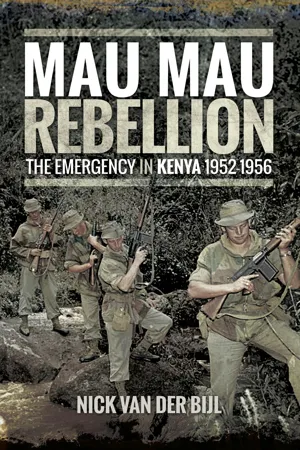
In The Mau Mau Rebellion, the author describes the background to and the course of a short but brutal late colonial campaign in Kenya. The Mau Mau, a violent and secretive Kikuyu society, aimed to restore the proud tribes pre-colonial superiority and rule. The 1940s saw initial targeting of Africans working for the colonial government and by 1952 the situation had deteriorated so badly that a State of Emergency was declared. The plan for mass arrests leaked and many leaders and supporters escaped to the bush where the gangs formed a military structure. Brutal attacks on both whites and loyal natives caused morale problems and local police and military were overwhelmed. Reinforcements were called in, and harsh measures including mass deportation, protected camps, fines, confiscation of property and extreme intelligence gathering employed were employed. War crimes were committed by both sides.As this well researched book demonstrates the campaign was ultimately successful militarily, politically the dye was cast and paradoxically colonial rule gave way to independence in 1956.
Information
Chapter 1
British East Africa
Zanzibar soon became such a thriving port and trading post that the British, French, Germans and Americans opened consulates. Elsewhere, Afrikaner farmers spreading north to escape British influence in South Africa came into conflict with the Zulus. Intrusion by imperialist explorers and earnest Christian missionaries clashed with African cultures and began to threaten the equilibrium of the vast emptiness of Africa, occupied by millions of animals, birds, reptiles and isolated indigenous tribes. The people living in the area around Mt Kenya were receptive to the ‘red men’, as they nicknamed Europeans, and their technological magic, but were far less impressed with the idea that their Ngai should be replaced by an invisible god. Nevertheless, those who recognised that reading, writing and arithmetic were worth practising professed to follow Christianity in order to learn and were persuaded to be baptised, attend church and take communion. But this came at a cost, as fathers often disinherited such sons.
Among the missionary-explorers was Dr David Livingstone, a Scottish Congregationalist who had offered his medical qualifications to the London Missionary Society. His exploration of eastern Africa and his crusade against the slave trade led to his becoming a Victorian hero, with his clarion call that Africa be redeemed by Commerce, Civilization and Christianity. When sixteen European countries agreed to carve up Africa at the 1884/85 Berlin Conference, they imposed their rule on millions of bewildered Africans in an unsavoury process that became known as the ‘Scramble for Africa’. One of the four agreed General Principles of the Conference was: ‘To watch over the preservation of the native tribes and to care for the improvements of the conditions of their moral well-being.’ Moral well-being meant Christianity.
Another principle was that no signatory could retain a sphere of interest unless it had established ‘effective occupation’ by a settlement, a garrison or an administrative function. When Great Britain and Germany, the belligerent new boy on the imperial block, agreed to share East Africa in 1886, five German warships trained their guns on the palace of the Sultan in Zanzibar and invited him to surrender his territories. On advice from London, the British consul recommended that he did so. Within the year, Germany had occupied what became German East Africa (now Tanzania). The British Government delegated responsibility for its own ‘effective occupation’ to Sir William MacKinnon, a Scottish ship-builder and, as was customary, issued him with a Royal Charter to form the Imperial British East Africa Company (IBEAC) with its head office in Mombasa. The Sultan was left a 10-mile-wide coastal strip. A year later, MacKinnon leased the strip from the him.
When hostilities broke out between Muslims, Protestants and Catholics in Kampala in Buganda (now Uganda), the IBEAC intervened. Meanwhile, Mackinnon’s dreams of constructing a railway inland foundered when differences within the company jeopardized investment, and he was relegated to developing a 600-mile ox track from Mombasa north-west to Busia on the Bugandan border. Although the Berlin Conference had agreed that Buganda was within the British sphere of influence, Dr Karl Peters, an ultra-imperialist in German East Africa, recognized that its occupation was key to German expansion and claimed that since Buganda lay beyond Lake Victoria, it was therefore outside the British boundary. In 1890, he persuaded its king to accept German protection, but Captain Frederick Lugard (East Norfolks), who had led an expedition of Somali and Sudanese soldiers against Arab slavers in Nyasaland, persuaded the king to a cede Buganda to Britain. London then offered Berlin the tiny island of Heligoland off the German coast, which had been a British possession since 1814, in return for recognizing the settlements of Zanzibar, Buganda and Equatoria (now South Sudan) as British. Germany accepted, and converted Heligoland into a useful naval base.
Meanwhile, two Royal Engineers, Captains James Macdonald and Wallace Pringle, had surveyed the Arab caravan track between 1891 and 1892 and concluded that a railway could be built 1,000 miles from Mombasa to Buganda, thereby opening up Central Africa to exploitation. When Lugard was instructed to build a string of forts along the route, one person he contacted was Chief Waiyaki wa Hinga, a respected Kikuyu chief whose first contact with Europeans had been with two Germans accompanied by a notorious Arab slaver. These forts were usually oblong and defended by a ditch, barbed wire, a palisade of stakes and two drawbridges. Inside were brick living quarters for the Europeans and African huts of grass, mud and wattle. Most were built near rivers and streams. In spite of misgivings from his fellow chiefs, Waiyaki saw benefit in establishing a relationship with Lugard and, entering into a blood-brotherhood treaty, gave him a plot of land on the forest edge near Gataguriti (later known as Dagoretti) in Kikuyuland. Lugard then departed, leaving a 30-strong garrison commanded by an officer named Wilson with instructions not to compromise Waiyaki’s power by taking land or property.
As detailed surveys began, Lugard returned to Kikuyuland to find that Kikuyu hostility had forced Wilson to abandon Fort Dagoretti; his force had been unable to prevent the Kikuyu harassing the caravans. The fort itself had been looted and burnt and a steel boat destined for Uganda stolen. Helped by men from the fort at Machakos and some Maasai, in a first act of confiscation Wilson had fined the Kikuyu fifty goats daily and instructed them to find 300 men to rebuild a new fort. Wilson was replaced by Captain Eric Smith, who had lost an eye and an arm while serving in the Life Guards and was now organizing the convoys. Waiyaki returned some of the property looted from the fort, but Smith incensed the Kikuyu by arbitrarily pitching the new Fort Smith in Waiyaki’s homestead in a place rejected by Lugard, completing it in mid-1892. Angry at this trespass, Waiyaki threatened to flatten the fort. Tension increased when several Kikuyu ambushed an ally of the Company. Since British retaliation was inevitable, Waiyaki retreated with his people and livestock to their ancestral refuges in the forest of the Aberdares.
Smith then undermined the relationship that Wilson had developed with the Maasai by attacking them, which led to retaliatory assaults on caravans in which about forty IBEAC employees were killed. Captain W.P. Purkiss, a former sailor with a talent for bricklaying, was appointed as Superintendent, Kikuyu Province, and while Smith dealt with the Maasai, he led an expedition against the Kikuyu that involved burning homesteads and shooting scores of spear-carrying men. During negotiations with Waiyaki at Fort Smith, both men became involved in a brawl which ended with Waiyaki being concussed and either being locked up in a room or handcuffed and chained by the neck to the fort flagstaff. Convicted in court the next day, he was exiled permanently ‘from the country, where he had proved such a treacherous enemy, and the cause of so much bloodshed’. Waiyaki rejected rescue and was quoted as saying, ‘You must never surrender one inch of our soil to the foreigners, for if you do so, future children will die of starvation’. Next day, 17 August 1892, as he was being marched to Nairobi, he died from the complications of his wounds. Some suggest that Purkiss had him eliminated and then buried upside down in Kibwezi, something which was considered sacrilegious by the Kikuyu.
Mutual understanding had been undermined by imperialist arrogance. The garrison left the fort only to raid homesteads for food and cattle to feed the IBEAC. In 1893 Captain Francis Hall (Bengal Native Infantry) arrived to command Fort Smith and further undermined the treaty with punitive raids against the Kikuyu that included confiscating 180,000 livestock. On occasion, he leaked warnings about the raids; nevertheless, he wrote to his father that the only way to deal with the Kikuyu was wipe them out ! except that they provided food for his soldiers. His letters are among the earliest records of life in British East Africa. He died from blackwater fever aged forty in 1901.
In 1894 East Africa was swamped by epidemics such as smallpox, locust plagues stripping fields and rinderpest decimating thousands of wild and domestic animals. The Maasai lost 90 per cent of their cattle. The Kikuyu abandoned their homesteads for the Aberdares. Meanwhile, as financial and managerial incompetence led to the British Government disbanding the IBEAC, from it emerged, on 1 July 1895, the Protectorate of British East Africa, to be governed by a Commissioner appointed by the Colonial Office. Within the year, the building of the railway from Mombasa to Kampala was approved, as a strategic response to Italian and French threats from the east and north and Belgian incursions from the west. Mr George Whitehouse, the Chief Engineer and Manager of the Uganda Railway, his British managers and technicians and the first of 32,000 Indian labourers and clerks recruited under terms and conditions agreed by the British and Indian governments, arrived. The small port of Mombasa soon swelled in importance as ships sailing though the Suez Canal arrived with steel and other equipment.
In January 1901 Sir Charles Eliot arrived as the second Commissioner. The author of books on Finnish grammar and the history and philosophy of the Ottoman Empire, he opposed violence and big game hunting, which was becoming a popular pastime for wealthy Europeans. Between 1900 and 1906, John Ainsworth, an administrator, converted the one-street tented encampment centred around a waterhole known to the Maasai as Enkare Nairobi (place of cool waters) into a seven-district town divided by blue gum trees that became known as Nairobi. The Europeans lived on the high ground while the Indians assembled as traders and businessmen in the Bazaar. The African communities were to the east and in the village of Kileleshwa. Attributing the completion of the Uganda Railway to British pluck, while professing he had no idea why it was built, Eliot wrote in his 1905 Report on the East Africa Protectorate that it had opened up a civilized territory and a possible residence for Europeans. After leaving Mombasa, the line ran through luxuriant coastal vegetation, climbed to a plateau of thorny scrub before again climbing through rolling countryside to Nairobi and thence through cultivated fields to Kikuyuland. The line then descended rapidly to the Mau Escarpment, where it perched on ledges alongside the Rift Valley, crossing ravines on twenty-seven viaducts, and then dropped to Naivasha before heading north to Nakuru. Rain, late deliveries, bridge-building, man-eating lions near Tsavo, derailments, theft of copper telegraph wire, bolts and rivets by the Nandi people for ornamental purposes and inaccurate financial assessments led to the railway terminating in 1902 at Kisamu (Milestone 584), which was renamed Port Florence in honour of Whitehouse’s wife. A branch line was later built through Kikuyuland to Nanyuki.
Eliot launched a campaign in South Africa to encourage emigration on the promise of abundant land, high yields and cheap labour to grow tea, coffee, maize and wheat. When London proposed in 1902 that Jews be given a homeland in the Central Highlands, a settler named Ewart Grogan escorted a Zionist Congress commission; however, he presented them with a poor case by camping on a track used by elephants, then entering an area frequented by lions and Maasai warriors. Between 1897 and 1900 Grogan was the first man to walk from Cape Town to Cairo in order to prove to his prospective father-in-law that he had the character to marry his daughter. Generally, the response from Great Britain was small, with only 2,800 people arriving between 1903 and 1905; but those who emigrated were mostly from upper class families, including about 200 acquaintances of Lord Delamere. Most retained the Edwardian clothes they had worn at home and were determined that British East Africa would become a white colony like South Africa, Canada, New Zealand and Australia. The Rt Hon. Hugh Cholmondeley, 3rd Baron Delamere, was a descendant of Prime Minister Sir Horace Walpole and owned a large estate in Cheshire. Born in 1870, he first visited Africa in 1891; while hunting lion in British Somaliland he had been mauled by one, leaving him with a limp. He is credited with coining the term ‘white hunter’. In 1896 he arrived at the head of a large caravan after a long safari across desert and semi-arid country from Somaliland, then crossed the empty, rolling and lush slopes temporarily abandoned by the Kikuyu, not dissimilar to the Wiltshire Downs, bathed in an ideal climate and too high for malaria-carrying mosquitoes. His first land application in May 1903 was rejected by Eliot on the grounds the land was too far from any population centres. His second application, for land near Lake Naivasha, was rejected on the grounds that it might cause friction with the Maasai. His third application, in 1906, saw him given a long lease on 100,000 acres near Gilgil on the shores of the picturesque Lake Elementaita near Njoro; the estate later became known as Soysambu. Briefly returning to Great Britain, he married Lady Florence Anne Cole, from a privileged Anglo-Irish family; the rigours of a pioneering life in a mud and grass hut with no close neighbours, while her husband was colony building, would be a far cry from a mansion in Ulster.
Among the Christian missionaries in the territory were Harry and Mary Leakey, at the Katebe Mission near Nairobi. One of their children, Louis Seymour Bazett, was born in 1903 and grew up among the Kikuyu. Indeed, aged thirteen, he was initiated into the tribe. The parents of Arundell Gray Leakey arrived in 1906 to help build the church at Kabete and lived on a farm five miles from Nyeri on the slopes on Mount Kenya. Arundell was also accepted into the Kikuyu as a ‘blood brother’, spoke their language fluently and was known as murungaru (‘tall, straight’ in Swahili). The Leakeys became a well-known Kenyan family. As the epidemics faded, the Kikuyu emerged from the forests to find that their arable and grazing lands had been grabbed by several hundred white people waving 999-year Crown leases. Kikuyu culture prohibited the permanent alienation of land to non-tribe members, but the Kikuyu had been weakened by the epidemics and were unable to do anything except watch as their tribal lands were converted into farms split by barbed wire fences. This fertile region soon became known as the White Highlands. Waiyaki had been right. Kikuyu resentment simmered, and as their livelihoods and traditions were destroyed by the necessity to find work as labourers, farm hands and maids, they retaliated. Meanwhile, the Maasai occupying the fertile land around Naivasha and Nakuruwere arbitrarily moved into two reserves, one in the highlands of Laikipia, north-west of Mt Kenya, and the other on the arid plains near the border with German East Africa; a treaty specified that the land was theirs ‘so long as the Maasai as a race shall exist’. The illiterate chiefs signed with their thumbprints, but settlers quickly began agitating for the lush land in Laikipia.
By 1 January 1902 the War Office had amalgamated the several regiments in East Africa into the King’s African Rifles (KAR) of 1st and 2nd (Nyasaland), 4th (Uganda), 3rd and 5th (Kenya) and 6th (Somaliland) Battalions, with an initial establishment of 104 British officers seconded from the British Army and 4,579 other ranks. Between 1902 and 1920 4 KAR was engaged in a campaign fighting Sayyid Mohammed Abdullah Hassan, the ‘Mad Mullah’, whose revolt threatened to destabilize the Horn of Africa. During the year, Kikuyu resistance reached such a peak that troops were sent to restore order. Captain Richard Meinertzhagen (Royal Fusiliers) serving with 3 KAR in 1903 focused on the confiscation of livestock but he also retaliated for the murder of a settler with the slaughter of an entire homestead, apart from the children sheltering in the forest. In a punitive expedition against Kikuyu and Embu homesteads, about 1,500 Africans were killed and 11,000 animals confiscated, at the cost of three soldiers killed and thirtythree wounded. Pangas and bows and arrows were no match for rifles and Maxim machine guns. When Meinertzhagen was implicated in the killing of a spiritual leader that led to peace negotiations, he successfully orchestrated a cover-up. The death of an American Quaker, allegedly caused by Nandi ambushing caravans, raiding settlements and stealing wire and other metals from the railway, led to Meinertzhagen’s troops killing all the adults involved. However, the War Office had become sufficiently concerned about him that he was recalled by his regiment. In 1904 he wrote, ‘I am convinced that in the end, the African will win.’ Nevertheless, he had spilt as much human blood as he had in shooting animals for sport.
Eliot resigned in 1905 after refusing to give two South Africans of the East Africa Syndicate 500 square miles of land between Ol Kalou and Ol Bolossat, pledged to them by Foreign Secretary Lord Lansdowne on unduly advantageous terms. The Syndicate was a company associated with IBEAC. Among the most successful settlers were Afrikaners, who arrived in 1903 to escape the depression of the two Boer states after their surrender in 1902. Thirty-three families trekked north to German East Africa but when they found its brand of colonialism far more rigorous than what they had practised, they headed north to British East Africa and settled beyond Thomson’s Falls, north of the Aberadares. Major Robert Foran, one of the first six European officers in the British East Africa Police, wrote of them:
They were an exceptional stamp of colonist, accustomed to giving and taking hard knocks in life. Even better still, they had mostly farmed in southern Africa and fully understood the handling of native African peoples.
Ten months later, the Protectorate passed under the control of the Colonial Office, the Commissioner was retitled ‘Governor’ and the Executive Council, entirely composed of settlers, moved from Mombasa to Nairobi. Among its members was Delamere as President of the Colonists’ Association. The settlers were also heavily represented in the Legislative Council. Delamere experimented with imported sheep, cattle and crops and battled against disease and crop failure until, in 1914, he succeeded with maize and saw his profits rise. In 1906, Eliot wrote an interesting report on British East Africa in which he compared its colonization with that of Uganda:
[Uganda] is adapted to be a black man’s country, like other African colonies. But in the East African Protectorate, the case is different. The native population is very small; only two districts (Kairondo and Kikuyu) can be said to be thickly populated; large areas are uninhabited, and those areas, with others, are climatically and otherwise suited to European colonisation. In other words, the interior of the Protectorate is a white man’s country. This being so, I think it is mere hypocrisy not to admit that white interest should be paramount, and that the main object of our policy and legislation should be to found a white colony.
He insisted that while there should be no violence against the Africans, European settlers must help to develop the land ‘for the benefit of mankind’ and that the nomadic tribes be prevented from monopolizing land for which they had no real use. Kikuyuland had a climate and country suitable for European settlement, and there was a sufficient native population available for labour. However, he also predicted that the Kikuyu would resist. A believer in the Victorian ideology of a ‘moral duty to civilize the resident population’ by conversion to Christianity and sure that the working class should be docile and compliant, he dismissed concerns that the British had no...
Table of contents
- Cover
- Title
- Copyright
- Contents
- Preface and Acknowledgements
- Maps
- Introduction
- Chapter 1 – British East Africa
- Chapter 2 – The Colonization of Kenya
- Chapter 3 – The Emergence of the Mau Mau
- Chapter 4 – Declaration of the Emergency
- Chapter 5 – The Crisis Deepens
- Chapter 6 – The Military Response
- Chapter 7 – Brigade Operations June/July 1953
- Chapter 8 – Consolidation 1953
- Chapter 9 – Opening the Offensive 1954
- Chapter 10 – The Initiative Seized
- Chapter 11 – The Defeat of Mau Mau 1955
- Chapter 12 – Mopping Up and Independence
- Conclusion
- Appendix A Order of Battle
- Appendix B Casualties
- Glossary
- Bibliography
- Plate section
Trusted by 375,005 students
Access to over 1.5 million titles for a fair monthly price.
Study more efficiently using our study tools.
Frequently asked questions
Yes, you can cancel anytime from the Subscription tab in your account settings on the Perlego website. Your subscription will stay active until the end of your current billing period. Learn how to cancel your subscription
No, books cannot be downloaded as external files, such as PDFs, for use outside of Perlego. However, you can download books within the Perlego app for offline reading on mobile or tablet. Learn how to download books offline
We are an online textbook subscription service, where you can get access to an entire online library for less than the price of a single book per month. With over 1.5 million books across 990+ topics, we’ve got you covered! Learn about our mission
Look out for the read-aloud symbol on your next book to see if you can listen to it. The read-aloud tool reads text aloud for you, highlighting the text as it is being read. You can pause it, speed it up and slow it down. Learn more about Read Aloud
Yes! You can use the Perlego app on both iOS and Android devices to read anytime, anywhere — even offline. Perfect for commutes or when you’re on the go.
Please note we cannot support devices running on iOS 13 and Android 7 or earlier. Learn more about using the app
Please note we cannot support devices running on iOS 13 and Android 7 or earlier. Learn more about using the app
Yes, you can access Mau Mau Rebellion by Nicholas van der Bijl in PDF and/or ePUB format, as well as other popular books in History & African History. We have over 1.5 million books available in our catalogue for you to explore.