eBook - ePub
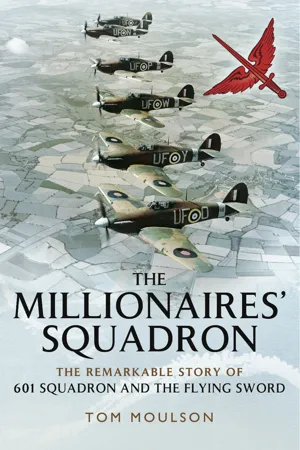
The Millionaires' Squadron
The Remarkable Story of 601 Squadron and the Flying Sword
- 256 pages
- English
- ePUB (mobile friendly)
- Available on iOS & Android
eBook - ePub
About this book
Imagined by an aristocrat in White's Club, London in 1925, a part-time squadron of wealthy young men with their own private aircraft was incorporated into a newly-established combat-ready Auxiliary Air Force, first as bombers, then fighters. The pre-war years combined serious training with frivolity and mischief, but the outbreak of war in 1939 changed that. Despite their social rank the pilots were thrust into the heart of the action, with mortality proving to be the great social leveler. From privileged pre-war lifestyles to front line deployment the lives of those who survived underwent radical change. Through the battles of Britain, Malta, the African desert and Italy the squadron's composition was transformed, and by war's end only a minority were British and none were millionaires. Britain had changed too, and the re-formed squadron filled with a combination of veterans and young middle-class ex-service pilots. The pilots flew Hurricanes in the Battle of Britain, and Spitfires thereafter until the arrival of jets in the '50s; DH Vampires and Gloster Meteors. The one aircraft they could not master was the little-loved mid-engine P-39 Bell Airacobra in 1941. Disbandment in 1957 of the by-then 'Royal' Auxiliary Air Force was fiercely resisted, but inevitable.Originally published in 1964 to great acclaim, this second edition features a wealth of brand new content in the form of newly uncovered documentation and photo illustrations. It is set to bring the story of this eccentric and dynamic squadron to a whole new audience of aviation and military enthusiasts.As seen in the Western Morning News and Epping Forest Guardian.
Information
Chapter 1
The Spirit of Grosvenor
We’ll surprise you yet!
Lord Edward Grosvenor, 1924
The east side of St James’s Street, Mayfair, is lined with handsome Edwardian buildings whose facades have barely changed since the nineteenth century when they were the town houses or homes of English nobility. James Lock & Co., the bespoke hatter, towards the south end, still possesses the design hand-drawn by Horatio Nelson for his famous admiral’s hat, and two doors further down is John Lobb the Bootmaker, which can show you the lasts made for the feet of Queen Victoria and King George V. Near the north end and close to Piccadilly stands No. 37, White’s Club, or simply White’s. A former gambling den where two members once bet £3,000, a fourtune in the early nineteenth century, on which of two raindrops would reach the bottom of a window first, it is still what it always was: an exclusive club for very rich gentlemen who make the selection cut, part of that cut being staunchly Tory, or today Conservative. The most exclusive gentleman’s club in London, White’s members have included The Prince of Wales, later Edward VII; Lord Rothschild the banker; Evelyn Waugh the writer; Oswald Mosley the British fascist; and Beau Brummell the fop. They also included Lord Edward Arthur Grosvenor, creator of No. 601 Squadron and known by his friends as ‘Ned’.
Grosvenor was an eccentric, but a lovable one. He would mount the steps to the club briskly, hand his silver-topped cane, a symbol of class and authority, to the porter and announce his arrival with the call ‘Hick-boo’, which nobody ever seemed to understand. He would settle into a seat, order a brandy, and talk. He would talk about aeroplanes. About flying. About a phenomenon that would have been incomprehensible to everyone a generation ago.
Grosvenor was born in 1892, the son of the first Duke of Westminster, with a family name redolent of London streets, squares, and parks his ancestors had owned and developed. He was a physically impressive man of thirty-two, six-feet-two and strongly built, powerful in personality. From the outset of his life Grosvenor was an adventurer. After leaving Eton he served in the French Foreign Legion, probably a unique distinction for a member of the English aristocracy. When the excitement he sought eluded him in the desert of North Africa he bought himself out of the Legion and returned to England where, for perhaps the last time in his life, he followed the convention of his class by joining the Royal Horse Guards.
But Grosvenor felt something was missing. When he was nine years old an event six thousand miles away had stunned the world and thrilled young Ned. On a windswept beach on the outer banks of North Carolina’s Atlantic coast the Wright brothers Orville and Wilbur succeeded in demonstrating the possibility of powered, controlled flight, in an ungainly biplane design with a horizontal stabiliser at the front and two pusher propellers behind the prone pilot, connected by chain drive to the engine, and with skids in place of wheels. Already balloons had carried people up and over great distances, but they were not flown; they couldn’t be tacked against the wind or turned at the direction of the pilot. The Wright brothers proved that a heavier-than-air machine could be lifted from the ground and controlled through all three axes. This was incredible enough. But a mere six years later and closer to home the French aviator Louis Blériot stirred as much alarm as admiration when he crossed the English Channel from Calais to Dover in an aeroplane of his own design, winning a Daily Mail prize of £1,000. Now, it dawned on Britain, she was vulnerable to attack and even invasion by continental enemies. What had been dismissed as nightmare fantasy was now real, the possible would quickly become normal, and in a very few years the military value of aeroplanes would be beyond question.
Grosvenor realised this threat at the same time as he felt the siren call of aviation. Blériot was made, and as soon as he was able to turn out his monoplanes in any number Grosvenor bought two of them and learned to fly at Brooklands race track at Weybridge, Surrey, obtaining Certificate No. 607 ‘without’, as the newspapers said, ‘breaking even a wire’.
Like many others Grosvenor was intoxicated by the miracle of flight in an open-cockpit stick and rudder aeroplane. He thrilled at the roar of the engine at full throttle, the sight of the ground falling away and the horizon unrolling infinitely, the fantastic downward view of earth and the tops of clouds, the exhilaration of diving and swooping like a swallow, of descending to a satisfying rumble of wheels on grass and the engine’s slowing to a ‘tecka-tecka-tecka’, a wondrous experience unimaginable throughout human history until now, all bursting into reality in his own lifetime.
He also saw beyond the fun. He remembered Blériot and what that meant. When the First World War came he gave one of his planes to the British government and flew the other to France where he offered it with himself to the Royal Naval Air Service. They taught him what they knew about military flying, which was little enough, and Grosvenor continued with his self tuition. Flight magazine reported with awe that ‘at the Blériot School at Buc, on Thursday of last week, Lord Edward Grosvenor succeeded in looping the loop, while on the following day Mr Skene also accomplished the feat. Both pilots made similar flights on Saturday’.
An experience while Grosvenor was flight commander in the RNAS that he enjoyed relating illustrates the primitive state of aviation at the time. He briefed a new pilot at Eastchurch on the south shore of the Thames Estuary, to report to his new squadron at Ostend, Belgium. The pilot could take his aircraft off and land it again in still air, but that was about the limit of his skill; he could neither read a map nor follow a compass course. Grosvenor waited for a perfectly clear, sunny day without a breath of wind, and took the fledgling by the shoulder, led him to a corner of the hangar and pointed to the east-facing Kent coast. ‘Take off that way,’ he advised, ‘that’s east, and when you reach the sea turn right. That’s south. When you get to France turn left, that’s east again, and Ostend is a little way up on your right’. The pilot walked to his plane muttering softly. An hour later, Grosvenor was called to the telephone.
‘I’m sorry’, a voice began, ‘but I must have got one of those turnings wrong and now I’m in a hell of a mess. Could somebody please come and pick up my aeroplane?’
‘Where is it?’ asked Grosvenor.
‘Ah, it seems I’m in the middle of, ah, the tramlines at Hammersmith Broadway …’
When the war ended Grosvenor helped popularise private aviation, which he thought the government was wrong in neglecting to do, and his benevolent figure in suit and cloth cap becoming a familiar sight at air races at Lympne and Croydon aerodromes. In 1923 he endowed the Grosvenor Challenge Cup, a handsome creation of the Goldsmiths and Silversmiths Company, accompanied annually by a first and second prize of a £100 and £50. Competing aircraft, engines and pilots had to be British, and companies couldn’t enter
But all the while a larger idea was forming in Grosvenor’s mind. As he assembled around him at White’s enthusiastic friends with whom he could converse about his wartime flying days, he would ponder, why shouldn’t there be a part-time air force? Loving aeroplanes more than horses, he visualised such a force as successor of the old mounted yeomanry, an elite corps composed of the kind of young men who in the past would have been interested in horses but were now attracted to flying machines, who had leisure and a thirst for adventure, and were prepared to indulge it in the service. The first obstacle, however, was that there wasn’t as yet even an air force.
In 1914 and throughout the First World War Britain’s air power was divided between the army’s Royal Flying Corps (RFC) and the Royal Naval Air Service (RNAS). After the war the idea of consolidating the two forces to reduce costs was being studied by the government, the very idea of which left the army and the navy aghast. Both spluttered that the idea of an independent air force was a fantasy, that no fighting force of any quality could be created from scratch. Senior officers of both forces looked at each other and wondered how mere operators of flying machines could be as smart and officer-like as they. But just when it seemed they would prevail and air power would remain divided, the Secretary of State for Air, Sir Samuel Hoare, pressed for a full enquiry. As a result, and largely for economic reasons, in 1918 control of air power was prised from its parents and consolidated as an independent Royal Air Force (RAF). Over this was established an Air Ministry with Lord Hugh (‘Boom’) Trenchard as its first Chief of the Air Staff (CAS).
Forever known affectionately as father of the Royal Air Force, Trenchard, a wartime RFC pilot, overcame relentless efforts by the navy and the army to dismember the new force. He went further. In a 1919 memorandum he argued for a home defence air force of both regular and non-regular squadrons, roughly two-thirds devoted to defence. Hoare, when later Lord Templetion, recalled in his work, Empire of the Air: ‘Trenchard realised that a fighting service must possess a non-regular branch with its roots firmly set in the civil life of the country.’
This was exactly what Grosvenor was asking for. He was ahead of the times, but not by much. It would take circumstances and politicians. The circumstances were the dire economic straits Britain was in after an exhausting war and with a far-flung empire to defend. The politicians were Hoare and Prime Minister Bonar Law. Neither was an air expert, but Trenchard was, and he had a respect for civilians as potential officers and artisans that seems unremarkable today. He had been impressed when after mistaking a fitter, newly inducted to the service, for a rigger, the fitter had nevertheless rigged an aircraft faultlessly by using a blueprint and common sense. He was convinced that there was ‘material’ in civil life which the air force couldn’t afford to ignore.
The citizen air force, Trenchard proposed, should be split into the Special Reserve Air Force, corresponding to the militia, and the Auxiliary or Territorial Air Force. The latter were not to be used as wastage in war, but kept in squadrons, each with a companionable mess and a distinctive life of its own – in effect its officers and men should be given the life and influence of a good regiment. Sensing the wind direction, Grosvenor hoisted his sails to catch it. He gathered his chosen few for dinner at White’s. ‘It will happen’, he assured them, ‘so let us together form the first squadron of the territorial air force,’ and it went without saying that he would command it. True, he admitted, no legislation had yet been passed; nor were there any administration, airfield, number, badge, or adoptive county, but these would all follow; the spirit of the squadron was in being. This, for all believers, was the moment of creation.
The RAF’s professional airmen looked down on the concept of a part-time air force with as much disdain as the army and navy had looked down on them. They puffed that it would be dangerous to allow purely weekend flyers to handle the supposedly complex service aircraft of the day, that the step from horses or lorries to flying machines was too great.
An election drove the Conservative Party from office and it was the short-lived Labour government of 1924 that was responsible for passing the Auxiliary Bill into law. Another election returned Hoare in 1924 and restored to him the welcome responsibility of beginning the force. Grosvenor was ebullient. Although his squadron would later embrace the happy legend that Grosvenor singly conceived and delivered the Auxiliary Air Force, obviously he didn’t. But his influence was significant. He had offered and then provided a ready-made flying unit of pilots and a commanding officer. Grosvenor never doubted that he was the Auxiliaries’ father. In his own words he had ‘sat on the doorstep of ‘‘Sammy’’ Hoare and “Boom” Trenchard’ until he had his way.
Hoare expressed his own delight by becoming the first honorary air commodore of Grosvenor’s squadron, thus giving his personal endorsement to a force which, despite initial doubts, eventually became the right hand of the regular air force. ‘The experiment’, he later recorded in Empire of the Air, ‘was successful from the beginning. So far from the non-regular units damaging the reputation of the regular squadrons they added some of the most glorious pages to the history of the Royal Air Force during the second war.’
Five squadrons were set up on a territorial basis: two in London, one in Birmingham and two in Scotland. Grosvenor took command of the 601 (County of London) unit. The county is the sprawling area we know of as London, the city of London being a tiny area within it. At the beginning there was something of an Auxiliary honeymoon as the squadrons drew together in support of their new force. Grosvenor’s reply to the still vocal critics was an angry snort and the words, ‘Just wait – we’ll surprise you yet!’
No. 601 Squadron was gazetted on 14 October 1925 and opened for business at Northolt with Grosvenor, two regular officers and twenty-one airmen. The aircraft were war-era Avro 504s, the squadron’s rôle bombing. Grosvenor’s selection criteria for officers were subtle. Owning one’s own aeroplane and knowing how to fly would be a plus, being rich was even more so, but hailing from the right social class was a requirement. That was the subtle part. The first commanders of the two flights were Robin Grosvenor, Ned’s nephew, and Bill Collett, son of the Lord Mayor of London. Nepotism and favouritism were perfectly natural, as was the assumption that only an officer could fly an aeroplane and only a gentleman could be an officer.
Grosvenor cannot be dismissed as a grandiose commander or a pleasure-seeking flyer. He realised that air fighting meant killing and, perhaps, being killed. As with all Territorials, patriotism placed at least second to esprit de corps as a motivation, and a commitment to fight for one’s country was total. During the First World War pilots carried with them a revolver, as much as anything with which to shoot themselves if plunging to earth in a bonfire of wood and fabric and dope, but also as a means of attack. Exasperated by the ineffectiveness of this, Grosvenor carried a loaded, sawn-off shotgun in his cockpit; no ordinary shotgun of course, but a bespoke model made to his specifications by J. Purdey and Sons and designed for shooting at flocks of birds.
Although the navy and army looked down on the regular RAF, the latter never suffered from lack of self-esteem. Far from it. They knew that pilots were the cream of the military because only they could fly. Anyone can stand on a ship’s deck or hold a rifle, they knew, and no doubt some sailors and soldiers had the potential to fly, but in reality they could not. Only pilots could fly, and there was no changing that. They could look down on the other services, literally from above. The Auxiliaries would adopt this self-regard and inflate it. Being from the cream of society they considered themselves double cream, as it were, and they were not bashful.
The Trenchard thesis called in the main for pilots who had no service experience. Aviation was still wondrously new, even suspect, and flying tuition was costly. The squadrons couldn’t accept officers unless they had acquired a minimum standard of competence in the air already, so the Air Ministry offered to refund an applicant’s tuition expense of £96 when he obtained an ‘A’ licence on his own account. This was the estimated average cost of the dual and solo training necessary before a pilot could be expected to handle a light aeroplane with reasonable safety. It was then up to the squadrons to elevate the new pilot to operational standard.
Each squadron had a regular service adjutant, and 601’s first was Horace George, known as ‘H. G.’ Bowen, later Air Commodore. ‘I know nothing about it,’ apologised the senior officer who was supposed to brief him. ‘You’ll have to find your own way about.’ Luckily, Bowen had known Grosvenor in France when flying with the Fifth Brigade, RFC, and respected Grosvenor. He reported at Northolt as Grosvenor’s right-hand man. He had, among his many duties, to convert the new pilots to military machines, and would give them dual instruction in the Avro 504K before letting them loose in the replacement Airco 9As, flat-nosed biplanes with 400 horsepower Liberty engines, which then seemed a great deal of power.
At the first annual training camp at Lympne airport, held in August of 1926, only four pilots had any service experience besides Grosvenor and the two regulars. The location of Lympne was very agreeable. The surrounding Kent countryside was beautiful, with the downs rising to the north and the land sloping down to Romney Marshes and the English Channel to the south. There were two local landowners. Goldenhurst Farm was owned by Noel Coward, while Porte Lympne was the seaside residence of Sir Philip Sassoon, a friend of Grosvenor’s. Both homes were permanently open to the officers.
Sassoon, a grandson of Baron Gustav de Rothschild of the Jewish Rothschild banking dynasty, a wartime second lieutenant and former member of the East Kent yeomanry, was serving as Under Secretary of State for Air. He quickly befriended the squadron, which couldn’t have had a more influential ally, and entertained its officers lavishly, so that the annual camp came to be dubbed ‘the Summer Outing of White’s Club’. The term was more than a joke since waiters from White’s would serve in the tented mess when the club was closed for the season. Sassoon wasn’t only rich but commensurately generous. His homes were in Park Lane, Mayfair; Trent Park, Hertfordshire; Poona, India; and Porte Lympne. Trent Park was a palatial dwelling in north London, on extensive grounds that had in the fourteenth century been a hunting ground of King Henry IV.
But Porte Lympe, Sassoon’s summer home, was his favourite. This was a huge and lavishly furnished historic mansion. The dining room walls were covered with rare stone, its ceiling with luminous opalescent stone, and the table was set with gilt-winged chairs and jade-green cushions, all surmounted by a frieze of scantily clad Africans. Statues of naked men in classical poses stood on plinths in the garden. While it would have been scandalous to suggest so then, the contemporary mind will have little trouble discerning the signs of a gay man.
The house, set in landscaped gardens designed by the architect Sir Herbert Baker, was a honey pot for the leading establishment and society figures of the 1920s and 1930s, including the Duke of York, England’s future king; Charlie Chaplin; Winston Churchill while a backbench MP; Anthony Eden; Sir Samuel Hoare; sundry foreign ambassadors; and T. E. Lawrence (‘of Arabia’), also known as ‘Aircraftman Shaw’, the celebrity with the lowest rank in the RAF by his own choosing. When a squadron member dined at Porte Lympne he would be among the most privileged of guests, for Sassoon’s admiration for his pilots matched his regard for anyone else. These happenings couldn’t escape the press, and it was inevitable that 601 should be tagged ‘The Millionaires’ Squadron’, a name that stuck with it forever. The regular RAF would call it ‘The Millionaires’ Mob’.
With wide terraces set in sumptuous grounds dotted with life-size bronze statues of animals and classical figures, leading down to a swimming pool and tennis courts bordered by tall juniper trees, Porte Lympne was a splendiferous paradise close to Lympne airport, where the squadron camped most summers. Whatever one might say about Porte Lympne’s Hollywood Baroque style – and behind his back many guests snickered – 601 loved it there. The officers and sometimes the NCOs and airmen came to swim, play tennis, lounge in deck chairs, dine, and rub shoulders with an eclectic assortment of VIPs from theatre, films, society, and politics. In the days of limited news, dining with Sassoon’s guests and hearing it from the top was considered learning from listening, as some officers said.
One of Grosvenor’s first tasks, into which he threw himself with diligence and pride, was to design a distinctive badge incorporating the idea of his squadron’s link with the County of London. Being a tolerable artist, he drew on the back of a large official envelope a scarlet Sword of London sprouting wings at the hilt. It was a marvellous design of unusual economy: all red and representing flight, the County of London, and perhaps bloody battle. This came to be known as The Flying Sword. Due either to an oversight or a stroke of genius Grosvenor didn’t add the customary ribbon under the crest bearing a motto. This design he sent to the Royal College of Heralds with a request that they arrange his device in a way formally acceptable to their standards. For a fee of five guineas the college made some minor alterations of an aesthetic chara...
Table of contents
- Front Cover
- Title Page
- Copyright Page
- Contents
- Acknowledgements
- Preface
- Chapter 1 The Spirit of Grosvenor
- Chapter 2 Fun and Games
- Chapter 3 Send the Children Out of the Room Now!
- Chapter 4 Ski Boots and Jackboots
- Chapter 5 Where is the RAF?
- Chapter 6 The Battle of Britain
- Chapter 7 Whitney Straight’s War
- Chapter 8 Wind the Windows Right Down
- Chapter 9 The Crucible of Malta
- Chapter 10 Twilight of the Gods
- Chapter 11 The Fate and Fame of Roger Bushell
- Chapter 12 Victory and Bankruptcy
- Chapter 13 The Lost Weekenders
- Chapter 14 Sequel
- Chapter 15 Afterword
- Bibliography
Trusted by 375,005 students
Access to over 1.5 million titles for a fair monthly price.
Study more efficiently using our study tools.
Frequently asked questions
Yes, you can cancel anytime from the Subscription tab in your account settings on the Perlego website. Your subscription will stay active until the end of your current billing period. Learn how to cancel your subscription
No, books cannot be downloaded as external files, such as PDFs, for use outside of Perlego. However, you can download books within the Perlego app for offline reading on mobile or tablet. Learn how to download books offline
Perlego offers two plans: Essential and Complete
- Essential is ideal for learners and professionals who enjoy exploring a wide range of subjects. Access the Essential Library with 800,000+ trusted titles and best-sellers across business, personal growth, and the humanities. Includes unlimited reading time and Standard Read Aloud voice.
- Complete: Perfect for advanced learners and researchers needing full, unrestricted access. Unlock 1.5M+ books across hundreds of subjects, including academic and specialized titles. The Complete Plan also includes advanced features like Premium Read Aloud and Research Assistant.
We are an online textbook subscription service, where you can get access to an entire online library for less than the price of a single book per month. With over 1.5 million books across 990+ topics, we’ve got you covered! Learn about our mission
Look out for the read-aloud symbol on your next book to see if you can listen to it. The read-aloud tool reads text aloud for you, highlighting the text as it is being read. You can pause it, speed it up and slow it down. Learn more about Read Aloud
Yes! You can use the Perlego app on both iOS and Android devices to read anytime, anywhere — even offline. Perfect for commutes or when you’re on the go.
Please note we cannot support devices running on iOS 13 and Android 7 or earlier. Learn more about using the app
Please note we cannot support devices running on iOS 13 and Android 7 or earlier. Learn more about using the app
Yes, you can access The Millionaires' Squadron by Tom Moulson in PDF and/or ePUB format, as well as other popular books in History & Military & Maritime History. We have over 1.5 million books available in our catalogue for you to explore.