- 264 pages
- English
- ePUB (mobile friendly)
- Available on iOS & Android
eBook - ePub
About this book
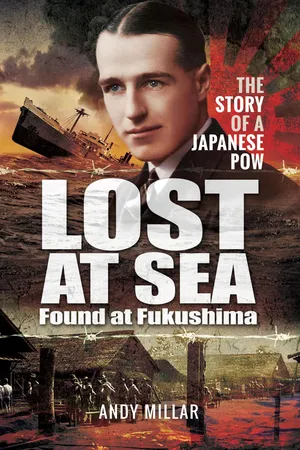
On a calm, tropical afternoon in the South Atlantic Ocean in April 1942, a British tramp steamer, the SS Willesden, was shelled, torpedoed and sunk by a German raider, the KMS Thor. The Willesden was carrying 47 officers and crew, and a cargo of vital war supplies destined for Britains 8th Army in North Africa. Five of Willesdens crew were killed in the attack. Among the survivors was Second Mate David Millar, who along with his crewmen was rescued by the Germans and interned on a succession of prison ships, before being handed over to the Japanese. Badly wounded, David spent the rest of the war as a POW in a camp at Fukushima, north of Tokyo.The Thor was also responsible for sinking two other steamers, the SS Kirkpool and SS Nankin. Their survivors, including 38 women and children, were dispatched to the same POW camp.What is remarkable about this story, apart from its inherent drama, is that these civilian POWs numbering more than 130 in all were officially listed as Missing at Sea: their presence in the camp remained a closely guarded secret. This meant that it was many months in some cases, years before the fog of mystery surrounding their disappearance lifted, and family and friends knew whether their loved ones were dead or alive. Lost at Sea tells the little-known story of these survivors. It is a tale of honour between enemy naval commanders; of suffering, courage and endurance, as months of imprisonment turned to years; and of the powerful relationships that form when people are forced together in life-threatening circumstances. Greatly enhancing the poignancy of this story is the fact that David Millar was the authors father.
Trusted by 375,005 students
Access to over 1.5 million titles for a fair monthly price.
Study more efficiently using our study tools.
Information
PART I
CAPTURE
November 1941– April 1942
DEN HELDER – NETHERLANDS
1530 hours, Friday 28 November 1941
‘Leinen los!’
Oberleutnant zur See Karl Mueller, Commanding Officer of Schnellboot S-52, gave the order to cast off.
The last lines tethering the E-Boat to the pier at the Squadron’s base, near the entrance to the Waddenzee, splashed into the water and were quickly recovered by the small party of sailors on the dock. The little ship backed away into the main shipping channel and her sister ships, S-51 and S-64, took up their positions in line astern. They were stationed approximately half a cable’s length (90 metres) apart for the passage through the shoals out into the North Sea.
As they passed the outer channel marker, Mueller, who was the senior Commanding Officer of the three, glanced astern to ensure that S-51 and S-64 were keeping station. He grunted with satisfaction. S-52 rose and twisted gently in the light northerly swell. Mueller reached out and eased the main throttles forward. The response from the three powerful Daimler-Benz diesels was virtually instantaneous. The little ship surged forward, alive and eager, throwing up a cockscomb of boiling white water in her wake.
The three E-Boats were part of the 4th Schnellboot Squadron, under the command of Kapitänleutnant Baetge of the German Kriegsmarine (Navy). Their mission was to lay mines northwest of Cromer off the English Norfolk Coast, then attack British shipping in that area as the opportunity presented.
An almost stationary, intense, low pressure system over Iceland created a stiff south-westerly breeze, whipping up whitecaps that slapped against the boat’s hull. At the pre-sailing briefing, the Squadron Met. Officer had advised that an associated frontal system was crossing the Irish Sea and would bring deteriorating weather, with the wind veering to the west and freshening to Gale Force 8. This would almost certainly bring squalls and driving rain to the E-Boats’ planned operations area within 24 hours. Visibility during the day was expected to be 10 miles, dropping to 2 miles or less in heavy rain. Already, the towering foulweather cumulus was building to the west; a warning of the worsening conditions to come.
Mueller was grateful for his heavy fisherman’s sweater, thick flannel trousers and warm socks, thrust deep into his seaman’s leather boots, but he still needed the warmth of his reefer jacket and his black fisherman’s knitted bonnet, to keep out the biting cold of the late November afternoon.
S-52 and her sister ships belonged to the early series of E-Boat. They first entered Kriegsmarine service in 1935. At 80 tons and 32 metres in length, they had a maximum speed of 35 knots in a light to moderate sea. Powerfully armed for their size, the boats each carried four 533-mm torpedoes, their primary offensive armament, a 20-mm anti-aircraft gun mounted aft and two heavy machine guns. Each boat was also capable of carrying up to ten mines.

Muriel Millar 1937.
The reliability of the torpedoes was Mueller’s greatest concern. They were the recently introduced G7-e electric torpedoes that had a designed range of 5000 metres at 30 knots. They could be fitted with either magnetic or contact pistols but the magnetic variants had proved so unreliable that Mueller had insisted the Armament Depot provide him only with weapons designed to explode on impact. Even so, these torpedoes had an annoying tendency to run up to 2 metres below the set depth and would often pass directly under the target without detonating.
As the grey afternoon light merged into the gathering dusk, there was one last but essential task to be completed before settling down for the passage westward to the English coast. Mueller reached for the klaxon and pressed it twice, firmly, at the same time switching on the boat’s tannoy broadcast system.
‘Hands to action stations! Hands to action stations!’
There was a clatter of feet over the wooden deck as officers and men raced to man their battle stations. Guns were cleared away and readied for firing. The torpedo tubes were manned and all electrical circuits checked and tested. Hatches clanged shut and were fully clipped to achieve maximum watertight integrity throughout the boat. The Chief Coxswain, having taken over the helm, glanced at Mueller and, after receiving a nod of approval, eased the throttles forward to Höchstgrenze (maximum). S-52 leapt forward like a greyhound leaving the starting gate, her powerful diesels whining as they reached their maximum operating R.P.M. Mueller clicked the stopwatch he held in his right hand as his Executive Officer reached the conning position from the main deck in two quick strides, saluting smartly.
‘Boat closed up and ready for action, Herr Kapitän,’ he reported. ‘Permission to proof fire all guns?’
Mueller glanced at the stop watch. ‘One minute twelve seconds. Not bad,’ he replied, ‘but we will have to do better if we’re to survive this war. Carry on and proof fire the weapons.’
The staccato rat-tat-tat of automatic gunfire proved all guns were functioning correctly, and the ready-use lockers near each gun were checked to ensure there was sufficient ammunition close at hand for the operations ahead. With checks completed, S-52 and her consorts reduced speed, prior to settling into their normal state of readiness for wartime patrol operations. Mueller ordered the two outboard engines shut down. Alone, the third engine maintained a cruising speed of 12 knots, which conserved fuel and minimised their wake. At this speed it would take the E-Boats 12 hours to reach their operating area, where the shoal waters of Outer Dowsing and the Haisborough Sands would force enemy coastal shipping into the restricted waterway known as ‘The Wold’, a favourite E-Boat hunting ground. Earlier in the day a Junkers high-level reconnaissance aircraft had reported that a British north-bound convoy appeared to be forming in the proximity of Southend, but the aircraft had been driven off by a patrolling Hurricane before further intelligence could be obtained.
Mueller ordered course to take the boats north of the Brown Ridge shoals and bring them to the Norfolk coast in the vicinity of Lowestoft before first light. Hopefully, they would have time to lay their mines and still be in position to intercept the British convoy, should it exist, some time on the 30th. A British defensive minefield, approximately 10 miles wide and 10 miles off the coast, stretched in an unbroken line from the Straits of Dover to the Orkneys in the north. It did not present a problem for the shallow drafted E-Boats; they would pass safely over the British moored mines.
Mueller took a final all-round look through his night-vision binoculars, before going below to eat and rest, leaving instructions to be called immediately should any contact be sighted or anything untoward occur.
ENGLISH COAST OFF HARWICH
2330 hours, Saturday 29 November 1941
David Millar, First Mate of the tramp steamer Empire Newcomen, was cold. Despite the heavy duffle-coat buttoned to the neck, his thick seaman’s clothing and rubber half-wellingtons, after three and a half hours as officer-of-the-watch on the open bridge, the biting wind was having an effect. He was looking forward to the warmth of his bunk, in his cabin three decks below. He sipped gingerly at the steaming mug of Ki which he cradled in his woollen gloved hands, and grunted as the scalding chocolate singed his throat and stomach. He checked the deck-watch in the dim lighting that illuminated the chart table and noted with satisfaction that the watch-on-deck would soon be calling his relief. The Third Mate normally kept the midnight to 0400 watch. Just time for David to fix the ship’s position and carry out the final zig for the watch. The next turn was scheduled to occur in 12 minutes.

David was a fine looking man, 5 ft 10 inches in his socks and weighing 154 lbs. He had a fair complexion and kindly blue-green eyes highlighted by dark brows. His fine dark hair was generally parted in the middle and brushed flat-back in the fashion of the time. At thirty, he was strong and totally confident, although two years of war in the North Atlantic had left its mark; he had an air of sadness that was impossible to hide.
David had been born in the family home in King Edward Street, Alexandria, Scotland on 24 October 1911. At the time his father, also David, was foreman in the finishing department of the Argyle Motor Company at their Alexandria Works. David’s father married Margaret Ferguson in 1907. They had three children: Flora, the eldest, was born in 1909, David in 1911 and Fergus in 1917. Following World War I, the family moved to St Andrews, where David’s father took a position with Messrs Wm Johnston, motor hirers.
David’s parents were staunch Scottish Presbyterians and his father was an elder in the local parish church. Although David never openly rebelled against them, the atmosphere at home was often difficult and the strict discipline and moral values that their beliefs imposed upon David were instrumental in his determination to leave the family home as soon as he was able, and pursue a life at sea.
David was educated at Madras College, St Andrews, where he displayed no particular aptitudes other than a certain skill in mathematics. From there, on 21 June 1928, with the very lukewarm support of his parents, he was indentured as an apprentice in the British Merchant Navy with Watts, Watts & Company Limited. His passion for a life at sea was not born of any wish to serve his country as much as a burning desire to travel, and to be free of restrictive parental discipline.
David completed his apprenticeship in June 1932 ‘to the entire satisfaction of this Company’ and served across the world in a number of the company’s ships until the outbreak of World War II.
In 1936 David joined the Star of Alexandria in Barry, South Wales, where he met and married Beatrice Muriel Roscoe. Their eldest son, Donald, was born later that same year, and their second son, Andrew, arrived on 30 August 1939, four days before the outbreak of the war with Germany.
David was philosophical about Britain’s entry to the war. He saw it neither as an adventure nor an opportunity, but simply as a job to be done – and felt a desire to play his part to the extent he was able. He was aware of the dangers and accepted that each time he put to sea there was a good chance he would not return but he was able to push such thoughts to the back of his mind – most of the time.
Before joining the Empire Newcomen on 28 November David served on a number of the Company’s ships plying the North Atlantic to Halifax, Nova Scotia, and participating in Arctic convoys to Murmansk and Archangel, high within Russia’s Arctic Circle. He was acquainted with appalling weather and the horrors of war at sea as, time and again, he witnessed the destruction of ships and men at the hands of Germany’s submarine wolf packs and Luftwaffe dive bombers, as they desperately tried to stra...
Table of contents
- Cover
- Title
- Copyright
- CONTENTS
- Preface
- Part I Capture
- Part II Prisoner of the Germans
- Part III Internment in Japan
- Part IV Homeward Bound
- Aftermath
- Appendix 1 Personal thoughts of Madeline Charnaud
- Appendix 2 Fukushima Camp Rules
- Appendix 3 The Fukushima List of Prisoners of War
- Endnote
- Glossary
- Bibliography
Frequently asked questions
Yes, you can cancel anytime from the Subscription tab in your account settings on the Perlego website. Your subscription will stay active until the end of your current billing period. Learn how to cancel your subscription
No, books cannot be downloaded as external files, such as PDFs, for use outside of Perlego. However, you can download books within the Perlego app for offline reading on mobile or tablet. Learn how to download books offline
Perlego offers two plans: Essential and Complete
- Essential is ideal for learners and professionals who enjoy exploring a wide range of subjects. Access the Essential Library with 800,000+ trusted titles and best-sellers across business, personal growth, and the humanities. Includes unlimited reading time and Standard Read Aloud voice.
- Complete: Perfect for advanced learners and researchers needing full, unrestricted access. Unlock 1.5M+ books across hundreds of subjects, including academic and specialized titles. The Complete Plan also includes advanced features like Premium Read Aloud and Research Assistant.
We are an online textbook subscription service, where you can get access to an entire online library for less than the price of a single book per month. With over 1.5 million books across 990+ topics, we’ve got you covered! Learn about our mission
Look out for the read-aloud symbol on your next book to see if you can listen to it. The read-aloud tool reads text aloud for you, highlighting the text as it is being read. You can pause it, speed it up and slow it down. Learn more about Read Aloud
Yes! You can use the Perlego app on both iOS and Android devices to read anytime, anywhere — even offline. Perfect for commutes or when you’re on the go.
Please note we cannot support devices running on iOS 13 and Android 7 or earlier. Learn more about using the app
Please note we cannot support devices running on iOS 13 and Android 7 or earlier. Learn more about using the app
Yes, you can access Lost at Sea Found at Fukushima by Andy Millar in PDF and/or ePUB format, as well as other popular books in History & Military & Maritime History. We have over 1.5 million books available in our catalogue for you to explore.