A real-life World War II tale of survival and perseverance against overwhelming odds from the international bestselling author of
Passport to Oblivion.
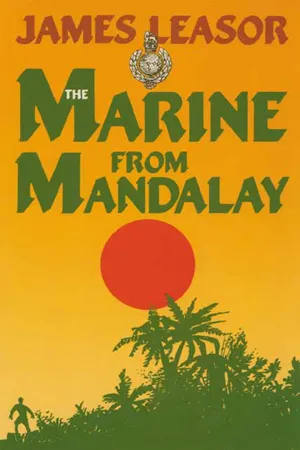
This is the true story of William Doyle, a Royal Marine wounded by shrapnel in Mandalay who undergoes a long solitary march through the whole of Burma to flee the Japanese. He then finds his way back through India and back to Britain to report for duty in Plymouth. On his way Doyle has many encounters and adventures and helps British and Indian refugees. He also has to overcome complete disbelief that a single man could walk out of Burma with nothing but his orders—to report to HQ—and his initiative.
- 146 pages
- English
- ePUB (mobile friendly)
- Available on iOS & Android
eBook - ePub
The Marine from Mandalay
About this book
Information
THE MARINE FROM MANDALAY
________________________
WILLIAM DOYLE WAS dreaming. He moved weightlessly, at ease, without care, in that happy half-lit hinterland between sleep and wakefulness. He was in his bed at his parent’s home in Mills Street, Middlesbrough, Yorkshire. Through half-closed eyes, he made out the familiar pattern on the wallpaper on the far wall beyond the end of the bed; the photogravure picture above the mantelpiece of a stag standing, antlers raised, on top of a mountain, the equally well-known washstand with china jug and bowl in the corner. Somewhere beyond all these friendly reminders of home, in the world of the fully awake, the factory hooter at Dorman Long, the steel mill at the end of the road, was blaring. The six o’clock shift was about to start; from six o’clock until two in the afternoon and then from two until ten o’clock at night, the two shifts worked six days a week. His father would be there – he was on the early shift – working as a straightener. As the white-hot rolled beams of steel came out of the furnace, he would check them for straightness on a special machine. He had done this as long as William could remember; there was something reassuring in this continuity.
William Doyle could sense rather than feel the nearness of his brother Joseph. Two other brothers, Dennis and John, were sleeping in the room beyond. As the hooter stopped, a clanging of trams began every half-hour, rattling along on their rails, the electrical pick-ups on their roofs sparking against the overhead cables.
Doyle stretched his six-foot-two-inches luxuriously in the warmth, yawned, opened his eyes fully – and was in that instant fully awake.
He was not in his own bed in his familiar room in Middlesbrough, but lying on his back on grass, thick and coarse, of a kind never seen in England. The warmth he felt did not come from the closeness of his brother, but from the sun as it crawled up the burnished sky, pouring heat and a blaze of light through a filter of thick fleshy leaves above his head.
He sat up, shaking his head, wondering whether this was reality or some continuation of his dream. Or could it be what it seemed – a nightmare come to life?
The noises he had mistaken for a factory hooter and a passing tram had no such homely origins. Unseen people were beating a gong, possibly Buddhist monks in a jungle temple. And with this thought came the ultimate realization where he was. The full horror of his predicament hit him like a hammer blow. He was 5000 miles away from home, alone in the centre of the Burmese jungle. The Japanese army was approaching steadily like a creeping tide from south to north. If he did not move, he could be captured, and in that time and place this meant almost certain torture and death.
Doyle stood up, shaking his head to try and rid himself of the panic that erupted in his mind. He was Marine Doyle, No. PLY X100893. Or was he?
Agreed, that was who he had been when he had been part of a proud and highly professional unit, one marine among many, ready to live up to the motto of their Corps, Per mare, per terram, by sea, by land. Now he was on his own, unarmed, on the run, virtually a refugee. In the middle of the world at war, he was alone, lost, abandoned, betrayed; a man of arms without any weapon – not even a pen-knife or a sharpened stone; without compass, money, even boots. He was all but naked to a host of advancing enemies.
He was not even wearing uniform. He wore khaki drill shorts, rotting with sweat. His issue khaki shirt had been torn to shreds by thorns in the jungle, and had swiftly deteriorated to a mass of ragged shreds of cloth. He had found an empty sugar bag in a looted warehouse and cut holes in this for his head and his arms. He did not have a hat of any kind to protect his head against the ferocious heat of a perpendicular noon-day sun. His feet and ankles had been badly cut by shrapnel in the last action in which he had been involved. The wounds had turned septic, and had been bound with bandages, now filthy and soaked with pus. It was impossible to squeeze any boots over these sodden bandages. So Doyle stood barefoot in the jungle.
How had he ever got into this extraordinary and bizarre situation?
Certainly little in his childhood had any bearing on his present situation or relevance to it. He left St Patrick’s School in Middlesbrough when he was 14, then served for a time as a butcher’s boy working for the Middlesbrough Co-operative Society. In this capacity, he had ridden a bicycle with a big wheel at the back, a small one in front and above this a metal tray where the packets of meat he had to deliver were wrapped up with a tiny skewer through each one, with a tag giving the name and address of the person to whom he had to deliver it.
He worked there for two years, but when the master butcher wanted him to go to night-school several evenings a week to learn how to cut the various joints, how to make beef olives, how to mark out a sirloin, Doyle had told him he wasn’t interested.
‘I was daft as a brush,’ Doyle would admit later. ‘I should have learned while I had the chance.’ As he was discovering now, chances often come unannounced and can pass unrecognized. It struck him that his life so far was rather like this trek through the jungle, set on a one-way course. He could stop or he could go on; he could never go back.
After refusing to attend night-school, Doyle had to resign. He was out of work for a fortnight and then someone in the Co-op asked whether he would care to go ‘on the milk’. This meant delivering milk every morning to upwards of a hundred homes. For the first few weeks he pushed a barrow packed with milk bottles in wire cages, one cage stacked on another. Then he progressed to a horse and cart. This was a little more exciting and a lot less effort. Sometimes the horse was frisky; if they passed a steam-roller in the road or a very noisy motorcycle, it would rear up and bolt and drag the cart all the way to Stewart’s Park, past the dairy, right up to the site of Captain Cook’s Museum.
Occasionally the horse took the bit between its teeth and careered along at such a rate that the cart turned over and all the bottles would be smashed. On other mornings the horse would be quite docile; it knew the daily routine better than Doyle; after all, it had been doing it longer. Stop at one house, pass three, stop at the fourth, go on to the seventh, and so on. Once, in a cul-de-sac, he had to turn the cart around, and the horse suddenly took fright at something, a bird or a car back-firing, and backed the cart into a house window.
At the time it seemed that the months spent walking milk rounds, up and down long streets, in and out of front gardens, were of no value beyond providing him with a wage. In fact, these miles of walking in all weathers, hot, cold and wet, provided a discipline that later he would remember with gratitude.
Life was casual then, thought Doyle now as he began to walk through the jungle, head down, each step an agony. Events tended to go at the pace of the horse, whereas for weeks now there was urgency behind him, the pressure of pursuit, where capture meant the unthinkable, an abandonment not only of liberty, but of hope.
On the morning of 3 September, a Sunday, William Doyle was delivering the milk to one house just after 11 o’clock when the housewife came out and said, without any greeting, ‘War’s broken out’. This was not unexpected, but the moment of its arrival, with the almost immediate wail of an air-raid siren, had the quality of finality. Doyle instinctively knew that from that moment on nothing would ever be quite the same again.
Next morning, when he was going home from work to have his midday meal, he decided to join up. He passed a recruiting office in the Wesley Hall in Linthorpe Road, looked at the photographs in the window of tanks and planes and ships, and decided he would volunteer for the Navy.
It seemed better to volunteer than wait to be called up. If he waited, he might not have the chance to join the service he wanted, but would be drafted wherever the need for recruits was greatest. Inside the hall were four desks with a pile of forms on each, extolling the attractions of the Royal Marines, the Royal Navy, the Army, the Royal Air Force. A Marines sergeant was standing at the door.
‘What can we do for you, son?’ he asked him cheerfully.
When Doyle told him he was planning to join the Navy, the sergeant shook his head.
‘A big smart fellow like you shouldn’t be joining the Navy,’ he told him. ‘You should be joining the Marines.’
Until then, Doyle had no idea what a marine was; he had never seen one in Middlesbrough. The sergeant, however, was wearing a smart blue uniform with red stripes down the seams of the trousers. This outfit certainly looked more attractive than the bell-bottoms of a matelot, with a flap that opened instead of fly-buttons, so Doyle asked him: ‘If I join the Marines, do I get a uniform like yours?’
‘Yes, of course,’ replied the sergeant enthusiastically. ‘Bags of action, bags of good grub, girls everywhere. And more, much more!’
Just how much more, at least in the way of experience, Doyle later discovered.
This sounded such an agreeable prospect to Doyle that he made up his mind at once.
‘I’ll join the Marines then,’ he said, and signed the form.
Two friends, Ted Porter and Joe Duggan, were milkmen with him, and they called into the Wesley Hall later that day and also joined the Marines. Within a week Doyle received his travel warrant and papers to report to the Marines’ headquarters in Plymouth. At Plymouth station a sergeant mustered a number of young men in civilian suits, sports jackets and flannels, pork-pie hats, flat caps, or no hats at all, who came off the train. They were bundled into trucks and driven to Stonehouse Barracks, just off Union Street.
The centre of Plymouth did not impress Doyle. Coming from the industrial bustle of Middlesbrough, his first impression was that it was old-fashioned and small. The barracks were large, however, and entered through a high stone archway. Here Doyle was given his number – X100893 – with the prefix PLY for Plymouth. Marines joining up at Deal had the prefix DEA. Portsmouth Marines came off worst: their code prefix was simply POX.
Doyle was there for six months, then at Fort Cumberland, where he became a member of the Mobile Naval Base Defence Organization. This involved being taught how to rig a huge tripod with a rope and pulleys so that two or three men could pick up and move a six-inch gun barrel and swing it around easily. The idea was that if they were posted abroad to a naval base and ships came in with guns shattered after a battle at sea, the Marines detachment would be able to winch the damaged barrels ashore and replace them.
Doyle could never imagine in what strange and unexpected circumstances this training would prove the means, not of taking lives, but of saving many – including his own – or when and how he would next march beneath the arch outside the barracks.
After a week’s embarkation leave, he sailed in a convoy from Greenock, taking both Arctic and tropical kit – either in an attempt to deceive any enemy agents, or because there was genuine doubt about their destination. When the ships reached Freetown in West Africa and lay offshore, the Arctic gear was stored in the hold. They sailed on to Durban, then up the east coast of Africa.
The troopship was an adapted Norwegian liner, with a crew of Norwegians and Canadians. One morning a message on the Tannoy asked for volunteers to help the cooks in the galley. This seemed to Doyle and several others more agreeable than being up on deck doing repeated lifeboat drill, falling in, falling out, manning guns, aiming but not firing at imaginary targets, or squatting on the after-deck out of the wind and the smoke from the funnels for a quick cigarette and a game of cards. In the galley there could be the chance of some extra food to supplement the dreary meals of corn-beef mash and mugs of tea, for which they queued with mess tins, to be eaten on mess decks crammed with men.
At night the floor of each mess deck was spread with blankets and, above the blankets, rows of hammocks were slung. If someone in a high hammock had drunk too much in the wet canteen, he might vomit on the man who lay beneath him, or if his bladder was weak and he was unable to reach the heads, he would urinate like an aerial fountain. Because every porthole was screwed shut with a steel cover over it throughout the hours of darkness, and every door had blackout curtains, the smell of sweat and food and urine did not add to appetite.
In the galley at least the lights were bright, there was always plenty of sweet, hot tea and maybe a couple of fried eggs on the side. Most of the work was classed as spud-bashing; each volunteer squatted on an unturned bucket and with a sharp knife peeled potatoes from one pile and then threw them on another.
The head chef was Norwegian, and at the end of each shift he would show his thanks by giving his helpers half a chicken out of one of the ship’s giant refrigerators, or a pound of butter, or maybe a loaf of bread. Then they would go to the wet canteen, pool their pay, buy a bottle of gin and sleep off their meal in the spud locker.
This wasn’t exactly the life that the recruiting sergeant in the smart blue uniform had promised, but at least it was survival, and more pleasant than life on a stinking mess deck.
One day a Canadian sailor drank too much red biddy, a rough raw concoction of methylated spirits, gin, whisky and rum, and died. It was announced on the Tannoy he would be buried at sea. On the night before this committal, after hours peeling potatoes, Doyle asked the Norwegian cook what they could have to eat.
The cook replied: ‘Go down to the main fridge and get yourself a chicken – there’s a mass in there. One’ll never be missed.’
So Doyle and a messmate went down into the deep r...
Table of contents
- Cover
- Half Title
- Series
- Title Page
- Copyright
- Acknowledgements
- Introduction
- The Marine from Mandalay
- Bibliography
Trusted by 375,005 students
Access to over 1.5 million titles for a fair monthly price.
Study more efficiently using our study tools.
Frequently asked questions
Yes, you can cancel anytime from the Subscription tab in your account settings on the Perlego website. Your subscription will stay active until the end of your current billing period. Learn how to cancel your subscription
No, books cannot be downloaded as external files, such as PDFs, for use outside of Perlego. However, you can download books within the Perlego app for offline reading on mobile or tablet. Learn how to download books offline
Perlego offers two plans: Essential and Complete
- Essential is ideal for learners and professionals who enjoy exploring a wide range of subjects. Access the Essential Library with 800,000+ trusted titles and best-sellers across business, personal growth, and the humanities. Includes unlimited reading time and Standard Read Aloud voice.
- Complete: Perfect for advanced learners and researchers needing full, unrestricted access. Unlock 1.5M+ books across hundreds of subjects, including academic and specialized titles. The Complete Plan also includes advanced features like Premium Read Aloud and Research Assistant.
We are an online textbook subscription service, where you can get access to an entire online library for less than the price of a single book per month. With over 1.5 million books across 990+ topics, we’ve got you covered! Learn about our mission
Look out for the read-aloud symbol on your next book to see if you can listen to it. The read-aloud tool reads text aloud for you, highlighting the text as it is being read. You can pause it, speed it up and slow it down. Learn more about Read Aloud
Yes! You can use the Perlego app on both iOS and Android devices to read anytime, anywhere — even offline. Perfect for commutes or when you’re on the go.
Please note we cannot support devices running on iOS 13 and Android 7 or earlier. Learn more about using the app
Please note we cannot support devices running on iOS 13 and Android 7 or earlier. Learn more about using the app
Yes, you can access The Marine from Mandalay by James Leasor in PDF and/or ePUB format, as well as other popular books in History & Military Biographies. We have over 1.5 million books available in our catalogue for you to explore.