A history of the Japanese aircraft, "illustrated by well reproduced black and white photographs" details the plane's impressive WWII aviation record. (
Aviation News)
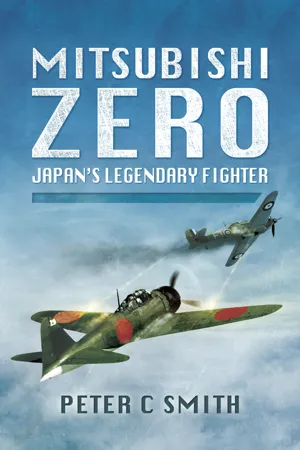
The Mitsubishi Zero is one of the greatest fighter aircraft ever to have graced the skies. Symbolic of the might of Imperial Japan, she represented a peak of developmental prowess in the field of aviation during the early years of the Second World War. Engineered with maneuverability in mind, this lightweight, stripped-back aircraft had a performance that left her opponents totally outclassed. The dogfights this aircraft engaged in with the Chinese, British, Dutch and American warplanes in the 1941-42 period are the stuff of aviation legend. The Zero remained a potent threat until the end of the war, not least in her final role, that of a Kamikaze plane, in which she created as much havoc on the sea as she had done earlier in the air.
Peter C. Smith takes the reader on a journey from inspired inception to the blazing termination of this unique aircraft, the first Naval fighter to be superior to land-based aircraft.
Mitsubishi Zero describes in detail the many victories that punctuated the early days of the plane's operational career as well as the final days of the Second World War which witnessed her demise. Smith also lists the preserved Zero aircraft on display today. This is a fast-paced and fascinating history of a fighter aircraft like no other.
- 240 pages
- English
- ePUB (mobile friendly)
- Available on iOS & Android
eBook - ePub
About this book
Information
Chapter 1
The Development of the Imperial Japanese Navy’s Fighter Force
Before describing the design and combat of the Mitsubishi A6M carrier-borne fighter aircraft of World War II one needs to know just how this aircraft came to be what it was like when she first appeared in the eastern skies. The modern world is very different to that of 1937 and so in order to understand this aircraft’s pedigree the origins and history that made her so unique have to be understood. For that a brief background as to why Japan was in China at all, and why a naval aircraft was to dominate land and sea warfare, needs to be outlined.
The origins of the Imperial Japanese Navy’s air arm can be established back to 1912 with the foundation of the Commission on Naval Aeronautical Research (Kaigun Kōkūjutsu Kenkyūkai) set up under the Technical Development Department. On 19 December Captains Yoshitoshi Tokugawa and Kumazo Hino, conducted the first power flights in a Henri Farman biplane and Grade monoplane respectively. Like its long-time mentor, the Royal Navy, initially much early work was concentrated on airships, but with developments during World War I, emphasis shifted to winged and powered flying machines. Aircraft were purchased from both France and the United States and pilot training commenced also from 1912 onward. From 1914, allied as it was to Great Britain, Japan assisted in the conquest of the German treaty port and base of Tsingtao in November 1914, replacing that power there for eight more years rather than handing it back to China. The Japanese used airships in the siege as well as the seaplane-carrier Wakamiya and co-operation between the two navies continued, a flotilla of Japanese destroyers being based at Malta during the war. However, the Japanese Army was equally as strongly pro-German and envisaged the mutually destructive European carnage as an enormous opportunity to exploit the weakness of China while attentions were focused elsewhere. The Japanese duly presented what were known as the ‘Twenty-One Demands’ to the Chinese Government, which, if implemented, would have given Japan unprecedented control of Chinese internal affairs and commerce and much territory. The Americans also entered the war in 1917 and thus technically became an ally of Japan and, like the British, their initial objections to this take-over were watered-down, with the American Under-Secretary of State, Robert Lansing, stating to Viscount Ishii Kikujirō in a note of 2 November 1917 that America now recognized that, ‘… territorial propinquity creates special relations between nations and consequently Japan has special interests in China’. This became known as the Lansing-Ishii agreement, which virtually gave Japan carte blanche to proceed with her ambitions, while secretly agreeing to extend both nations’ influences in China at the expenses of all other powers.
After the Great War ended with Germany’s unexpected collapse, Japan benefitted from her involvement on the Allied side by taking over the Mandates of Germany’s former Pacific colonies in the Caroline, Mariana and Marshall islands. But these acquisitions did not sate her expansionist plans in China and Manchuria. Meanwhile, Japan still remained allied to Great Britain and Royal Navy influence dominated the expansion of her naval aircraft development. From April 1916 Naval Air Units (hikōtai) were established by the Naval Affair Bureau, at Yokosuka and then Kasumigaura. The British experiments with the carriers Furious and Argus in the latter part of the Great War naturally aroused the interest of the Japanese as did the laying down of the first fully designed aircraft carrier, the Hermes. The Americans at this stage were yet to convert the collier Jupiter into the carrier Langley and lagged far behind the British. The Japanese response was to build the Hōshō, and she, due to the malaise that gripped British defence policy post-war, beat the Hermes into commission to become the first operational aircraft carrier built as such. The dead hand of RAF control soon stifled the initial British lead and both Japan and America quickly overtook and then left the Royal Navy far behind in naval aircraft development, but in the early 1920s it was still to her ally Britain that Japan looked.
Japanese naval aviators flew from the Furious in 1920 and Britain sent an ‘unofficial’ Naval Air Mission under the Colonel The Master of Sempill, with thirty former RNAS and RAF pilots to Japan between September 1921 and 1922 to train a cadre of naval flyers in the latest techniques. When Hōshō commissioned it was again a British flyer, William Jordan, a former RNAS and then test pilot for the Sopwith Company, who, in February 1923, made the first deck landing flying a home-built Mitsubishi aircraft. It was not until 16 March that a Japanese pilot, Lieutenant Shunichi Kira, performed the same feat. Under Herbert Smith former Sopwith flyers such as Jordan, along with Jutland hero Frederick J. Rutland (later to become a spy for Japan), introduced the latest techniques and machines such as the Mitsubishi 1MF3 Type 10 Kōsen (carrier fighter). Herbert Smith had been the Chief Aircraft Designer for the British Sopwith Aviation Company. Among the most famous of his many successful warplane designs during World War I had been the Sopwith Pup and Sopwith Camel. When Sopwith’s disappeared in the harsh climate of British post-war austerity, Smith was invited to Japan by the Mitsubishi Engine Manufacturing Company, at Nagoya, along with other former Sopwith engineers whose expertise was more prized in Japan than in the UK. This team helped Mitsubishi establish their Aircraft Division and Smith oversaw three major Japanese aircraft designs before retiring and returning home in 1924. This was a single-engined single-seat biplane powered by a 300hp Mitsubishi 8-cylinder water-cooled engine and armed with two forward-firing fixed Type 97 7.7mm light machine guns (LMG), and had a maximum speed of 132mph. Another early Japanese model carrier fighter was the Nakajima A1N1/A1N2 Type 3 fighter, based firmly on the one-off speculative British Gloster Gambet, itself a carrier version of the Gloster Gamecock, and which had first flown on 12 December 1927 and was sent to Japan the following year. The A1N was licence-built, and of similar wood and fabric design but with a 420hp Nakajima Jupiter VI 9-cylinder air-cooled radial engine as power plant, which could attain a top speed of 148mph and also carry two 66lb bombs for dive-bombing. Some 150 were built, the first entering service in 1939. A further advance was the Nakajima A2N1 Type 90 carrier fighter. She was also a single-seater and she was a composite design with an all-metal fuselage construction with metal fabric-covered wings that could attain a maximum speed of 182mph.
British aircraft were the inspiration for early Japanese designers, with the Yokosuka Naval Air Arsenal the first manufacturer of such types quickly joined by Aichi, Mitsubishi and Nakajima. They soon began producing aircraft that were at least the equals of western types. Japan was full of confidence and looked forward to continued expansion of her dominions and power. She had already annexed Korea in 1910 and was looking for further additions to her overseas territories to maintain her expanding population and provide sources for coal and iron to fuel her growth. Two revolutions, one against the Manchu Dynasty in China in 1911 and one for its restoration in 1913, both had the hidden hand of the Japanese behind them who sought to benefit from the destabilization of that state. Now, in 1919, the ‘Open Door’ policy of access to China was increasingly unacceptable to Japan who sought predominance and the exclusion of all other powers.
Then, in 1921, an unexpected intervention happened on the world stage that eclipsed even the Versailles Treaty; the Americans suddenly called a conference to limit naval shipbuilding and produced a set of ratio figures, in a total arbitrary manner, totally without any consultation whatsoever, and designed to ensure their own domination of the seaways. This followed the vast programme of naval construction initiated by President Wilson designed to elevate the US to be the principal power, based on their own self-image (one not shared by the rest of the world) of ‘The leader of the democratic impulse’. This assembly became the generally known as the Washington Naval Conference.
The United States continued to castigate and hector the other delegates during the resulting conference to accept the United States’ parity with Great Britain and also assigned tonnage limits on the other world powers.1 Negotiations were long and acrimonious, especially on the part of Japan who felt that her natural progression to join the leading naval powers and her much-cherished ‘Eight-Eight’ naval shipbuilding programme were needlessly sacrificed.2 In contrast, myopic British politicians, headed by Tory politician Arthur J. Balfour, urged on by an all-powerful Treasury Department, meekly caved in to the American demands and abandoned Britain’s three hundred-year-old dominance of the sea with hardly a murmur; indeed they wanted to go further so that Beatty, the First Sea Lord, wrote in despair that if things continued ‘… there would not be a Navy at all’.3 The Japanese were less accommodating to the diktat from President Warren G Harding in the White House and his team backed by demands from Senators from such states as Iowa and Nebraska thousands of miles from any ocean. That the Japanese signed at all was remarkable, as it reduced their total tonnage to just two-thirds of the new American and British limits. While British politicians meekly accepted this ratio, the reception received by the returning Japanese delegates, under Katō Tomosaburō, was dire. Most admirals, the so-called ‘Big-Navy’ group, and in particular Vice-Admiral Katō Kanji, who had also been a delegate member, were bitterly opposed to the deal, and made no secret of it. Another by-product that favoured the Americans and nobody else was that the Anglo-Japanese alliance, which was due to be renewed that same year, was allowed to lapse. Great Britain therefore lost her naval dominance and her principal naval ally both at the same time – for this outcome Balfour received an earldom! In Japan one effect that the resulting treaty had was that it concentrated the minds of the Japanese Naval Staff on how to offset this deliberate restriction of their ambition, and in the ensuing years they increasingly tended to see the development of their naval air arm as a way of reducing the balance of American dominance. Two of the abandoned capital ships, the battleship Kaga and the battle-cruiser Akagi, were converted on the stocks to become aircraft carriers.4
This switch was further reinforced by the subsequent London Naval Treaty of 1930 in which restriction on tonnages and armament size for cruisers was extended by a limitation on numbers, in roughly the same ratio as for battleships and carriers. This was another blow to Japan, which had sought to build outstanding cruisers to make up for the enforced deficiency in her battle line. Now that expansion was also thwarted the air option increasingly became the attractive option for parity in some fields. In 1924 a brand-new Aviation Research centre was constructed at Kasumigaura to replace one demolished in the Tokyo earthquake, to centralize development, testing and research, although existing facilities at Hirō and a new engine testing centre was opened at Yokosuka. Further development took place here with the building of the new Naval Air Arsenal completed six years later. Once ready this new facility became the focus of the IJN’s naval air expansion, allowing both the existing Technical Section and the Aviation Department of the Navy to share design, development, manufacture and flight-testing, via the Hikō Jikkkenbu right through to training and tactical application by the Yokosuka Kōkūtai, not only of all non-private aircraft types but of the hardware associated with military aircraft as well. Such an integrated facility as the Kaigun kōkūtai (re-named as the Naval Air Technical Arsenal – Kaigun Kōkū Gijutsushō – in 1939) was an enormous asset to the Navy and enabled combat experience to be readily assimilated and built into new designs.5 Compare this seamless progression and total control of all aspects of naval air development with the convoluted and time-wasting process by which the Admiralty had to go cap-in-hand to the Air Ministry with their requests, which the latter had barely concealed contempt for (and a overwhelming aversion to consider any military option other than laying Berlin in ruins), and with a hostile Treasury and pacifist government opposing both. It is little wonder that the Royal Navy’s air arm withered while that of the IJN waxed stronger and more powerful each year.
Through this new centralized command the Navy, which contained many air-minded admirals (some of whom, like Vice-Admiral Inoue Shigeyoshi, wanted the entire navy to be solely a land-based aerial armada), was able to channel all Japan’s limited resources to achieving two common goals; to cease reliance on foreign designs and to establish air superiority for the fleet. This superiority was not confined to carrier aircraft either; modern long-range bombers, capable of both high-altitude attacks and aerial torpedo attacks, were developed as a fully integrated force rather than as separate entities. This forward-looking policy was named Project Aviation Technology Independence6 and was carried through with vim and vigour. Private companies were encouraged to compete and from 1932 under the new Prototypes System, under which maximum effort was attained by controlled competition, manufacturers were made to bid in pairs on new designs, outline requirements of which were laid down by the Navy. The best of each competitor’s designs were then adopted, but there were no losers for the firm whose design was rejected was permitted to construct their rival’s machine, or to provide engines for it, thus keeping both fully engaged and able to maximize output and resources.
Hand-in-hand with these innovations that spurred the indigenous aircraft industry forward and enabled the Japanese to cease to rely on foreign technologies to a large extent, was an expansion of pilot and aircrew training in order to meet a manning requirement for almost one thousand aircraft by 1938.7
The development of the bombing arm was consistent with the traditional Japanese approach of attack over defence. This led to the adoption of dive-bombing and torpedo-bombing by the carrier embarked aircraft as well as the long-range bomber, and this tendency somewhat overshadowed the fighter force, which was seen as purely defensive. This was not just a Japanese trait however, the Italian General Giulio Douhet espoused the same philosophy in Europe,8 while Lord Hugh Trenchard in Britain wedded the whole of the RAF’s doctrine to the heavy bomber ethos with Air Marshal Arthur Harris carrying out this theory in bloody detail during the war. American thinking was very much the same with the gimmicky exhibitionism of Billy Mitchell grabbing headlines in a series of very one-sided tests against unmanned, stationary, obsolete warship targets and the predominance of the United States Army Air Corps ‘Bomber Mafia’ under Harold L. George and John F. Curry at Langley Field. All were to be proved wrong in the years ahead but the Japanese came earlier than most to the realization that the popular mantra ‘The bomber will always get through’, as propagated by British Prime Minister Stanley Baldwin in 1932, was a typically simplistic political fallacy.
The reason the Japanese were far ahead of the pack in this realization was because in the years between 1918 and 1937 she had continued her expansionist policy in the Far East and had become embroiled in a series of interventions that were, in all but name, wars.
It is typical that, in an oblique apology at the beginning of their book, authors Masatake Okumiya and Jirō Horikoshi stated that Japan had been, on occasions, ‘… forced into armed conflict with neighbouring countries’. They add that, ‘… such action may be justified …’, but little or no justification was apparent in the first of such adventures, which they totally ignore, the Liutiaohu Incident, which was nothing less than a plot to take over, through force, the whole of Manchuria. On 18 September 1931, a group of disaffected and militant Kwantung Army officers originated a plan whereby one Lieutenant Kawamoto Suemori planted explosives that blew up the Japanese owned South Manchuria Railway line between Changchun and Lüshun; using this as an excuse, they marched in and took over Mukden, the capital. Here, they put in place a puppet ruler Emperor Kang-de (formerly Puyi of the Quing Dynasty), and created a new subservient state, which they named Manchukuo. At the Liaodong Peninsula in the south (Dairen and the former Port Arthur or Ryojun) Japan ruled directly as the Kwantung Leased Territory and based their Kwantung Army (Kantōgun) there. Thus Japan had gained a firm military foothold on the mainland with Kange-de as a nominal figurehead for a nation that, in reality, the Japanese Army really administered.
In 1932 Japanese naval forces at Shanghai were involved in another incident when, with the beating and murder of Japanese Buddhist priests and anti-Japanese demonstrations as an excuse, an armed force was landed from warships at the port. Unfortunately for them they encountered the Chinese 19th Route Army and had to be hastily reinforced by regular army units sent from Japan. There was much fighting before the matter was settled by negotiation thanks to the British Admiral on the spot, Sir Howard Kelly, acting alone with little support from either his Government at home or the senior Admiral on the spot (an American) who refused to get involved. Meanwhile, the Japanese had annexed Jehol Province into Manchukuo in 1933 and in 1935 another puppet state, the East Hebei Autonomous Council, was set up absorbing the provinces of Chahar and Hebei. This, in effect, almost isolated the Chinese capital of Peking (now Beijing) other than from the south.
Five years later things turned more serious and on 7 July 1937 the so-called Marco Polo (Lugouqiao) Bridge incident occurred. Here the Peking (Beijing) to Tianjin railway ran through the town of Wanping, which the Japanese had long set their sights on. This friction point ruptured on the night of 6/7 July when the Japanese Kwantung Army conducted night manoeuvres without notifying their Chinese opposite numbers, who opened fire on the Japanese. The misunderstandings multiplied and fighting ...
Table of contents
- Front Cover
- Title Page
- Copyright Page
- Contents
- Introduction and Acknowledgements
- Chapter 1 The Development of the Imperial Japanese Navy’s Fighter Force
- Chapter 2 Striving for the Impossible
- Chapter 3 Trial and Error
- Chapter 4 Into Action
- Chapter 5 None so Blind
- Chapter 6 Preliminaries to War
- Chapter 7 Forging a Legend
- Chapter 8 Peak and Nadir
- Chapter 9 Grim Attrition
- Chapter 10 On the Back Foot
- Chapter 11 Last Shout for the Little Warrior
- Chapter 12 Final Sacrifice
- Appendix I: Basic Specification of the A6M2
- Appendix II: Principal Variations of the A6M
- Appendix III: Production of the A6M
- Notes
Trusted by 375,005 students
Access to over 1.5 million titles for a fair monthly price.
Study more efficiently using our study tools.
Frequently asked questions
Yes, you can cancel anytime from the Subscription tab in your account settings on the Perlego website. Your subscription will stay active until the end of your current billing period. Learn how to cancel your subscription
No, books cannot be downloaded as external files, such as PDFs, for use outside of Perlego. However, you can download books within the Perlego app for offline reading on mobile or tablet. Learn how to download books offline
Perlego offers two plans: Essential and Complete
- Essential is ideal for learners and professionals who enjoy exploring a wide range of subjects. Access the Essential Library with 800,000+ trusted titles and best-sellers across business, personal growth, and the humanities. Includes unlimited reading time and Standard Read Aloud voice.
- Complete: Perfect for advanced learners and researchers needing full, unrestricted access. Unlock 1.5M+ books across hundreds of subjects, including academic and specialized titles. The Complete Plan also includes advanced features like Premium Read Aloud and Research Assistant.
We are an online textbook subscription service, where you can get access to an entire online library for less than the price of a single book per month. With over 1.5 million books across 990+ topics, we’ve got you covered! Learn about our mission
Look out for the read-aloud symbol on your next book to see if you can listen to it. The read-aloud tool reads text aloud for you, highlighting the text as it is being read. You can pause it, speed it up and slow it down. Learn more about Read Aloud
Yes! You can use the Perlego app on both iOS and Android devices to read anytime, anywhere — even offline. Perfect for commutes or when you’re on the go.
Please note we cannot support devices running on iOS 13 and Android 7 or earlier. Learn more about using the app
Please note we cannot support devices running on iOS 13 and Android 7 or earlier. Learn more about using the app
Yes, you can access Mitsubishi Zero by Peter C. Smith in PDF and/or ePUB format, as well as other popular books in History & Military & Maritime History. We have over 1.5 million books available in our catalogue for you to explore.