"An important work for anyone interested in warship design, the naval side of World War II in the Mediterranean, or modern Italian history."—New York Military Affairs Symposium
For its final battleship design Italy ignored all treaty restrictions on tonnage and produced one of Europe's largest and most powerful capital ships, comparable with Germany's
Bismarck class, similarly built in defiance of international agreements. The three ships of the
Littorio class were typical of Italian design, being fast and elegant, but also boasting a revolutionary protective scheme—which was tested to the limits, as all three were to be heavily damaged in the hard-fought naval war in the Mediterranean;
Roma had the unfortunate distinction of being the first capital ship sunk by guided missile.
These important ships have never been covered in depth in English-language publications, but the need is now satisfied in this comprehensive and convincing study by two of Italy's leading naval historians. The book combines a detailed analysis of the design with an operational history, evaluating how the ships stood up to combat. It is illustrated with an amazing collection of photographs, many fine-line plans, and colored artwork of camouflage schemes, adding up to as complete a monograph on a single class ever published.
Among warship enthusiasts, battleships enjoy a unique status. As the great success of Seaforth's recent book on French battleships proves, that interest transcends national boundaries, and this superbly executed study is certain to become another classic in the field.
"A very impressive piece of work."—
History of War
"An essential book for all naval history enthusiasts."—Firetrench
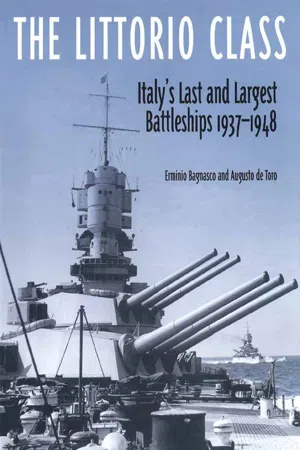
eBook - ePub
The Littorio Class
Italy's Last and Largest Battleships 1937-1948
- 320 pages
- English
- ePUB (mobile friendly)
- Available on iOS & Android
eBook - ePub
About this book
Information
Contents
Introduction
Chapter 1: Battleships and Italian Naval Policy between the Two World Wars
The Washington Treaty and the Italo-French naval rivalry
The February 1929 naval programme and the battleship question
The 1930 Conference and the Treaty of London
Construction of Dunkerque and the Italian response (1931–1933)
The definitive failure of the Italo-French negotiations and construction of Strasbourg
Construction of Littorio and Vittorio Veneto and reaction abroad
Building Littorio and Vittorio Veneto
The London Conference of 1935–1936 and the end of naval disarmament
Sanctions and naval construction
Reconstruction of the Duilio class ships and plans for 27,000-ton battleships (1935–1937)
From the Littorio to the Impero class and the French response
Chapter 2: Design and General Characteristics
The preliminary design
The working design and the principal additional modifications
Chapter 3: Technical Description
Hull and stability
Superstructures
Protection and safety measures
Propulsion system
Armament and fire control
Steering gear and ground tackle
Communications and warning systems
Other on-board systems
Aircraft arrangements and embarked aircraft
Crew, general organisation aboard, and mess accommodations
Paint schemes and camouflage
Chapter 4: Construction, Sea Trials and Commissioning
The progress of construction
Vittorio Veneto’s sea trials
Littorio’s sea trials
Entry in service of Vittorio Veneto and her transfer to Taranto (28 April – 21 May 1940)
Entry in service of Littorio and her transfer to Taranto (6–24 May 1940)
Construction and fitting-out of Roma
Plates – ship plans and details
Impero (never completed)
Chapter 5: Operational History
From the declaration of war to the transfer of the Naval Squadron to La Spezia, 10 January 1941
From the action against Operation ‘Excess’ to the First Battle of Sirte, January to December 1941
From Operation ‘M 43’ to the transfer of 9th Division to La Spezia, January to December 1942
From December 1942 to the eve of the armistice
Plates – ship plans and details
Colour section and modelling notes
From the armistice until the decommissioning and scrapping of Vittorio Veneto and Roma
Annex 1: Composition of Italian Naval Forces from the entry into service of Littorio and Vittorio Veneto (May 1940) until 8 September 1943
Annex 2: Commanders of Littorio class battleships 1940–1948
Chapter 6: Comparisons and Conclusions
Appendices
Appendix 1: Movements and Changes of Location of the Littorio Class Battleships from Entry into Service until their Loss or Decommissioning
Appendix 2: Damage Sustained by Littorio Class Battleships during the War
Appendix 3: Performance Characteristics of Littorio Class Heavy and Medium Calibre Guns
Sources and Bibliography
Acknowledgements
Index
INTRODUCTION
The Littorio class, the Italian navy’s largest and most powerful battleships, have previously been the subject of only one worthwhile, but short, monograph, and this dates back to the early 1970s (Bargoni, Gay and Andò, see Bibliography). It is true that there have been a great number of articles dealing with these ships, in Italy and abroad, and chapters pertaining to them in general works on battleships or warships of the Regia Marina (Royal Italian Navy), but these are all brief treatments that add little to overall understanding of the subject.
We were inspired to write a new, comprehensive monograph dedicated to these ships by a number of factors: the unavailability for some time of the previously cited work; the continuing intense interest shown by enthusiasts for the Italian ‘35,000-tonners’, which have become a symbol of the ‘great navy’ of the 1940s and of Italian technological and industrial capabilities of that era; the realisation that the level of research and understanding of the Littorio class had not kept pace with studies of similar battleships in other navies; and finally, the availability of new documents and photographs.
Our intention was, in fact, to produce a work that took into account all of those factors, providing the reader with the most complete and up-to-date picture possible of the genesis, design, building and employment of these ships.
The technical description – supported by an impressive number of images – is followed by a description of their operational activity from the summer of 1940 until the end of the war.
To engage in a complete analysis of the wartime activity (and inactivity) of these ships would have meant writing yet another history of the Italian war at sea during the Second World War, something which, in truth, is neither possible nor useful in this publication. We preferred, instead, on the one hand to concentrate on the more technical aspects, which are less known or less examined, which help to give a better idea of the overall effectiveness and soundness of the Littorio design, while on the other hand highlighting Italian official thinking about the importance of these ships, during the war and for the post-war period – concepts which we should say immediately were very different from the oversimplified and undervalued views of the role of the battleship that became common in post-war historiography.
The analysis of operational activity is rounded out by two appendices: the list of all movements carried out, from commissioning into the Regia Marina to the loss or decommissioning of the three Littorios that entered service, and a list of damage incurred by the same ships due to wartime action. Finally, there is a brief section with modelling notes that represents a new feature in Italian naval monographs, although it is common in publications dealing with aircraft. We entrusted this section to an expert modelmaker, Giancarlo Barbieri, who recently completed a perfect reproduction of the battleship Roma in 1:100 scale, a highly-demanding project that required many years of work on a ‘monster’ that is fully 2.38 metres (7.8 feet) long!
With respect to the numerous drawings that illustrate this volume, all external views and many of the sectional views are the work of Roberto Maggi; other sectional drawings and construction details are either reproductions of original shipyard plans or drawings based on them that come from the important archives of the Associazione Navimodellisti Bolognesi (Naval Modellers Association of Bologna); the colour schemes and camouflage patterns from specific times are thanks to the collaboration of Maurizio Brescia; and, finally, the colour profiles of the shipborne aircraft are by Angelo Brioschi.
Regarding the photographs, the majority have been in our own collections for many years; for others, the source, when known, is shown in the caption. Particular attention was paid to providing as precise a date as possible for each image, by comparing them to many other photos as well as analysis of the movements of the various ships. Photo selection obviously is oriented toward those of the highest quality, but nevertheless in some cases we had to resort to images that were not technically perfect but that were irreplaceable because they referred to a particular time or event.
In concluding this brief introduction, we wish to thank all who provided help and collaboration with advice, memories, documents and illustrations. A specific citation is given for each source, be they organisations or private individuals, at the end of this volume, following the list of archival sources and a select bibliography.
We trust that we have succeeded in what we set out to accomplish: that is, to give a complete history of these ships and of their activities. We leave the final judgement of our work to students and enthusiasts of naval history, who we invite to point out any errors or to contribute suggestions that we might consider for what we hope may soon be a new edition.
E.B. – A. d.T. Milano-Udine, Autumn 2007
Chapter 1
BATTLESHIPS AND ITALIAN NAVAL POLICY
BETWEEN THE TWO WORLD WARS
IItaly came out of the First World War having made significant efforts towards the conduct of the war at sea, especially in the construction of new ships. This construction had concentrated on light flotilla craft (destroyers and escorts), ‘stealth’ units (motor torp...
Table of contents
- Cover
- Front Inside
- Half Title
- Title Page
- Copyright
- Contents
Trusted by 375,005 students
Access to over 1.5 million titles for a fair monthly price.
Study more efficiently using our study tools.
Frequently asked questions
Yes, you can cancel anytime from the Subscription tab in your account settings on the Perlego website. Your subscription will stay active until the end of your current billing period. Learn how to cancel your subscription
No, books cannot be downloaded as external files, such as PDFs, for use outside of Perlego. However, you can download books within the Perlego app for offline reading on mobile or tablet. Learn how to download books offline
Perlego offers two plans: Essential and Complete
- Essential is ideal for learners and professionals who enjoy exploring a wide range of subjects. Access the Essential Library with 800,000+ trusted titles and best-sellers across business, personal growth, and the humanities. Includes unlimited reading time and Standard Read Aloud voice.
- Complete: Perfect for advanced learners and researchers needing full, unrestricted access. Unlock 1.5M+ books across hundreds of subjects, including academic and specialized titles. The Complete Plan also includes advanced features like Premium Read Aloud and Research Assistant.
We are an online textbook subscription service, where you can get access to an entire online library for less than the price of a single book per month. With over 1.5 million books across 990+ topics, we’ve got you covered! Learn about our mission
Look out for the read-aloud symbol on your next book to see if you can listen to it. The read-aloud tool reads text aloud for you, highlighting the text as it is being read. You can pause it, speed it up and slow it down. Learn more about Read Aloud
Yes! You can use the Perlego app on both iOS and Android devices to read anytime, anywhere — even offline. Perfect for commutes or when you’re on the go.
Please note we cannot support devices running on iOS 13 and Android 7 or earlier. Learn more about using the app
Please note we cannot support devices running on iOS 13 and Android 7 or earlier. Learn more about using the app
Yes, you can access The Littorio Class by Ermingo Bagnasco,Augusto de Toro in PDF and/or ePUB format, as well as other popular books in History & Italian History. We have over 1.5 million books available in our catalogue for you to explore.