This sweeping history of maritime warfare through the Middle Ages ranges from the 8th century to the 14th, covering the Mediterranean and Northern Europe.
After the fall of Rome, the sea becomes the center of conflict for Western Civilization. In a world of few roads and great disorder, it is where power is projected and wealth is sought. Yet, since this turbulent period in the history of maritime warfare has rarely been studied, it is little known and even less understood.
In
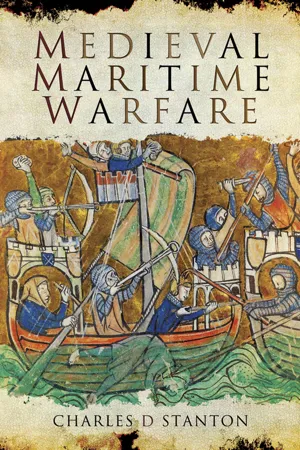
Medieval Maritime Warfare, Charles Stanton depicts the development of maritime warfare from the end of the Roman Empire to the dawn of the Renaissance, recounting the wars waged in the Mediterranean by the Byzantines, Ottomans, Normans, Crusaders, and the Italian maritime republics, as well as those fought in northern waters by the Vikings, English, French and the Hanseatic League. Weaving together details of medieval ship design and naval strategy with vivid depictions of seafaring culture, this pioneering study makes a significant contribution to maritime history.
- 256 pages
- English
- ePUB (mobile friendly)
- Available on iOS & Android
eBook - ePub
Medieval Maritime Warfare
About this book
Information
PART I
SOUTHERN EUROPE
The Mediterranean and the Black Sea
CHAPTER 1
The Byzantine–Muslim Struggle for Supremacy on the Middle Sea
The ‘revived Romania’ of Justinian did not remain unchallenged for long.1 Its very nature made it vulnerable to assault. The Byzantine Empire at the time was essentially a maritime one. With the exception of Anatolia (Asia Minor), it was only shoreline deep in most places, buttressed on the landward side by a system of frontier forts. It depended on naval power to hold it together. Instead of the old Roman network of roads, Constantinople relied on sea lanes to communicate with its far-flung provinces and gather nourishment from such grain-producing regions as Egypt.2 Thus, aside from the main fleet at Constantinople, it maintained smaller flotillas at Cherson on the Black Sea, at Tyre and possibly Acre on the Syrian coast, at Alexandria in Egypt, at Ravenna on the Adriatic, at Syracuse on Sicily, at Carthage and possibly Ceuta in North Africa, and perhaps even a squadron in Andalusia or the Balearics. Byzantium used these fleets to rush its limited land forces to troublespots in order to quell rebellions or staunch invasions.3
That is how the empire dealt with simultaneous pressure from the Avars (fierce Turkic nomads who had swept into the Balkans in the sixth century) and the Sassanid Dynasty of Persia. Emperor Maurice, a former general who famously penned a manual of war called Strategikon, managed to hold the line for two decades with a firm military mind, but it all began to unravel after his assassination in 602.4 The very next year the Sassanid monarch Chosroes II launched a massive offensive against Byzantium which Phokas, Maurice’s cruel and incompetent successor, was helpless to stem. By 608 Persian forces were at Chalcedon across the Bosporus from Constantinople. Antioch fell to them in 611, Damascus in 613, Jerusalem in 614 and Alexandria in 619.5 Meanwhile, the Avars had moved into Macedonia and were advancing through Thrace. Heraklios (610–41), Phokas’ more reliable replacement, succeeded in forestalling the Avars with a truce in 622 while stymieing the Sassanids with a brilliant Anatolian campaign, but ultimately the two imperial adversaries struck an alliance to besiege the Byzantine capital. In the summer of 626 Sahrvaraz, the great Persian general, mustered his armies at Chalcedon, while the Avars, according to the early ninth-century Byzantine chronicler Theophanes the Confessor, ‘filled the gulf of the [Golden] Horn with an immense multitude, beyond all number, whom they had brought from the Danube in carved boats’.6 Byzantine naval power, however, easily prevailed. The emperor gathered a great fleet of war galleys which had no difficulty dispersing the primitive monoxyla (dugouts) of the Avars, and the siege fell apart after a mere ten days. The next year Heraklios used his fleet to support an invasion of the Persian Levant, finally crushing the remnants of Chosroes’ armies near Nineveh.7
The empire’s hold on its Mediterranean domains, nonetheless, remained tenuous and susceptible to large-scale incursions from the interior. And certainly such a security system was never designed to withstand the sort of massive shockwave that emanated from the Arabian peninsula at the beginning of the seventh century. Ironically, the emperor himself prepared the way for the onslaught. Like his predecessors, and so many of his successors, he dabbled in the religious controversy that would plague the empire until its fall nearly a millennium later. It was Justinian who had begun the practice. Without the restraining influence of the Empress Theodora, who died in June 548, Justinian sought to impose Dyophysite Orthodox dogma (that Christ had two natures: one divine and one human) on the Monophysite churches of Syria and Egypt (which believed that the Son of God had a single divine nature).8 His successors followed suit with heavy-handed policies designed to enforce state-mandated religious conformity throughout the empire. Heraklios attempted to mend the empire’s religious rupture by imposing a ham-fisted compromise between Orthodox Dyophysitism and Monophysitism but it satisfied no one. While conceding that Christ indeed had two natures, one human and one divine, he insisted that the Son of God had only one will and thus one energy (later termed Monothelitism). This view was raucously rejected by both Rome and the Monophysite churches of Syria and Egypt.9
To make matters worse, Heraklios declared Greek as the official language of the empire. He then subjected the Monophysite Christians of Syria and the Coptics of Egypt to the punishing persecution of his governors and the fiscal tyranny of his tax collectors. Instead of unifying the empire, Heraklios had hopelessly debilitated it with further philosophical dissonance. This caused a fatal rift which rendered the entire region ripe for invasion. The Semitic peoples on the southern and eastern borders of the empire doubtless had a greater affinity with Muslim monotheism than with the Greek Orthodoxy of Constantinople, in any case. As a consequence, they were more inclined to view the Islamic invaders as liberators to be welcomed openly rather than as potential oppressors to be resisted.10 The timing could not have been worse.
Sandstorm out of the East: the Rise of Muslim Maritime Might (632–55)
Muhammad died in Medina on 8 June 632. By 634 the storm that was Islam (which means ‘submission’) was already sweeping into Syria. Damascus fell to the forces of the Rashidun Caliphate of Arabia in September that year. They came by land, of course, in the initial stages, for they had no navy at that point and no need of one. In all fairness to Heraklios, he moved to meet the threat as soon as it had become apparent, but the onslaught was too swift and utterly inexorable. That said, the emperor made a respectable effort to stem the tide, fielding a force of some 80,000 allied soldiers at Antioch under his personal leadership in the spring of 636 against a Rashidun army roughly half its size under the command of Khalid ibn Walid. The two forces faced each other at the Yarmouk river southeast of the Sea of Galilee in August. Theophanes described the denouement of the six-day engagement: ‘And as a south wind was blowing in the direction of the Romans, they could not face the enemy on account of the dust and were defeated.’11 The annihilation of the Byzantines caused the entirety of Syria to devolve to the Arabs.12
Metaphorically speaking, the sandstorm continued unabated. Palestine soon suffered the same fate as Syria. Jerusalem was captured in April 637, followed by Caesarea Maritima the next year. By the end of 639 most of Persia, including Ctesiphon and all of Byzantine Armenia and Mesopotamia, was in Muslim hands. At the beginning of 640 the Arabs surged into Egypt behind their brilliant commander Amr ibn al-’As, a contemporary of Muhammad. They seized Heliopolis and Babylon (both near modern Cairo) in July. When Heraklios died of dropsy in February 641, Amr was already marching on Alexandria. It surrendered in September, making the Arabs masters of Egypt.13
Still, Byzantium remained a force to be reckoned with on the seas and thus had the means to threaten Arab conquests in the Fertile Crescent. Constans II, Heraklios’ heir, dispatched a naval expedition in 645 under an Armenian named Manuel to recover Alexandria. Manuel succeeded with such unexpected ease that it must have alarmed Caliph Uthman ibn Affan. The latter had previously relieved Amr as governor of Egypt, but now hastily reappointed him. The highly effective field commander quickly gathered an army of 15,000 and forced Manuel to withdraw.14 The experience was a valuable one, nonetheless. It had impressed upon these conquerors from the desert the value of sea power and the vulnerability of their gains to Byzantine fleets. Accordingly, the Rashidun Caliphate became determined to rectify the weakness. First of all, the Egyptian capital was relocated from Alexandria over a hundred miles up the Nile to Fustat in the environs of modern Cairo. Of even greater significance for the future of the Byzantine–Muslim struggle was the decision to develop a naval capability to rival that of Constantinople. Abdullah ibn Sa’ad ibn Abi as-Sarh, a successor to Amr as governor of Egypt, began by building a shipyard on al-Rawdah, an island in the Nile abeam Fustat.15 It came to be called dar al-sina’a, meaning ‘house of work’, which medieval Italian mariners later adopted as darsena, denoting a ‘dock’, or arsenale, referring to a ‘dockyard’ – and hence the modern term ‘arsenal’ in the sense of a shipyard.16
Little is known about the nautical architecture of these early Arab vessels. No reliable ship descriptions or depictions appear until the thirteenth century. (Pl. 6) It is presumed, however, that they were much like their Byzantine counterparts. After all, the shipwrights that the Caliphate relied upon to construct its ships in the newly conquered lands of the Levant were the same Syriac Christians and Coptics that the Byzantines had called upon to build their vessels in these formerly imperial territories. In fact, some of the Arab ships bore names that sounded similar to their Greek equivalents. The chelandion, for instance, was sometimes called the shalandi in Arabic. John Pryor offers an explanation: ‘These terms were used by Greek-speaking functionaries in the chanceries of their Muslim rulers writing directives to fellow Greek-speaking functionaries of other Muslim officials.’17 Thus, warships were often referred to as dromōns in both Arabic and Greek sources.18 An Arabic translation of the Emperor Leo VI’s Naumachika, a treatise on naval warfare, is actually contained in the Al-ahkam al mulukiyya wa’l dawabit al-namusiyya (‘Royal rules and customary regulations for the art of naval warfare’) of Muhammad ibn Mankali, a fourteenth-century court official of Mamluk Egypt.19 Accordingly, Arab fleets were probably composed of ships quite similar to the Byzantine vessels described earlier with the exception that, in the view of medieval maritime specialist Frederick Hocker, ‘The main Arab ships were considered to be larger, higher, heavier, and slower than their Byzantine opponents.’20 The truth is that there is no way of knowing for certain.
Command structure and crew composition also seemed to have shared parallels with their Byzantine counterparts. An amir (emir = leader) was normally designated a fleet commander and eventually came to be known as an amir al-rahl, at least in the West. A ship’s captain was a ra’is, who was responsible for navigation and anchorage, but direct supervision of the sailors, nawatiya (from the classical word nauta for ‘mariner’), was assigned to the qa’id al-nawatiya (‘chief of the sailors’). In the early stages the mariners themselves were recruited from local Coptic and Syrian Christian populations, but embarked soldiers or marines were Muslim.21
At about the same time as the governor of Egypt was building his fleet at al-Rawdah Island, the governor of Syria, Muawiyah ibn Abi Sufyan, began assembling a fleet at Tyre and Acre.22 At first, much of the fleet was composed of merchantmen confiscated from Syriac Christians. Muawiyah was clearly quite suc...
Table of contents
- Front Cover
- Title Page
- Copyright Page
- Contents
- List of Illustrations
- Preface
- Introduction
- Part I: Southern Europe – The Mediterranean and the Black Sea
- Part II: Northern Europe – The North Sea, the Baltic Sea and the English Channel
- Conclusion
- Selected Bibliography
Trusted by 375,005 students
Access to over 1.5 million titles for a fair monthly price.
Study more efficiently using our study tools.
Frequently asked questions
Yes, you can cancel anytime from the Subscription tab in your account settings on the Perlego website. Your subscription will stay active until the end of your current billing period. Learn how to cancel your subscription
No, books cannot be downloaded as external files, such as PDFs, for use outside of Perlego. However, you can download books within the Perlego app for offline reading on mobile or tablet. Learn how to download books offline
Perlego offers two plans: Essential and Complete
- Essential is ideal for learners and professionals who enjoy exploring a wide range of subjects. Access the Essential Library with 800,000+ trusted titles and best-sellers across business, personal growth, and the humanities. Includes unlimited reading time and Standard Read Aloud voice.
- Complete: Perfect for advanced learners and researchers needing full, unrestricted access. Unlock 1.5M+ books across hundreds of subjects, including academic and specialized titles. The Complete Plan also includes advanced features like Premium Read Aloud and Research Assistant.
We are an online textbook subscription service, where you can get access to an entire online library for less than the price of a single book per month. With over 1.5 million books across 990+ topics, we’ve got you covered! Learn about our mission
Look out for the read-aloud symbol on your next book to see if you can listen to it. The read-aloud tool reads text aloud for you, highlighting the text as it is being read. You can pause it, speed it up and slow it down. Learn more about Read Aloud
Yes! You can use the Perlego app on both iOS and Android devices to read anytime, anywhere — even offline. Perfect for commutes or when you’re on the go.
Please note we cannot support devices running on iOS 13 and Android 7 or earlier. Learn more about using the app
Please note we cannot support devices running on iOS 13 and Android 7 or earlier. Learn more about using the app
Yes, you can access Medieval Maritime Warfare by Charles D. Stanton in PDF and/or ePUB format, as well as other popular books in History & European Medieval History. We have over 1.5 million books available in our catalogue for you to explore.