- 256 pages
- English
- ePUB (mobile friendly)
- Available on iOS & Android
eBook - ePub
About this book
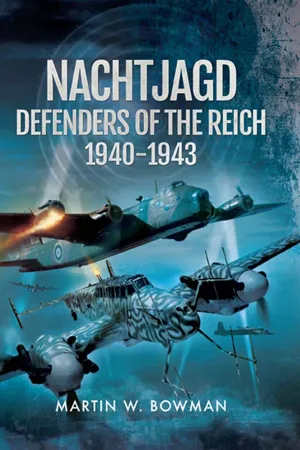
This new volume from Martin Bowman examines the first three years of the Second World War, consolidating first-hand accounts from German fighter pilots caught up in some of the most dramatic night time conflicts of the early war years.Viewing Bomber Command's operations through the eyes of the enemy, the reader is offered a fresh and intriguing perspective. Set in context by Bowman's historical narrative, these snippets of pilot testimony work to offer an authentic sense of events as they played out.
Information
Chapter One
‘Night Fighting! It Will Never Come To That!’
Josef Kammhuber was born in Tüssling, Bavaria on 19 August 1896, the son of a farmer. At the beginning of World War I he was 18 and joined a Bavarian engineer battalion. He experienced the Battle of Verdun in 1916 and was promoted to Leutnant in 1917. He was allowed to remain in German’s tiny post-war army and in 1925 was promoted to Oberleutnant. Between October 1926 and September 1928, he received division-level leadership training. From 1 May to 30 September 1930 he was sent to the USSR for secret pilot training. On his return he joined the staff of General Walter Wever, chief of staff of the Luftwaffe. He was promoted to Hauptmann on 1 February 1931. Wever was in the process of attempting to set up a strategic bomber command but in June 1936 Wever was killed in an air crash. Kammhuber had continued to rise in the ranks, promoted to Major on 1 October 1934, Oberstleutnant on 1 October 1936 and then Oberst on 1 January 1939. Kammhuber had put in a request in February 1939 for active duty. Promoted to Generalmajor, he was assigned as chief-of-staff of Luftflotte 2 and was in this position at the start of the war in September. In January 1940 he was transferred to the Western Front where he became Geschwader-Kommodore of KG51, a tactical bomber unit. During the French campaign he was shot down and captured and interned in a French PoW camp at the age of 44. He was released at the end of the Battle of France in July 1940 and returned to Germany where he was placed in command of coordinating flak, searchlight and radar units. At the time these were all under separate command and had no single reporting chain; so much of the experience of the different units was not being shared. The result was XII Fliegerkorps, a new dedicated night-fighting command.
Patrick Foss was born in Ketton, Rutland on 8 November 1913. When he was about nine years old he decided he wanted to go to sea in the Merchant Navy. He searched a reference book of schools and found the Nautical College, Pangebourne. His mother, who ran the Linden Hall Hotel in Bournemouth, agreed that she would send him there when he was thirteen. At the end of his first year, aged fourteen, he spent his summer vacation signing on a tramp steamer on the run from Cardiff to Oporto in Portugal as a shilling a month steward. He slept late and ate in the officers’ quarters, but did any work that needed doing, from scraping paint to taking a turn at the steering wheel. When he was seasick the Captain sent him down to the engine room where he was put to work greasing the steel piston rods as they reciprocated out of the cylinders. It was at that point in the ship where the movements were minimal. A year later Foss signed on for another trip with his brother Denis, this time from Barry Docks in South Wales to Nantes on the River Loire in France, conveying coal dust to a power station. Returning to Barry Docks he glimpsed dimly the dimension of the vast unemployment gripping Britain. These were the early days of the Great Depression and something like two million were registered unemployed. Then and there he decided that for an ambitious lad like him the sea was not his profession. His thoughts turned to the sky.
While he waited for work at Saunders Roe, which had no work, Foss worked at a garage near the Linden Hall Hotel, pumping petrol into the customers’ cars. He ground in valves and helped skilled men work on jobs and learned a great deal. He felt sure that he was headed on his chosen road of aviation. Then came the next step along the aviation path. A young aviation engineer visited the hotel. He told Foss that if he wanted to learn to fly, the most inexpensive way was to go to Germany where he could get cheap flying instruction, especially on gliders, because of the high rate of exchange of the Travellers Mark. Foss at once booked the first course in the spring of 1931 on the Wasserkuppe in Bavaria. Germany led the world in the art of gliding. This was no accident. Under the Versailles Treaty, following World War One, Germany was forbidden to train military pilots and so men who looked ahead to the building an air force used gliding to create a reservoir of men skilled in the basics of flying.
After a long rail journey down the Rhine and into the hinterland Foss reached the mountain, Wasserkuppe, upon which the gliding school stood. He found a number of German youth milling around the station and they clubbed together to hire a taxi. The school consisted of long, low army huts, divided into small rooms sleeping two each. Other huts were a dining room, cook house and workshops, with hangars alongside. The whole place was under several feet of snow and a blanket of fog. There was no possibility of gliding. They were given some ground instruction and sat around and filled the day as best they could. Foss found two Britishers on the course, one a dance band drummer in his mid-thirties and the other a student aged twenty-one.
Foss flew gliders during the day and found someone to give him lessons in German in the evenings. He became very good friends with Günther Groenhoff, who was a test pilot for the remarkable designer, Dr. Alexander Lippisch who had an experimental glider workshop nearby.1 Groenhoff was the national sail-planing champion who held several long-distance and height records. Foss graduated to the small Klemm low-wing monoplane with a 60 hp engine.
That summer of 1931 in Marburg many of the students were being enrolled in the Sturm Abteilung Hitler legions. His friend Hans Stech was among them and he took Foss along to the parades - ‘hundreds of marching youth in their brown shirts and swastika armbands, singing through the streets’. The young Englishman could see that the Nazis (National Socialists) were ‘going places and capturing the youth with big aims and demanding discipline and sacrifices’. He was impressed, as most youngsters of seventeen would be. Foss wrote: ‘At that time in England there was little get up and go spirit and young people yearned for it. In both Germany and Britain at that time there were growing unemployment and hopelessness, while politicians manoeuvred and denounced and looked out for their own interests.
‘There were at least thirty political parties in Germany that year and I went to some of their parades. The most impressive and frequent were the Nazi parades, with hundreds of students in their brown shirts and breeches moving with discipline. The Nazi challenge was along the lines of an appeal to sacrifice and patriotism. Nazi posters proclaimed: ‘The German youth does not smoke’ and ‘The German girl does not make up her face’. I saw little evidence of the evil thing Nazism was to become. One incident which I put down at the time to student high spirits happened at a lecture I attended at which a Jewish professor was shouted down and driven out of the hall with blows.’
In 1932 Foss returned to Germany to take an advanced gliding course near Kassel and he returned to Germany twice more before war closed the frontiers. He found a number of German soldiers enrolled on the course. He got on well with them and they with him and was invited into their barracks and saw the ‘not permitted’ tanks and other military equipment that they manned. ‘I still did not realise the significance of their involvement in the gliding as a means of bypassing the ban on military flight training, as Germany began its building of an air force’ he wrote. ‘Nine years later, as I flew over Germany at night on bombing raids, I wondered if the German fighter pilots hunting me might be the same men with whom I learned to fly in Kassel. I comforted myself with the thought that those men had probably by now been promoted to Generals.’
He returned to Germany twice more before war closed the frontiers. As he travelled, his German had improved sufficiently for him to be taken as a German, though they detected something different from his accent. Germans from the south would ask, ‘Aren’t you from Hamburg?’ or, in northern tones, ‘Aren’t you from the Black Forest?’ Yet he could barely write a word and I had no grammar. In 1935 Foss had an added incentive to visit Germany. While ice skating at an ice rink, he met a delightful girl from the Harz Mountains in middle Germany named Renate. She was a blonde beauty and he became very fond of her and she of him. He went to her home and met her family. Nearby an air force flying school had been opened and he heard that they had lost eighteen pupils in flying accidents in the previous weeks. He thought that they must have been working under a great deal of pressure. One day Renate took Foss for a walk in the woods. She suddenly stopped, told him to stand still and went and looked around behind all the trees. Then she sat down and to his surprise, for he was expecting something different, began to whisper about a terrible place near there which she called a ‘concentration camp’. ‘Clearly it distressed and frightened her, but its horror did not impinge on my mind’ wrote Foss. ‘I was equally obtuse when I was travelling through the country and stayed the night in Bremen in the home of a young woman I had met. The family was Jewish and well-to-do. In the late evening we heard marching feet in the street below the flat, stamping, singing and shouting. The family were clearly mortally afraid and told me it was the SS (Hitler Bodyguard men). Then came terrifying sounds; glass smashing, the crash of doors being broken down, cries, shrieks and drunken oaths. I wanted to look out of the window, but the family begged me not to or make any sign that the flat was occupied. I had never seen people in such terror, but I didn’t draw any conclusions from the incident, certainly not that such scenes would be allowed to grow in Germany and other countries until war became inevitable.’
Back in Britain Foss applied for a short service commission of six years as a pilot in the RAF and from a crowd of applicants he was one of just two who were selected. The selection board was no doubt impressed that both applicants stood out as a result that they had done something unusual. In the 1930s Foss had become a recruit to the Oxford Group (later Moral Re-Armament) which had challenged him to make a daily practice of ‘trust and teamwork, coupled with asking God to show what is right,’ as he put it. From this, he claimed, sprang much of his initiative and willingness to carry responsibility. Foss had trained as a sailor and had completed glider training in Germany and the other applicant had flown light aircraft in northern Canada; summer and winter. The RAF would teach them to fly all over again but first they had to wait nine months before the Service took them for training.
Foss went on to fly elderly biplanes like the Armstrong Whitworth Atlas and Siskin, of metal and fabric before progressing to the Handley Page Hinaidi biplane developed from the WWI Handley Page HP 500, at Upper Heyford. Early in 1934 he was posted to 7 Squadron at Worthy Down near Winchester in Hampshire to fly the Vickers Virginia biplane bomber. In 1935, when the squadron was first beginning to equip with Heyfords, it was thought for a time that they might have to fly them into combat after Benito Mussolini, the Italian dictator invaded Ethiopia. Although Mussolini’s invasion of Ethiopia did not involve Britain, in 1936 7 Squadron moved to one of the airfields under construction at Finningley near Doncaster in South Yorkshire with the promise of re-equipment with Wellesley bombers. In 1937, with about eighteen months of his short service to go before transfer to the Reserve, Foss - now a flight lieutenant - was posted to Andover, Hampshire, to 142 Squadron, equipped with Hawker Hinds and commanded by Squadron Leader Edward Collis de Virac Lart.2
Early in 1938 Foss flew to Manchester to collect the squadron’s first Fairey Battle bomber and his next task was to convert all the pilots on to the low winged monoplane which had a crew of three. In May that same year they were ordered hurriedly to disperse their Battles into the fields around the airfield at Andover. Eighteen months later the Battle squadrons were sent to stop German tanks invading Belgium and Holland with disastrous results. The Battle squadrons were decimated and the aircraft was never heard of again as a fighting plane. On 3 September 1939 war with Germany was declared and Foss became a flying instructor.
In the late 1930s the RAF considered that bombers like the twin-engined Hampden, Wellington, Whitley and Blenheim with machine-gun turrets and flying in close formation to maximize defensive fire power against attacking fighter aircraft were unbeatable: It was even assumed that these aircraft did not need any form of fighter escort to reach and destroy their assigned targets. Events would soon shatter this illusion but in the 1930s for anyone who wanted to fly, the RAF was considered to be the best ‘Flying Club’ in which to do just that. In Germany however, the mood was quite different. During the Spanish Civil War of July 1936 to March 1939 volunteers from the Luftwaffe and the Wehrmacht Heer served with General Franco’s Nationalists. Hugo Sperrle commanded the unit’s aircraft formations. The ‘Legion Kondor’, upon establishment, consisted of the Kampfgruppe 88, with Ju 52 bombers and the Jagdgruppe 88 with Heinkel He 51 fighters, the reconnaissance Aufklärungsgruppe 88 (supplemented by the Aufklärungsgruppe See 88), an anti-aircraft group, the Flakbteilung 88 and a signals group, the Nachrichtenabteilung 88. Overall command was given to Hugo Sperrle, with Alexander Holle as chief of staff.3 The Legion Kondor developed methods of terror bombing which were used widely in the Blitzkrieg tactic in World War II. The destruction of Guernica a town in northern Spain in Operation ‘Rügen’ at about 1630 on Monday, 26 April 1937 by waves of Ju 52 and He 51s commanded by Wolfram Freiherr von Richthofen resulted in perhaps 200-300 people killed but the number reported dead by the Basques was 1,654 dead and 889 wounded. In his journal for 30 April, von Richthofen wrote: ‘When the first Junkers squadron arrived, there was smoke already everywhere (from the VB [VB/88] which had attacked with three aircraft); nobody would identify the targets of roads, bridge and suburb and so they just dropped everything right into the center. The 250s toppled a number of houses and destroyed the water mains. The incendiaries now could spread and become effective. The materials of the houses: tile roofs, wooden porches and half-timbering resulted in complete annihilation. Most inhabitants were away because of a holiday; a majority of the rest left town immediately at the beginning [of the bombardment]. A small number perished in shelters that were hit.’
When Britain declared war on Germany in September 1939 young RAF bomber pilots were enthusiastic and confident in their aircraft and equipment. The RAF believed that modern aircraft like the twin-engined Hampden, Wellington, Whitley and Blenheims with machine-gun turrets and flying in close formation to maximise defensive firepower against attacking fighter aircraft were unbeatable. The strategy was that these aircraft did not need fighter escort to reach and destroy targets but as the Luftwaffe would discover in the Battle of Britain (and much later the Americans from 1942 onward), this was all wishful thinking. The Handley Page Hampden and the Vickers Armstrong Wellington, Armstrong Whitworth Whitley and Bristol Blenheim, all twin engined bombers, were the mainstay of Bomber Command early in the war.
Like many of its genre, the Wellington was weakly armed but quite often it was this bomber’s exploits, which featured in the headlines in the British press and sometimes in German papers as well. During the first month of the war the RAF mostly focused its bomber attacks against anti-shipping operations on the German Bight. Operations by 24 Wellingtons against elements of the German fleet at Heligoland on 3 September 1939 met with stiff opposition from fighters and flak. Although ‘Freya’ radar had warned the German gunners of the impending raid the thick cloud at their bombing altitude fortunately had hidden the Wellingtons from view. Four Messerschmitt Bf 109Ds of 1 Gruppe Zerstörergeschwader 26 at Jever led by Hauptmann Friedrich-Karl Dickore climbed and intercepted the bombers after they had bombed but their aim was spoiled by cloudy conditions. Even so, the two pairs of Bf 109Ds damaged two of the Wellingtons in the attack. One pair attacked from above and the other pair from below. Leutnant Günther Specht, who damaged one of the Wellingtons, was shot down by return fire. Specht ditched in the sea and he was later rescued. The German had been wounded in the face and later had to have his left eye removed. 4 Luckily for the Wellington crews, the three remaining Bf 109Ds were low on fuel and they broke off the engagement, while sixteen Bf 109D/Es and eight of I./ZG26’s new Bf 110Cs arrived too late to intercept the bombers.
Continued bombing operations by the inexperienced Wellington crews were brave but foolhardy; especially when one considers that many of their battle-hardened opponents had honed their fighting skills in the Legion Kondor in Spain. On 14 December twelve Wellingtons on shipping searches were attacked Bf 109Es of II./JG77 that had taken off from Wangerooge together with four Bf 110s of 2/ZG26 at Jever and five Wellingtons were shot down. Air Vice-Marshal John Eustace Arthur ‘Jackie’ Baldwin, AOC 3 Group was compelled to compare it to the Charge of the Light Brigade. Worse was to follow. RAF bombers mounted a heavy attack against shipping off Wilhelmshaven on 18 December in what came to be known as the ‘Battle of the Heligoland Bight’. Twenty-four Wellingtons on 9 Squadron, 37 Squadron and 149 Squadron formed up over Norfolk heading for the island of Heligoland. Two aircraft aborted the operation due to mechanical defects, but the remaining 22 pursued the attack and as the Wellingtons approached the German coast near Cuxhaven, Bf 109 and Bf 110 fighters of Jagdgeschwader 1, guided by radar plots of the incoming formation made by the experimental ‘Freya’ early warning radar installation at Wangerooge and directed by ground control, were waiting. The Wellingtons were easy pickings and the RAF crews were caught cold as the cunning German fighter pilots made beam attacks from above. Previously, attacks had been made from the rear but now the German pilots tore into the bombers safe in the knowledge that the ventral gun was powerless at this angle of attack. They knew too that the front and rear turrets could not traverse sufficiently to draw a bead on them. For almost half an hour 44 Luftwaffe fighters tore into the Wellingtons. In addition to the twelve Wellingtons lost and the two written off in crashes, three others were damaged in crash landings in England. Luftwaffe fighter claims for aircraft destroyed on the raid totalled 38, which later, were pared down to 26 or 27. Among these, Oberleutnant Johannes Steinhoff’s claim for two destroyed was reduced to one.5 Hauptmann Wolfgang Falck of 2./ZG76 who claimed two Wellingtons, force-landed his aircraft on Wangerooge after return fire from the bombers damaged his engines. Only two of I/ZG76’s sixteen claims were disallowed, one of which was Falck’s second. Falck’s wingman, Unteroffizier Fresia, was credited with two confirmed destroyed. Leutnant Uellenbeck limped back to Jever with no fewer than 33 bullet holes in his 110.
‘I was with the second formation on a course of 120 degrees, about fifty kilometres to the north of Ameland. Suddenly we came upon two Wellingtons flying 300 metres beneath us, on the opposite heading. I attacked the leader from the side and it caught fire. Then I opened fire on the second one, from the left and above. When he didn’t budge I moved into position 300 metres behind him and opened up with everything. The nose of the bomber fell and it dived towards the sea. It was at this time that I was hit by a bullet, between my neck and left shoulder; the round went clean through me and hit Unteroffizier Dombrowski the radio operator on his left w...
Table of contents
- Cover
- Title Page
- Copyright
- Contents
- Acknowledgements
- Chapter 1: ‘Night Fighting! It Will Never Come To That!’
- Chapter 2: The Early Experten
- Chapter 3: ‘The Other Prinz’
- Chapter 4: Defence Of The Reich 1942
- Chapter 5: Under Cover of Darkness
- Chapter 6: The Common Danger
- Chapter 7: ‘Das Nachtgespenst’
- Photo Gallery
- Chapter 8: The ‘Wilde Sau’
- Chapter 9: ‘Emil-Emil’
- Chapter 10: Gomorrah
- Chapter 11: Deadly Nacht Musik
- Chapter 12: Hydra
- Chapter 13: ‘Zahme Sau’
- Chapter 14: Once The Most Beautiful City In The World
- Appendix I: German ranks and their Equivalents
- Appendix II: The 100 Highest Scoring Nachtjagd Pilots
- Glossary
- Bibliography
Trusted by 375,005 students
Access to over 1.5 million titles for a fair monthly price.
Study more efficiently using our study tools.
Frequently asked questions
Yes, you can cancel anytime from the Subscription tab in your account settings on the Perlego website. Your subscription will stay active until the end of your current billing period. Learn how to cancel your subscription
No, books cannot be downloaded as external files, such as PDFs, for use outside of Perlego. However, you can download books within the Perlego app for offline reading on mobile or tablet. Learn how to download books offline
Perlego offers two plans: Essential and Complete
- Essential is ideal for learners and professionals who enjoy exploring a wide range of subjects. Access the Essential Library with 800,000+ trusted titles and best-sellers across business, personal growth, and the humanities. Includes unlimited reading time and Standard Read Aloud voice.
- Complete: Perfect for advanced learners and researchers needing full, unrestricted access. Unlock 1.5M+ books across hundreds of subjects, including academic and specialized titles. The Complete Plan also includes advanced features like Premium Read Aloud and Research Assistant.
We are an online textbook subscription service, where you can get access to an entire online library for less than the price of a single book per month. With over 1.5 million books across 990+ topics, we’ve got you covered! Learn about our mission
Look out for the read-aloud symbol on your next book to see if you can listen to it. The read-aloud tool reads text aloud for you, highlighting the text as it is being read. You can pause it, speed it up and slow it down. Learn more about Read Aloud
Yes! You can use the Perlego app on both iOS and Android devices to read anytime, anywhere — even offline. Perfect for commutes or when you’re on the go.
Please note we cannot support devices running on iOS 13 and Android 7 or earlier. Learn more about using the app
Please note we cannot support devices running on iOS 13 and Android 7 or earlier. Learn more about using the app
Yes, you can access Nachtjagd by Martin W. Bowman in PDF and/or ePUB format, as well as other popular books in History & Military & Maritime History. We have over 1.5 million books available in our catalogue for you to explore.