- 192 pages
- English
- ePUB (mobile friendly)
- Available on iOS & Android
eBook - ePub
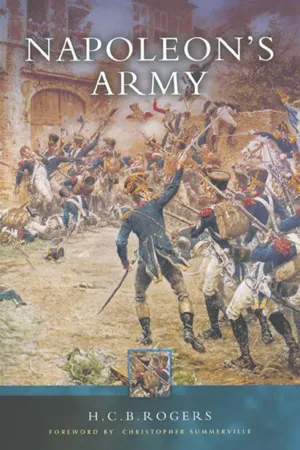
Napoleon's Army
About this book
Many books have been written about Napoleon and his campaigns, but very little about the soldiers of his armies and of the organization and conditions under which they lived and served. In this classic study, now reissued in paperback, H.C.B. Rogers examines Napoleon's army in terms of its staff systems, its arms and its supporting services as it existed and changed during the long period that separated the battles of Valmy and Waterloo. This is not another history of Napoleon's campaigns. Apart from the brief narrative of the opening chapter designed to serve as an aide-memoire, military operations are only cited to illustrate organization, tactics, equipment and administration. The author seeks to show how, as Lord Wavell put it, Napoleon inspired 'a ragged, mutinous, half-starved army and made it fight as it did'.
Information
CONTENTS
Foreword
Introduction
1 From Valmy to Waterloo
2 Cavalry
3 Infantry
4 Artillery
5 Engineers and Signals
6 Administration
7 Medical
8 Imperial Headquaters
9 The Third Corps – Auerstaedt
10 The Third Corps – Poland
11 Epilogue
Index
FOREWORD
‘Troops are made to let themselves be killed,’ Napoleon once observed philosophically. And killed they were: between 1792 and 1814 France lost some 1,500,000 of her sons, drowned in a river of blood, for the sake of Revolution and Empire. But what of these soldiers? How were they trained, equipped, organised? As author Colonel Rogers points out:‘Many books have been written about Napoleon and his campaigns, and the great battles fought by his armies have been described time and time again. Much less has been written about the soldiers of those armies and of the organisation and conditions under which they lived and served.’ The present volume, then, seeks to plug this gap in our knowledge.
Bonaparte began reforming the French Army in 1802. After years of neglect, the military had fallen into something of a decline, but the energetic first consul set to work to create a new national force: bad officers were weeded out, good ones promoted; intensive training was introduced; shortages in horses and guns addressed; and the basic structure of command and control reorganised and revitalised. Encamped at Boulogne, and ostensibly preparing for the invasion of Great Britain, the French Army was gradually honed into a first class military machine. In the words of Dumas, the camp at Boulogne was ‘The best and most complete war school that could have ever been conceived.’
Proclaimed emperor in May 1804, Napoleon required a Grand Army and the work of reform and reorganisation continued apace. This included the appointment of eighteen marshals to oversee the Army, under Napoleon’s direct authority. This was followed by a personal inspection of the camp at Boulogne, a scene described Bourrienne, the emperor’s biographer:
‘When he reviewed the troops, he asked the officers and often the soldiers in what battles they had been engaged, and to those who had received serious wounds he gave the cross [the prestigious Legion of Honour]. Here, I think, I may appropriately mention a singular piece of charlatanism to which the emperor had recourse, and which powerfully contributed to augment the enthusiasm of his troops. He would say to one of his aides-de-camp, “Ascertain from the colonel of such a regiment whether he has in his corps a man who has served in the campaigns of Italy or of Egypt. Ascertain his name, where he was born, the particulars of his family, and what he has done. Learn his number in the ranks, and to what company he belongs, and furnish me with the information.” … On the day of the review, Bonaparte, at a single glance, could perceive the man who had been described to him. He would go up to him as if he recognized him, address him by his name, and say,“Oh! So you are here! You are a brave fellow - I saw you at Aboukir - how is your old father? What! Have you not got the cross? Stay, I will give it to you.” Then the delighted soldiers would say to each other, “You see the emperor knows us all; he knows our families; he knows where we have served.” What a stimulus was this to soldiers, whom he succeeded in persuading that they would all, some time or another, become marshals of the empire!’
On 5 December 1804, three days after his coronation, Napoleon held a grand festival on the Champs de Mars, and distributed regimental standards-the celebrated imperial eagles-to the regiments that formed the Paris garrison. According to Furse, in Campaigns of 1805, ‘Napoleon addressed his troops thus: “Soldiers, behold your flags; these eagles will serve you always as rallying points; they will be wherever your Emperor may judge it necessary for the defence of his throne and of his people. Swear to sacrifice your life to defend them, and to keep them always by your courage on the path of victory. Do you swear it?” Thousands of voices replied with enthusiasm, “We do swear it.” The army kept its oath, for in less than twelve months the same eagles, after a series of sanguinary combats, were waving on the walls of Vienna and floating in the breeze on the plateau of Pratzen.’
Central to Napoleon’s reforms was the subdivision of the Army into corps: big, self-contained units of all arms, which were in effect, separate miniature armies. Each corps was placed under the command of a senior general or marshal, while Napoleon retained the command in chief. The main benefits of this system were speed and flexibility: with several self-reliant forces, capable of fending off large enemy units until reinforced, Napoleon could march rapidly over available roads (40 km per day, according to Georges Blond) without having to concentrate his army into one dense, slow-moving mass. And by keeping his corps within a day’s march of each other, Napoleon could rapidly change from dispersion to concentration, as circumstances demanded. The corps system was a major ingredient in the emperor’s military success and it was rapidly copied by his enemies.
In Napoleon’s Army, Colonel Rogers examines the corps system in detail, along with a fascinating array of facts and figures covering all aspects of the Grand Army’s organisation and effectiveness in the field. The battles and campaigns are briefly and clearly outlined, to give essential background, but the book is primarily an in-depth study of the hard-marching, hard-fighting Napoleonic war machine, from its birth at Boulogne, through its years of triumph, to disaster at Waterloo. Along the way, the author answers how, as Lord Wavell put it, Napoleon ‘inspired a ragged, mutinous, half-starved army and made it fight as it did’.
Fondly regarded by leading Napoleonic scholars and aficionados as the book which turned them on to this fascinating period, Rogers’ authoritative study is now available in a paperback edition accessible to all. The author was a distinguished military historian and an expert on the campaigns and armies of the Napoleonic Wars. His best-known books are The British Army in the Eighteenth Century, The Confederates and the Federals at War, Wellington’s Army, Artillery Through the Ages, Weapons of the British Soldier and Tanks in Battle.
Christopher Summerville, York 2004
INTRODUCTION
The French Revolution inaugurated a form of warfare in which the long-service armies of the eighteenth century, waging campaigns with limited objectives, were replaced by national armies of conscripted men fighting for total victory: a form of warfare with which we have become all too familiar. That Napoleon, in commanding such armies, was so successful was due perhaps as much to his understanding of his soldiers and his personality as a leader of men, as to his brilliant generalship. Field Marshal Lord Wavell wrote, ‘If you discover how … he inspired a ragged, mutinous, half-starved army and made it fight as it did, how he dominated and controlled generals older and more experienced than himself, then you will have learned something.’ And Major-General J. F. C. Fuller, in his The Conduct of War (1961), draws attention to Napoleon’s following Order of the Day: ‘A battalion commander should not rest until he has become acquainted with every detail; after six months in command he should know the names and abilities of all the officers and men of his battalion.’ Napoleon set out to make every man feel that it was a privilege to belong to the French Army; and he knew that the mentality of the French soldier would respond to such appeals as: ‘All men who value life more than the glory of the nation and the esteem of their comrades should not be members of the French Army.’ General Fuller quotes him as saying: ‘When in the fire of battle I rode down the ranks and shouted: “Unfurl the standards! The moment has at length come!” it made the French soldier leap into action.’ And, ‘The 32nd Brigade would have died for me, because after Lonato I wrote: “The 32nd was there, I was calm.” The power of words on men is astonishing.’
The personality of this remarkable man was so tremendous that he is perhaps the only general in history who was so reflected in the army he commanded that it is impossible to discuss one without the other.
CHAPTER ONE
FROM VALMY TO
WATERLOO
The wars with which we are concerned began on 20th April 1792 when the French Assembly declared war on Austria. Hostilities had been threatened from the previous August when the Emperor of Austria and the King of Prussia declared that they were ready to join other Powers to restore the authority of the French monarchy. Revolutionary France hurriedly prepared for war and on 14th December 1791 three armies were formed for the defence of the northern and eastern fronti...
Table of contents
- Cover
- Title Page
- Copyright
- Contents
Trusted by 375,005 students
Access to over 1.5 million titles for a fair monthly price.
Study more efficiently using our study tools.
Frequently asked questions
Yes, you can cancel anytime from the Subscription tab in your account settings on the Perlego website. Your subscription will stay active until the end of your current billing period. Learn how to cancel your subscription
No, books cannot be downloaded as external files, such as PDFs, for use outside of Perlego. However, you can download books within the Perlego app for offline reading on mobile or tablet. Learn how to download books offline
Perlego offers two plans: Essential and Complete
- Essential is ideal for learners and professionals who enjoy exploring a wide range of subjects. Access the Essential Library with 800,000+ trusted titles and best-sellers across business, personal growth, and the humanities. Includes unlimited reading time and Standard Read Aloud voice.
- Complete: Perfect for advanced learners and researchers needing full, unrestricted access. Unlock 1.5M+ books across hundreds of subjects, including academic and specialized titles. The Complete Plan also includes advanced features like Premium Read Aloud and Research Assistant.
We are an online textbook subscription service, where you can get access to an entire online library for less than the price of a single book per month. With over 1.5 million books across 990+ topics, we’ve got you covered! Learn about our mission
Look out for the read-aloud symbol on your next book to see if you can listen to it. The read-aloud tool reads text aloud for you, highlighting the text as it is being read. You can pause it, speed it up and slow it down. Learn more about Read Aloud
Yes! You can use the Perlego app on both iOS and Android devices to read anytime, anywhere — even offline. Perfect for commutes or when you’re on the go.
Please note we cannot support devices running on iOS 13 and Android 7 or earlier. Learn more about using the app
Please note we cannot support devices running on iOS 13 and Android 7 or earlier. Learn more about using the app
Yes, you can access Napoleon's Army by H. C. B. Rogers in PDF and/or ePUB format, as well as other popular books in History & 19th Century History. We have over 1.5 million books available in our catalogue for you to explore.