"A simply magnificent book describing the Italian Navy of the Second World War, profiling all classes of vessels, from battleships . . . [to] submarines." —
Pegasus Archive
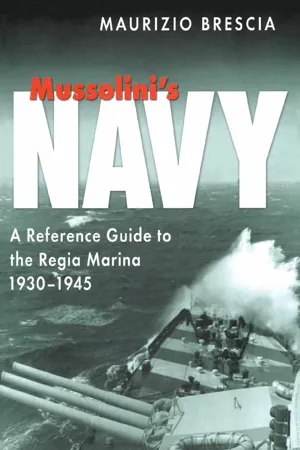
This book is a complete guide to the Regia Marina, the navy with which Italy fought the Second World War. Starting with the historical background, it describes how the navy developed, how it was organized, the facilities that supported it, and the operations it conducted both before and after the armistice in 1943. It also details all its ships, with full technical particulars, plans and photos. Furthermore, there are chapters on special topics like camouflage; uniforms, decorations and insignia; and a "who's who" of important naval personalities; and the reference value of the book is enhanced by a comprehensive bibliography and guide to sources. The illustration is a noteworthy feature of the book as the author's collection of naval photographs is one of the best in Italy. He is also a fine draughtsman, and his ship plans and color illustrations are both detailed and accurate, adding a particular appeal for modelmakers. Of all the main combatant navies of this era, the Italian is probably the most poorly represented in English publications, so this comprehensive handbook will be especially welcomed by the naval community.
"An overview of the wartime Italian Navy, including its bases and organization, ships and aircraft . . . an enjoyable book." —
Warships International Fleet Review
"A major achievement and a milestone in the renaissance of Italian Naval history . . . [the] book is a gem and is thoroughly recommended." —
The Navy Vol 75
- 240 pages
- English
- ePUB (mobile friendly)
- Available on iOS & Android
eBook - ePub
About this book
Information
Contents
Foreword
Introduction and Acknowledgements
CHAPTER 1
The Regia Marina from 1861 to 1939
The Regia Marina from 1861 to 1939
The Early Years
Among the European Powers
The Regia Marina in the First World War and Naval Operations in the Adriatic
The Regia Marina 1919–1939
CHAPTER 2
Dockyards, Naval Bases, Ports, Shipyards and Coast Defences
Dockyards, Naval Bases, Ports, Shipyards and Coast Defences
Naval Bases
Shipyards
Coast Defences
CHAPTER 3
Fleet Organisation and Operations
Fleet Organisation and Operations
The Regia Marina at war 1940–5 – a brief chronology
Convoy Operations
Submarines in the Atlantic
The Black Sea and the Red Sea
CHAPTER 4
Ships in Service 1940–5
Ships in Service 1940–5
Battleships
Aircraft Carriers
Heavy Cruisers
Light Cruisers
Old, Miscellaneous and War Prize Cruisers
Destroyers
Torpedo Boats
Escort Vessels
MAS, MTBs and VAS
Submarines
Miscellaneous Warships
CHAPTER 5
Surface and Underwater Assault Craft
Surface and Underwater Assault Craft
Surface Assault Craft
Underwater Assault Craft
CHAPTER 6
Naval Aviation
Naval Aviation
CHAPTER 7
Italian Naval Camouflage in the Second World War
Italian Naval Camouflage in the Second World War
Identification Letters and Hull Numbers
Colour Section
CHAPTER 8
Flags
Flags
CHAPTER 9
Uniforms, Ranks, Insignia and Decorations
Uniforms, Ranks, Insignia and Decorations
Uniforms
Ranks and Insignia
Decorations
CHAPTER 10
‘Who’s Who’ of the Italian Navy in the Second World War
‘Who’s Who’ of the Italian Navy in the Second World War
Flag Officers
Other Personnel
Selected Bibliography
Notes on the Photographic Sources
Index
Foreword
DESPITE THE TITLE OF this volume, the Italian Navy was never particularly fascist. This does not mean that the Regia Marina’s officers and men were opponents of the Mussolini regime, just that they were no more Fascist than the rest of the Italian population, especially in the 1930s – although the traditionally monarchist officer corps was somewhat more critical of the regime. This is perhaps indicated by the fact that only two battleships (Littorio and Impero), two destroyers (Camicia Neva and Squadrista) and a few other minor vessels bore Fascist names.
Between the two world wars, the Italian navy undertook an expansion programme which, despite the strain it imposed on the state finances, brought it almost to the same level as the French navy, its traditional rival, which is to say to fourth or fifth place in the navies of the world. However, when Italy declared war on France and Great Britain on 10 June 1940, this programme was still two years from completion. Nevertheless, on that date, the Regia Marina had two modernised battleships in commission (two similar ships and two modern ‘35,000-ton’ battleships of the Littorio class were fitting out), seven heavy cruisers, twelve light cruisers, almost sixty destroyers and thirty-five modern torpedo boats, as well as a large underwater arm with 115 operational submarines. This was a balanced group of well-built ships, robust and of recent design but the Italian Navy lacked aircraft carriers which, despite studies in the 1920s and 1930s, were never built because of the mistaken estimation (in particular within the navy itself) of their operational effectiveness in the restricted waters of the Mediterranean.
The lack of aircraft carriers – and of an adequate naval aviation arm – was not the Italian Navy’s only shortcoming in this period. Development of radar and sonar equipment had been neglected, the problems this caused being exacerbated by the limited effectiveness of antiaircraft and other guns designed before the mid-1930s. Hull designs and machinery were, however, generally excellent, granting high speeds but at the cost of endurance owing to high rates of fuel consumption. These deficiencies were not solely due to bad planning by the Regia Marina but largely because of problems in Italian industry, not least the almost ‘cottage industry’ state of the electronics sector.
At the same time, the Regia Marina was also expanding and upgrading its dockyards and naval bases both in Italy and the colonies, but shortage of money prevented this expansion from meeting actual requirements. Likewise, coastal defences could not be upgraded to the extent required. On the other hand, the naval training establishments were expanded, providing excellent training for officers and ratings: at the beginning of 1940 the personnel of the Regia Marina reached the considerable number of 140,000 men (officers, petty officers and ratings), similar to the levels at the end of the First World War.
All this – and much more – is addressed in this volume, representing a wide-ranging descriptive analysis of the Italian Navy, its ships and its organisation in the Second World War. All the ships, from battleships to the small yet effective human torpedoes and assault craft, as well as naval bases and major support infrastructure, are described in this book, enhanced with an impressive number of high-quality photographs and specially-commissioned drawings.
This is certainly the first ‘companion’ of this kind presented to English-language readers who have in recent years demonstrated a growing interest in the Italian Navy whose ships and men, despite frequent bad luck and facing superior numbers, fought gallantly between June 1940 and September 1943.
Erminio Bagnasco
Editor of the Italian monthly magazine
STORIA militare
Editor of the Italian monthly magazine
STORIA militare

Aboard the battleship Cesare, on the afternoon of 7 July 1940, the ship’s CO, Capt. Angelo Varoli Piazza, and two ensigns carry the battleship’s battle flag and ensign from the officer’s quarters (where they were usually stowed) up to the signal bridge and to the conning tower shortly before the ship’s departure on the mission that would conclude with the Battle of Punta Stilo on 9 July 1940. (E Bagnasco collection)
Table of contents
- Cover
- Half Title Page
- Title Page
- Copyright Page
- Contents
Trusted by 375,005 students
Access to over 1.5 million titles for a fair monthly price.
Study more efficiently using our study tools.
Frequently asked questions
Yes, you can cancel anytime from the Subscription tab in your account settings on the Perlego website. Your subscription will stay active until the end of your current billing period. Learn how to cancel your subscription
No, books cannot be downloaded as external files, such as PDFs, for use outside of Perlego. However, you can download books within the Perlego app for offline reading on mobile or tablet. Learn how to download books offline
Perlego offers two plans: Essential and Complete
- Essential is ideal for learners and professionals who enjoy exploring a wide range of subjects. Access the Essential Library with 800,000+ trusted titles and best-sellers across business, personal growth, and the humanities. Includes unlimited reading time and Standard Read Aloud voice.
- Complete: Perfect for advanced learners and researchers needing full, unrestricted access. Unlock 1.5M+ books across hundreds of subjects, including academic and specialized titles. The Complete Plan also includes advanced features like Premium Read Aloud and Research Assistant.
We are an online textbook subscription service, where you can get access to an entire online library for less than the price of a single book per month. With over 1.5 million books across 990+ topics, we’ve got you covered! Learn about our mission
Look out for the read-aloud symbol on your next book to see if you can listen to it. The read-aloud tool reads text aloud for you, highlighting the text as it is being read. You can pause it, speed it up and slow it down. Learn more about Read Aloud
Yes! You can use the Perlego app on both iOS and Android devices to read anytime, anywhere — even offline. Perfect for commutes or when you’re on the go.
Please note we cannot support devices running on iOS 13 and Android 7 or earlier. Learn more about using the app
Please note we cannot support devices running on iOS 13 and Android 7 or earlier. Learn more about using the app
Yes, you can access Mussolini's Navy by Maurizio Brescia in PDF and/or ePUB format, as well as other popular books in History & Italian History. We have over 1.5 million books available in our catalogue for you to explore.