"A fascinating and well-written account of a failed military operation that deserves to be on the bookshelves of all those interested in naval history." —Marine News
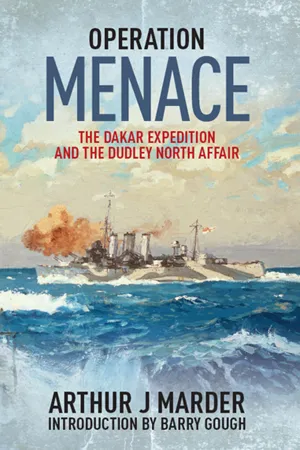
Continuing on from his study of the Oran operation of July 1940, when the French warships were destroyed at Mers-el-Kébir, the author investigates the allied expedition of September that year, with De Gaulle present, which unsuccessfully attempted to break the French at Dakar away from the Vichy Government. In addition, there is the story of the Admiral Sir Dudley North, Flag Officer Commanding at Gibraltar at the time, who was relieved from his post after allowing a French naval squadron to pass out of the Mediterranean and so jeopardize the Dakar operation.
A pet operation of Prime Minister Churchill, it was undertaken against all advice, and it turned out to be a fiasco. In the author's words, "Menace exemplifies, in its genesis, planning, and execution, all that can go wrong in warfare; an operation fouled up by unforeseen contingencies, the accidents of war, and human error, and against a background of undue political interference, inadequate planning, and half-baked cooperation between Allies."
Using Admiralty and Cabinet papers, as well as private sources of information, Marder weaves a skilled course through all the complex material to produce a masterly case-study of how an operation is mounted and how it can go disastrously wrong. It is a classic, tragi-comic illustration of the fog of war.
"Marder's analysis is neutral and objective; his research is exhaustive and its results instructive . . . This is an example of naval history at its best and this volume is strongly recommended." —Warship World
- 320 pages
- English
- ePUB (mobile friendly)
- Available on iOS & Android
eBook - ePub
About this book
Information
Topic
HistoriaSubtopic
Historia militar y marítimaPart One
The Story of ‘Menace’
A STUDY IN THE FOG OF WAR
The story of the Dakar episode deserves close study, because it illustrates in a high degree not only the unforeseeable accidents of war, but the interplay of military and political forces, and the difficulties of combined operations, especially where allies are involved. To the world at large it seemed a glaring example of miscalculation, confusion, timidity, and muddle.
Churchill, Their Finest Hour
Chapter One
‘Menace’ is Born
I thus undertook in an exceptional degree the initiation and advocacy of the Dakar expedition.
Churchill, Their Finest Hour
(Charts 1, 5)
(1) The Situation in July 1940
THE vigorous British action in the first week of July to prevent the major French naval units from falling into enemy hands had met with only partial success but had (especially Oran, 3 July) precipitated a grave crisis in Anglo-Vichy French relations. Marshal Pétain, ‘Chief of the French State’, made official the rupture of diplomatic relations with Great Britain that had existed since the departure of the British Ambassador and his entire staff from France on 22 June. Although war had been averted, sources of friction remained. Anglophobia in Vichy was fed by the stepped-up British propaganda against the new régime, including the dropping of leaflets in Morocco; by the development of the Free French organization in London, with official British approval and support (Vichy considered de Gaulle a British puppet); by the efforts, through British agents, to provoke the French colonies, particularly in North and West Africa, to declare their independence of Vichy; and by the announcement in the House of Commons on 30 July of a War Cabinet decision of 13 July, that the blockade of Germany would be extended to French North Africa. (A decision of 25 June, made known in the Commons on 2 July, had already extended the blockade of Germany to the whole of metropolitan France, occupied and unoccupied.) The blockade could easily lead to open hostilities between Britain and Vichy France, if it proved effective and thereby provoked the French to try to force it. In practice, the extension of contraband control to North Africa was nominal, since there were not enough ships to enforce it. To sum up, tensions had increased dangerously in the weeks following Oran. One serious incident might bring on outright war. On the other hand, the French Admiralty and Foreign Office, as will be brought out in due course, were giving signs of a more friendly disposition.
The absence of direct official relations was a severe handicap in ironing out differences and misunderstandings. The exchange of diplomatic correspondence through the British and French ambassadors in Madrid, and the retention in London by Vichy of the French Consul-General as Acting French Agent to liquidate French economic interests, were pis-allers, no more. The Foreign Secretary, Lord Halifax, was ‘doubtful whether even unofficial relations with France will stand the strain of the action we are taking in the matter of French ships, in the French colonies, in encouraging the resistance of free Frenchmen, in conducting propaganda, in blockading and bombarding France.1 Two months later the British precipitated a crisis that put the tenuous British-Vichy relationship under an almost unendurable strain.
The catalytic agent was that remarkable personality, General Charles de Gaulle, whom the British Government had recognized on 28 June as the ‘leader of all free Frenchmen wherever they might be, who will rally to him in support of the Allied cause’. The catalytic event stemmed from de Gaulle’s African schemes.
A pen portrait of de Gaulle at this time reads:
A strange-looking man, enormously tall; sitting at the table he dominated everyone else by his height, as he had done when walking into the room. No chin, a long, drooping elephantine nose over a closely-cut moustache, a shadow over a small mouth whose thick lips tended to protrude as if in a pout before speaking, a high, receding forehead and pointed head surmounted by sparse black hair lying flat and neatly parted. His heavily-hooded eyes were very shrewd. When about to speak he oscillated his head slightly, like a pendulum, while searching for words.2
De Gaulle’s weaknesses are well known. He was an exceptionally difficult man to deal with—proud to the point of arrogance, aloof, direct, autocratic, austere, irascible, stubborn, self-righteous, vain, hyper-sensitive in some ways, thick-skinned in others, and trusting no one completely. Though of a retiring disposition, he was, in a social situation, neither dour nor lacking a sense of humour. He was a man of vast culture, with a powerful brain, and an enormous capacity for work and to lead men. ‘Certain men,’ he once wrote, ‘have, one might almost say from birth, the quality of exuding authority.’ In military matters his decisions were quick and generally sound. He passionately hated the Germans, but at the same time had a fundamental distrust of Britain and her rulers. Major-General Spears, who as Churchill’s personal representative with de Gaulle (‘Head of the British Mission’ to him) came to know the General well, writes: ‘He could neither understand nor accept that when we said we had no territorial ambitions at France’s expense, we meant it, nor believe that we would not somehow, sometime, succumb to the temptation to help ourselves to a tempting morsel of the French empire’.3 Never in dispute were de Gaulle’s fervid nationalism—his belief in and love of France—and his absolute faith in the eventual restoration of her independence and her greatness. ‘His one ambition was to serve the goddess he revered more than all the saints in heaven—France’ (Spears). In spite of the difficulties and differences between de Gaulle and the British Commanders in the Dakar operation, the latter could not but admire his utter dedication, dignity, and belief in himself.
In July 1940 no part of France, metropolitan or colonial, had rallied to de Gaulle. His supporters were few and he had himself been sentenced to death in absentia by a court martial in Toulon late in June. Where to begin to build the Free French movement into a national endeavour? ‘It all really began in Africa’, a Gaullist remarked after the war. Why Africa? De Gaulle gives us the raison d’etre, of which this is the most cogent part:
To take part in the Battle of Africa with French forces and territories was to bring back, as it were, a fragment of France into the war. It was to defend her possessions directly against the enemy. It was, as far as possible, to deflect England—and perhaps one day America—from the temptation to make sure of them on their own account, for their fighting needs and for their advantage. It was, lastly, to wrench Free France free from exile and install her in full sovereignty on national territory.
But where should we start upon Africa?4
Prospects were poor in French North Africa, where a ‘wait and see’ attitude, together with much hostility to de Gaulle, prevailed. Even a very large force would be received with hostility, he believed, and especially since Oran. But ‘the fire was smouldering’ in the French Cameroons and the Equatorial African territories, which had close economic ties with the British colonies in West Africa.5 On 13 August three Gaullist ‘missionaries’ (Major Claude Hettier de Boislambert, General Philippe Leclere, and René Pleven) arrived in Lagos (British Nigeria) with the object of rallying these French territories. Meanwhile, de Gaulle was preparing to carry out the other part of his African plan, the rallying of French West Africa and its principal city and capital, Dakar, in the Vichy-controlled colony of Senegal.6 The General had a special motive here. Establishing a seat for his government in such a large and strategically important centre as Dakar would enhance the prestige of the Free French movement and its leader, while at the same time checking any British designs on that great naval base and its prize, the uncompleted 35,000-ton battleship Richelieu, damaged but repairable. De Gaulle was confident that Dakar, itching to be free, would rally to the Cross of Lorraine. There were other players and other stakes.
The British interest in Dakar was primarily strategic. Located on the westernmost point of Africa, it had all the requisites of a good port. The approach was easily fortified, there was no bar such as existed in most West African coastal ports, and the reasonably deep-water harbour was well sheltered. The large artificial harbour protected by breakwaters was perfectly sheltered and free from swell. Intelligence reports suggested that the Germans were planning to make use of the port. In German hands Dakar would provide a very effective base for operations by U-boats, surface raiders, and aircraft against British sea communications in the North and South Atlantic, and particularly against the shipping and troop convoys around the Cape of Good Hope. These routes were vital, since communications with the Middle East, India, and Australia via the Mediterranean and Suez Canal were hazardous after Italy entered the war in June 1940. Also, the Germans, if they acquired Dakar, would pose a threat to British communications with their West African colonies, the enclaves of Gambia, Sierre Leone, the Gold Coast, and Nigeria, on the southern coast of French West Africa. The Germans, moreover, would have a base for offensive action against these colonies and for depriving the British of the use of Freetown, thereby complicating their task of convoying ships by the Cape route. There were, then, weighty reasons for keeping the Germans out of Dakar. But there were equally important advantages to Britain in seizing Dakar for her own use. If available to British convoys and escorts, it would be a useful addition to the limited resources of Freetown in Sierre Leone, the only British naval base in West Africa, as a base for anti-submarine operations. Other rich prizes at Dakar were the Richelieu, and the vast quantity of Belgian and Polish gold, amounting to 65 billion francs, which the Banque de France had transferred to Dakar in June. Finally, there was a political prize to be won. The whole of French West Africa under Free French control would serve as a buffer against German penetration from Dakar, about which the British administration in Nigeria, above all, had nightmares. On instructions from the Chiefs of Staff, the Joint Intelligence Sub-Committee examined the question of a German or Italian offensive against Dakar and concluded: ‘If the British Navy were no longer able to use Gibraltar as a base and had therefore no base between Plymouth and Freetown, we think that an enemy expedition against Dakar would have a very fair chance of evading interception.’7
The British concern over Dakar was paralleled and reinforced by the attitude of the United States. Though still neutral, the Americans had a powerful stake in the future of Dakar. U-boats operating from that base would threaten American as well as Allied shipping, and the proximity of Dakar to the bulge of Brazil (1,700 miles) posed another potential danger to American interests. To keep an eye on the developing situation in Dakar, in August 1940 the Americans decided to reopen their consulate. (It had been closed in 1931 for economy reasons.) The Consul, Thomas C. Wasson, arrived in Dakar on 15 September, a week before the sudden appearance of an Allied armada off the port.
We must bear in mind the persistent reports in London and Washington that the Germans were infiltrating into Dakar as emissaries of one kind or another, or under the guise of ‘tourists’. In the words of a British official announcement issued after the abortive expedition (25 September), ‘H.M. Government were all the more ready to afford General de Gaulle this support as information had reached them that German influence was spreading to Dakar’. The Diplomatic Correspondent of The Times (26 September) wrote of the ‘clear signs’ being received at de Gaulle’s London headquarters for some weeks before the Dakar operation that ‘the Germans and Italians were gently laying their hands on the port: their officers were arriving by air on various excuses’.
We know that Grand Admiral Raeder, C-in-C of the German Navy, would have liked the use of Dakar as a U-boat base for attacks on important convoy routes in the Atlantic.8 He first stressed its extreme value to Hitler at a conference on 20 June, in the course of discussions on the terms of an armistice with France, and again on 11 July. But Hitler then appeared to be more interested in one of the Canary Islands, which he thought he might get free from Spain in exchange for French Morocco. On 6 September, when unbeknown to German intelligence the Anglo-Free French expedition was on its way to Dakar, Raeder once more stressed the value of Dakar for Germany. He pointed out that now that French Equatorial Africa had (as we shall see) sided with de Gaulle, the unrest and uprisings might spread to the colonies in West Africa. ‘An agreement between the colonies and Britain, and revolt against France would jeopardize our own chances of controlling the African area; the danger exists that strategically important West African ports might be used for British convoy activities and that we might lose a most valuable source of supplies for Europe. The danger of an attack on the part of the U.S.A. is not entirely out of the question …’ Nothing happened. The German Naval War Staff continued to stress Dakar’s great value for a successful prosecution of the war in the Atlantic, but this, too, was of no avail. The Naval War Staff realized that the OKW (Supreme Command of the Armed Forces) were too exclusively absorbed in purely Continental questions to appreciate the urgency and importance of the problem of North and West Africa, and that in consequence Hitler was inadequately briefed by the OKW on these problems. From the remarks in the ‘SKL’ (Seekriegsleitung) diary it is obvious that the Naval War Staff were too weakly represented i...
Table of contents
- Cover
- Title Page
- Dedication
- Copyright
- Introduction
- Preface
- A Note on Sources
- Abbreviations
- Contents
- List of Illustrations
- List of Charts
- Calendar of Events
- Part One. The Story of ‘Menace’: A Study in the Fog of War
- Part Two. The Story of Dudley North: Was Justice Done?
Trusted by 375,005 students
Access to over 1.5 million titles for a fair monthly price.
Study more efficiently using our study tools.
Frequently asked questions
Yes, you can cancel anytime from the Subscription tab in your account settings on the Perlego website. Your subscription will stay active until the end of your current billing period. Learn how to cancel your subscription
No, books cannot be downloaded as external files, such as PDFs, for use outside of Perlego. However, you can download books within the Perlego app for offline reading on mobile or tablet. Learn how to download books offline
Perlego offers two plans: Essential and Complete
- Essential is ideal for learners and professionals who enjoy exploring a wide range of subjects. Access the Essential Library with 800,000+ trusted titles and best-sellers across business, personal growth, and the humanities. Includes unlimited reading time and Standard Read Aloud voice.
- Complete: Perfect for advanced learners and researchers needing full, unrestricted access. Unlock 1.5M+ books across hundreds of subjects, including academic and specialized titles. The Complete Plan also includes advanced features like Premium Read Aloud and Research Assistant.
We are an online textbook subscription service, where you can get access to an entire online library for less than the price of a single book per month. With over 1.5 million books across 990+ topics, we’ve got you covered! Learn about our mission
Look out for the read-aloud symbol on your next book to see if you can listen to it. The read-aloud tool reads text aloud for you, highlighting the text as it is being read. You can pause it, speed it up and slow it down. Learn more about Read Aloud
Yes! You can use the Perlego app on both iOS and Android devices to read anytime, anywhere — even offline. Perfect for commutes or when you’re on the go.
Please note we cannot support devices running on iOS 13 and Android 7 or earlier. Learn more about using the app
Please note we cannot support devices running on iOS 13 and Android 7 or earlier. Learn more about using the app
Yes, you can access Operation Menace by Arthur J. Marder in PDF and/or ePUB format, as well as other popular books in Historia & Historia militar y marítima. We have over 1.5 million books available in our catalogue for you to explore.