- 208 pages
- English
- ePUB (mobile friendly)
- Available on iOS & Android
eBook - ePub
About this book
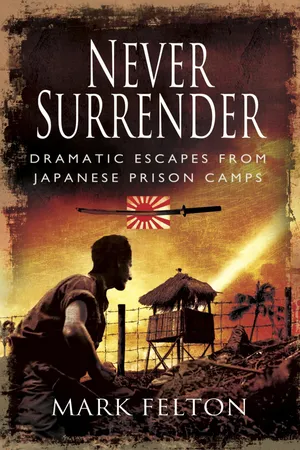
While there have been many fine books covering the appalling experiences and great courage of the many thousands of POWscaptured by the victorious Japanese during late 1941 and early 1942, escape accounts are much rarer. This is due in large part tothe fact that only a comparatively small number of brave souls attempted to escape to freedom rather than suffer brutality,starvation and very possibly death as POWs. However, as Never Surrender vividly describes, there were a significant number who took this desperate course. Escapersfaced challenges far more daunting than those in German hands. They were Westerners in an alien, hostile environment; the terrain and climate were extreme; disease was rife; their physical condition was weak; there was every chance of starvation andbetrayal and, if captured, they faced, at best, the harshest punishment and, at worst, execution. The author draws on escapeattempts from Hong Kong, Thailand, the Philippines, Borneo and China by officers and men of the British, Commonwealth andUS armed forces. As this superbly researched and uplifting book reveals, few escapers found freedom but all are inspiring examples of outstandingand, indeed, desperate courage. The stories told within these pages demonstrate the best and worst of human spirit.
Trusted by 375,005 students
Access to over 1 million titles for a fair monthly price.
Study more efficiently using our study tools.
Information
Subtopic
Women in HistoryIndex
HistoryChapter 1
Escape is Forbidden
The prisoners, for fairly obvious reasons, always have the feeling of being on the edge of a volcano and we find the mentality of our captors so complex when compared to our own that it is difficult to estimate just what is going to happen.
Captain R.M. Horner, Singapore, 1942
Four young white men stood on an idyllic beach with their backs to the gently lapping sea. In times past the beach had resounded to the sounds of fun and pleasure, but now it had become something sinister and terrible. Close by, a group of senior British and Australian officers stood watching the horrific events that unfolded with dreadful certainty. ‘Take aim’ barked out a Japanese officer who stood beside the firing party – four turbaned Indian soldiers armed with British Lee-Enfield rifles. The prisoners tensed but bravely faced down their executioners having refused the blindfolds that the Japanese officer had offered them a few moments before. ‘Fire!’ The rifles crashed out a volley that echoed along the wide and empty Changi Beach in Singapore, startled seabirds lifting off with a cry. Cordite smoke hung in the warm, humid air. The four prisoners were not dead, only wounded. They lay moaning on the sand with their hands tied behind their backs, their blood staining the yellow sand a dark red. Their leader, 39-year-old Acting Corporal Rodney Breavington, called out asking the Japanese to finish them off and end their suffering. The senior officers watching could only shake their heads in disgust and mutter epithets under their breath. A Japanese barked out a series of commands and the Indians fired several more times at the prone men until they were dead. Then the bodies were unceremoniously rolled into the graves that the prisoners had dug for themselves before the execution. Such was the punishment for attempting to escape from the Japanese.
‘If the POWs believed they were victims with rights, to the Japanese they were a sullen, disgraced mob, who had lost their rights as individuals and were to be treated as such.’1 Captain R.M. Horner wrote at the time that the prisoners, for ‘fairly obvious reasons, always have the feeling of being on the edge of a volcano and we find the mentality of our captors so complex when compared to our own that it is difficult to estimate just what is going to happen.’2 In fact, the cultural gulf between the Japanese and their POWs was virtually impossible to bridge and would lead to a great deal of suffering, both intentional and accidental.
Although the Japanese government had signed the Geneva Convention of 1929 it had not been ratified by the Diet, the parliament in Tokyo, so therefore Japanese armed forces were not bound by its terms. This fact eliminated at a stroke the legal protections afforded to prisoners of war in other theatres, such as those fighting the Germans and the Italians. Instead, the Japanese governed their POWs according to their own harsh military code. Surrender was a disgraceful and illegal act under Japanese military law, and the Japanese made no allowances for the fact that Allied troops who surrendered came from an entirely different mindset and culture, where the needless sacrifice of lives when military objectives could no longer be achieved was deemed pointless, and an honourable surrender humane. The Japanese described the Geneva Conventions as ‘The Coward’s Code’, and they meant it. The Allied soldiers had lost their status as combatants when they had raised the white flag and were now effectively persona non grata. Their lives had only been spared because the God-Emperor Hirohito had deigned to do so, and their lives now belonged to the Emperor to do with as he wished.
Some writers have made much of the fact that the Japanese treated captured German and Austro-Hungarian prisoners exceedingly well during the First World War. This is certainly true, but the reasons why they treated POWs like guests in 1914 and like slaves in 1941 are simple. In 1914 Japan, then an ally of Britain, wanted its place in the sun, its seat at the table of the Great Powers. The Japanese military at this time went out of its way to treat European prisoners well, thereby countering any negative view about a rising non-Anglo-Saxon power having a right to rule over Asian territories. If the behaviour of the Japanese military is examined during the 1894 – 95 Sino-Japanese War and the 1905 Russo-Japanese War astonishing cases of massacre, cruelty and ill-treatment of prisoners and civilian populations are found. The activities of the Japanese in China in 1931 and 1937 again point to a wholesale disregard of internationally accepted standards of behaviour on and off the battlefield. By the early 1930s the Japanese had broken with Britain and were being propelled down the path of rampant nationalism and reaction against the Western Powers, who were commonly viewed as attempting to frustrate the ‘right’ of Japan to expand overseas for their own selfish and racist reasons. The experience of prisoners in Japanese hands during the First World War was not atypical of Japanese behaviour in wars both before and after 1914 – 18. ‘We were dealing with a fanatical and temperamental people who, for all practical purposes, only played to the rules when it suited them to do so,’ remarked General Percival, who himself had been a prisoner of the Japanese.
On the issue of escape the Japanese military was curiously confused. Escape was every soldier’s duty under The Hague and Geneva Conventions, and although the Japanese did not apply the Hague Conventions to their POW policy, this did not remove the duty of Allied soldiers to follow it. The Japanese mocked Allied prisoners for their perceived ‘cowardliness’ in being captured, yet it would surely follow in Japanese logic that any prisoner who tried to escape was for a brief moment truly a soldier again, and had therefore in some way regained his martial honour. Yet, instead of taking this view, the Japanese generally treated captured escapers with a brutality that was both sadistic and revealed the moral vacuum at the heart of their military machine. In fact, escape was about the worst possible ‘crime’ that a prisoner could commit in the Japanese military mentality.
Escape was to the Japanese a particularly dangerous transgression because it revealed that their ‘slaves’ were not subservient enough, not cowed and frightened enough of the all-powerful Imperial Army. Importantly, the prisoners had not accepted their ‘shame’ – a significant factor in Japan. Many examples were made in order to terrify Allied POWs into becoming better slaves for their masters but, though beaten and humiliated, they never accepted that role, and many of them took it upon themselves to remind their Japanese masters that they would not be cowed and that they felt no shame for their present circumstances. They escaped from camps and work parties, sabotaged forced labour projects, disobeyed orders, argued with Japanese officers about ‘law’ and ‘rights’ and even worshipped secretly. Their senior officers regularly stood up to the Japanese authorities, even though the consequences were usually painful and sometimes fatal.
General Percival issued a directive to all the prisoners at Changi Prisoner of War Camp that reaffirmed the duty of every soldier to attempt to escape, but cautioned the men that they should only attempt to do so after proper planning had been conducted, and the chances of actually getting away appeared good. Percival knew, as most Allied prisoners knew, that the chances of reaching Allied lines were virtually nil, and once a prisoner had stepped through the wire he was on borrowed time. Simply throwing away lives in pointless escapes was not acceptable to Percival when even basic survival inside the camps was extremely precarious. ‘We had to adjust our actions accordingly,’ wrote Percival. ‘There is nothing to be gained in such circumstances in being obstinate.’3
The attitude of the Japanese to escape attempts, though not yet formalised, was, judging by their general demeanour towards POWs, harsh and bloody. Some men did try to get away from Singapore, but it was incredibly difficult. They were on an island infested by Japanese, deep within Japanese controlled territory, they were white and they could not count on assistance from the civilian population. The Chinese were pro-British to a certain extent, but terrified of the Japanese after the bestial Sook Ching Massacre after the fall of the island, when the Japanese had machine-gunned thousands on the beaches. While many Chinese remained loyal to Britain, many Malays and Indians were openly hostile to their former colonial masters, and they were being actively courted by the Japanese, who were encouraging the spread of anti-colonial nationalist movements within the territories they had occupied and even trying to form quisling foreign legions such as the Indian National Army.
At Changi, Lieutenant Colonel Charles Heath, commanding officer of 9th Coast Regiment, Royal Artillery, was forced to witness the execution of three of his men for attempting to escape in March 1942, around the same time that Acting Corporal Breavington and Private Gale were planning their quest for freedom. On 19 March 1942 Heath was summoned to General Percival’s headquarters inside the camp, and informed that three young soldiers from his regiment, Gunners D. Hunter, J. McCann and G. Jeffries, ‘had been apprehended by the Japanese outside the camp and that the Japanese proposed to shoot them. I went to Headquarters . . . where I was told by Brigadier [Terence] Newbigging that the Japanese were determined to carry out the shooting despite the fact that General Percival had lodged a strong protest against it as being absolutely illegal.’4 Newbigging decided to go and see Lieutenant Okasaki, Supervising Officer at the Japanese Prisoner of War Administration office at Changi. Joining him for the short drive were Heath, Captain B. Griffith, the condemned men’s battery commander, and Padre Watson. As Newbigging pulled in at the Japanese HQ a truck pulled up with the three British gunners loaded aboard. Newbigging spoke to Okasaki at some length, but made no progress. He turned to Heath and told him that the Japanese had rejected Percival’s plea of leniency and they were going to shoot the prisoners.
The officers drove behind the lorry, following it to a quiet beach. On the beach they discovered that the Japanese had dug a large single grave in the sand. Heath and his companions spoke to the three men, but what they said Heath did not record. The Japanese guards led the bound men to the edge of the grave. ‘They were blindfolded and made to kneel down beside the grave at intervals of about one and a half yards. The Japanese firing party of three stood about thirty yards away and fired a volley on an order from the Japanese warrant officer or NCO in charge of them. All three men fell almost simultaneously but not all of them were dead. The firing party and the NCO then walked up to the grave and . . . finished off the prisoners still alive by firing at least 3 more shots.’5 Afterwards, the Japanese soldiers filled the grave in, saluted, and placed some shrubs on the pile of sand in place of a wreath or flowers. The Japanese interpreter present turned to Heath and told him to warn his men ‘that their fate would be the same if any of them were caught trying to escape.’6
At this stage there was no formal Japanese policy concerning the punishment for escapers, but the executions witnessed by Heath were obviously designed to prevent any further attempts at Changi. In this they failed.
Acting Corporal Breavington and Private Gale, the two Australians executed on the beach alongside two British soldiers on 2 September 1942, had made their escape attempt from Singapore two months after Gunners Hunter, McCann and Jeffries had been put to death. Breavington, in civilian life a police sergeant from Northcote, and Gale, a 23-year-old from Toronto, New South Wales, serving with Breavington in the 2/10th Ordnance Workshop Company, RAAOC, managed to seize an open native fishing boat. They spent around six weeks at sea with minimal supplies, rowing and drifting several hundred miles before beaching on an Indonesian island where they were promptly recaptured. On 12 July 1942 both men had been admitted to Changi Military Hospital suffering from starvation and tropical diseases, Gale recovering more quickly than the older Breavington. The fact that the Japanese sent them to hospital indicates that they were unsure of how to punish them at this stage. In the case of Gunners Hunter, McCann and Jeffries in March 1942, the Japanese had shot all three men for the ‘crime’ of attempted escape.
Once Breavington and Gale were fit they were discharged back into Changi Camp. It was at this point, in August 1942, that the Japanese decreed all Allied POWs must sign a document, which read: ‘I hereby, on my honour, promise that I will not attempt to escape.’7 The penalty for breaching this contract was, unsurprisingly, death. Senior Allied officers were appalled by this breach of the accepted Rules of War, not to mention The Hague and Geneva Conventions, and they told their men not to sign.
The Japanese use of ‘non-escape pledges’ and similar good conduct documents requiring the signatures of POWs was unique in the history of warfare. It revealed that the Japanese military wished to formalise its regulations for POWs concerning escape by making prisoners responsible for their own illegal ill treatment and murder. The documents served to remove from POWs their internationally recognised legal protections under the Rules of War and to replace them with a set of completely arbitrary regulations that could be applied according to the whims of Japanese commanders rather than through any real legal process. The Japanese also revealed the cynical nature of their requests by often breaking their word in agreements with Allied POWs, and in denying prisoners any due process of military law, even Japanese military law, in cases of escape or overt resistance to Japanese regulations.
Major General Hervey Sitwell, commanding British forces on Java, surrendered on 12 March 1942 to Lieutenant General Maruyama of 2nd Imperial Guards Division. During the surrender negotiations General Sitwell recalled that both he and his RAF commander, Air Vice Marshal Paul Maltby, were specifically concerned about the application of the Geneva Conventions. ‘When the terms were originally handed to Air Vice Marshal Maltby and myself, they were of unconditional surrender, and that all troops would obey absolutely any orders of the Japanese troops,’8 remarked Sitwell. Both Sitwell and Maltby were cautious of signing any document without proper assurances. ‘I, and I think Air Vice Marshal Maltby also, asked Maruyama through his interpreter whether that would mean we would have the benefit of the Geneva Convention.’9 General Maruyama ‘said that we should certainly have the benefit of the Geneva Convention, and accordingly a statement to this effect was included in the surrender terms.’10 Sitwell and Maltby remained suspicious and they demanded further written assurances from Maruyama. ‘Maltby suggested that the word “lawful” should be inserted before the word “orders”, but the Japanese refused to insert this word, arguing that no orders given by the Japanese would be illegal, and further that we were completely covered against illegal orders by the promise that the conditions of the Geneva Convention would be fulfilled.’11 We can perhaps suggest that Sitwell and Maltby were naïve or overly trusting, as it was well known that the Japanese had rejected the Geneva Conventions in other wars, but in such a position the Allied leaders had to try and obtain the best treatment possible for their men.
General Sitwell discovered that the Japanese were barefaced liars just eight days after signing the surrender document when he was brutally interrogated for military information in direct violation of the Geneva Conventions. On 20 March 1942 Sitwell was taken before a Major Saito of the Kempeitai Military Police in Bandoeng. Saito was described by Sitwell as ‘very dark; wore spectacles; very Japanese in appearance; rather a projecting jaw; had a most villainous face.’ Sitwell recalled in 1945, ‘He asked me a number of questions which I refused to answer, the upshot of which was that Saitu [sic] said I must answer and that I was only a prisoner. He then threatened me and said that it would cost me my life if I did not answer.’12 Sitwell thought that Saito was bluffing. ‘I said that under the Geneva Convention he could not make use of threats. His answer to this was that Japan only stuck to the Geneva Convention when it suited her the same as Britain did. I got angry at this and turned my back on Saitu, whereupon he gave an order to the guard and I was taken outside.’13 The 46-year-old British Major General was frogmarched to a grubby concrete cell, ‘where I was handed over to about five dirty Japanese who were in uniform . . . They proceeded to beat me up with their hands and boots, kicking me in the ribs frequently and about the head.’ Some of the guards even stamped on Sitwell’s head, the others ‘endeavoured to remove my badges of rank which I was wearing, and I was eventually knocked unconscious.’14 Following this assault, Sitwell endured eighteen days of solitary confinement; much of it bound up and forced to sit on the floor. If the Japanese could treat a captured general in this fashion, their attitude towards junior officers and other ranks would be easy to guess.
In July 1942 the Japanese authorities at Bicycle Camp in Java ordered all British, Australian, American and Dutch prisoners to sign a form promising that they would obey all orders of the Imperial Japanese Army, including not attempting to escape. The prisoners discussed the wording of the pledge and they demanded that the phrase ‘subject to the oath of allegiance I have already taken’ be added to the document as a disclaimer before they would sign it. This decision was unanimous, and the reaction of the Japanese was predictable intransigence followed swiftly by threats and violence.
...Table of contents
- Dedication
- Title Page
- Copyright Page
- Table of Contents
- Acknowledgements
- Introduction
- Chapter 1 - Escape is Forbidden
- Chapter 2 - Fast Boat to China
- Chapter 3 - The BAAG and a Great Escape
- Chapter 4 - ‘This is the BBC’
- Chapter 5 - Ten Escape from Tojo
- Chapter 6 - Three Thousand Miles to Freedom
- Chapter 7 - Officially Dead
- Chapter 8 - March into Oblivion
- Appendix A - Asia-Pacific War Timeline
- Appendix B - Roll of Honour
- Appendix C - Speech by Lieutenant Colonel Y. Nagatomo, Chief No. 3 Branch Thailand POW Administration to Allied POWs at Thanbyuzayat Camp, Burma, 28 October 1942
- Notes
- Bibliography
- Index
- ALSO AVAILABLE FROM THE SAME AUTHOR
Frequently asked questions
Yes, you can cancel anytime from the Subscription tab in your account settings on the Perlego website. Your subscription will stay active until the end of your current billing period. Learn how to cancel your subscription
No, books cannot be downloaded as external files, such as PDFs, for use outside of Perlego. However, you can download books within the Perlego app for offline reading on mobile or tablet. Learn how to download books offline
Perlego offers two plans: Essential and Complete
- Essential is ideal for learners and professionals who enjoy exploring a wide range of subjects. Access the Essential Library with 800,000+ trusted titles and best-sellers across business, personal growth, and the humanities. Includes unlimited reading time and Standard Read Aloud voice.
- Complete: Perfect for advanced learners and researchers needing full, unrestricted access. Unlock 1.4M+ books across hundreds of subjects, including academic and specialized titles. The Complete Plan also includes advanced features like Premium Read Aloud and Research Assistant.
We are an online textbook subscription service, where you can get access to an entire online library for less than the price of a single book per month. With over 1 million books across 990+ topics, we’ve got you covered! Learn about our mission
Look out for the read-aloud symbol on your next book to see if you can listen to it. The read-aloud tool reads text aloud for you, highlighting the text as it is being read. You can pause it, speed it up and slow it down. Learn more about Read Aloud
Yes! You can use the Perlego app on both iOS and Android devices to read anytime, anywhere — even offline. Perfect for commutes or when you’re on the go.
Please note we cannot support devices running on iOS 13 and Android 7 or earlier. Learn more about using the app
Please note we cannot support devices running on iOS 13 and Android 7 or earlier. Learn more about using the app
Yes, you can access Never Surrender by Mark Felton in PDF and/or ePUB format, as well as other popular books in History & Women in History. We have over one million books available in our catalogue for you to explore.