![]()
Chapter One
Early Days – Ausf A–C
Development of Hitler’s Panzer Mk IV medium support tank commenced in the mid-1930s at the same time as that of the Mk III medium tank. The latter was codenamed the Zugführerwagen (platoon commander’s vehicle) and the former the Bataillonsführerwagen (battalion commander’s vehicle), so were dubbed the ZW and BW series respectively. Each was assigned differing roles. As early as 1930 the German Army High Command, through the Heereswaffenamt Wa Prüf VI (Army Ordnance Department 6), had requested that Krupp and Rheinmetall-Borsig each produce a support tank prototype. This had to be done secretly, along with all other tank development, because of the restrictions on German rearmament following the First World War.
The first prototype was dubbed the Vollkettenkraftfahrzeug 2001, which translates as fully-tracked experimental vehicle. Built in 1935 the Rheinmetall-Borsig Rh-B BW VK2001, with four pairs of road wheels, three return rollers, front drive sprocket and rear idler, was powered by a 300PS motor giving a speed of 35km/hr. This 18-ton prototype utilized the Wilson type steering and many of the design features were later incorporated into the development of the Krupp BW.
That same year Krupp-Gruson and Maschinenfabrik & Augsburg-Nurnberg also produced competing prototypes. A Daimler design never got much further than the drawing board. Interestingly all the initial drawings for the Daimler, Krupp and MAN plans had large inter-leaved road wheels, a feature that was later incorporated in the Panther and Tiger tanks. Following trials at the Kümmersdorf and Ulm testing grounds in southern Germany, the Krupp model was selected as the most promising. The MAN prototype was too high and the Rheinmetall-Borsig pilot model had a vulnerable external suspension mechanism for the road wheels.
Ausf A
While the first Panzer III built by Daimler-Benz, armed with a 37mm gun, was initially intended to be in the 15-ton category, the Panzer IV, armed with a 75mm gun, was supposed to be five tons heavier. In reality wartime requirements meant that both tanks ended up over 20 tons with the final production models being 23 tons and 25 tons respectively. Both looked very similar and required a five-man crew, but the Panzer III ultimately proved problematic as it was very difficult to up-gun the turret.
Krupp was issued the development contract for the 7.5cm Geschütz-Panzerwagen (Vs Kfz 618) or the experimental 75mm gun armoured vehicle No.618. Rather confusingly the Panzer III was designated the 37mm gun armoured vehicle N.619. Geschütz-Panzerwagen was then altered to Panzerkampfwagen (tank armoured fighting vehicle) or PzKpfw for short in 1937. The Panzer IV was re-designated the Vs Kfz 622 which was originally assigned to the Panzer II armed with a 20mm gun.
What gave the Panzer IV a better punch from the infantry’s point of view than the Mk III was its short-barrelled low-velocity 75mm KwK37 L/24 gun (KwK – Kampfwagenkanone or tank gun). This was primarily a close-support weapon designed mainly for firing high explosive shells. Therefore ammunition comprised 65 per cent HE, 25 per cent armour-piercing and 10 per cent smoke rounds. Its armour-piercing capability was relatively poor due to the low muzzle velocity. Nonetheless, it had a much greater range. As a result the Panzer III was later up-gunned with a more effective 50mm weapon.
The 37mm KwK L/46.5 on the first five models of Panzer III depended on ammunition having a muzzle velocity of 745m/s and at 100m could penetrate 34mm of armour or at 500m some 29mm. The 75mm L/24 could manage less than 400m/s. It was electrically fired with a semi-automatic breech action. The inner main gun mantlet on the Panzer IV featured a right-hand coaxial MG34 machine gun (fitted on the A, B and C models), with a second one in a ball mount on the right-hand side of the superstructure on the Ausf A. The KwK37 was also used on the early model Sturmgeschütz III which had the same role as the initial Panzer IV.
The Panzer IV consisted of four major sub-assemblies – the hull, front and rear superstructure and the turret. These were all bolted together in the final assembly stage. The hull itself was divided into three by two bulkheads. The engine was positioned in the rear with the drive shaft powering the front sprockets running forward to the driving compartment under the fighting compartment floor. The gearbox was located in the middle of the front compartment, with the driver to the left and the radio operator to the right. The superstructure overhung the hull sides, allowing good internal storage.
Visibility was provided for the tank commander by a prominent vertical drum cupola with a total of eight vision slits. This was the same type as that used on the Panzer III Ausf B and had a similar overhang on the rear turret plate. The turret’s power traverse was driven by a 500cc two-stroke petrol engine located to the left of the main engine. A number of pistol ports and vision slits were installed throughout the turret and hull.
Whereas the driver and hull gunner’s front plate was flat on the Panzer III, on the early IVs the driver’s section was stepped forward of the rest of the superstructure. This feature permitted the driver to see to his right as well as giving more ammunition storage space. The driver also had a forward-facing vision port and binocular episcope. Roof hatches served both the driver and radio operator. Hinged flaps on the glacis plate gave access to the steering mechanism and gearbox.
The initial Panzer IV was powered by a V-12 cylinder 230hp Maybach engine (first the HL 108TR and then the HL 120TRM – also used in the Panzer III), which gave a speed of 31km/hr and a range of 150km. Subsequent improvements to the engine would provide later models a speed of 40km/hr and a range of 200km. The drive was powered by the gasoline engine via a five speed transmission with an epicyclic clutch and brake steering system.
Each side of the hull had four pairs of rubber-tyred road wheels with a front drive sprocket and adjustable rear idler, plus four upper return rollers. This immediately made the Panzer IV easy to distinguish from the Panzer III, which only had three pairs of road wheels and three return rollers. On the Panzer IV the rear roller was set slightly lower than the others in order to run the track down onto the idler which was set lower than the sprocket.
The suspension was of leaf spring design rather than the much newer torsion bar system. This was in part as a result of Krupp-Gruson drawing on its experience with the Panzer I. The mounting bracket for the bogies and suspension was bolted to the side and base of the hull. Under the leading axle of each bogie were quarter-elliptic leaf springs, with the tail of the spring resting under a trailing axle on a roller.
Up to the Ausf E the Panzer IV idler wheel was fabricated from steel plate. The metal tracks were the single pin skeleton type utilising a central triple guide horn to slot the links together. This meant they could be manufactured lighter than other tracks and were suitable for almost all terrain types. The first tracks consisted of 101 links either side, were 38cm wide and cast from manganese steel. From the Ausf F onwards the tracks were widened by a modest 2cm.
Production of the Panzer IV Ausf (Model) A commenced in the autumn of 1937, with a total of just thirty-five completed by Krupp-Gruson by March 1938. This small number rather suggested that it was just another developmental prototype undergoing extensive trials. However, all of them were accepted for service by the army with the first three being issued to the panzertruppen in January 1938. The numbers actually reflected their support role and there was a greater requirement for the Panzer III. By April that year thirty were in service and the Ausf A went on to see combat in Poland, Norway and France.
The main drawback with the Ausf A was that its very thin armour – just 15mm – was no better than the initial Panzer III’s and it was slower than the latter. Access for the driver and radio operator was not ideal as they both had two-piece hatches that opened backward and forward. The rear section could catch on the main gun barrel and the mantlet. As a result it was withdrawn before the spring campaigns of 1941.
Ausf B
The frontal armour on the next three models, Ausf B–D, was doubled to 30mm. Krupp-Gruson were instructed to produce forty-five improved Ausf B in April 1938 but only forty-two were finished due to problems with parts. Key changes from the A model included the doubling of the frontal armour and a more powerful 300hp Maybach HL120 TR engine and a six-speed SSG 76 transmission. This boosted the speed from 31km/hr to 40km/hr.
The Ausf B also had a new type of stepped cupola, offering better protection for the commander. Other differences involved the installation of single-piece hatches over the driver and radio operator that only opened forward. The superstructure front was also one straight piece, thereby losing the A model’s step, with the hull MG 34 replaced by a visor and pistol port. Limited numbers of Ausf B saw combat in Poland, France, the Balkans and Russia. They were phased out through attrition by late 1943.
Ausf C
Just as the limited production run of the Ausf B was coming to an end, work started on the 3rd series BW or Ausf C. This proved to be the most numerous of the first three models with 134 built between September 1938 and August 1939. The Inspectorate for Engineers was also provided with six chassis for bridge-laying tanks. The initial Ausf C order had been for 300 tanks, but this was cut by 160 before production even started.
Changes on the Ausf C were largely internal with an improved turret race (or fitting), engine mount, redesigned gun mantlet housing and armoured sleeve to protect the coaxial machine gun. The engine was uprated to the Maybach HL 120TRM. Like its predecessor the Ausf C was progressively up-armoured with bolt on armoured plates and remained in service until 1943.
A few of the early model Panzer IVs continued in service well into 1944, which were not upgraded. For example, the 21st Panzer Division had half a dozen Ausf B or C still with the short 75mm gun and the 116th Panzer Division had three on its books. They should have been brought up to G and H standard by this stage of the war. These outdated models were presumably employed for training or as observations tanks (in the case of one its crew were photographed shopping for cheese!). Nonetheless, they ended up being sent into action in France.
At the end of August 1944 one of the Ausf B/C belonging to 21st Panzer was photographed abandoned in Normandy that had clearly not been up-gunned or uparmoured. It was still armed with the 24-calibre 75mm gun, had a pistol port instead of a hull machine gun and featured the narrow 36cm tracks. It looked undamaged and one of the glacis access hatches was missing, indicating it had broken down rather than been knocked out.
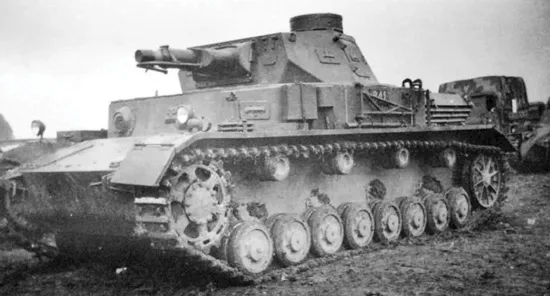
The Panzer IV Ausf A is immediately identifiable by its distinctive drum cupola and forward driver’s position. All Panzer IV had eight road wheels and four return rollers (except for the final Ausf J, some of which only had three return rollers). Krupp-Gruson built just thirty-five of the A model from October 1937 to March 1938.
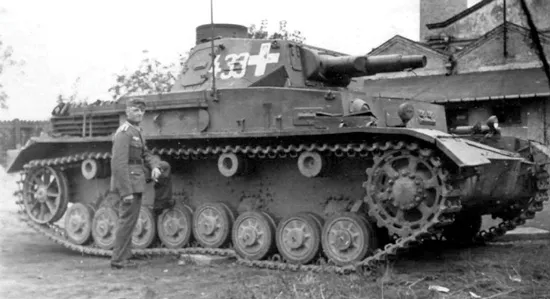
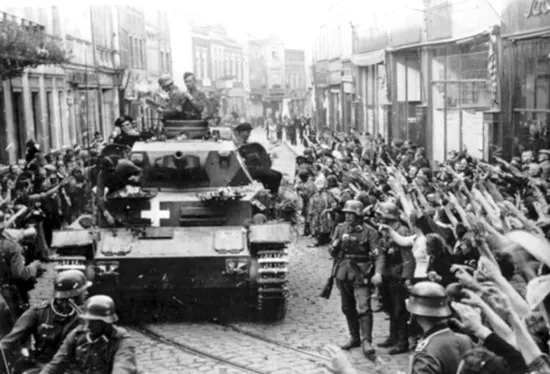
This Ausf A was photographed during the invasion of Poland in 1939. The solid white cross or balkenkruez was specific to this particular campaign. The design was soon abandoned as it made the tank far too conspicuous. The white tactical number painted over the turret vision port indicates it is the third tank of the third troop in the fourth company.
The crew have removed the right-hand drive sprocket and tracks on this Ausf A. Limited numbers of the Ausf A saw combat not only in Poland but also Norway and France before being withdrawn from the panzer regiments prior the spring campaigns of 1941.
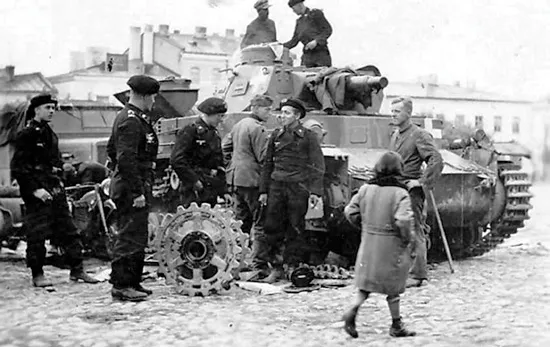
Ausf B or C being given a warm welcome in Poland in 1939.
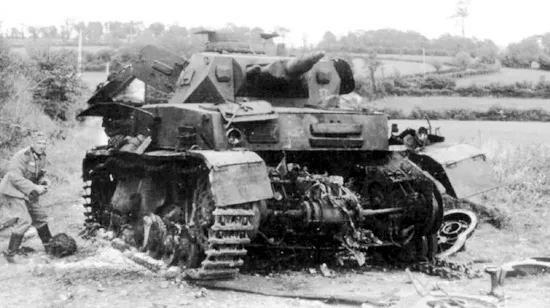
The burnt and smashed remains of a Panzer IV – the armoured sleeve protecting the coaxial machine gun identifies it as a C mode...