A concise, authoritative, heavily illustrated summary of this class of German WWII-era warships, covering their design histories and careers.
The Deutschland class included three ships of a design so revolutionary that it defied conventional categories.
Deutschland (later renamed
L
ützow),
Admiral Scheer, and
Admiral Graf Spee were simply termed
Panzerschiffe (armored ships) by the Germans, but they were known to their opponents by the far more evocative term Pocket Battleships.
Part of a six-volume series on the German Navy's WWII-era warships written by Gerhard Koop and illustrated by Klaus-Peter Schmolke, this book contains an account of the development of the Deutschland class, a detailed description of the ships with full technical details, and an outline of their service, heavily illustrated with plans, battle maps, and a substantial collection of photographs.
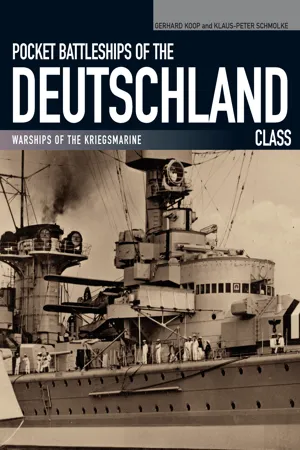
eBook - ePub
Pocket Battleships of the Deutschland Class
Warships of the Kriegsmarine
- 244 pages
- English
- ePUB (mobile friendly)
- Available on iOS & Android
eBook - ePub
Pocket Battleships of the Deutschland Class
Warships of the Kriegsmarine
About this book
Information
Contents
Foreword
Introduction
Data
Armour
Armament
Fire Control and Radar
Machinery
Refits
Scale Plans
Panzerschiff Deutschland
Panzerschiff Admiral Scheer
Panzerschiff Admiral Graf Spee
Conclusions
Bibliography
Index of Ships
Foreword
The three Panzerschiffe – ‘armour-clad ships’ – of the Deutschland class were the first heavy units to be built by Germany after World War I, and they replaced obsolete pre-dreadnought battleships of the Imperial Navy under the provisions of the 1919 Treaty of Versailles.
The name-ship, Deutschland, aroused worldwide interest when she appeared. It had been the purpose of the 1922 Washington Treaty ratified by the victorious sea powers – France, Italy, the United States, Great Britain and Japan – to curtail the massive naval construction programmes pursued by the latter three nations; unintentionally, Deutschland overturned the accord and gave impetus to a new naval arms race. As Germany’s traditional enemy, France reacted to the ‘menace’ with the new Dunkerque class battleships. Mussolini saw a threat to Italian security from the French and laid down a new class of battleships, to which France responded in turn. Britain was content to look on, but the United States laid down new capital units principally as a precaution in view of Japan’s grandiose naval plans.
Of the many beliefs current at one time or another about the Panzerschiffe, the most ludicrous was the allegation voiced at the Nuremberg Trials that the six scheduled, three completed ‘pocket battleships’ were deliberately designed to spearhead the conquest of the world: rather, they were ships of a hybrid type engineered to fill certain naval roles whilst apparently complying with the letter of the Versailles Treaty, under which it was otherwise impossible for Germany to build a modern, combat-worthy battleship within the tonnage limitations. The design was completely successful even though the hull shape, the arrangement of the armament and, above all, the propulsion machinery were revolutionary in concept.
Pocket Battleships of the Deutschland Class is a companion to two earlier volumes featuring the Bismarck and Scharnhorst classes. It explains the development stage, provides a detailed review of the important facts and figures and recounts the career history of each vessel separately, supplemented by documentary references, War Diary extracts and combat reports. The text concludes with a critical epilogue. Also provided are detailed sketches, technical tables and a comprehensive selection of photographs not previously published in this compact form, many of which appear in an English-language publication for the first time.
Without the support and assistance of helpers this book could not have been compiled. Valuable references, advice and supporting documents were provided by Werner F. G. Stehr, A. Didrichs and S. Breyer. F. Bavendamm assisted me where necessary with the reproduction of photographs. To all go my grateful thanks.
All plans and sketches were prepared by Klaus-Peter Schmolke unless otherwise stated. Photograph sources were the Town Archive, Wilhelmshaven; the MAN Archive; A. Klein; Renard, Kiel; Urbahns; the U-boat Archive, Cuxhaven; Command Naval Base, North Sea; Marine/Kriegsmarine Werft, Wilhelmshaven; Deutsche Werke, Kiel; the RAF, RN and USN; and PK, Koop Collection/Gally/Klein. Most of the photographs come from my private collection, which comprises the comprehensive stock of photographs bequeathed by the former photographer at the Wilhelmshaven Naval Yard; and from private albums purchased by me from, or from reproductions made from albums lent to me by, former crew members of the three ships.
Gerhard Koop
Introduction
At Jutland in 1916 the German High Seas Fleet proved its hitting power against a superior enemy force, but thereafter it was practically reduced to insignificance. In his diary entry for 7 October 1918, the Fleet Commander-in-Chief, Admiral Hipper, stated that the overriding priority for the Navy was the prosecution of the U-boat war. The duty of the Fleet was to protect the mines weeping formations and the North Sea U-boat bases. This would be achieved by having the Fleet in home waters. Thus the great ships eked out a miserable existence in port or at some secluded anchorage, the monotony broken once or twice by minor forays. The majority of crews, subjected to a negative influence under a leadership riddled with outmoded notions of class, grew to think of themselves as idlers and loafers, and fell an easy prey to the political whisperings of the time. The growing dissatisfaction came to a head with the first mutinies, which were put down ruthlessly. But the mob still seethed with discontent.
Whilst the German Army was bleeding to death in the West, the Fleet remained inactive. Political agitation continued: the naval blockade was starving a war-weary German population into surrender. When the United States was still neutral President Wilson had put forward an alluring 14-point programme for peace. Despite the risk that entering negotiations with the Entente might be interpreted at home as weakness — the United States had since sided with Germany’s enemies – the German Government approached the US President as an intermediary in the misguided expectation of obtaining an end to hostilities on fair terms.
In October the situation for Germany was increasingly desperate: on 9 November 1918, at Supreme HQ, Admiral Scheer advised the Kaiser that he could no longer rely on the loyalty of the Fleet. The German Reich accepted an Armistice with conditions which came into effect on 11 November 1918. The Navy was hit very hard. All U-boats, and the most modern sixteen capital ships, eight light cruisers and fifty torpedo-boats of the High Seas Fleet had to be surrendered to the victorious powers. In German...
Table of contents
- Half Title
- Full Title
- Copyright
- Contents
Trusted by 375,005 students
Access to over 1.5 million titles for a fair monthly price.
Study more efficiently using our study tools.
Frequently asked questions
Yes, you can cancel anytime from the Subscription tab in your account settings on the Perlego website. Your subscription will stay active until the end of your current billing period. Learn how to cancel your subscription
No, books cannot be downloaded as external files, such as PDFs, for use outside of Perlego. However, you can download books within the Perlego app for offline reading on mobile or tablet. Learn how to download books offline
Perlego offers two plans: Essential and Complete
- Essential is ideal for learners and professionals who enjoy exploring a wide range of subjects. Access the Essential Library with 800,000+ trusted titles and best-sellers across business, personal growth, and the humanities. Includes unlimited reading time and Standard Read Aloud voice.
- Complete: Perfect for advanced learners and researchers needing full, unrestricted access. Unlock 1.5M+ books across hundreds of subjects, including academic and specialized titles. The Complete Plan also includes advanced features like Premium Read Aloud and Research Assistant.
We are an online textbook subscription service, where you can get access to an entire online library for less than the price of a single book per month. With over 1.5 million books across 990+ topics, we’ve got you covered! Learn about our mission
Look out for the read-aloud symbol on your next book to see if you can listen to it. The read-aloud tool reads text aloud for you, highlighting the text as it is being read. You can pause it, speed it up and slow it down. Learn more about Read Aloud
Yes! You can use the Perlego app on both iOS and Android devices to read anytime, anywhere — even offline. Perfect for commutes or when you’re on the go.
Please note we cannot support devices running on iOS 13 and Android 7 or earlier. Learn more about using the app
Please note we cannot support devices running on iOS 13 and Android 7 or earlier. Learn more about using the app
Yes, you can access Pocket Battleships of the Deutschland Class by Gerhard Koop,Klaus-Peter Schmolke in PDF and/or ePUB format, as well as other popular books in History & Military & Maritime History. We have over 1.5 million books available in our catalogue for you to explore.