- 256 pages
- English
- ePUB (mobile friendly)
- Available on iOS & Android
eBook - ePub
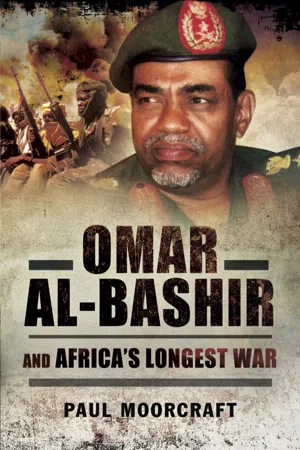
Omar Al-Bashir and Africa's Longest War
About this book
President Omar al-Bashir is Africa's and arguably Arabia's most controversial leader. In power since 1989, he is the first sitting head of state to be issued with an arrest warrant, for war crimes, by International Criminal Court.He has been a central personality in Islamic and African politics, as well as a love-to-hate figure for the US in the 'war on terror'.For military history readers, Al-Bashir is a field marshal who has fought possibly the world's longest conflict. Modern Sudan has been embroiled in war since 1955.No proper biography has been written on him before. Nor has there been a comprehensive military history of Sudan. The book briefly covers the military background until independence. Then it dissects the long north-south civil war until Bashir's Islamist military coup in 1989. Thereafter it narrates the wars in the east, south, west (in Darfur), International political and military intervention is also factored in.The author draws on in-depth one-on-one interviews with Bashir himself and his family and close political, military and intelligence colleagues.
Information
Chapter 1
The Historical Background
What is Sudan?
Sudan derives its name from the Arabic bilad as-Sudan meaning ‘land of the blacks’ and historically referred to the wider region immediately south of the Sahara; so modern Sudan is just part of a region defined by Arabicspeaking North Africans. Separately, Sudd (or Sadd) is Arabic for ‘barrier’; this defines the largest swamp in the world, to be found in the south. The country also boasts the longest river in the world, the Nile; actually it is at least two rivers, mainly the Blue Nile, creamy brown from the mud of the Ethiopian highlands, and the paler White Nile, which merge at Khartoum, the capital of what was Africa’s biggest country until the secession of the south.
Topography and climate have pre-conditioned much of the country’s history. A glimpse at a relief map will immediately distinguish the dry north from the more tropical south. It is a land of mountains, swamps and jungles as well as unforgiving deserts and interminable savannah. For thousands of years the nature of the terrain made military campaigning difficult, even for modern armies, as the British found in the late nineteenth century, not least contending with the forbidding cataracts on the Nile. Colonialists would talk of MMBA – miles and miles of bloody Africa.
Michael Asher, the historian and explorer, said it was ‘the most fascinating country in Africa’ and noted that its ‘vastness and diversity of cultures qualify it almost for the status of a miniature continent’. Modern Sudan was a land of over 600 ethnic groups and distinct languages and dialects, the heritage of migration and conquest. Nomadic lifestyles based on cattle-herding and camel routes to the Red Sea, including maritime access for the Haj, led to conflicts with settled pastoralists, clashes which related to changing weather patterns, not least in today’s Darfur. It has also been a land of contending religions, chiefly Islam in the north and Christianity and animism in the south.
For thousands of years the land was subject to invasions and wars, which almost inevitably produced an often venomous cultural racism, based less on colour and ideology and more on ethnic identity and language. An adequate analysis of the Arab tribal groups and southern ethnic distinctions would require a large book on its own. So I will refer to these complex distinctions when they are directly relevant to specific military political events.
For most of my story I will focus on the Ja’aliyyin, Shayqiyya and the Danaqla groups (awlad al-bahr; people of the river) that comprise the dominant riverine Arabs, now centred in Khartoum state. These groups have tended to control politics, the civil service and the military since independence. What defines ‘Sudanese’ has usually been a hard question to answer; the Khartoum elite stressed the Arabic language, claims to Arab ancestry (and sometimes a lineage from the Prophet) and the Islamic religion. This sometimes insecure sense of self-identification was reinforced by the fact that the rest of the Arab world did not always uphold the Sudanese elites’ claim to their Arab authenticity. Invasions from the north and, later, Turkish, Egyptian and British occupations reinforced this inferiority/superiority paradox. The mixed ‘African-Arab’ peoples in the west, in Darfur, although nearly all passionate Muslims, were often looked down on as ill-bred rustics. That feeling extended to many of the peoples in the east, especially the unruly Beja, who were Muslims, though not Arabs. The elite’s racism applied in spades to the south, where the majority of the many tribal groups were not Arab and not Muslims. In the modern era many elite Sudanese did not feel entirely comfortable with being identified with ‘black Africans’ and certainly did not want to be defined as ‘blacks’ when they worked or travelled in Europe or North America.
What constituted Sudanese identity was still an unanswered question long after independence. The coup of 1989 tried to find a solution: the government was committed to making all Sudanese proper Arabs and Salafist Muslims via a vigorous programme of Arabization and Islamization. This had been tried before by imposing Sharia law in the south, but it had triggered ever more resistance among the non-Muslim majority there. After 1989, the Islamist revolutionaries would try again, but they would eventually cause the south to secede. Paradoxically, the northern elite’s Khartoum-centric racist behaviour was then replicated in the southern capital of Juba. There, a tiny elite held nearly all the wealth and power; it largely disregarded the peripheries, which exacerbated old and bitter ethnic divisions that in turn fuelled the civil war from December 2013.
Early history
Archaeologists have found evidence of a Neolithic culture along the Nile from the eighth millennium before our common era (BCE). The region of Upper Egypt and Nubia (the latter centred on the confluence of the Blue and White Niles and River Atabara) developed similar systems of kingship – rule by Pharaohs – around 3,300 years BCE. The Nubian Kushite kingdom invaded Egypt in 800 BCE. The Kushite Empire stretched from South Kordofan to the Sinai, until the Assyrians halted the Nubian expansion when they invaded Egypt.
The Nubian capital became Meroë. The kingdom was advanced, among the first to develop iron-smelting technology. The Kushite kingdom of Nubia survived the expansion of Roman power in the region, but eventually collapsed in the fourth century AD. The empire broke up into many small states run by warrior aristocracies based around the Nile in what is now northern Sudan. The princely courts were soon influenced by the growing power of Byzantium, thus coming under the sway of various branches of Christianity after AD 550. In the seventh century, the armed followers of the Prophet Mohammed exploded into one of the most remarkable military expansions in history, which eventually conquered territory from the Pyrenees to the borders of China. The Islamic conquests of Egypt inevitably spread the word of the Prophet south via a mixture of war, trade and intermarriage. The riverine Arabs of today descended from the fusion of Arab and Nubian cultures. During the sixteenth century the Funj people moved from southern Nubia and displaced the surviving Christian kingdoms to establish what became known as the Sultanate of Sennar or the Blue Sultanate.
This Sultanate practised an unusual mix of Islam along with Christian and animist beliefs; for example, many of the festivals involved a great deal of alcohol consumption. Despite conflict with Abyssinia/Ethiopia in the east, and the African kingdoms of the south, for the first hundred years the Sennar armies were very effective. They relied on shock troops of heavy cavalry formed from the nobility, as in Europe; they were armed with long broadswords, rather than lances. The horsemen also wore chain mail. The mass of the army, however, was based on infantry carrying swords. Unusually, the Sennar Sultanate sustained a standing army, the result of a successful gold-based economy. It was the largest standing army in northeast Africa until the early nineteenth century. Forts and castles were set up as permanent garrisons. This centralized and well-trained force meant that neighbouring ad-hoc armies were usually defeated. The empire was finally overcome by a bigger, better-organized and better-armed empire – the Ottoman Turks, via their Egyptian proxy.
The Turkiya
Technically, Egypt was ruled as part of the Ottoman empire based in Istanbul, but the Khedive (Viceroy) in Cairo, Muhammad Ali, regarded himself as an independent ruler, one with his own imperial ambitions. Originally an Albanian (or some say Kurdish) general in the Ottoman army sent to drive Napoleon’s forces from Egypt, Muhammad Ali wanted to forge an Egyptian empire in Libya, Sudan, Ethiopia and east Africa. He later pushed into Arabia, planning to displace Ottoman rule completely. The gold and slaves he would acquire would pay for his army’s conquests. It would also distract his army from meddling in domestic politics. In 1821 the Khedive’s third son, Ismail Kamil Pasha, headed a motley force of 4,000 Albanians, Turks, troops from the Maghreb and Egyptian Bedouin, plus, crucially, an artillery unit led by an American officer, into northern Sudan.
They gradually conquered most of the riverine settlements. The locals referred to the invaders in general as ‘Turks’. Turkish was the language of the administration, only gradually replaced by Arabic. Sudanese call this period Turkiya, although Western historians use the awkward phrase Turco-Egyptian rule. Some Sudanese clans fought back, but their lances and swords – and often determined bravery – were no match for the invaders’ firepower. Central administration and irrigation brought improvements, but modernization also meant rigorous taxation. The newcomers attempted to introduce a more orthodox form of Islam to the Sudanese, although the mystical Sufi version remained dominant in the rural areas. An extremely onerous system of tax on slaves, cattle and grain, plus a hut tax, eventually prompted a revolt, led by the Ja’aliyyin coalition in Shendi. They burnt to death Ismail Pasha and his key henchmen in their quarters, and the revolt spread.
‘Turkish’ rule tottered and would have collapsed except for their superior weapons. The survival of the occupiers was aided, as ever, by tribal disunity among the Sudanese. One of the most determined initial resisters to the Turks was the Shayqiyya tribe. They fought so bravely that Ismail Pasha absorbed their cavalry units into his own forces and later sent them to strengthen his garrisons around the country – their widespread influence was to last well into the twentieth century. When the Ja’aliyyin clans rebelled, the armed horsemen of the Shayqiyya remained loyal to their new foreign overlords and helped to suppress the rebellion. Incensed by the death of his son, the Khedive in Cairo ordered his occupying troops to destroy all opposition with ‘fire and sword’. So great was the vengeance that it took sixty years for the Sudanese to organize another revolt against the Ottoman system.
The occupiers installed a new ‘Governor-General’, Uthman Bey, who established, in 1825, a new capital in Khartoum. The origins of the name are disputed. Early British explorers assumed it came from qurtum, a flower cultivated extensively in Egypt for its oil. Arab historians prefer to derive the name from the shape of the spit in land in the confluence of the White and Blue Nile that looked a little like an elephant’s trunk. The Arabic khartum fits this translation better.
Uthman Bey was a middle-aged Mamluk, originally from the Caucasus. The Mamluks, a little like the Janissaries who comprised mainly Christian boys from the Balkans, were originally a warrior class formed from slaves. Their discipline was akin to the Christian military orders, except in this case their loyalty was to Islam. The Mamluks had acquired respect because they had defeated the Mongols and the Crusaders, although the Khedive also had to suppress a Mamluk rebellion in Cairo. True to his own origins, Uthman Bey set about forming a new regular army by capturing slaves from the Nuba Mountains and the upper Blue Nile region. Slavery was believed, by some, to be sanctioned by the Koran, although it was haram, forbidden, to enslave Muslims. Other imams argued it was haram to enslave anybody. Ordinary slaves could never carry weapons, but the strict discipline and Islamic indoctrination of the new army, called jihadiyya, inspired loyalty. They were trained in Aswan by European instructors, although their officers were literate in Turkish, the language of command. This regular force comprised the backbone of the military power of the Turco-Egyptian regime.
The civilian administration, however, did not match the relative efficiency of its army. Eventually the rapacious tax system was reformed, but the slave-raiding economy was not. The Khedive in Cairo, still an ambitious empire builder, urged his administration in Khartoum to explore the White Nile and to traverse the so far impenetrable Sudd to reach the imagined riches of the African hinterland. Gold, ivory and slaves were there in abundance, Cairo believed. This expansionism coincided with a growing European interest, especially in France and Britain, in discovering the source of the White Nile. The Khartoum government was encouraged by Cairo to push ever south, but meanwhile the Turkiya controlled only the settlements along the river as far as Khartoum and a few so-called ‘islands of authority’ in regions such as Kordofan. Elsewhere, except for occasional punitive or slave-raiding expeditions by the jihadiyya, local warlords and nomads did what they pleased in the vast ungoverned expanses. The ghazis, or tribal warriors, carried on their feuds and mini-wars, capturing cattle and women, untroubled by the would-be centralizers and modernizers in the far-away capital.
As Muhammad Ali, the Khedive in Cairo, slipped into senility and paranoia, his empire declined, especially in Sudan. He had become more and more reliant on foreign aid from European Christians, especially bankers, traders and soldiers. When he died in 1849, his successor, his grandson Abbas I, was an ineffective conservative who did his best to exclude Western influence during his brief rule. His successor, however, Muhammad Said Pasha, had been educated by French tutors and welcomed Western investment, not least for the construction of the Suez Canal and the development of the telegraph. He came to rely more and more on foreign loans. As he slipped more deeply into debt, he considered abandoning Sudan.
He stayed, however, and made the weak provincial administrations directly responsible to Cairo, thus enfeebling further the already fragile central government in Khartoum. Influenced by his Western advisers, he ordered his powerless Governor General in Sudan to stop the slave trade in 1854. This incensed Sudanese traders, who regarded the practice as not only a major source of income, but ordained by the Koran. Almost worse for pious Sudanese was the appointment of an Armenian Christian as governor of Khartoum and Sennar. Meanwhile, Western missionaries and traders became more active, often working hand in hand with Europe’s great powers who wielded extensive power via their local consuls. The Western traders chased ivory in the south, while the missionaries sought to save souls and prevent slavery. The Muslim elite in Khartoum felt increasingly alienated by Western and Egyptian interventions in their traditional lifestyle.
In 1863 a new more dynamic Khedive, Ismail Pasha, tried to revitalize Egypt and Sudan by extending railways, the telegraph, schools and a postal service – and the final abolition of the slave trade. Railway tracks from Egypt reached Khartoum in 1874 and Suakin on the Red Sea in 1875. The paddle-steamers built in Khartoum improved transportation up the White Nile. Ismail Pasha inherited the dreams of an empire in equatorial Africa. A modernized army could be deployed by the new trains and ships. Krupp artillery was introduced, and repeating Remington rifles from the USA replaced the old muzzle-loaders. At the end of the American Civil War, soldiers from both sides were recruited as military advisers. Most notably, a US Union officer, Brigadier General Charles Pomeroy Stone, served as the Egyptian chief of staff. Stone had enjoyed a chequered career. He was jailed without trial, including a long period in solitary confinement, after being accused of treason after the Battle of Ball’s Bluff in October 1861. In perhaps one of the most controversial cases of American military jurisprudence, he was eventually released, without charge or apology. Stone was an innocent victim of political infighting. In partial recompense, the US military recommended him for service in Egypt, where he commanded, very ably, for thirteen years. Ironically, the general who had been accused of treason ended up using his engineering skills to build the foundations and pedestal of the Statue of Liberty.
The Khedive also tried to establish an effective police force from Shayqiyya irregulars. They did little to crush the slave trade, however. The traders usually bribed the police when they were stopped on boats on the White Nile or at inland slave markets. The local corruption and connivance in the slave trade further encouraged the Khedive to appoint more European officers whom he considered incorruptible and also morally committed to abolishing slavery. One of the most colourful of these soldiers with a missionary bent was Sir Samuel Baker. Obsessed, like many other Victorian English adventurers with discovering the source of the Nile, he had reached Lake Albert (Nyanza) in 1864. Baker used to travel with his female companion, Florence, who apparently could outshoot and outride her male colleagues. Baker outraged Queen Victoria herself by ‘being intimate with a woman not his wife’, as the Sovereign put it. That was true. Nevertheless, perhaps because of the popularity of his travel books, he secured a knighthood, but not complete acceptance in polite society. He possibly romanticized the lady not his wife. Baker claimed he had saved the beautiful blonde from sale in a Balkan slave market. She was en route to the Sultan’s harem, he said. This was a typical plot of many Victorian pulp novels, but Baker’s lifelong hostility to the slave trade may imply that his story of Florence, whom he eventually married, may have had some credibility.
As an Ottoman Pasha, Baker led an army into the south in 1870. He spoke reasonable Arabic and was an energetic leader who managed to penetrate the Sudd and expand the Khedive’s equatorial empire. According to one leading historian of Sudan, however, he showed ‘colossal insensitivity as an Englishman and Christian leading Turkish, Egyptian and Sudanese Muslims on a mission to end the slave trade’.1 He fought battles with hostile – sometimes cannibalistic – tribesmen and argued bitterly with his own allies. Frustrated, he left Sudan in 1873 never to return.
Interestingly perhaps for Western historians, but fatal to many Sudanese, Baker was replaced as Governor of Equatoria by another flamboyant military adventurer who, in addition, happened to be a stubborn and self-righteous Christian mystic: Charles George Gordon. He was more commonly known as General ‘Chinese’ Gordon because he had suppressed the Taiping rebellion in 1864. With a small core of European officers, he restored the morale and discipline of the garrisons along the Upper Nile and introduced armed steamers. To the south he raised the Egyptian flag on Lake Albert, in the Great Lakes region dividing Uganda and the Congo. Khedive Ismail was planning an imperial pincer movement by sending an army along the Red Sea into Ethiopia. London put pressure on the Khedive to abandon his forlorn hopes of a new north-eastern empire. Diplomatic constraints and defeats in the field forced a withdrawal from Ethiopia. The Khedive’s troops were more successful in Darfur, where the Fur army was defeated in January 1874. The capital of El Fasher was occupied.
Cairo became the victim of imperial overreach generating military setbacks in Ethiopia and renewed revolt in Darfur and elsewhere in Sudan. General Gordon promised the Khedive that he could restore order in the whole of Sudan and also crush the slave trade. The Khedive agreed to Gordon’s ambitious plans in early 1877. The purchase and sale of all slaves was to be terminated by 1880. The Khedive was no humanitarian campaigner; he was keen to use abolition as part of his charm offensive to ensure Western political and financial support for his regime.
Gordon became perhaps the British imperial icon, because of the nature of his death which became almost the late Victorian equivalen...
Table of contents
- Cover
- Title Page
- Copyright
- Contents
- About the Author
- Abbreviations
- Glossary of Terms
- Modern Sudanese Timeline
- Maps
- List of Illustrations
- Introduction
- Chapter 1: The Historical Background
- Chapter 2: British Rule
- Chapter 3: Failed Democracy – Failed Coups (1956–1989)
- Chapter 4: The Making of a President
- Chapter 5: The Duopoly
- Chapter 6: The General Takes the Reins
- Chapter 7: The Road to Peace in the South
- Chapter 8: The War in the West: Darfur
- Chapter 9: ICC and Sudan
- Chapter 10: The Fall of the Republic
- Chapter 11: Aftermath
- Conclusion – Omar Al-Bashir’s Legacy
- Appendix – A Short Guide to the Internal Forces Fighting in Sudan’s Civil Wars
- Endnotes
- Select Bibliography
Trusted by 375,005 students
Access to over 1.5 million titles for a fair monthly price.
Study more efficiently using our study tools.
Frequently asked questions
Yes, you can cancel anytime from the Subscription tab in your account settings on the Perlego website. Your subscription will stay active until the end of your current billing period. Learn how to cancel your subscription
No, books cannot be downloaded as external files, such as PDFs, for use outside of Perlego. However, you can download books within the Perlego app for offline reading on mobile or tablet. Learn how to download books offline
Perlego offers two plans: Essential and Complete
- Essential is ideal for learners and professionals who enjoy exploring a wide range of subjects. Access the Essential Library with 800,000+ trusted titles and best-sellers across business, personal growth, and the humanities. Includes unlimited reading time and Standard Read Aloud voice.
- Complete: Perfect for advanced learners and researchers needing full, unrestricted access. Unlock 1.5M+ books across hundreds of subjects, including academic and specialized titles. The Complete Plan also includes advanced features like Premium Read Aloud and Research Assistant.
We are an online textbook subscription service, where you can get access to an entire online library for less than the price of a single book per month. With over 1.5 million books across 990+ topics, we’ve got you covered! Learn about our mission
Look out for the read-aloud symbol on your next book to see if you can listen to it. The read-aloud tool reads text aloud for you, highlighting the text as it is being read. You can pause it, speed it up and slow it down. Learn more about Read Aloud
Yes! You can use the Perlego app on both iOS and Android devices to read anytime, anywhere — even offline. Perfect for commutes or when you’re on the go.
Please note we cannot support devices running on iOS 13 and Android 7 or earlier. Learn more about using the app
Please note we cannot support devices running on iOS 13 and Android 7 or earlier. Learn more about using the app
Yes, you can access Omar Al-Bashir and Africa's Longest War by Paul L. Moorcraft in PDF and/or ePUB format, as well as other popular books in History & Military Biographies. We have over 1.5 million books available in our catalogue for you to explore.