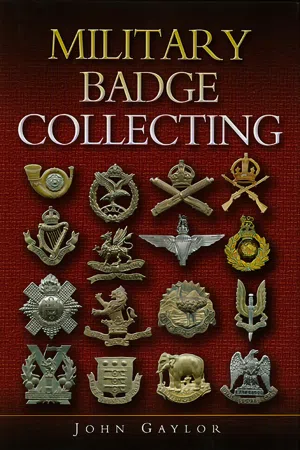
An identification guide to British Army cap badges from the Calvary and Royal Armoured Corps, the Guards, Women's Units, Kitchener's Army, and others.
This book is a comprehensive guidebook, which will appeal to anyone with an interest in medal collecting. The book contains British Army badges from the earliest days to the present, with photographs of 800 examples.
"This is an excellent text and complements the bookshelves of any researcher of the British army . . . an outstanding feat of research and I can only summarise by saying 'Well done.'"—Military Archive Research.com
In order to define and recognize the British Army cap badge it is necessary to see how it evolved.
Full dress for the bulk of the army ceased in 1914; its headdress was the spiked infantry helmet of German pattern, introduced in 1878. This was worn by most of the infantry and the Corps as well as the Royal Artillery and the Royal Engineers, by some with a ball rather than the spike. The infantry headdress badge was an eight-pointed star with the regiment’s number, consisting of detachable brass numerals, in the centre of the Garter placed on the middle of the star.
In 1881 the British infantry consisted of 109 separate regiments of foot, numbered consecutively from 1 to 109, and some bore regional or territorial designations. What are usually described as the Cardwell Reforms took effect in that year and gave a regional title to every regiment. They instituted the two-battalion regimental system whereby one battalion of the newlyconstituted regiment served abroad and the other remained in the United Kingdom as a draft-producing and training unit as well as fulfilling its largely nominal internal security role. A list of the titles allocated is given in Appendix B. The system was that at infrequent intervals the two battalions would change places and the roles would be reversed. Like most such reforms these produced some unfortunate and unhappy marriages but in the main they were accepted; the old numbers were dropped but not forgotten and the new titles adopted. These titles were the common currency of the South African and the two World Wars and can be the basis of a collector’s plan.
The 1881 reforms made it necessary to discard the old numbers in the helmet plate and a new, universal star plate was produced with a one and seven-eighths inches diameter space in the centre, designed to take a standard pattern badge. This consisted of a circle bearing the new title with the regimental device, often a collar badge, in the centre.
Concurrently with the helmet, the glengarry was worn as the undress cap. This is usually thought of as exclusively a Scottish headdress but it was adopted in about 1870 for walking out by all troops and was worn by English, Irish and Welsh as well as Scots. It was not popular and was supplanted in the mid-1890s by the field-service cap of Austrian pattern which seems, like an old soldier, never to die. It was in use again in 1939 by the new Militia and later by the rest of the army. Replaced by the general service cap and the beret during the Second World War it has again come to light in its many coloured variety for wear with No. 2 Dress (the barathea, officer-type, service dress uniform in current use).
Until 1881 the badge in the glengarry had embodied the numeral and usually some regimental device, like a sphinx, a bugle-horn, a castle, etc., but after that date the badge was replaced by the helmet-plate centre (called HPC by collectors, the helmet plates themselves being HPs) and when so worn, a detachable crown was set above the HPC. The War Office of the day, as paternal and considerate as now, issued a back-fitting or template to ensure that these two should be positioned correctly. The HPC also appeared in India, worn on the foreign-service helmet, and the odd HPC is often found with a long prong fastener, suggesting that it may have been used for this purpose, tucked in the folds of the pagri or folded muslin wound around the helmet.
When the field-service cap became general wear the HPC was found to be too large and at first a collar badge was worn. Cavalry, having no collar badges, wore brass numerals and letters such as ‘4 DG’ and ‘VIII H’. The new infantry cap badges dropped the constraining circular band of the HPC and displayed the regimental motif more clearly. There is no certain date for the changeover since the battalion abroad was always far slower to adopt new fashions, and slower still if such fashions were disliked by the CO. India was a long way from the War Office in the nineteenth century! But by about 1898 sealed patterns had been evolved for most regiments, cavalry and infantry.
How does one recognize a cap badge? The infallible indicator used to be the vertical prong or slide-fastener, a narrow tongue of metal whereby the badge was slid into the glengarry, field-service cap, service-dress cap or beret. But some regiments favour two loops secured by a split-pin so that the badge does not fall from the cap when the headdress is removed. If in doubt, one can usually judge from the size since collar badges, or collar dogs as the soldier inexplicably calls them, are obviously much smaller having been designed originally to fit on the narrow stand-up collar of the jacket.
Apart from the size and the prong-fastener there is no common feature but one soon develops an eye for the cap badge.
The nearest thing to a standard work on the subject for the British Army was Major T.J. Edwards’ Regimental Badges, now out of print, but the first edition published in 1951 is best for the beginner. This, for instance, gives a clearer idea of the Infantry of the Line as it was during the two World Wars, whereas the latest edition deals with the more recent changes which are as far-reaching in their effects as were the 1881 reforms: the Brigade System born in the 1957 White Paper and the subsequent Infantry Divisions.
How to start a collection
I began collecting in 1939 when at school and at a time when the schoolboy hobby enjoyed a topical popularity. I cast about among my father and uncles who mustered their own badges from the First World War. One day a schoolfriend’s father had a collection of ninety-six badges that he was prepared to sell for a pound. This was a considerable sum for a schoolboy in 1939 and six of us decided to pool our resources. I invested two-and-six which entitled me to twelve of the badges. For one new penny each I added, among others, the Guards Machine Gun Regiment and the Huntingdonshire Cyclist Battalion badges.
I do not suggest that you will get a similar offer but in these days it is an unusual family which has not had some member who either served in the Second World War or who subsequently did National Service. With some prompting they can probably be persuaded to look out their old badge or badges and so you have a start. The most reluctant soldier usually kept his cap badge. A search of local markets and old furniture shops will very likely unearth others at fairly modest prices. These general dealers will put any old military brassware aside for you if you show signs of becoming a regular visitor. When they do this you should take it whether you need it or not. This will encourage them and you will have items for exchange or sale to other collectors. I have carried such pieces around in my spares box for months and then had them snapped up eagerly by someone who had long been in search of just such specimens.
As badge collecting is still an unsophisticated hobby you will probably find yourself the only local enthusiast. ‘Cash and contacts’ are my two hints for assembling a collection. Most badges can be bought once you have found them. If you have the resources, watch the auction sales at Bosley’s, 42, West Street, Marlow, Bucks, SL7 1NB or Messrs Wallis and Wallis, West Street Auction Galleries, Lewes, Sussex BN7 2NJ. Since the average collector cannot afford the time or the money to do this he must resort to contacts. These probably can best be found in the Military Historical Society, National Army Museum, Royal Hospital Road, London, SW3 4HT. The Society was founded by a collector in 1948 and now embraces all aspects of military history and interests. Membership is worldwide, a meeting is held monthly and the quarterly journal usually has an article of interest to badge collectors. The Society has branches based in the East and West Midlands and Dorchester.
Having amassed a quantity of badges there is the problem of how and where to mount them. I suggest that you put them on a sheet of white or black cardboard until you have enough to start to classify them. This would be a good time to buy Major Edwards’ book or to beg or buy an old Army List which gives a great deal of very useful information. Major Edwards’ book has drawings of most of the badges in use during and immediately after the Second World War so that you will be able to identify some of the problem items which do not carry their designation on the scroll or titleband.
For badges of earlier vintage Twenty Years After had a series of plates and the Boys’ Own Paper once produced a folding plate of illustrations of those in use during the First World War. These, of course, included the Irish regiments which ceased to exist in 1922 on the formation of the Irish Free State. Some of the illustrations from the former may be suspect as the drawings were made twenty years after and some post-1920 patterns purport to be those worn during the war.
As there are many badges that cannot be illustrated in this book I will try to explain some of the varieties which you will encounter to help you to identify them.
Regimental histories are inconsistent in their treatment of badges, some giving a full description while others gloss over or ignore the subject entirely.
Like many other collectors I restrict my own collection to ‘other ranks’ badges. Exceptions are the Royal Army Chaplains’ Department and the Army Legal Corps which consist of officers only.
The ‘other ranks’ limit is mainly because of cost but was originally for interest’s sake. Officers’ badges on service dress were given a bronzed finish that was not very interesting. When service dress was supplanted by battle dress and became the undress uniform, badges were made more attractive and burst into coloured enamels and precious metals. These must necessarily be more expensive than the plain die-struck badges of the rank and file and are, in any case, far harder to find. Nevertheless, if a collector proposes to specialize in one particular regiment or corps he will have to have officers’ badges as well.
Crowns
These are a first rough guide to the date of usage of a badge. Around 1898, when most cap badge designs emerged, Queen Victoria was on the throne. There were several variations of her crown but all are easily recognized. There is the angular one (shown in the 18th Hussars badge in Plate 4), the curved one (shown in the 4th Hussars badge in Plate 3) and the flat-topped variety (shown in both 21st Lancers badges in Plate 4) said to have been awarded to those units with most service in India at the time of the 1897 Jubilee because it was similar to that depicted in the Order of the Star of India. In the text I have followed the custom of collectors and dealers in referring to the crown of this period as ‘QVC’, qualifying it as ‘flat-topped’ when necessary.
When Edward VII came to the throne in 1901 the crown changed to the Tudor Crown, a ‘domed’ pattern (seen in the ‘1914’ plates). It was retained by George V, Edward VIII and George VI (normally referred to as ‘K/C’).
With the accession of Elizabeth II in 1952 the crown changed to St Edward’s Crown, a ‘dropped centre’ type (referred to as ‘Q/C’). Wherever a badge included the Royal Cipher, this naturally changed for a new monarch.
There are others, mural crowns, naval crowns and various types of coronet, as well as Saxon crowns, which will be encountered from time to time. Possession of these always has some significance whereas the possession of the sovereign’s crown does not. There are Regiments such as the Suffolks, and Corps such as the Intelligence, which each have a crown but are not Royal. Conversely, others such as the Royal Scots Greys and the Royal Wiltshire Yeomanry do not bear the crown on their badge although they have ‘Royal’ in their title.
In this connection there is a story, current in the Intelligence Corps, that George VI when examining the possibilities of various corps becoming ‘Royal’ in 1946 enquired about the services performed by this one. He said that while obviously deserving of the honour, there were several aspects of the Corps’ work which it was better should not be acknowledged by the Crown. So it seems unlikely that the Intelligence Corps will ever become ‘Royal’.
Metals
To simplify things I refer to the metals of which other rank badges are normally made as white metal (which looks like silver) and brass. Major Edwards in his book refers to gilding metal but practically all collectors overlook this purism and speak of brass badges, white metal badges and bimetal badges – those made of both metals.
In 1952 there appeared the ‘Staybrite’ badge, of anodized aluminium which did not need cleaning. If they are rubbed, the brass or white-metalseeming dye comes off baring the grey metal underneath. Most badges in use then and since have been made in this finish. Contrary to official belief they are not popular with soldiers. One of their claimed advantages is that, in the case of collar badges, they would not need to be removed from the tunic for cleaning and so obviate wear and tear on clothing. Most serving soldiers and most collectors dislike them for their bright tinsel look but one cannot logically refuse to collect them if one intends to have an unbroken collection.
For the most part I have not mentioned in the text that all badges in current use are made in anodized aluminium but it may safely be assumed that they are.
In the past decade there is evidence that some regiments and corps are turning against the anodized aluminium badges to the extent that they are commissioning metal badges and purchasing them privately.
Dates
Difficult though it is to be accurate with the dates of usage of badges I have quoted dates in most cases. These can be easily refuted or contradicted but it is a very difficult matter on which to be precise. Sealed patterns were often not brought into use for many years and sometimes not at all; some badges were worn but never sealed or approved. Old soldiers will generally be hard pushed to remember when badges changed pattern or size, and photographs are far from a good indication. I cannot recall that anyone took a photograph of me in uniform in 1966 but if so his grandchildren will have irrefutable photographic evidence that this depicted a pre-1953 soldier since I was still wearing a K/C badge! Soldiers are conservative and sentimental, preferring their old badges: ERE soldiers (extra regimentally employed, i.e. serving away from their own units at a headquarters or a transit camp or with another arm) would often be found wearing old badges and formation signs long out of use in their own regiments but retained for sentiment’s sake.
Forgeries
In the past few years the number of restrikes appearing has grown and the collector has had to be careful when offered a scarce or unusual item. Some dealers have even gone to the extent of ‘weathering’ their products by exposing them to the English climate in an attempt to secure instant tarnish. One’s attitude to restrikes again must be a purely personal one. If you are content to have a copy of a badge, made from the original die, in your collection then this is your own decision. I do not doubt that many presentday collectors, loud in their denunciations of recent restrikes, proudly cherish specimens of Fox restrikes of the pre-territorial glengarry badges made over ninety years ago (and sold for
d each) and now made respectable by the passing years!
But cast metal badges must be mentioned. In 1914–15 many Territorial Force units were sent to India to relieve regular battalions who were sent to serve in France. In India the Territorials needed badges and some were made locally in the bazaars under semi-official arrangements. Later, enterprising merchants in Pakistan produced a range of cast badges none of which can be regarded as authentic.
I do not claim to have mentioned all patterns, all badges, nor all units in the pages which follow but I hope that what there is will help to solve a few problems and give an idea of the scope of the hobby. It is easy to amass a collection of badges in a jackdaw fashion but the real interest comes from learning the stories behind them, the regimental past, the regimental politics and the regimental mistakes. It is a hobby capable of great expansion if it is extended to Commonwealth countries but once embarked upon you may well find that the British Army provides challenge enough.
I have purposely avoided discussing cash values because intrinsically it is a matter of coppers only. But values have become inflated in recent years and simple cap badges once priced at twopence halfpenny in Ordnance Vocabularies are now pursued by people with folding money in their hands. It would be nice to think that co...
Table of contents
Cover
Title Page
Copyright
Dedication
Contents
Introduction
Introduction to this edition by Ray Westlake
1: The Hobby
2: The Cavalry and Royal Armoured Corps
3: The Brigade of Guards
4: Regular Infantry of the Line before 1958
5: Airborne Forces
6: Infantry of the Line since 1958
7: Volunteer Battalions
8: Territorial Infantry Badges
9: The London Regiment
10: Yeomanry
11: Arms and Services
12: Women’s Units
13: Pipers
14: Kitchener’s Army
15: Military Cyclists
16: The Home Guard
17: Miscellaneous – Schools and Training Establishments
18: War-raised Units
19: The Brigade of Gurkhas
20: Options for Change
A: Order of precedence
The Plates
Regimental Index
Trusted by 375,005 students
Access to over 1.5 million titles for a fair monthly price.
Study more efficiently using our study tools.
Frequently asked questions
Yes, you can cancel anytime from the Subscription tab in your account settings on the Perlego website. Your subscription will stay active until the end of your current billing period. Learn how to cancel your subscription
No, books cannot be downloaded as external files, such as PDFs, for use outside of Perlego. However, you can download books within the Perlego app for offline reading on mobile or tablet. Learn how to download books offline
Perlego offers two plans: Essential and Complete
Essential is ideal for learners and professionals who enjoy exploring a wide range of subjects. Access the Essential Library with 800,000+ trusted titles and best-sellers across business, personal growth, and the humanities. Includes unlimited reading time and Standard Read Aloud voice.
Complete: Perfect for advanced learners and researchers needing full, unrestricted access. Unlock 1.5M+ books across hundreds of subjects, including academic and specialized titles. The Complete Plan also includes advanced features like Premium Read Aloud and Research Assistant.
Both plans are available with monthly, semester, or annual billing cycles.
We are an online textbook subscription service, where you can get access to an entire online library for less than the price of a single book per month. With over 1.5 million books across 990+ topics, we’ve got you covered! Learn about our mission
Look out for the read-aloud symbol on your next book to see if you can listen to it. The read-aloud tool reads text aloud for you, highlighting the text as it is being read. You can pause it, speed it up and slow it down. Learn more about Read Aloud
Yes! You can use the Perlego app on both iOS and Android devices to read anytime, anywhere — even offline. Perfect for commutes or when you’re on the go. Please note we cannot support devices running on iOS 13 and Android 7 or earlier. Learn more about using the app
Yes, you can access Military Badge Collecting by John Gaylor in PDF and/or ePUB format. We have over 1.5 million books available in our catalogue for you to explore.