A history of the high-speed wooden aircraft—from bomber to fighter, to photographic and weather reconnaissance—from the author of
B-17 Memphis Belle.
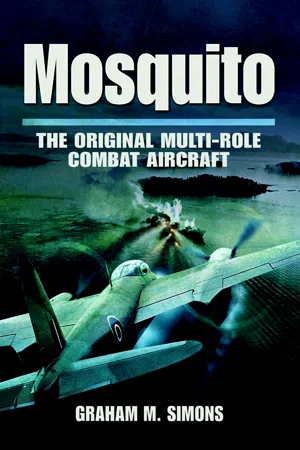
During the history of aviation there have been very few aircraft that have achieved immediate success when entering front-line service. The de Havilland Mosquito was one such aircraft. It was not designed to an RAF requirement, but was the result of an initiative of the designers and builders to utilize the skills of woodworkers and the relative abundance of wood in the crisis years of World War II. The result was an airplane that could be built quickly, was extremely fast and extremely versatile. The pilots loved it.
This book describes how it was built and utilizes many hitherto unpublished photographs from the design studio and production lines. It illustrates and explains the many different roles that the aircraft took as the war progressed. Fighter, bomber, reconnaissance, night fighter there were few tasks that this brilliant design could not adopt.
"To most
Britain at War readers, the de Havilland Mosquito needs little introduction. Dramatic as such low-level attacks were, there is, as Graham Simons reveals in this latest insight into a remarkable aircraft, far more to the wartime service of the 'mossy.'"—Britain at War
- 256 pages
- English
- ePUB (mobile friendly)
- Available on iOS & Android
eBook - ePub
About this book
Information
AN INFINITELY ADAPTABLE AIRCRAFT
Although the main basic types of combat requirement - bomber, fighter, fighterbomber and photographic reconnaissance had been catered for in the Mosquito design, these were by no means the only uses to which the aircraft was put.
Other branches of the armed forces, and even civil airlines, wanted to use the aircraft, either by specialized adaptation of the design, or just because it was simply the best machine for the purpose. The post-war years brought a plethora of adaptations of the Mosquito airframe that the original designers could never have envisaged.
Civilian Interlude
Throughout the Second World War the British Overseas Airways Corporation (BOAC) struggled to maintain as much as possible of their pre-war long-range airline route network. One of their tasks was to conduct a regular air service between Scotland and neutral Sweden, but it became more difficult and dangerous as German fighters swept northwards into Norway and Denmark after the invasion of those countries in April 1940.
Daily contact with Stockholm was of vital importance, from both the strategic and political points of view, for the Swedes were trading legally with both sides and wished to maintain their contact with London without offending the Germans. It was a delicate situation. The German propaganda machine, under Doctor Joseph Göebbels, painted a black picture to the Swedes of Britain’s impending defeat, one that could partially be countered by flying over British newspapers and magazines. These same flights brought back small, but specialized engineering products, such as tool steel, ball bearings, fine springs and electrical resistances. Much of this Anglo-Swedish co-operation took the form of personal negotiations, so many important passengers were flown along with the mail. A further and important part of this transport service was the carriage of additional freight which passed through Sweden bound for the Soviet Union. These flights led to the strange situation where BOAC and Deutsche Lufthansa aircraft often shared the same airport apron at Bromma. Many of the aircrew involved had previously been friendly during the pre-war years at London’s Croydon Airport. Now, instead of friendly conversations, they would just exchange a curt nod.
BOAC operated several Lockheed Hudsons and Lodestars and the occasional Douglas DC-3 on the route in conjunction with the Swedish airline AB Aerotransport, who also operated DC-3s. The service was fraught with danger, both natural and man-made. The aircraft had to avoid daylight, moonlight, clear weather and the Northern Lights in an attempt to evade German interceptors. Cloudy weather was also disliked by the crews for it meant the increased risk of icing and navigational errors, while the light summer nights of almost continuous daylight made the route virtually inoperable between May to August.
After the German invasion of Norway, the Royal Norwegian Air Force in Britain used Lockheed Lodestars to assist Norwegians who had escaped to Sweden and wanted to come over to the Allies to fight.
Increased German activity in the Skagerrak during late 1942 meant that an even more northerly route was needed. Identification and navigation in the narrow Swedish corridor was difficult, radio navigation aids were unreliable and there existed no direct contact between Leuchars, whence most flights departed, and Stockholm. Radio silence was kept at all times, and although a single high-frequency transmission would serve to identify an aircraft to the Swedish anti-aircraft gunners, it could also be received by the Germans and was therefore prohibited. The Germans would not allow the Norwegian bases at Stavanger and Bergen to broadcast, but the Norwegians often managed to get around this by leaving the transmitters switched on so that a carrier-wave was broadcast to assist BOAC and RAF crews. Keeping radio silence almost certainly resulted in an aircraft being fired upon by the Swedish anti-aircraft gunners, although almost always the shells went conveniently wide of the target!
To reduce the hazards a faster aircraft was needed, and one that could fly much higher than the 20,000ft then available using the Hudsons and Lodestars. The solution came when the RAF was asked to deliver a quantity of top-secret mail to Sweden on 6 August 1942. One of 105 Sqn’s aircraft was chosen, Mosquito DK292 which had all its RAF roundels and markings removed and the crew, Flight Lieutenant Parry and Flying Officer Robinson, dressed in civilian clothing before they flew the diplomatic bag over to Stockholm. They landed there only a few minutes ahead of the Junkers Ju.52 used by Göebbels and his staff! The crew stayed the night and the aircraft was placed under a joint British and Swedish guard. After this incident an immediate request was made by BOAC to the Air Ministry for a number of Mosquitos. Eventually two Corporation pilots were allowed to go to Lyneham to learn to fly the type.
It was decided that Mosquito B.Mk.IV DZ411 would be allocated for conversion into a form of an airliner/mailplane by De Havilland. Long-range tanks were installed in the bomb bay, leaving little space for payload; and, to ensure as high a speed as possible, separate ejector exhausts were fitted. The finished aircraft was delivered to BOAC wearing standard camouflage but with the British civil registration G-AGJV on 15 December 1942. The pilots were quick to express their concern at the lack of de-icing equipment, which was eventually fitted to all BOAC Mosquitos.
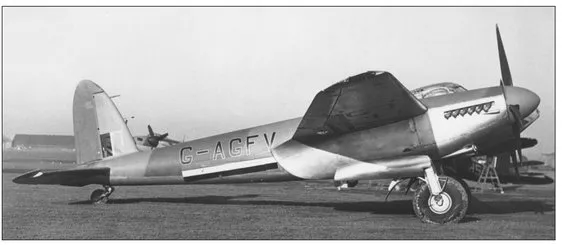
Mosquito G-AGFV of BOAC. It was in this aircraft that Captain Rae made a forced landing at Barkaby, Sweden on the night of 22/23 April 1943 after being attacked by German fighters.
(© BAE SYSTEMS)
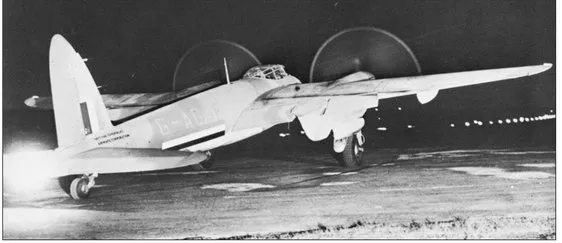
Mosquito HJ720 - now marked as G-AGGF taxies out at Leuchars ready for a flight to Stockholm early in 1943. The two lines of dark writing at the base of the fin states the ownership ‘British Overseas Airways Corporation’.
(© BAE SYSTEMS)
After a short period of training, the first Mosquito flight to Stockholm was made on 4 February 1943, crewed by Captain C.B. Houlder - who was later to become BOAC’s Mosquito Training Captain - and radio-operator F. Frape. Radio and fuel system troubles, along with further crew training, delayed operations somewhat, but on 12 April it was decided that BOAC were to receive six more unarmed Mosquitos; this time they were FB.Mk.VIs. These were all civil-registered and delivered to Brammcote near Nottingham between 16 April and 2 May 1943. The chief project engineer at Hatfield, C. H. Clarkson, wrote to BOAC explaining the differences in performance: the B.Mk.IV had unshrouded multiple ejector exhausts which, compared with the saxophone exhausts of the FB.VI, gave an increase in top speed of 12 mph and 9 mph in the cruise. The external wing tanks of the Mk.VI cost a further 5 mph, thus making the B.Mk.IV a favourite with crews in terms of speed, but not range.
Following the USAAF 8th Air Force raid on the German ball-bearing production plant at Schweinfurt near Frankfurt in mid-1943, it became vital for Britain to purchase Sweden’s entire ball-bearing output to prevent it from falling into enemy hands. In a matter of hours two Mosquitos were modified to carry a single passenger each in cramped conditions in their bomb bays. This allowed the British negotiators to reach Sweden an hour or so ahead of the Germans, and later led to a similar journey for many important people on a regular basis. Much propaganda was made of this event, so much so that the popular press of the day dubbed BOAC’s Swedish air service the ‘Ball Bearing Run’ Although many ball bearings were carried in the Mosquitos - up to l,300 lb, due largely to the compactness of the packing - far more bearings were brought out by fast motor boats from Gothenburg to ports in Scotland.
A typical Mosquito ‘passenger’ reclined on a mattress in the plywood-lined bomb bay and wore a flying suit, boots, Mae West and parachute harness. As the hydraulic jacks used for closing the bomb doors were inside the bay, they folded into the ‘passenger compartment’ as the doors closed. To avoid having his legs trapped, the unfortunate passenger had to tuck his knees up under his chin as the doors closed; then he could relax and stretch out under the closed jacks. The passenger had a small reading lamp, a temperature control and could adjust the oxygen flow to his mask when ordered to do so by the pilot via the intercom.
BOAC MOSQUITOS
Mk.IV DZ4II/G-AGFV
Received 15 December 1942. Forced-landed at Barkaby, Sweden 23 April 1943 with hydraulic trouble, following enemy attack. Repairs took until 10 December 1943 when the aircraft was returned to service. The machine swung off the runway at Stockholm 7 April 1944 when the airspeed indicator went unserviceable, forcin...
Table of contents
- Title Page
- Copyright Page
- Table of Contents
- ACKNOWLEDGEMENTS
- INTRODUCTION
- PROJECT
- PROTOTYPES
- CONSTRUCTION AND BUILD
- PHOTO-RECONNAISSANCE
- FIGHTERS
- FIGHTER-BOMBERS
- BOMBERS
- AN INFINITELY ADAPTABLE AIRCRAFT
- FROM THE COCKPIT
- MOSQUITO VARIANTS
- TEST AIRCRAFT
- IN CONCLUSION
- INDEX
- BIBLIOGRAPHY
Trusted by 375,005 students
Access to over 1.5 million titles for a fair monthly price.
Study more efficiently using our study tools.
Frequently asked questions
Yes, you can cancel anytime from the Subscription tab in your account settings on the Perlego website. Your subscription will stay active until the end of your current billing period. Learn how to cancel your subscription
No, books cannot be downloaded as external files, such as PDFs, for use outside of Perlego. However, you can download books within the Perlego app for offline reading on mobile or tablet. Learn how to download books offline
Perlego offers two plans: Essential and Complete
- Essential is ideal for learners and professionals who enjoy exploring a wide range of subjects. Access the Essential Library with 800,000+ trusted titles and best-sellers across business, personal growth, and the humanities. Includes unlimited reading time and Standard Read Aloud voice.
- Complete: Perfect for advanced learners and researchers needing full, unrestricted access. Unlock 1.5M+ books across hundreds of subjects, including academic and specialized titles. The Complete Plan also includes advanced features like Premium Read Aloud and Research Assistant.
We are an online textbook subscription service, where you can get access to an entire online library for less than the price of a single book per month. With over 1.5 million books across 990+ topics, we’ve got you covered! Learn about our mission
Look out for the read-aloud symbol on your next book to see if you can listen to it. The read-aloud tool reads text aloud for you, highlighting the text as it is being read. You can pause it, speed it up and slow it down. Learn more about Read Aloud
Yes! You can use the Perlego app on both iOS and Android devices to read anytime, anywhere — even offline. Perfect for commutes or when you’re on the go.
Please note we cannot support devices running on iOS 13 and Android 7 or earlier. Learn more about using the app
Please note we cannot support devices running on iOS 13 and Android 7 or earlier. Learn more about using the app
Yes, you can access Mosquito by Graham M. Simons in PDF and/or ePUB format, as well as other popular books in History & Military & Maritime History. We have over 1.5 million books available in our catalogue for you to explore.