- 208 pages
- English
- ePUB (mobile friendly)
- Available on iOS & Android
eBook - ePub
About this book
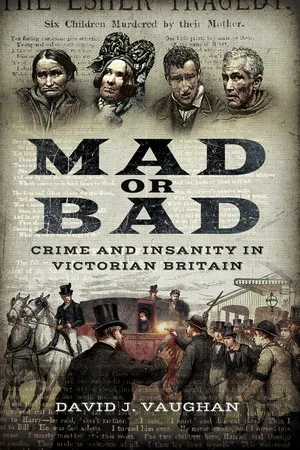
In a violent 19th century, desperate attempts by the alienists - a new wave of 'mad-doctor' - brought the insanity plea into Victorian courts. Defining psychological conditions in an attempt at acquittal, they faced ridicule, obstruction - even professional ruin - as they strove for acceptance and struggled for change. It left 'mad people' hanged for offenses they could not remember, and bad people freed on unscrupulous pleas.Written in accessible language, this book - unlike any before it - retells twenty-five cases, from the renowned to obscure, including an attempt to murder a bemused Queen Victoria; the poisoner Dove and the much-feared magician; the kings former wet-nurse who slaughtered six children; the worst serial killer in Britainand more.A Who's Who introduces the principal players - lifesaving medics, like Maudsley and Bucknill; intransigent lawyers like Bramwell and Parke., while a convenient Glossary of terms and conditions: ranging from Insane on Arraignment to Her Majestys Pleasure, Ticket of Leave to Burden of Proof, helps to explain the outcomes of the cases.Insanity Conditions presents, in glossary format, the diagnosed maladies put forward in court. Rarely accepted, more often rejected, by those keen on justice in its traditional form. A History of Debate explains the titular subject - through graspable language and a window in time. How the ones found 'not guilty on the grounds of insanity' were curiously handled in Victorian law.A chapter devoted to madness and women - from hysteria to murder, monthly madness to crime. Raising opportune questions about the issue of gender, and exposing the truths of a masculine world.
Information
Chapter 1
Who’s Who
Without people, this book would not be. Those accused gave the subject its innate human story. So too, the alienists, lawyers, politicians – and juries – of whom so few can here be named. To them all, however, we owe an unimpeachable debt.
Caveats: not considered exhaustive; author’s interpretations using various sources; highlighted cases appear in Part 5
Alienists
‘Psychiatrists who assesses the competence of a defendant in a law court’ (based on OED). Promoted the insanity plea in criminal trials, though not always present in court. Their work, reputations and public personae shaped the future of crime and insanity.
Those mentioned in the following pages:
John Charles Bucknill (Superintendent Devon Asylum) – maverick, commentator and lunacy reformer. Supported – and vexed – both sides in the crime and insanity wrangle. Rare success from the county (public) lunacy network, helped professionalise a discipline which he so often graced. His Manual of Psychological Medicine (1858) – co-authored with Daniel Hack Tuke – became the practitioner’s ‘bible’.
Thomas Clouston (Superintendent, Royal Morningside Asylum) – feared women’s latent mental capacity and exhaustion from ‘excessive’ use of the mind. Supported Fraser in his ‘sleep-walking’ trial.
John Conolly – iconic exponent of ‘moral management’ and the end of restraint in lunacy care. Struggled to grasp insanity causes (eg see Conolly 1830), believing women more susceptible to damage than men. Cited the ‘disruptive influences’ of menstruation, motherhood and reproduction.
James George Davey (Medical Superintendent, Northwoods Asylum) – believed in the natural order of things. Diagnosed unnatural madness through a phrenological approach (van Whye n.d.). Much criticised witness in case of James Pownall.
William Charles Hood (Medical Superintendent, Bethlem) – appeasing witness in the case of James Pownall and supporter of early photography of the photogenically mad (cf Morison, below).
Thomas Laycock (Lecturer and Physician to the Queen in Scotland) – believed in the duality of the physical brain and ethereal mind; also function and impact of the nervous system and its relation to action. His Nervous Diseases of Women (1840) emanated from a belief in impulsive insanity – blaming a fault in the brain for loss of the ‘will’ (see Part 2).
Henry Manning (Medical Superintendent, Laverstock Asylum, Salisbury) – expert witness in Maclean’s trial for High Treason, through which he ‘confirmed’ the accused’s irresistible moral impulse (cf discrete entries in Part 2).
Henry Maudsley (Superintendent, Manchester Royal Lunatic Asylum) – juggernaut of the alienist movement, author of many seminal works. Attracted criticism for his views on the menstrual cycle – and its debilitating effect on a woman’s ‘volatile mind’. Strident views on puerperal insanity and on controversial eugenics. A keen (if now unpopular) author, his Sex in Mind and in Education and Responsibility in Mental Disease were both tracts of their time (both pub. 1874). Married Ann, John Conolly’s daughter.
Sir Alexander Morison (visiting physician to Bethlem) – early student of mental disease. Reviewed many significant trials (eg Brixey). Gained notoriety for his sketches (The Physiognomy of Mental Diseases), and his objection to Conolly’s distaste for restraint (Showalter 1987: 46).
Henry Turnbull Pringle (Superintendent, Bridgend Asylum) – singlehandedly perhaps influenced the outcome of Collins’ trial, by suggesting the man had suffered aural illusions.
James Cowles Prichard (founding Commissioner in Lunacy) – ‘…the author of by far the best English work on insanity in his generation’ and deviser of moral insanity (Tuke 1891: 1). Expanded the notion that a person’s morality could be distinct from their intellectual reason, undermining the Rules and the ‘right-wrong test’ (see Appendix 3). His irresistible impulse (eg to murder) earned him the unflattering epithet, the ‘homicidal orgasm’.
Isaac Ray (American medic) – powerful voice in changing public perception of the insanity condition. Commentator on medical jurisprudence and critical of ‘the Rules’ and the ‘right-wrong test’ (see Appendix 3).
C. Lockhart Robertson (Physician to Sussex County Asylum) – one-time editor of Bucknill’s Journal of Mental Science, worked hard to unify the alienist movement (Smith 1981a: 13). Nevertheless, condemned jurists and alienists alike in the Brixey debacle.
George Savage (Chief Medical Officer, Bethlem) – infamously dismissed spiritualism as ‘a girl with hysterical symptoms’ (Green and Troup 1999: 311). Became confused in his reason during Dyer’s indictment.
Edgar Sheppard (Medical Superintendent, Male Department, Colney Hatch) – appeared as expert in Maclean’s trial for High Treason.
Professor Alfred Swaine Taylor (Professor of Medical Jurisprudence) – author of Principles and Practice of Medical Jurisprudence (1865), his colossus on forensic science for body and mind. Achieved universal respect for his dual grasp of both medicine and law.
Daniel Hack Tuke (great-grandson of York Retreat founder) – brought alienist knowledge to the reading public, eg as co-author with Bucknill of their veritable tome (see above). Showed interest (and expertise) in human automatism, including somnambulism and its role in murderous acts (eg Fraser). Marr...
Table of contents
- Cover
- Title
- Copyright
- Contents
- Acknowledgements
- Introduction
- Glossary of Terms
- Part 1 Who’s Who
- Part 2 Insanity Conditions
- Part 3 History of Debate
- Part 4 Mad Women, Bad Women
- Part 5 Case Histories
- Appendix 1: List of Statutes
- Appendix 2: Selected Key Events
- Appendix 3: The Rules
- Appendix 4: Early Forensics
- Bibliography
- Plate section
Trusted by 375,005 students
Access to over 1.5 million titles for a fair monthly price.
Study more efficiently using our study tools.
Frequently asked questions
Yes, you can cancel anytime from the Subscription tab in your account settings on the Perlego website. Your subscription will stay active until the end of your current billing period. Learn how to cancel your subscription
No, books cannot be downloaded as external files, such as PDFs, for use outside of Perlego. However, you can download books within the Perlego app for offline reading on mobile or tablet. Learn how to download books offline
Perlego offers two plans: Essential and Complete
- Essential is ideal for learners and professionals who enjoy exploring a wide range of subjects. Access the Essential Library with 800,000+ trusted titles and best-sellers across business, personal growth, and the humanities. Includes unlimited reading time and Standard Read Aloud voice.
- Complete: Perfect for advanced learners and researchers needing full, unrestricted access. Unlock 1.5M+ books across hundreds of subjects, including academic and specialized titles. The Complete Plan also includes advanced features like Premium Read Aloud and Research Assistant.
We are an online textbook subscription service, where you can get access to an entire online library for less than the price of a single book per month. With over 1.5 million books across 990+ topics, we’ve got you covered! Learn about our mission
Look out for the read-aloud symbol on your next book to see if you can listen to it. The read-aloud tool reads text aloud for you, highlighting the text as it is being read. You can pause it, speed it up and slow it down. Learn more about Read Aloud
Yes! You can use the Perlego app on both iOS and Android devices to read anytime, anywhere — even offline. Perfect for commutes or when you’re on the go.
Please note we cannot support devices running on iOS 13 and Android 7 or earlier. Learn more about using the app
Please note we cannot support devices running on iOS 13 and Android 7 or earlier. Learn more about using the app
Yes, you can access Mad or Bad by David J. Vaughan in PDF and/or ePUB format, as well as other popular books in History & British History. We have over 1.5 million books available in our catalogue for you to explore.