- 224 pages
- English
- ePUB (mobile friendly)
- Available on iOS & Android
eBook - ePub
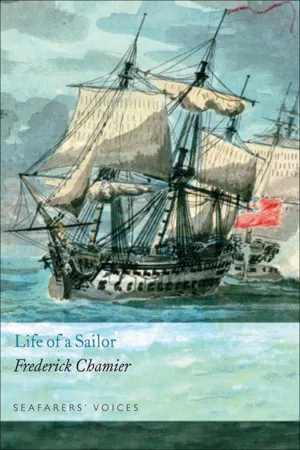
Life of a Sailor
About this book
Chamier was a Royal Navy officer, who like his exact contemporary Captain Marryat is best remembered for a series of naval novels. The Life of a Sailor was his first publication and is usually catalogued as fiction, which may be a tribute to Chamiers story-telling skills but it is wrong the book is an exact account of his naval career, with every personality, ship and event he describes corroborated by his service records. By the time he went to sea in 1809, the heroic age of Nelson was over, but the war was far from won, and he was to see a lot of action, from anti-slavery patrols off Africa to punitive raids on the American coast during the War of 1812.His descriptions of the latter were to prove highly controversial. Like many liberal officers, he deplored the strategy of bringing the war to the civilian population, and the book was much criticised by more senior naval officers for saying so. Chamier represents a new generation of post-Nelsonic naval officer, more gentlemanly, better educated and perhaps more open-minded he certainly got on well with Lord Byron, whom he met in Constantinople and his sympathies generally look forward to the Victorian age. He was too young to rise to high rank, and after the Napoleonic War, like many others, he was condemned to a life on half-pay and perhaps forced into a literary career, but out of it came one of the eras most authentic accounts of a junior officers naval service.
Information
1. Birth. Schooling. I am sent to sea.
I WAS BORN ON 2 November 1796, a strange night during which the rain fell in torrents, the wind howled against the casements, and I came forth in a caul, my old nurse, Ann Young, declaring later that a child born in a caul is always fortunate. Sailors, of course, believe that wearing a caul around the neck saves one from drowning, and have the same confidence in the ‘wood of the True Cross’. Once, sailing from Lough Swilly to Staffa, while the wind howled and the sea foamed, I remarked that we were perilously situated off a lee shore.
‘Your Honour need not fear the Devil himself just now!’ said an Irish sailor. ‘For I’ve some of the True Wood round my neck – and even should the wind blow the top off Instraholl lighthouse – it could not puff us ashore!’ Next minute we were wrecked on a ledge of rocks off Enishowen Head.
Notwithstanding the caul, I was not a fortunate youth, being sent at six to Dr Stretch’s school at Twyford. As six might seem a tender age, I must give the reason why my mother parted with her curly-headed boy. We lived in Clarges Street, as dull and miserable then as it will always be, and it was seldom that my brothers and myself could find a passer-by on whom to bestow a blessing. But one day in July, a tall, well-powdered gentleman, who had removed his hat in consequence of the excessive heat, passed under our windows. My brother emptied the contents of a jug of water on his coat, whilst I squirted some on his bald head. My brother then made a speedy retreat, while I remained on the half-landing, awaiting result. The gentleman knocked loud, and swore louder, and I, foreseeing a storm, opened a window and leapt into the back yard, falling, as cats, boys, and drunken men do, upon my legs. There I commenced to roar as if dying. My mother, in her anxiety for me, bowed the gentleman out before he had hardly begun his complaint, while Nanny swore I was killed, and the footman ran for a surgeon. The truth being ascertained, my mother scolded and cried, Nurse declared that I should be locked in a dark cupboard, and the infernal butler suggested that school was the best place for Master Frederic.
Thus I was sent to Dr Stretch – as kind a master, and lenient a punisher, as the most idle boy could pray for, or the most careless request. At Twyford little occurred worth remembering excepting Latin and Greek, which most boys immediately forgot, but I cannot forget Twyford, for it is associated with many pleasant memories, and but one very unpleasant incident. This happened on a midnight in August. We were all awake with the heat, and near the window. The moon was bright, and as the school fronted a churchyard, the view of the gravestones was unimpeded. We were relating, in turn, some ghostly anecdote and, boy-like, shaking like leaves whenever a board creaked or a bed moved. Suddenly a scream was heard from the churchyard, and advancing to the window we saw, in a long white shroud, a figure stretched on a grave into which the preceding day a man’s body had been consigned. One boy fainted, others cried, the school was instantly in motion. Half-clad maids rushed screaming into the room and, seeing the figure in the churchyard, screamed louder. Dr Stretch gave me a cut upon my seat of honour which made me caper like a harlequin, then called up a spectre of his own – John, his servant. It was incumbent for the doctor to investigate outside, but as it would obviously be more dignified to be preceded, he desired John go first, at which John’s legs began to tremble like the needle of a pocket-compass. Luckily for both their reputations, the shrouded figure arose and quietly departed out of the churchyard gate – later to be discovered as the widow of the man buried the previous day. Having somehow lived in a state of happiness with her husband, she had come to mourn over his grave. This scene, I must point out, did not make me any braver – but, rather, gave me my first idea of fear – an idea that has often recurred.
I was now sent from school to school until finally I landed at a French seminary at Durham House, Chelsea. The headmaster was a pert, fat, powdered tyrant, who constantly amused himself trying the hardness of my head against a thick ruler. Here I learnt the language after a fashion, but was soon dismissed as an incorrigible devil. And now a career for me became the subject of discussion. The family agreed I should never do for a parson, while my father declared that none of his sons should idle away life as a guards officer, dressed in a red coat and gold lace and looking like one of the Duchess of Gloucester’s footmen, or loll against the posts in St James’s Street with a hat like that of an Astrakhan merchant. My mother objected to any trade, banker, lawyer, fiddler, etc., and consequently I was to go either to India (where my father had been), or to sea, where my grandfather was an admiral, my uncle a half-pay lieutenant. Of these two evils, I chose what I felt to be the lesser, and, with the indifference of a boy, elected to become a defender of Albion, and a thing upon which to fit a midshipman’s coat.
In general, people are sent to sea to be got rid of: I was sent to be saved.
2. I join the Salsette (36 guns), frigate.
MY UNIFORM, WHEN IT arrived, dazzled my imagination. At first light I paraded Grosvenor Place to the gratification of myself, and the astonishment of the milk maids and chimney sweeps. I was introduced to my future captain, poor old Bathurst, afterwards killed at Navarino. He ran his short fingers through my hair, called me by my Christian name, and swore he saw a positive likeness to Lord Nelson. I then went to visit my old schoolfellows at Durham House, walking the yard with all the arrogance and all the self-importance of an admiralty porter (a species of vermin as haughty as their superiors.) At Durham House, my cocked hat was fitted on every head; my dirk was withdrawn and sheathed while I paraded about. The French tyrant headmaster ridiculed the folly of sending ‘children’ to sea, and I swore as I left that I would be revenged for that ‘children’ – and for the many hard blows and little knowledge I had received for my father’s money.
In July 1809, not yet thirteen, I stepped into my father’s carriage, tittering with joy, my family in tears; I thinking only of glory, they about a possible last farewell. For parents of an advanced age, parting with a loved son is hard, as they know, especially should he be going to India, that their eyes gaze on him for the last time. And while they may for some years read of his success, and be inspired by hope and the prospect of riches, that hope is desperate. The child is already dead – though living; the parents yet exist – but have passed away. And now, driving from the door, although my father was with me, I began to feel the coldness of desolation, seemingly already removed from the remembrance of my mother, the solicitude of my sisters, and the ever-willing hand of my old nurse.
The ship was at the Little Nore. We drove to the Three Tuns inn, about as miserable a hole, in as swampy a place, as the Washington Arms at Savannah. Here we slept. The next morning, at ten o’clock, we found a boat waiting to convey us on board the Salsette, frigate, my future home. Having dispatched my chest by yawl, I and my father now followed in the captain’s gig. As we came alongside they were just hoisting in my traps.
‘Hulloa!’ said the first lieutenant, seeing my chest (a lumbering thing marked No. 6, used by my father on his Indian voyages). ‘Does this youngster fancy the ship was made for him? Here, Mr M’Queen,’ calling one of the senior midshipmen, ‘No. 6 into steerage for now, the hold afterwards!’ At this, instead of the careful hands of an elegant butler and trim footman, a parcel of half-clad savages seized hold of No. 6, and, in a moment, I witnessed all my worldly treasures descend into a sort of hole in the deck.
Captain Bathurst was there to receive his old friend, my father. I was noticed kindly, undergoing at the same time a severe inspection by my future companions, all laughing covertly at my frightened appearance – laughing out loud not being allowed on the quarterdeck. Being then very slim, I heard myself christened ‘Fat Jack’ by about as ugly a midshipman as a mother ever produced or father saw. Before descending the hatch way, I turned to view the main deck which I had anticipated as a kind of elegant house with guns in the windows. Instead, on one side of the ship provisions were being received, on the other coals and wood, whilst in the middle the shoeless tars of England were rolling casks about the deck. Dirty women, the objects of the sailors’ affections, with beer-cans in hand, were everywhere conspicuous, while shrill whistles squeaked, and the voices of the boatswain and his mates roared like thunder. The deck itself was dirty, slippery, and wet, the smells abominable, the whole disgusting. And when I noted the slovenly attire of the midshipmen – shabby round jackets, glazed hats, no gloves, some without shoes – I forgot all about the glories of Nelson, and for nearly the first time in my life (I wish I could say it was the last), I took a handkerchief from my pocket, covered my face, and cried like the child I was.
Time slipped away and suddenly my father, who had not seemed on board a minute, was now leaving. He saw me placed under the protection of Mr M’Queen, gave me his last blessing, shook my hand, then left. Well do I remember leaning over the gun in the captain’s cabin, my head out of the port, crying with all the bitterness of the forsaken child: alone in the world, yet surrounded by it. Captain Bathurst now entered with Mr M’Queen, and I was walked off to that finest school for aristocratic pride and delicate stomachs, a midshipman’s berth, and ushered in with: ‘Here, my lads! Another messmate! Rather green at present, but as thin as our pig, and as sharp as a razor.’
‘What? Another!’ roared a ruddy-faced youth of about eighteen. ‘Then he must stow himself somewhere else, for we are chock-a-block here.’
As it was noon, the time the men and midshipmen dine, my companions were at their scanty meal. A dirty tablecloth, full of fingermarks, which had also seen duty as the towel since the previous Sunday, covered the table. On this table, which was fixed by sea-lashings to the bulkhead, and of that comfortable size a man might reach across without any particular elongation of the arm, was a piece of half-roasted beef, gravy chilled into a solid, some potatoes in their jackets, biscuit in a japanned basket, and some very questionable beer. Also present, acting as a soup tureen, was a heavy piece of block tin, pounded hollow, plates for that liquid being represented by shoes and quadrant cases. The knives were black, both handles and blades. Forks, after being plunged through the tablecloth to clean between the prongs, were then wiped upon it before use; an empty bottle served as a candlestick.
The berth itself was about ten feet long by eight broad. A fastened seat, with lockers underneath, was built round the bulkhead. The sides of the berth were adorned with dirks. Cocked hats, belonging to no particular member of the community, were placed on a tenpenny nail. It was an habitation like this that Dr Johnson compared to a ‘prison’, with, he adds, ‘the chance of being drowned’.
Also present was a servant – a ‘midshipman’s boy’ named Smith: face as black as a sweep’s, hands like a coalheaver’s, without shoes or stockings, and dressed in a pair of loose inexpressibles17 (though tight round the hips), and a checked shirt with the sleeves turned up. Good judges have held it difficult to determine which is most worthy of compassion – a hackney coach horse, a peddler’s donkey, or a midshipman’s boy. For my own part, I have always believed that a midshipman’s boy in a frigate, with about fourteen masters and no assistant, is in as cursed situation as the vengeance of man could suggest.
‘I say, youngster,’ said a dirty-looking messmate, ‘It’s no use your piping your eye here. So what will you have? Come, speak like a man!’
I answered in a trembling voice that I would take a glass of water, which was saluted with a loud laugh, while the boy forthwith began to pour out dingy-looking liquid in a teacup, cups being used because glass was expensive and easily broken, and showed dirt both in the liquid it contained and on its sides.
How this first evening went, I have, thank God, quite forgotten. I only remember that at about nine o’clock, Mr M’Queen stuck a large fork in the table, and instantly all the youngsters retired to bed. I remained, not understanding the hint, but I was shortly ordered to, ‘Obey signals and be off!’ The business of the final toilet of the day, instead of being assisted by a clear light shining on a French looking-glass, was finished in the dark, using a pewter basin, wet towels, dirty hair brushes, all afterwards deposited in my chest, which consequently produced, from the lack of air, a very disagreeable smell.
After this I was conducted to my hammock, sides touching that of the next, fourteen inches space being allowed per midshipman. Never shall I forget my first sensations at undressing before company. I turned round like a lady in a squall, until at last I was ‘unrigged’, and there I might have stood all night shivering and shaking like a dog in a wet sack, had Mr M’Queen not taken me in his arms and placed me fair and square in my hammock. In endeavouring to get between the clothes, I lost my balance, and went out the other side. I was instantly seized by a lady, an acquaintance of one of the midshipmen, and tucked up. From her I had a kiss, which savoured much of rum. After this I was left, not in the dark, nor entirely to my own reflections, until from a sound sleep I suddenly heard, ‘Seven bells, sir,’ from the marine dubbed my servant.
‘What bells?’ said I.
‘Seven, sir. You must turn out. The hammocks are piped up, and the master-at-arms is coming round. Here is your hammock-man waiting, sir.’
‘Well,’ said I, ‘Go out of the room and I’ll get up.’ At which the marine threw off the coverings, and lifted me out in a most improper state of nudity to make my toilet before breakfast – this latter being cocoa, and such iron biscuit I never wish to see again.
The war was a stirring time. Ships were not allowed to remain long in harbour, and two days after I joined, the Salsette was under weigh for the Downs. There we found the fleet preparing for the attack on Flushing. My first feelings of disgust now began to pass; general bustle always gives animation and courage. I soon forgot home and comfort and, boy-like, was only alive to the surrounding scene. To be sure, I was pushed about from place to place for, as with little pigs and old women, I was always exactly where I should not have been. But once anchored, I began, practical seamanlike, to go aloft. The first three or four ratlines I managed without much fear; after that, I clung to the shrouds like a doctor to a consumptive patient. But, by degrees, the difficulty vanished, like all difficulties which are fear lessly opposed, and on returning to the midshipman’s berth I was greeted with ‘Well done, youngster!’ and told I was as ‘active as a monkey!’ and handed a glass of grog to drink. I knew nothing of grog, but did as I was told, for I had soon learnt to obey. Swallowing the large measure, I soon became as brave as a lion, talked of all the feats I would perform, and promised myself the immortality of a Nelson. By degrees I found it difficult to articulate, words seeming to hang about on my lips without faltering into speech. I then resolved to go on deck, but making a bad slant, fell back down the cockpit where I began a cry of ‘Murder!’
Murder is a very unusual word on board ship. I only remember hearing it once, when an Irishman, having been struck by a splinter, called out, ‘Killing no murder!’ But no sooner did I cry it out than I had a full levee of attendants. The surgeon arrived first, to be informed I had tumbled down the hatchway. One glance told him the reason, and he reported that I had made a very pretty beginning, and was as drunk as a lord. When I awoke, I found myself in my hammock, sick as a dog, my head turning like a spinning jenny. From that day to this I have never been in so disgraceful a state. I had a lecture the next morning, and was pardoned.
We landed the 28th Regiment on the island of Tholen. The French were drawn up on a rising ground, resolving to dispute the beach. I was given the captain’s gig in order to land Major Brown, after which I was to return to the ship. As we neared the shore, the enemy commenced firing, and I commenced shivering. Major Brown cheered on the crew, which I, parrot-like, repeated: ‘Bravo, my boys! Stretch out!’ The boats kept in a pretty regular line but, owing to the shoal, grounded at some distance from the beach. The gallant 28th instantly jumped overboard, formed in the water, and with a loud cheer, charged the French. It did not occur to me to follow them. I had landed my cargo, and intended to go back as ordered. But the boat’s crew turned deaf ears to my command, and in spite of the cannonballs whistling and whizzing over their heads, were determined to put themselves ashore. Fortunately for my honour, the 28th’s charge settled the business and the French retreated. I returned aboard covered with laurels, having smelt powder and heard ball. The captain, duly appreciating my valour, patted me on the back.
‘There,’ said he, ‘You are fairly a sailor now. Been drunk, been aloft, and been in action. But take your hands out of your pockets, or I shall order the sailmaker to stitch them up.’
The next morning I was returned to earth by being sent on that same shore to buy milk for the captain’s breakfast. On our approaching the beach, I remarked a soldier with a musket walking as a sentinel, but the crew, ever ready for schnapps, laughed at the idea of an enemy. So we landed, bought the milk, and were progressing out of the creek when my friend with the musket desired us in French to land again, or he should fire. Calling out in my Durham House French, I answered there must be some mistake.
‘Not at all,’ said he, and began to get ready for action. We were now clear of the creek, but still very close. The fellow took aim and fired, the ball passing over my head. As there is nothing like coolness in danger, to show how little I thought of the matter, I now lay down in the stern sheets, knowing that a boat could be propelled faster through the water if the weight was below the surface. The rest of the French guard now came down to enjoy the shooting, and the bowman got a slight graze from the first volley. The crew did not require to be told to ‘stretch out’ this time. Steered by the captain’s steward, we took care to keep out of the line between the enemy and the Salsette, allowing the Salsette’s officer of the deck to let fly with an eighteen-pound shot which settled the French guard and the business.
It is of little use to show the egregious errors of the Flushing expedition. Had the fleet advanced to Antwerp, there were not one hundred soldiers left to protect that town, while the banks of the river were so low that no battery could have been of much avail, and the city could easily have been taken by only sounding the river. But no! Lord Chatham, with sword drawn, was waiting for Sir Richard Stra’han. Sir Richard, longing to be at ’em, was waiting for the Chatham, etc. Enough of this. We bungled the business completely and lost thousands of brave men.
The Salsette was now ordered to the Mediterranean. We anchored in the Downs, and I was sent home for a day or two, with orders to rejoin at Portsmouth. It was quite astonishing the change six months had worked in me. Before I left home, boiled mutton did not agree with me, plain water was unwholesome, veal not sufficiently nutritious. Now I would happily have eaten pork with the skin on, even though it were covered with bristles as thickset as a scrubbing brush and as long as a Russian’s beard.
Once more experiencing the delights of cleanliness and flattery, it occurred to me that I might mention to my father that, if it were all the same to him, I would just as soon lodge in Grosvenor Place as on the Salsette. I told one of my sisters who immediately took me by the arm, and so completely humbugged me with merit rewarded, England, home, and beauty that I put on the best face I could, reduced chest No. 6 to a more con venient size, cut...
Table of contents
- Cover
- Title Page
- Copyright
- Contents
- Editorial Note
- Introduction
- The Life of a Sailor
- Preface
- 1 Birth – schooling. I am sent to sea.
- 2 I join the Salsette (36 guns).
- 3 First love. Impressions of Malta.
- 4 Smyrna: 1810. Lord Byron solicits a passage to Constantinople. We are ordered to Malta where I remove to the Fame I witness a public execution – Gibraltar, and then home.
- 5 I join the Arethusa, Captain Coffin. We cruise Africa against the slavers – run aground and are almost wrecked.
- 6 1811 – I join the Menelaus, Captain Peter Parker. A miraculous escape – a day I would forget forever.
- 7 Ordered back to Portsmouth we take a prize and discover a deserter. In 1814 we retake a great Spanish treasure ship, the St John the Baptist.
- 8 Looking for American privateers we land at Fernando de Noronha. We sail for America where we ruin, rob, and burn.
- 9 In 1815 I am appointed to the Euphrates, Captain Robert Preston. We visit Corfu – Captain Preston becomes insane through love.
- 10 I see service on a guard ship, the Bulwark – on a revenue cruiser, the Asp – and then the Arab., in which I patrol Northern Ireland and Scotland. Returning home, I am almost turned out of my own house.
- 11 I am ordered to the West India station on the Scylla. The crew succumb to drink and disease and I exchange to the Lively – I take the fever and am given up for dead.
- 12 I am sent to Vera Cruz on the Lively, then ordered overland to report revolutionary matters to our consul in Mexico City. We are robbed, and come within danger of our lives.
- 13 We return to Jamaica. I am appointed commander of the Britomart – I roam from place to place collecting gold and silver freight from merchants. I return home, paying off at Portsmouth – the end of the life of a sailor.
- Notes
Trusted by 375,005 students
Access to over 1.5 million titles for a fair monthly price.
Study more efficiently using our study tools.
Frequently asked questions
Yes, you can cancel anytime from the Subscription tab in your account settings on the Perlego website. Your subscription will stay active until the end of your current billing period. Learn how to cancel your subscription
No, books cannot be downloaded as external files, such as PDFs, for use outside of Perlego. However, you can download books within the Perlego app for offline reading on mobile or tablet. Learn how to download books offline
Perlego offers two plans: Essential and Complete
- Essential is ideal for learners and professionals who enjoy exploring a wide range of subjects. Access the Essential Library with 800,000+ trusted titles and best-sellers across business, personal growth, and the humanities. Includes unlimited reading time and Standard Read Aloud voice.
- Complete: Perfect for advanced learners and researchers needing full, unrestricted access. Unlock 1.5M+ books across hundreds of subjects, including academic and specialized titles. The Complete Plan also includes advanced features like Premium Read Aloud and Research Assistant.
We are an online textbook subscription service, where you can get access to an entire online library for less than the price of a single book per month. With over 1.5 million books across 990+ topics, we’ve got you covered! Learn about our mission
Look out for the read-aloud symbol on your next book to see if you can listen to it. The read-aloud tool reads text aloud for you, highlighting the text as it is being read. You can pause it, speed it up and slow it down. Learn more about Read Aloud
Yes! You can use the Perlego app on both iOS and Android devices to read anytime, anywhere — even offline. Perfect for commutes or when you’re on the go.
Please note we cannot support devices running on iOS 13 and Android 7 or earlier. Learn more about using the app
Please note we cannot support devices running on iOS 13 and Android 7 or earlier. Learn more about using the app
Yes, you can access Life of a Sailor by Frederick Chamier in PDF and/or ePUB format, as well as other popular books in History & Military & Maritime History. We have over 1.5 million books available in our catalogue for you to explore.