- 288 pages
- English
- ePUB (mobile friendly)
- Available on iOS & Android
eBook - ePub
About this book
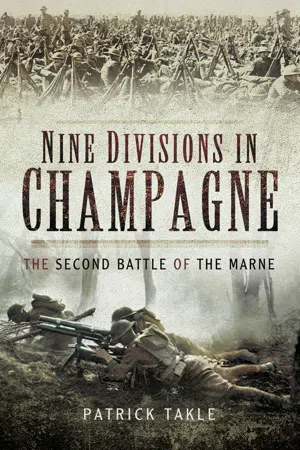
The book explains how the Allies, after a series of swingeing defeats, sank their differences and came together to turn the tide against the German Army in the Summer of 1918. Although it is a detailed history of the fighting by British divisions, it also highlights the growing presence of American forces and their huge contribution to victory, too often understated in earlier works. The book deliberately binds together the genesis, size and equipment of the British and American divisions and seeks to inter-mingle the American and British campaigns of 1918.By blocking the Third German Offensive on the Chemins des Dames and then arriving in time to turn the Kaiser's army out of the Marne salient, the Allied divisions cleared the way for the decisive counter offensive at Amiens. Exhausted and demoralized, the German Army collapsed and the outcome of The Great War was decided.
Information
The Foch Offensive and the arrival of the Americans
As a young man of just 18, Ferdinand Foch had served briefly as a volunteer in the infantry during the disastrous Franco-Prussian War of 1870-71. He had witnessed the fall of the regime of Napoleon III, as well as the resulting dramatic conversion of his college town of Metz into a German city, which turned him into an implacable enemy of Germany. In 1873 he was commissioned into the artillery and began an illustrious military career. He held a succession of staff and regimental appointments until, by 1895, he was a major and was appointed to serve for six years at the French Staff College, where he proved to be a very gifted instructor. His analysis of the French defeat in 1870, and his writings on military history and theory, became extremely influential, and led to the regeneration of the French Army. Although he firmly believed that the attack was the key to victory, he did not recommend recklessness in military strategy. Nevertheless, his reputation for blind espousal of the attack, above all else, blighted his later reputation. However, it was his unfailing optimism during the crises of the dark days of 1918, partnered by the courage of the equally indomitable Prime Minister Georges Clemenceau, which ensured the eventual triumph of the Allies.
General Foch was no stranger to the River Marne area. In 1914 the courageous attacks by his XX Corps had held up the advancing Germans in Lorraine, and caused General Joffre to promote him to command the newly-formed Ninth Army. He was then able to liberate Châlons on the River Marne from the Germans, and went on to co-ordinate the northern French armies and liaise with the British during the ‘Race to the Sea’. Eventually he was placed in command of the Northern Army Group of French and British armies. However, he was blamed for the heavy loss of life in the campaigns of 1915 and 1916, fell out of favour, and was posted to Italy. In 1917 he was rehabilitated by General Pétain, who, taking over from General Nivelle as the French Commander-in-Chief, brought Foch back to be Chief of the General Staff of the French Army. In the crisis of March 1918 he continued to show determination and fighting spirit and was selected by the Allies to be the Supreme Allied Commander with responsibility for ensuring that reserves were available to guarantee there would be no breakthrough of the Allied front in France.
In later years Foch was frequently criticized for always favouring the offensive in battle, but it is undeniable that conducting skilful defensive battles and withdrawals, while absolutely necessary, does not actually win wars. Nevertheless, while the Germans held the strategic initiative, as they did during the early part of 1918, it was essential for the Allies to defend themselves as economically as possible. Experience through much of the war showed that an elastic defence, bolstered by reserves, artillery and machine guns, would always overcome the attacker. Every German or Allied offensive, no matter how successfully launched, was doomed to run out of fresh troops and supplies and then flounder in the debris of the battle zone. Eventually the offensive would succumb to enemy counter-attacks, thus making it impossible to administer a single mighty knock-out blow. Aware that the key to blocking powerful German attacks was the ready availability of reserves, Foch spent much of his effort as ‘Supremo’ persuading his allies to make reserves available to support each other.
To achieve Allied victory General Foch envisaged that they would need both to recover the strategic initiative, and then mount a succession of repeated attacks to wear down the great German war machine. Therefore, during the crisis summer months of 1918, Foch had to steer carefully between the competing needs of his two major commanders. Pétain was under serious political threat, and sought to draw reserves to Paris for its immediate defence, while Haig was desperate to attract more reserves to ensure the survival of the British Army against a repeat of the hammer blows of March and April. While balancing these needs, Foch was continually pressing the Allies to build up their troop numbers and to think about mounting offensives as soon as conditions would allow.
The role of Supreme Allied Commander was not easy. Foch had no direct powers of command and had to work through the senior Allied commanders, Pétain, Haig, and Pershing. He could demand control of reserves, but had to negotiate to persuade the commanders to undertake offensives where he thought it would have best effect. It was also natural for the Allies to feel that more was being demanded of them than the Supreme Commander was asking of his own nation. Fortunately, Foch was a commander with unique qualifications. Not only did he have outstanding abilities as a military thinker, he had also repeatedly demonstrated his outstanding leadership and determination through four years of war. He had shown his ability to command successfully major French formations in the field and had worked closely with the British in the northern sector. Moreover, Foch was usually supported by the equally pugnacious veteran French prime minister, Georges Clemenceau, who was able to prevail upon the reluctant British prime minister, Lloyd George, to send more troops to France. The Allies were fortunate that in Foch, they had chosen a supremo who was strong enough to hold the alliance together and to inspire the Allies to make sacrifices to help each other to withstand the challenging reverses inflicted by the victorious German Army.
Fortuitously, Foch recognized the vulnerability of the German positions around Soissons, and was primarily responsible for championing and initiating the Second Battle of the Marne. Following its success, it was he, not Pétain, the French Commander-in-Chief, who was rewarded by promotion to maréchal on 6 August 1918; Pétain was promoted a few months later. Marshal Foch, by his vision and determination, became the undoubted architect of the succession of heavy Allied attacks across the whole front, which defeated and threatened to encircle the German forces in France. In outline his strategy was based on two major thrusts, one from the south-east, the Franco-American St Mihiel-Meuse-Argonne offensive, and one from the north-west, the Belgian, British and French offensives in Flanders. Despite heavy casualties, both offensives succeeded, and were only halted close to the borders of Germany by the German requested Armistice.
Nevertheless, despite his belief in eventual victory, there seems little doubt that the rapid success of the third German offensive on 27 May 1918 took Foch, as well as the other senior French commanders, by surprise. The first two offensives had struck the British, and it was confidently expected that the third attack would also be in Flanders, where most of the reserve divisions had been gathered. As a result, many sections of the 450-kilometre French front line had been thinned out. Therefore, Ludendorff’s brilliant decision to switch his attack from Flanders to a weakly-held section of the French line in the Champagne area richly deserved the total strategic and tactical surprise that it achieved. The French Intelligence service, normally clever and well-informed, was duped and failed to detect the movement of thousands of guns and more than a dozen divisions to the Reims area. As a result, the violent initial artillery barrage on 27 May achieved complete surprise as it shattered the forward positions of the French XI and British IX Corps on the thinly-held Chemin des Dames line. Then the great tide of rampaging German infantry swamped all French attempts to plug the gap, enabling the Germans to advance almost thirty miles and reach the River Marne within three days. Ludendorff was within an ace of achieving his aim of drawing sufficient reserves away from his preferred attack area, which remained Flanders.
The Germans appeared to be on the cusp of achieving total victory in the early summer of 1918 as their infiltration tactics and commitment of fresh divisions repeatedly surprised the Allies and gained them huge swathes of territory. The swingeing losses also badly undermined Allied civilian and military morale. However, these signal victories were all achieved at a huge cost in casualties to the German Army, which then required additional troops to garrison the new longer and less easily défendable front lines. The loss of so much territory was a stunning shock to the Allies, and it initially overshadowed the realization that they had actually managed to contain the best the Germans could throw at them. Moreover, the prospect of imminent defeat forced them to sink their differences and combine their resources under Foch as the single Supreme Commander.
While the three spring defeats had been bitter, the Allies now knew how to recognize the indicators of the German preparations for a surprise attack, and how to counter these new German tactics with a deeper, more flexible defence. It was abundantly clear that as long as the Germans retained the strategic initiative they would be able to make a significant impact on almost any part of the front, but actually breaking through into the open area behind the front would remain very difficult for them. As a result the subsequent two major German attacks, in June and July, were held comfortably by the French, who had quickly gathered sufficient reserves to meet these attacks. In addition, for the first time, the French benefited from the significant support provided by a few of the new divisions of the American Army.
Having contained the fifth great German offensive of 15 July, Foch immediately exploited the opportunity to strike the over-extended German divisions, particularly in the west of the Marne salient. There is little doubt that, supported by their tanks, aircraft and artillery, the French, attacking with their Tenth, Sixth, Ninth and Fifth Armies would have achieved surprise and a degree of success with their co-ordinated counter-attacks on the 18th. However, the French Army was generally very short of trained reserves, and, under Pétain’s pessimistic leadership, had adopted a largely defensive posture in front of Paris. Moreover, after four years of bitter war and huge debilitating losses, many French soldiers had lost their appetite for sacrifice. They were prepared to defend France to the death, but few believed that further offensive action would make any real difference against the proven ability of the Germans to seal off every breach in their defences.
Foch’s genius was to appoint one of his best attack generals, Charles Mangin, to command the troops of the enlarged Tenth Army that he was carefully husbanding in the thick Forest of Villers-Cotterêts. Then he negotiated with Pershing to add American troops to Mangin’s Army. The addition of two divisions of fresh American troops, brave to the point of recklessness, added enormous punch, vitality and momentum to Mangin’s attack. The sheer power and sacrifice of these fresh American troops ensured that Tenth Army was able to break through the thickest lines of German wire, trenches and artillery barrages, to threaten the neck of the salient at Soissons.
When the United States declared war against Germany on 6 April 1917 it was dependent, like the pre-war British, on a small regular army and a back-up territorial force, namely the state-based National Guard. Some steps had already been taken to increase both forces, but the regular army had only 127,588 officers and men, supplemented by a National Guard of about 180,000 men. This was a very small force in the context of a European war. Interestingly enough, when George Marshall became Acting Chief of Staff in July 1939 the enlisted strength of the active regular army was still only 174,000 men, with just 12,000 officers. Bitterly Marshall complained to Congress in 1939 that the Americans, once again, had no field army, while the Germans had ninety divisions available and the Japanese deployed fifty divisions in China alone.
However, in 1917, almost 1,000,000 men immediately volunteered for service, and another 3,000,000 were drafted. The dramatic expansion of the army and the training of so many officers and men represented an enormous training commitment, which needed time to produce results. The very first soldiers of the 1st Division were shipped in June and July 1917, but were only a token of the forces to follow. By the summer of 1918, 250,000 men were being shipped each month; actually, 313,410 landed in France in July 1918. More than 2,000,000 ‘doughboys’ (as the American soldiers were nicknamed) sailed to France before the end of hostilities, and, despite the best efforts of German submarines, very few were lost at sea; some 230 men were lost in the sinking of the British SS Tuscania by UB-77 in February 1918, and another fifty-six were lost when the British SS Moldavia was sunk by UB-57 in May 1918. By the Armistice, the Americans had created an enormous logistical support base, and brought forty divisions to France, of which twenty-nine had been in combat. Generally it was the early divisions which saw most action and, accordingly, suffered the greatest losses. Altogether 50,280 American soldiers were killed in battle; more than half of these (26,277) were killed in the bloody Argonne offensive while another 56,000 died from other causes in France, principally influenza, and some 205,690 were wounded or gassed.
It was planned that each newly-formed division should be given six months’ training in the United States before being sent abroad. This was to be followed by two months more continuation training and exposure in quiet sectors of the front in France before commitment to intensive operations in an active sector. However, many units did not receive any training on their artillery or infantry support weapons until they actually got to Europe. Indeed, in the rush to send sixteen divisions to France in May and June of 1918, many only partially-trained men were embarked precipitately. For example, when Buster Keaton, the famous Hollywood actor, enlisted in July 1918, he said he was given just two weeks’ training before being shipped overseas with the 40th ‘Sunshine’ Division.
It was felt necessary to show the Allies some early benefit from the American participation in the war, and the first four regular divisions were quickly formed from a mixture of regular army personnel and volunteers and then rushed to France, often with the minimum of training, two in 1917 and two in early 1918. In addition a number of divisions based on National Guard formations were also hurried to France, including the famous 26th (Yankee) and 42nd (Rainbow) Divisions, which both arrived in late 1917.
As mentioned earlier both Bernard Montgomery and George C. Marshall were young captains serving as operational staff officers in 1917, but both were destined to play huge and significant roles in winning the Second World War for the Allies. Each acknowledged the debt they owed their war service in France in preparing them for the later conflict. Perhaps Montgomery’s most important was the realization that one neede...
Table of contents
- Front Cover
- Half-Title Page
- Title Page
- Copyright Page
- Dedication
- Contents
- Acknowledgements
- Maps
- Preface
- Chronology of Main Events in the final year of the War
- Introduction
- The German Spring Offensives of 1918
- The formation of IX Corps and the training of Generals
- The destruction of IX Corps on the Chemin des Dames
- The Foch Offensive and the arrival of the Americans
- XXII Corps with 51st and 62nd Divisions joins French Fifth Army in the Ardre Valley
- The 51st (Highland) and 62nd (West Riding) Divisions fight their way up the Ardre Valley
- The 15th (Scottish) Division joins XX Corps in Tenth Army
- The New 34th Division joins XXX Corps in Tenth Army
- The British contribution to Victory in the Champagne and its impact on eventual Allied Victory
- Tributes to the British Units which fought in the Champagne Battles of 1918
- Address by General Mangin to the American Army
- British Units which fought in the Champagne Battles
- Total Casualties of the Nine British Divisions in the Champagne Campaigns
- American Cemeteries and Memorials in the Champagne
- British Cemeteries and Memorials in the Champagne
- The Italian Military Cemetery at Chaumuzy
- French Memorials to the Second Battle of the Marne
- Bibliography
Trusted by 375,005 students
Access to over 1.5 million titles for a fair monthly price.
Study more efficiently using our study tools.
Frequently asked questions
Yes, you can cancel anytime from the Subscription tab in your account settings on the Perlego website. Your subscription will stay active until the end of your current billing period. Learn how to cancel your subscription
No, books cannot be downloaded as external files, such as PDFs, for use outside of Perlego. However, you can download books within the Perlego app for offline reading on mobile or tablet. Learn how to download books offline
We are an online textbook subscription service, where you can get access to an entire online library for less than the price of a single book per month. With over 1.5 million books across 990+ topics, we’ve got you covered! Learn about our mission
Look out for the read-aloud symbol on your next book to see if you can listen to it. The read-aloud tool reads text aloud for you, highlighting the text as it is being read. You can pause it, speed it up and slow it down. Learn more about Read Aloud
Yes! You can use the Perlego app on both iOS and Android devices to read anytime, anywhere — even offline. Perfect for commutes or when you’re on the go.
Please note we cannot support devices running on iOS 13 and Android 7 or earlier. Learn more about using the app
Please note we cannot support devices running on iOS 13 and Android 7 or earlier. Learn more about using the app
Yes, you can access Nine Divisions in Champagne by Patrick Takle in PDF and/or ePUB format, as well as other popular books in History & British History. We have over 1.5 million books available in our catalogue for you to explore.