- 144 pages
- English
- ePUB (mobile friendly)
- Available on iOS & Android
eBook - ePub
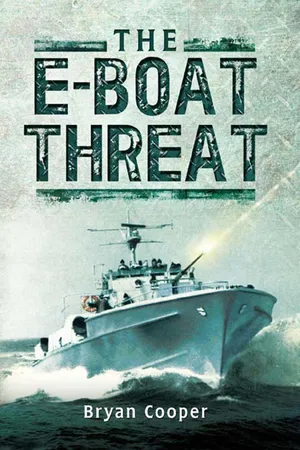
The E-Boat Threat
About this book
One of the major lessons of World War II was the importance of coastal waters. It was not widely recognised beforehand just how vital the control of such waters would become, both in defending essential convoys as well as attacking those of the enemy, and in paving the way for amphibious landings.While land based aircraft could carry out offshore operations by day and destroyers and cruisers patrolled deeper waters, the ideal craft for use in coastal waters were motor boats armed with torpedoes and light guns. But with the exception of Italy, none of the major powers had more than a handful of these boats operational at the outbreak of war.From a small beginning, large fleets of highly maneuverable motor torpedo boats were built up, particularly by Britain, Germany and the USA. They operated mainly at night, because they were small enough to penetrate minefields and creep unseen to an enemy's coastline and fast enough to escape after firing their torpedoes. They fought in every major theatre of war, but the first real threat came in the North Sea and English Channel from German E-boats, crossing to attack Britain's vital convoys. Ranged against them in the 'battle of the little ships' were British MTBs and MGBs and, later, American PT boats. They often fought hand to hand at closer quarters than any other kind of warship in a unique conflict that lasted right to the end of the war.The E-boat Threat describes the development of these deadly little craft, the training of their crews who were usually volunteers and the gradual evolution of tactics in the light of wartime experience. Methods of defence are also related, which included the use of aircraft and destroyers as well as motor gunboats, sometimes acting under a unified command.
CONTENTS
Introduction
Early Development
World War II Line-Up
Merchant Shipping Under Attack
E-boats in Action
Growing Threat to Coastal Convoys
Coastal Forces Strike Back
New Boats
In the Balance
Coastal Forces Take the Offensive
Stalemate
Fight to the End
Epilogue
Appendix 1 Anti-E-boat Weapons
Appendix 2 Mines
Bibliography
Index

Camouflaged E-boatreturning tobase after an operational sortie
INTRODUCTION
All the major powers that fought in World War II, with the exception of Japan, built large numbers of motor torpedo boats specifically to operate in coastal waters. These highly manoeuvrable ‘little ships’, when they met in action, were involved in some of the closest-fought sea battles of the war. But their main function was to attack much larger enemy vessels, either merchant shipping or warships, by using the striking power of their torpedoes.
The main advantages of motor torpedo boats were their size and speed. They were small enough to move largely unseen at night, with sufficiently shallow draught to pass safely over enemy minefields. They were fast enough, with speeds of 40 knots and more, either to roar up on enemy ships to attack them broadside or, what was often preferable, to make a rapid escape after creeping up slowly and quietly on the enemy. Once their torpedoes had been fired, the little ships needed speed to get away before the enemy’s guns could be brought to bear on them. One further advantage was that such craft could be built relatively cheaply in numerous boatyards, leaving the more specialised shipyards free to concentrate on building warships.
But motor torpedo boats had their disadvantages as well. Because weight of armament had to be sacrificed to speed, they were especially vulnerable to attack by enemy aircraft and this usually limited their operations to the hours of darkness. Because of the high fuel-consumption of their powerful engines, range was limited to a few hundred miles unless auxiliary gasoline tanks were carried. And because of their size and light construction – necessary factors in achieving high speeds – motor torpedo boats could not operate in very heavy seas. Even in less rough conditions they were prone to mechanical breakdown. Nevertheless, it was extraordinary what a hammering they could take and still survive. The men who crewed these night hunters might curse the buffeting they got, but as they rode the waves with bows lifted and wakes foaming a long trail behind, they knew an exhilaration of speed that no other kind of ship could give.
In spite of the very considerable damage they caused, the motor torpedo boats of all the major navies were too small and numerous to be given the dignity of individual names and were known by numbers instead. To the British they were MTBs (Motor Torpedo Boat), to the Americans PT-boats (Patrol Torpedo), to the Italians MAS-boats (Motoscafo Anti-Sommergibile), and to the Germans S-boats (Schnellboot, meaning fast boat). For some curious and unexplained reason, the Schnellboot was always referred to by the British Navy as an E-boat, presumably standing for ‘Enemy’ war motorboat. This term could, of course, be applied to many other enemy craft and would have caused only confusion rather than aiding identification. In fact, in all other instances, the British Navy used the initial letter of the actual German word for describing a particular type of craft. Had this been done in the case of motor torpedo boats, they would have been known rightly as S-boats, as they were to the Germans. Several suggestions have been put forward to explain this, including the ingenious theory that the ‘E’ might have stood for the technical term ‘Lürssen Effekt’ (one of the features introduced into their boats in the 1930s by the Lürssen shipyard which later became responsible for building most of the German S-boats). It is probable, however, that the real explanation is the simplest and that the ‘E’ was meant to stand merely for Enemy. Both before and at the beginning of the war, these craft (whether British or German) were not taken very seriously by the Admiralty, and it is likely that the definition was rather thoughtlessly coined in the belief that it would seldom be used. Although the Germans also developed motor boats for other purposes, such as the Lürssen R-boats (Räumboot) which were used for minelaying, mine-sweeping and coastal convoy protection when it was armed with 37mm and 20mm guns, these were referred to by their correct prefixes, so that the Royal Navy’s E-boat designation stood only for motor torpedo boats.
Whatever they were called, motor torpedo boats fought very successfully in the coastal waters of every major theatre of the war – in the North Sea and English Channel, the Mediterranean and among the dreamy islands of the Aegean, the Baltic, off Burma and Malaya and in the South China Sea, and across the Pacific to the final liberation of the Philippines. Probably their most wide-scale use was in the Pacific, largely by the United States for the Japanese did less than any other naval power to develop such craft, mainly due to chronic lack of suitable engines. Thus there was nothing comparable to combat the American PT-boats as they took part in the island-hopping strategy to liberate Japanese-occupied territories. PT-boats were used to attack coastal supply ships, they cooperated closely with the US Army during troop landings, and took part in some of the great fleet battles in the Pacific where they were effective in sinking Japanese warships up to the size of light cruiser. The Mediterranean conflict saw the biggest variety of craft. The British, Americans, Germans and Italians used motor torpedo boats both to attack as well as to defend convoys as both sides fought desperately to keep open lines of supply to their land forces. Malta and Sicily featured prominently in this struggle, as bases respectively for British and Axis craft. The large canvas of Mediterranean operations gave considerable scope for the kind of lone role that suited the individualistic temperament of those who served in the little ships. As well as their main purpose of attacking enemy convoys, MTBs and PT-boats took part in commando raids and co-operated with partisans fighting behind enemy lines. Large numbers of Italian MAS-boats played a part in the early stages of the war, since Italy had given more attention than the other powers to the military application of such craft and had the largest number of them. At one point in the war, an American PT-squadron was the only representative of the US Navy in the Mediterranean.
However, the fiercest motor torpedo boat battles were fought in the seas off the east and south coasts of Britain, and it is with these operations that this book is concerned. With Germany’s occupation of France and the whole coastline of Western Europe, the E-boats had bases from which to launch a concerted attack on Britain’s vital east coast shipping. Further targets were of course available in the overseas convoys bringing goods and supplies into Britain, but as these were usually well escorted when close to British ports, it was against the more vulnerable coastal convoys that the E-boats directed their main attack. This included direct attack by torpedo and the more indirect attack of laying mines on the convoy routes, overall the more successful of the two. At the same time, British MTBs were similarly used to attack German coastal shipping. But there was a marked difference in the make-up of the two navies, in that the Germans had less coastal shipping and more armed escorts to protect it, whereas the British at any one time had several hundred merchant ships sailing up or down the east coast and few escort vessels available to protect them. Such was the havoc caused by the E-boats in their nightly raids along E-boat Alley – the main convoy route off the coast of East Anglia – that special motor gunboats (MGBs) were designed to combat them. It was in the North Sea that battles raged between the British and German craft, fought hand to hand at closer quarters than any other kind of warship. The Germans held the upper hand until the end of 1942, when Britain’s Coastal Forces (as the MTB and MGB flotillas were known) began to reach equal terms with the E-boat, in many ways the best of all motor torpedo boats used during the war. The fighting increased in intensity in 1943 and again in 1944 with the Normandy landings. It was at this time that American PT-boats first appeared in British waters, helping the MTBs to protect the Allied supply routes from harrassment by the German boats. Although by then outnumbered and out-classed, the E-boat crews fought tenaciously until the very end of the war, when they were still doing their best to sink Allied shipping.
Motor torpedo boat warfare was, however, built up from very small beginnings. Although such craft had been used very successfully during World War I, especially by the Italians against the Austrians, they were largely neglected by Britain and the USA in the inter-war period. Even in Germany, they were originally developed mainly as a means of getting around the terms of the Versailles Treaty. It was the attitude of most nations with large navies that the bigger the ship, the better. Little was done officially to develop motor torpedo boats, and most of the essential research carried out was by private companies and individuals, largely for sport and pleasure. Record-breaking attempts by men such as Sir Malcolm Campbell and Sir Henry Segrave provided much valuable knowledge on fast boat design, and the German Schnellboot was, in fact, based on the design for a motor launch built privately for an American customer by the Lürssen yard. At the same time, smaller nations – perhaps because they could not so easily build big ships – were very much alive to the possibilities of motor torpedo boats. Companies like Vosper and Thornycroft built MTBs for many foreign navies, some of them later to be used against the Allies. Because of the interchange of ideas and equipment between countries which were later to find themselves on opposing sides, there was an extraordinary situation at the beginning of the war in which the few British MTBs that were in service were powered by Italian Isotta-Fraschini engines, the best small-boat petrol engine designed at that time but one which naturally became unavailable when Italy entered the war. Such was the even greater neglect in the USA that an MTB design by the British Power Boat Company was used as the basis for most of the American PT-boats. The American Packard engine which became the main power unit for all British and American boats was itself a development of the Rolls-Royce Merlin engine. Japan did least of all to develop fast fighting boats, and the very few that were built were based on a Thornycroft design.
One of the lessons that had to be re-learnt in World War II – for the same has been true of nearly every war in this century – is the vital importance of coastal waters. Not only must merchant ships from abroad bring in supplies through such waters, but often, coastal convoys are the only practical and economic means of taking materials from one part of a country to another. These convoys must be protected, while at the same time, plans must be made to attack those of the enemy. From a ...
Table of contents
- Cover
- Half Title
- Dedication
- Full Title
- Copyright
- Contents
Trusted by 375,005 students
Access to over 1.5 million titles for a fair monthly price.
Study more efficiently using our study tools.
Information
Publisher
Pen & Sword MilitaryYear
2015Topic
HistoryPrint ISBN
9781473827837
Subtopic
Military & Maritime HistoryeBook ISBN
9781473853836
Index
HistoryFrequently asked questions
Yes, you can cancel anytime from the Subscription tab in your account settings on the Perlego website. Your subscription will stay active until the end of your current billing period. Learn how to cancel your subscription
No, books cannot be downloaded as external files, such as PDFs, for use outside of Perlego. However, you can download books within the Perlego app for offline reading on mobile or tablet. Learn how to download books offline
We are an online textbook subscription service, where you can get access to an entire online library for less than the price of a single book per month. With over 1.5 million books across 990+ topics, we’ve got you covered! Learn about our mission
Look out for the read-aloud symbol on your next book to see if you can listen to it. The read-aloud tool reads text aloud for you, highlighting the text as it is being read. You can pause it, speed it up and slow it down. Learn more about Read Aloud
Yes! You can use the Perlego app on both iOS and Android devices to read anytime, anywhere — even offline. Perfect for commutes or when you’re on the go.
Please note we cannot support devices running on iOS 13 and Android 7 or earlier. Learn more about using the app
Please note we cannot support devices running on iOS 13 and Android 7 or earlier. Learn more about using the app
Yes, you can access The E-Boat Threat by Bryan Cooper in PDF and/or ePUB format, as well as other popular books in History & Military & Maritime History. We have over 1.5 million books available in our catalogue for you to explore.