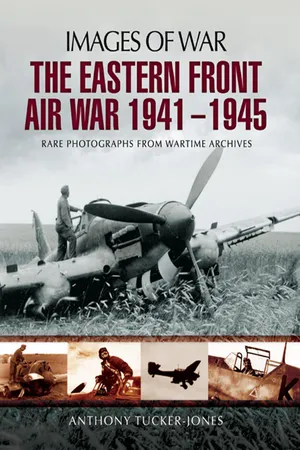
This lavishly illustrated WWII history examines the bitter aerial combat of the Eastern Front through rare wartime photographs and informative text.
Though the air war was a major aspect of the Eastern Front conflict, it has long been neglected by historians. Anthony Tucker-Jones's photographic history offers a vividly detailed introduction to the subject. With more than 150 archival images—most of which have never been published before—this volume examines Stalin's Red Air Force and Hitlers Luftwaffe, their equipment, and the role they played in supporting the war on the ground.
Just before Hitler's invasion of the Soviet Union, Stalin had decimated the leadership of the Red Air Force in a series of purges. Thousands of Russian fighter aircraft were swiftly destroyed in the German Blitzkrieg. But a remarkable recovery followed as the Red Air Force turned the tide against the ravages of the Luftwaffe to wrestle back air superiority by 1944.
- 144 pages
- English
- ePUB (mobile friendly)
- Available on iOS & Android
eBook - ePub
The Eastern Front Air War, 1941–1945
About this book
Information
Print ISBN
9781473861626
Subtopic
Military & Maritime HistoryChapter One
Stalin’s Falcons Decapitated
Ironically, in the year preceding Hitler’s invasion, as the Red Air Force’s numerical strength grew its effectiveness declined. This was in part due to its loss of technical parity with other European air forces, as well as the setbacks it experienced in Spain during the Spanish Civil War and in the Winter War with Finland. The Red Air Force was slow to learn from these hard-won lessons and in common with the Red Army suffered thanks to the destruction of its high command by Stalin.
The Red Air Force was not immune to Stalin’s purges during the late 1930s. General Ya. I. Alksnis, Red Air Force Commander-in-Chief, and General A.I. Sedyakin, Air Defence Commander-in-Chief, were shot during the Soviet leader’s paranoid bloodletting. The execution of the former Red Air Force commander, General Ya. V. Smushkevich, occurred four months after the German invasion, Smushkevich having been dismissed in 1940. His replacement, Pavel Rychagov, lost his job in the spring of 1941 to Pavel Zhigarev. According to German intelligence the actual strength of the air force prior to the invasion was about 30 per cent less than the authorized establishment. Stalin’s air force, like the rest of the Soviet armed forces, was not in the best condition to fend off Hitler’s blitzkrieg.
Stalin, who was almost the architect of his own destruction, did all he could to derail the modernization of the Red Air Force. Alksnis’ crime was being too closely associated with the discredited modernizer Marshal Tukhachevsky. He was on his way to a diplomatic reception in Moscow when, on 23 November 1937, he was grabbed and whisked away to the Lubyanka prison: he was dead in less than year.
Alksnis was not alone; most of his comrades suffered the same fate, including Chief of the Air Staff and Head of the Special Purpose Air Arm Vasily Khripin, Head of the Air Force Political Directorate B.U. Troyanker, and Head of the Zhukovsky Air Force Academy General A.I. Todorski, along with five military district air commanders. Only a year before, these men had received decorations from Stalin himself.
Alksnis’ initial replacement did not prove up to the job and was replaced by the highly experienced Smushkevich ready for the invasion of Eastern Poland in 1939. Under the nom de guerre General Douglas, Brigade Commander Yakov Vladimirovich Smushkevich commanded the Soviet Air Group in Spain known as Stalin’s Falcons. They combat tested the Soviet Union’s I-15 and I-16 fighters as well as the SB-2 bomber. Smushkevich then went on to command the Red Air Force, supporting General Georgy Zhukov’s brief and highly successful border war against the Japanese on the Mongolian–Manchurian border. Smushkevich was unable to repeat his Manchurian successes over Finland and the poor condition of the Red Air Force was highlighted during the Winter War, which broke out in November 1939 and was fought through three and a half months of freezing weather.
Smushkevich had 900 aircraft available for operations against less than 100 Finnish planes. Nonetheless, they suffered heavy losses, especially the obsolescent SB, DB-3 and TB-3 bombers. Large-scale Soviet bombing raids failed to achieve much and ground support was poorly coordinated. By the time the war with the Finns came to an end the Red Air Force had massed 2,000 aircraft against Finland. Despite much backslapping the Soviets lost up to 950 aircraft whilst the Finns lost just seventy. It was a hard-won victory that showed the Red Air Force to be a largely flawed instrument.
In April 1940 Smushkevich was sacked and replaced by his former brother-in-arms Pavel Rychagov. He was another of Stalin’s Falcons, credited with fifteen victories in Spain and named as a Hero of the Soviet Union. Rychagov also saw action against the Japanese in Manchuria. Commissioned as a fighter pilot in Ukraine, he rose in four short years from squadron leader to head of the Red Air Force, only to be swept away in Stalin’s purges barely two months before Hitler’s invasion. He lasted until the spring of 1941, to be replaced by Pavel Zhigarev (another commander from the Soviet Far East) in what must have felt like an unending game of deadly musical chairs. Smushkevich was shot on 28 October 1941, depriving the Red Air Force of his valuable expertise.
The Soviet aircraft industry suffered as well; A.N. Tupolev, head of the Experimental Aircraft Design Section, was arrested on the ludicrous charge of having sold the plans for the Bf 109 and Bf 110 fighters to Germany! His senior design team, including Vladimir Petlyakov and Vladimir Myasishchev, soon joined him. An estimated 450 designers and engineers were interned from 1934 to 1941. Of these, fifty were executed and 100 died in the Gulag.
At the same time, many of the aircraft factories lost key personnel, including directors, chief engineers and designers. The failures of prototypes to meet performance criteria and accidents during test flights were considered deliberate sabotage. When Valery Chkalov was killed in the prototype I-180 fighter on 15 December 1938, the death of this national hero led to a wave of arrests despite the accident being down to pilot error. This fighter was abandoned shortly afterwards, depriving the Red Air Force of 3,000 I-180s that would have been in service by June 1941.
The Soviet armed forces were divided into five elements prior to the Second World War: the ground forces, navy, air force, national air defence and armed forces support. The ground forces accounted for the largest proportion of personnel, with just over 79 per cent. The Red Air Force had just over 11 per cent and the navy had just under 6 per cent. The Red Air Force consisted of four key elements: the Voenno-Vozdushnye Sily (VVS – Air Force), Protivovozdushnaya Oborona (PVO – Air Defence), the Fleet Air Force and Gosudarstvenny Komitet Oborony (GKO – State Committee for Defence) Air Reserve.
The Soviet Union claimed to have the world’s largest air force in 1940, but in reality 75 per cent of them were obsolete I-15, I-152 and I-153 biplanes and I-16 monoplanes. Whilst the I-16 was the best, it was significantly inferior to the German Bf 109E. Their new LaGG-3, MiG-3 and Yak-1 had yet to be issued in any number although by 22 June 1941, about 2,030 of these aircraft had been produced.
Initially, a Soviet fighter regiment consisted of three squadrons with an established strength of forty aircraft. These squadrons flew tight defensive formations with three or four aircraft known as Zveno. A fighter aviation division was made up of three regiments, with a nominal strength of 120 aircraft. These divisions were grouped in two or threes to create aviation army corps with strength of up to 375 fighters.
At the outbreak of the war the mainstay of the Red Air Force’s fighter squadrons were aircraft designed by Nikolai N. Polikarpov. The Polikarpov I-16 was first flown in late December 1933 and was the first production monoplane in the world to feature a retractable undercarriage. It was also the first Soviet fighter to incorporate armour plating around the cockpit. Introduced into service in 1934, this aircraft had a number of major design faults; most notably, the engine was too close to the centre of gravity and the cockpit was too far back. This gave the airframe insufficient longitudinal stability, making it impossible to fly ‘hands off’.
Taking off and landing was not pilot friendly, either. The pilot had to hand crank the undercarriage forty-four times before retraction was complete. When deployed the undercarriage suspension was hard, which meant the aircraft had a habit of bouncing violently when it ran over uneven ground. This gained it the nickname Ishak (donkey). Nonetheless, in the hands of an experienced pilot the I-16 proved to be highly manoeuvrable. The I-16 saw combat in Spain with Stalin’s Falcons against the Spanish Republicans and against the Japanese in the Far East. The Spanish Nationalist Air Force christened it the Rata (rat). This nickname stuck and was used by the Luftwaffe.
Despite its shortcomings, by the time production ceased in 1940 some 6,555 I-16s had been built. Variants included the TsKB-18 assault aircraft armed with four PV-1 synchronized machine guns, two wing-mounted machine guns and 100kg of bombs. The Type 17 featured two wing-mounted cannon and this variant was built in large numbers. The TskB-12P was the first aircraft in the world to be armed with two synchronized cannon firing through the propeller arc. The last fighter version the Type 24 was capable of a top speed of 523km/h (325mph).
The Polikarpov I-153 was first flown in 1938 and was derived from the I-15 biplane fighter. The latter had featured a gull-type upper wing, while the following variant, the I-15bis (or I-152) was fitted with a straight wing. The I-153 reverted to the gull wing arrangement, resulting in it being dubbed the Chaika (seagull). Unlike its predecessor it featured a retractable undercarriage. A series of engine upgrades eventually gave the Chaika a top speed of 426km/h (265mp).
The pilot sat in an open cockpit with only a small windscreen for protection. The aircraft was armed with four synchronized machine guns firing along canals between the engine cylinders. A few were also fitted with two 20mm cannon. The Chaika first saw action in 1939 against the Japanese. It was also heavily involved in the Winter War of 1939–40, when the Soviet Union clas...
Table of contents
- Cover
- Title Page
- Copyright
- Contents
- Introduction
- Photograph Sources
- Chapter One: Stalin’s Falcons Decapitated
- Chapter Two: The Falcon’s Shturmoviks
- Chapter Three: Hitler’s Eagle
- Chapter Four: Catastrophic Summer
- Chapter Five: Junkers to the Rescue
- Chapter Six: Circle of Death
- Chapter Seven: Heroes of the Soviet Union
- Chapter Eight: Ostfront Downfall
- Chapter Nine: Göring’s Ground War
- Chapter Ten: Red Storm Rising
Trusted by 375,005 students
Access to over 1.5 million titles for a fair monthly price.
Study more efficiently using our study tools.
Frequently asked questions
Yes, you can cancel anytime from the Subscription tab in your account settings on the Perlego website. Your subscription will stay active until the end of your current billing period. Learn how to cancel your subscription
No, books cannot be downloaded as external files, such as PDFs, for use outside of Perlego. However, you can download books within the Perlego app for offline reading on mobile or tablet. Learn how to download books offline
Perlego offers two plans: Essential and Complete
- Essential is ideal for learners and professionals who enjoy exploring a wide range of subjects. Access the Essential Library with 800,000+ trusted titles and best-sellers across business, personal growth, and the humanities. Includes unlimited reading time and Standard Read Aloud voice.
- Complete: Perfect for advanced learners and researchers needing full, unrestricted access. Unlock 1.5M+ books across hundreds of subjects, including academic and specialized titles. The Complete Plan also includes advanced features like Premium Read Aloud and Research Assistant.
We are an online textbook subscription service, where you can get access to an entire online library for less than the price of a single book per month. With over 1.5 million books across 990+ topics, we’ve got you covered! Learn about our mission
Look out for the read-aloud symbol on your next book to see if you can listen to it. The read-aloud tool reads text aloud for you, highlighting the text as it is being read. You can pause it, speed it up and slow it down. Learn more about Read Aloud
Yes! You can use the Perlego app on both iOS and Android devices to read anytime, anywhere — even offline. Perfect for commutes or when you’re on the go.
Please note we cannot support devices running on iOS 13 and Android 7 or earlier. Learn more about using the app
Please note we cannot support devices running on iOS 13 and Android 7 or earlier. Learn more about using the app
Yes, you can access The Eastern Front Air War, 1941–1945 by Anthony Tucker-Jones in PDF and/or ePUB format. We have over 1.5 million books available in our catalogue for you to explore.