- 224 pages
- English
- ePUB (mobile friendly)
- Available on iOS & Android
eBook - ePub
The Burma Air Campaign, 1941–1945
About this book
The scene is set with an overview of the respective states of the RAF and Japanese Airforce, and an explanation of how the American Volunteer Group (The Flying Tigers) came to be in China. There is a concise description of air ops covering the Japanese invasion of Indo China, Malaya and Singapore, together with a close study of the sinking of the Prince of Wales and Repulse, which altered the air/sea power equation. The main emphasis is on the use of air power both offensive, defensive and air transport during the protracted Burma Campaign. This embraces operations in the Arakan and the various Chindit long range penetration expeditions. These relied almost totally on air supply and evacuation. In the later stages of the War, the US and RAF combined forces and predictably this was not without controversy. Few realize that US B29s operating from India attacked Japan itself. Finally the role of ground attack aircraft against the retreating Japanese played a significant part in the Allied advance in Burma.
Information
Contents
| Acknowledgements | |
| Abbreviations | |
| Japanese Terms Used in Text | |
| Introduction | |
| Chapter 1 | A Wing and a Prayer |
| Chapter 2 | Burma’s ‘Few’ |
| Chapter 3 | The End of the Beginning |
| Chapter 4 | The Flight of the Phoenix |
| Chapter 5 | Crescendo |
| Chapter 6 | ‘Play Ball’ |
| Chapter 7 | End Game |
| Appendix I | Principal Allied Air Forces as at June 1943 |
| Appendix II | Approximate list of operations carried out by 5th Hikoshidan during the 2nd Chindit/Imphal/Myitkyina campaigns |
| Appendix III | Outline particulars of principal Allied and Japanese aircraft used in the Burma Air Campaign |
| Index | |
Acknowledgements
To the following individuals and organizations I would like to offer my grateful thanks for their invaluable cooperation during the preparation of this book:
Wireless Operator Ken Armstrong, RAF.
Flight Sergeant Les Brazier, 167 Wing, 224 Group RAF.
Flight Sergeant Alex (Paddy) Calvert, 607 Squadron RAF.
The Embassy of Japan, London.
F.A. Galea, 355 Squadron RAF.
Flight Lieutenant Wilfred Goold DFC, 607 Squadron RAF.
Imperial War Museum Photographic Archive, London.
The Library of Congress, Washington DC.
Mr J.W. Loosemore, 67 Squadron RAF.
The National Archive, Kew.
National Archives and Records Administration, Modern Military Branch, Maryland USA.
Steven Ramsey for his excellent work on the maps.
Royal Air Force Museum, London.
607 (County of Durham) Squadron Association, Northumberland.
Harold Staines, 34 Squadron and the RAF Regiment, and his daughter Diana.
Ronald White, 152 Squadron armourer fitter.
Basil Wood, 159 Squadron RAF.
Michael Pearson
Abbreviations Used in Text
| AATO | Army-Air Transport Organisation. |
| ABDACOM | American, British, Dutch and Australian Command. |
| ACM | Air Chief Marshal. |
| ACSEA | Air Command South East Asia. |
| AHQ | Air Headquarters. |
| AOA | Air Officer Administration. |
| AOC | Air Officer Commanding. |
| AOC-IN-C | Air Officer Commanding-in-Chief. |
| ATC | Air Transport Command, USAAF. |
| AVG | American Volunteer Group. |
| CAF | Nationalist Chinese Air Force. |
| CCTF | Combat Cargo Task Force. |
| CMU | Command Maintenance Unit. |
| COL | Chain Overseas Low (radar). |
| DZ | Drop Zone. |
| EAC | Eastern Air Command. |
| FAA | Fleet Air Arm. |
| FAMO | Forward Airfield Maintenance Organisation. |
| GCI | Ground Controlled Interception (radar). |
| GHQ | General Headquarters. |
| GOC | General Officer Commanding. |
| GR | General Reconnaissance. |
| IAF | Indian Air Force. |
| IOGROPS | Indian Ocean General Reconnaissance Operations. |
| JAAF | Japanese Army Air Force. |
| JNAF | Japanese Navy Air Force. |
| MT | Motor Transport. |
| MU | Maintenance Unit. |
| NCAC | Northern Combat Area Command. |
| POW | Prisoner of War. |
| PR (U) | Photographic Reconnaissance Unit. |
| PSP | Pierced Steel Planking. |
| RAAF | Royal Australian Air Force. |
| RAF | Royal Air Force. |
| RAMO | Rear Airfield Maintenance Organisation. |
| RCAF | Royal Canadian Air Force. |
| RDF | Radio Direction Finding (later known as radar). |
| RNZAF | Royal New Zealand Air Force. |
| RP | Rocket Projectile. |
| RSU | Repair and Salvage Unit. |
| SEAC | South East Asia Command. |
| 3 TAF | 3rd Tactical Air Force. |
| TCC | Troop Carrier Command. |
| USAAF | United States Army Air Force. |
| VCP | Visual Control Post. |
| VHF | Very High Frequency. |
Japanese Terms Used in Text
| Chutai | Squadron. |
| Hikodan | Air Brigade. |
| Hikodan Shireibu | Air Brigade Headquarters. |
| Hikosentai | Flying Regiment. |
| Hikoshidan | Air Division. |
| Hikoshidan Shireibu | Air Division Headquarters. |
| Kokugun Shireibu | Air Army Headquarters. |
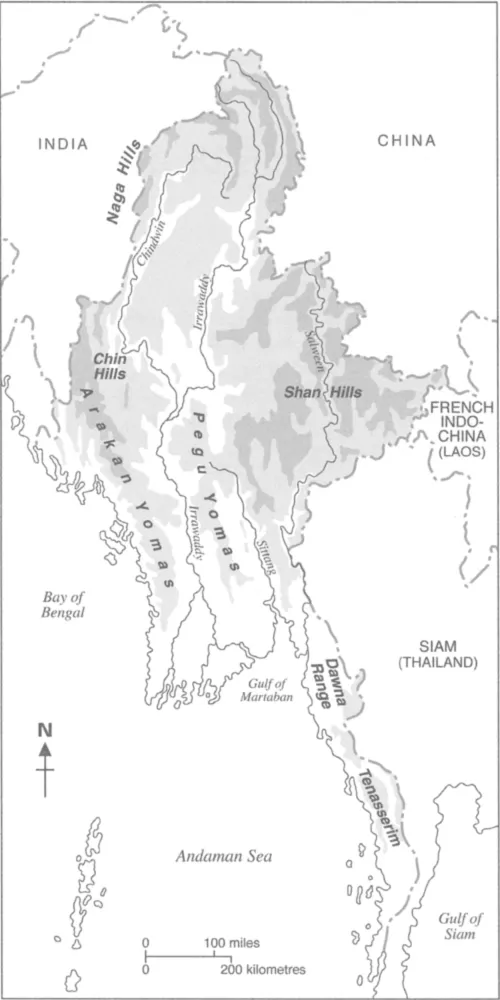
Burma – Principal Geographical Features
The Japanese Plan
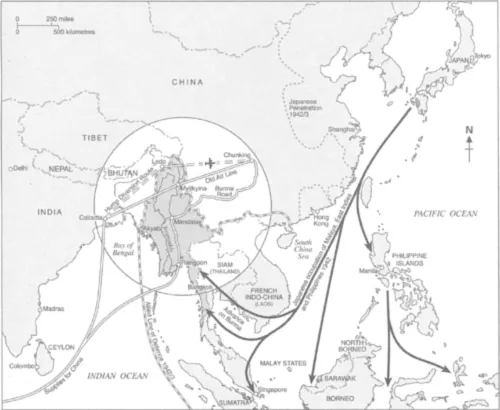
The Japanese Imperial High Command believed that by conquering Burma they would cut off the last supply route to China and protect their vast conquests in the south-west Pacific. The possibility also existed for further gains westward into India.
They also believed that mountains and jungles would set the Allies an impossible task should they attempt to reconquer Burma from bases in India to the north.
Airfields in Burma/Siam – December 1941–April 1942
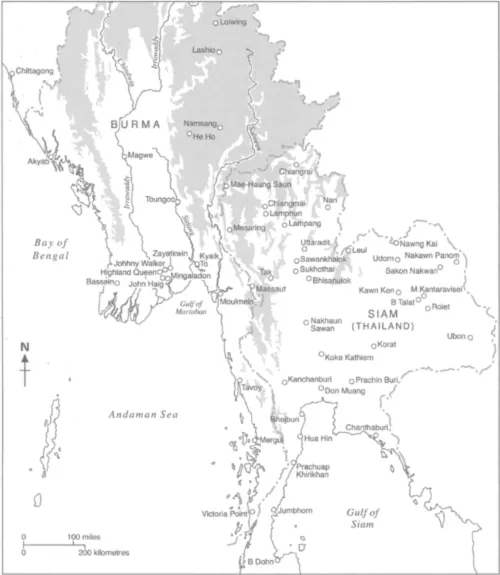
The Japanese Invasion of Burma
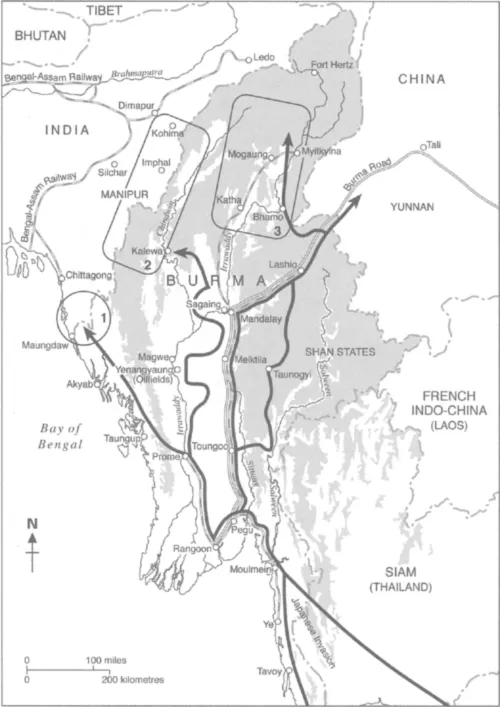
Key. The three fronts along which battle lines stabilized:
1. The Arakan.
2. The Central Front around Imphal.
3. Northern Combat Area Command.
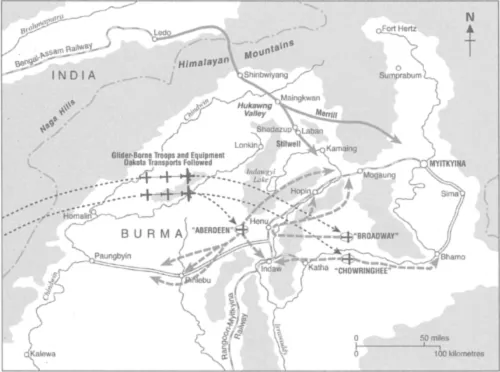
Operation Thursday – the Second Chindit Expedition
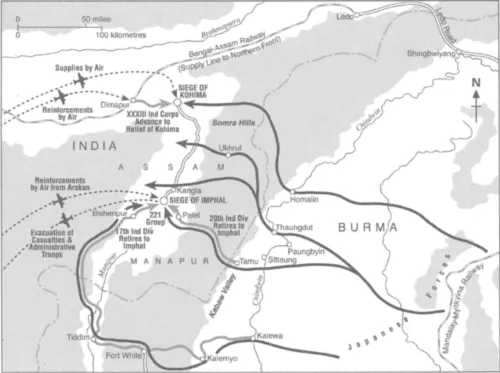
Imphal and Kohima
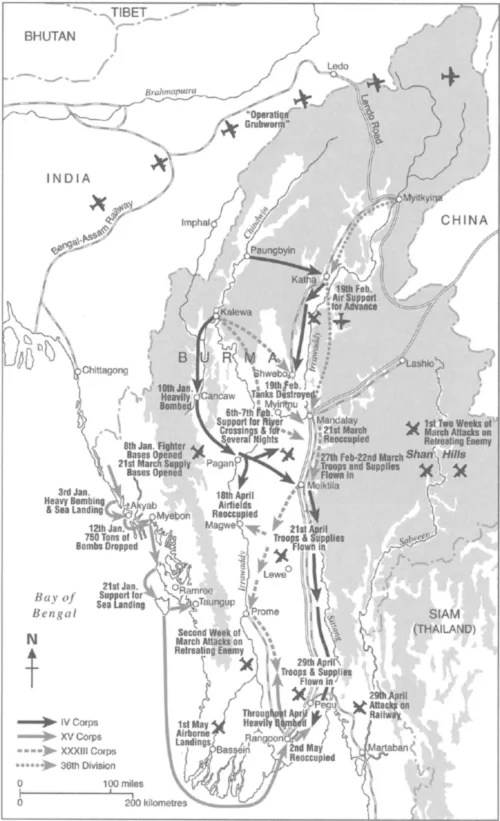
The Reconquest of Burma
Introduction
The campaign for Burma during the Second World War has been called the ‘Forgotten War’ and the soldiers of the Fourteenth Army the ‘Forgotten Army’. It has also been said, with some justification, that nobody considered the air forces involved in the campaign long enough to forget about them. This is particularly unfortunate since air power in all its facets truly came of age in the China/Burma/India theatre during 1941–1945. The Japanese capture of Rangoon in March 1942 denied large-scale seaborne support to Allied ground forces in Burma, consequently, without compensating supply from the air, the Fourteenth Army could not have achieved the complete victory that it ultimately did. Air Chief Marshal Sir Keith Park, Air Commander in Chief, South East Asia Command from February 1945, probably encapsulated the essential interlocking of the two arms when he said that on the Western Front ‘the Armies of Liberation are advancing under the protecting wings of the Air Forces. But here in Burma our Armies are advancing on the wings of the Allied Air Forces.’
The battle to first win and then hold the air superiority necessary to enable the massive air supply operation to take place would be a difficult and dangerous one. The Japanese Army Air Force would prove to be a tough and courageous opponent, despite ridiculous pre-war assertions which sought to maintain that the Japanese would make bad pilots because they wore thick spectacles, or because, one leading newspaper reported in all seriousness, the tradition for Japanese mothers to carry newborn babies in papoose baskets on their backs upset their children’s sense of balance in later life! Such nonsense would be rapidly disproved in combat. In terms of equipment the Japanese also had the edge to begin with. While the famous Mitsubishi A6M Zero Fighter, principally operated by the Japanese Naval Air Force (JNAF), rarely put in an appearance over Burma and India, the Japanese Army Air Force (JAAF) in that theatre had in its armoury the equally formidable Nakajima Ki-43 Peregrine Falcon (Allied code name Oscar), and others. What impressed Allied air forces was the speed and manoeuvrability of the Japanese fighters in comparison with their own equipment, however these advantages were often gained at the cost of reduced or in some cases non-existent armour protection for the pilot, which in turn led inexorably to a high mortality rate among Japan’s experienced airmen. The reasoning behind this short-term approach might well lie rooted in the Imperial Japanese High Command’s belief that the ‘effete’ Western democracies were simply not willing or able to fight a protracted war and would rapidly sue for peace; ironically the same mistake made by that other totalitarian military state of the time, and Japan’s principal ally, Nazi Germany.
Both the topography and climate of Burma would prove to be significant factors as the ground and air campaigns fought for control of the country. At more than 240,000 square miles Burma (now Myanmar) covers a vast area, and was in 1941 populated by some 17 million people. The natural grain of the country runs north to south, fixed by four major rivers with intervening mountain ranges (see map on p. 00). The source of the Irrawaddy River lies in the Himalayas far to the north near Fort Hertz, the river flowing southward down the spine of the country across a dry central plain to the Rangoon delta. The Chindwin also rises in the north to flow into the Irrawaddy at Pakkoku, south of Mandalay. The Sittang River starts its journey to the east of the Irrawaddy just south of Meiktila in central Burma and runs south to the Gulf of Martaban. The last of the country’s great rivers, the Salween, is also the farthest east. With its source in China the Salween and its tributaries flow through deep gorges that cross the 3,000-foot-high tableland that constitutes eastern Burma, to debouch from the Tenasserim Peninsula into the Gulf of Martaban at Moulmein. All four rivers have numerous tributaries, most of which formed a serious obstacle to movement.
The eastern border of Burma runs along mountain ranges that stretch from China in the north, south and south-eastward to the border with Indo-China (Laos), and further south and south-westward along the border with Siam (Thailand). Mountains also comprise a major feature of the country’s western border with India, and compri...
Table of contents
- Cover
- Half Title
- Full Title
- Copyright Page
- Dedication
- Contents
Trusted by 375,005 students
Access to over 1.5 million titles for a fair monthly price.
Study more efficiently using our study tools.
Frequently asked questions
Yes, you can cancel anytime from the Subscription tab in your account settings on the Perlego website. Your subscription will stay active until the end of your current billing period. Learn how to cancel your subscription
No, books cannot be downloaded as external files, such as PDFs, for use outside of Perlego. However, you can download books within the Perlego app for offline reading on mobile or tablet. Learn how to download books offline
Perlego offers two plans: Essential and Complete
- Essential is ideal for learners and professionals who enjoy exploring a wide range of subjects. Access the Essential Library with 800,000+ trusted titles and best-sellers across business, personal growth, and the humanities. Includes unlimited reading time and Standard Read Aloud voice.
- Complete: Perfect for advanced learners and researchers needing full, unrestricted access. Unlock 1.5M+ books across hundreds of subjects, including academic and specialized titles. The Complete Plan also includes advanced features like Premium Read Aloud and Research Assistant.
We are an online textbook subscription service, where you can get access to an entire online library for less than the price of a single book per month. With over 1.5 million books across 990+ topics, we’ve got you covered! Learn about our mission
Look out for the read-aloud symbol on your next book to see if you can listen to it. The read-aloud tool reads text aloud for you, highlighting the text as it is being read. You can pause it, speed it up and slow it down. Learn more about Read Aloud
Yes! You can use the Perlego app on both iOS and Android devices to read anytime, anywhere — even offline. Perfect for commutes or when you’re on the go.
Please note we cannot support devices running on iOS 13 and Android 7 or earlier. Learn more about using the app
Please note we cannot support devices running on iOS 13 and Android 7 or earlier. Learn more about using the app
Yes, you can access The Burma Air Campaign, 1941–1945 by Michael Pearson in PDF and/or ePUB format, as well as other popular books in History & Asian History. We have over 1.5 million books available in our catalogue for you to explore.