A comprehensive guide to counterterrorism units around the world, and their recruitment, training, weapons, equipment, tactics, and missions.
In the past thirty-five years, counterterrorist units have been deployed to deal with airplane, ship, train, and bus hijackings. They have rescued hostages in various types of buildings and have dealt with barricaded bank robbers, prison rioters, and assorted dangerous criminals. Thousands have been rescued and millions have been safer because terrorists were aware that elite antiterrorist units were poised to act should they take hostages.
Following the September 11th attack on the World Trade Centre, the mission of many anti-terrorist units has expanded. Some units now track terrorists to their lairs in other countries and strike them there. Despite the significant and growing role of these units, little is known about the way they operate. The selection, training, structure, and principles of maintaining such units, together with basic theories of asymmetric warfare are the subject of Thompson's latest work.
In a practical, step-by-step guide he analyses the necessary organization of such elite teams, the arming and equipping of units, and methods for a variety of missions from hostage rescue and high-level dignitary protection to securing foreign embassies and counter–WMD strikes.
Open the pages of this book and enter the world of the counterterrorist operator.
Praise for
The Counter Terrorist Manual
"A finely illustrated guidebook to antiterrorist units deployed to handle airplane, ship, train and bus hijackings. Units around the world are examined in a survey of these elite antiterrorist units and their operations, a pick for any military library and packed with color photos of equipment and more." —Midwest Book Review
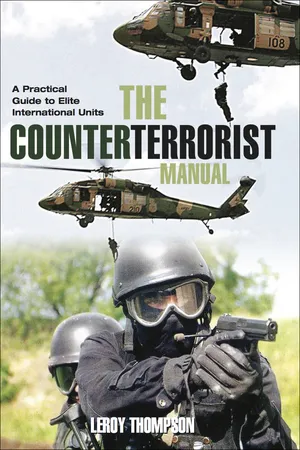
eBook - ePub
The Counter Terrorist Manual
A Practical Guide to Elite International Units
- 256 pages
- English
- ePUB (mobile friendly)
- Available on iOS & Android
eBook - ePub
About this book
Information
Topic
GeschichteSubtopic
Militär- & SeefahrtsgeschichteChapter I
Antiterrorism: Background and Evolution
The hijacking of airliners and attacks on El Al flights during 1968 and 1969 certainly brought the threat of terrorism to the attention of world governments. Many governments, however, viewed the threat of Middle Eastern terrorism as a primarily Israeli problem and either ignored the threat or made concessions to Palestinian groups in the hope that they would look elsewhere for targets. The September 1970 hijackings of multiple airliners from multiple countries, their landings in Jordan, and their destruction on the ground should have warned the world that the threat had become endemic and was not going to disappear. As might be expected, however, Israel, the primary target of terrorism, was the first country to see the need for units trained and ready to take action against terrorists. The May 8, 1972 hijacking of a Sabena airliner and its landing in Tel Aviv set the stage for a successful Israeli rescue of the passengers. Using many techniques that would later become standard with antiterrorist units—including practice on a similar airliner, the use of disguise to get the rescue team close to the aircraft, and the use of deception (more than 300 Israeli soldiers posing as freed Palestinian militants on fake Red Cross buses)—the Israeli team successfully killed or captured the terrorists and freed all the hostages. (An interesting side note to this rescue is that two future Israeli prime ministers—Ehud Barak and Benjamin Netanyahu—took part in the assault. Netanyahu was wounded during the operation.) Israel had demonstrated that it was not necessary to make concessions to terrorists and that effective action could be taken if trained personnel and national resolve were present.

The scene of the 1972 Munich hostage crisis—#31 Connollystrasse—as it looked in March 2006; note the balconies on which the terrorists observe police activity. Note also the glass-covered stairway.

The view of the back of #31 Connollystrasse. The hostages were held in the second floor room to the right rear.
It was not until the September 1972 Munich Olympic Massacre stunned the world, however, that many countries realized that they were impotent when faced with a terrorist act. The German response to the taking of Israeli athletes was a virtual textbook study of how not to deal with a terrorist incident. Long before the Olympics, the Germans had ignored the potential threat and had not trained the Munich police to deal with a hostage incident. A police psychologist had warned of the likelihood of an incident that would play out much as the actual event transpired. Security at the Olympic Village was so lax that the terrorists were able to gain entry to the dormitory that would house Israeli athletes and reconnoiter it before the Olympics began.
Once the hostages had been taken, negotiations were carried out incompetently and offers of assistance from the Israelis, who were considered to be the most experienced antiterrorist force in the world at the time, were ignored. The attempted rescue by the German police at the Olympic Village was inept and was compromised by being broadcast live on television, a broadcast viewed by the hostage takers! The German police ignored the possibility of a rescue when the terrorists were transporting the hostages by bus to two waiting helicopters, an option many antiterrorism experts now think offered the highest likelihood of success. At Fürstenfeldbruk Airport, located 15 miles out of Munich, the Germans did not deploy enough trained snipers. They had not rehearsed the operation with the helicopter crews landing the hostages to offer the snipers optimum shooting angles. The “snipers” lacked intelligence and didn’t even have radios. All the elements were there for a disaster and those elements came together to cause the death of all of the hostages.
In the aftermath, many Western democracies vowed not to exhibit the same inability to cope with a major terrorist incident. To implement that vow, however, specialized and highly trained units would be required. Stung by world criticism and by the disaster that had befallen the Olympics it had hoped would truly erase the stigma of Nazism, Germany was one of the first countries to take action. Ulrich Wegener, who had actually been present during the Munich hostage incident as an aide to the West German Interior Minister, would be charged with forming an antiterrorist unit within the German Federal Border Guards (Bundesgrenzschutz, BGS). This unit, designated GSG-9, became active in 1973. Among other units that became active in 1973 were France’s GIGN and Austria’s GEK Cobra.
The suspicion toward elite units within the German Army that harked back to the World War II SS made the Border Guards a compromise choice for an antiterrorist unit since the BGS was a paramilitary formation with some law enforcement powers. As countries around the world formed their own antiterrorist units, they faced a similar dilemma. Military units already had elite formations with many of the qualifications that were desirable in an antiterrorist commando. As a result, a pool of well-qualified manpower was there to be tapped. They also possessed ready access to aircraft, helicopters, and boats/ships to transport troops. Additionally, they had access to the types of training facilities that could be modified for antiterrorist training. On the negative side, many countries either had laws that prevented the armed forces from operating within the country or a historical dislike of the military carrying out raids. Generally, too, military personnel are trained to solve problems with overwhelming firepower rather than in the surgical manner required of the antiterrorist unit.

During the early days of their existence, members of GSG9 practice free climbing the side of a building prior to an assault. (BGS)
If a national antiterrorist unit were to be formed within the police, then, substantial time and expense would be required to train it to the standard of military special operations troops. A clear chain of command and jurisdiction for its employment would also have to be established. Some countries with formations having police powers while also functioning in a quasi-military role chose these formations as a compromise. In many countries, more than one antiterrorist unit was formed—a military one with responsibilities outside of the country and a police one with responsibilities within the country. Still a third unit might eventually be deemed necessary to handle MAT (Maritime Antiterrorism) operations. Military units with antiterrorist responsibilities would include the British, Australian, and New Zealand Special Air Service, the U.S. Delta Force, and the ROK 707th Special Mission Battalion. Police units with military or quasi-military status would include the French GIGN, Spanish GEO, Belgian ESI, Italian GIS, German GSG-9, and Dutch BBE (which employed a mix of Dutch Marines and police). Units such as the U.S. FBI HRT or Italian NOCS were drawn from non-militarized national law enforcement agencies. Specialized maritime antiterrorist units included the British SBS, U.S. SEAL Team Six, and Italian COMSUBIN.
There is a less obvious advantage to forming a national antiterrorist unit within a law enforcement agency. A national antiterrorist unit has to be trained to a very high standard. As a result, it is very hard to keep the edge necessary to perform at the level required over years and years when the unit is not employed operationally. A police unit can keep its personnel sharp by using them on high-risk warrant service, apprehension of dangerous felons, prison sieges, criminal hostage situations, and other types of entries. Many antiterrorist units have come to the conclusion that SWAT (Special Weapons and Tactics) teams in big U.S. cities make more raids and entries in a single month than most major antiterrorist units have in years. Just as the medics for special ops and antiterrorist units find the best place to train is big city emergency rooms, many also realize that the best place to train operators is on big city SWAT teams. This has resulted in personnel from some military antiterrorist units being assigned as “observers” with big city SWAT teams.
While many Western democracies were forming antiterrorist units in response to the Munich Massacre, Israel took a more Old Testament approach as it launched its Wrath of God teams around the world to track down those involved in the Munich Massacre and assassinate them.
Throughout the 1970s, additional countries formed specialized antiterrorist forces while terrorist groups continued to take hostages, offering governments the incentive to spend the money to form such units. Israel, of course, had formed Unit 101 in 1953 with an antiterrorist mission. This unit would evolve into other units with various designations including General Staff Deep Reconnaissance Unit, Unit 262, and Sayaret Matkal. Incidents targeting Israel continued and Israel used its antiterrorist forces not just for hostage rescue missions but for retaliatory operations against the Palestinians. Other Middle Eastern states learned they were not exempt from terrorism, however. In March 1973, the Saudi Embassy in Khartoum was seized by Black September terrorists. The House of Saud would be the target again in September 1973, when a Black September splinter group seized the Saudi Embassy in Paris.
In fact, throughout 1973, governments that may have been hesitant about forming antiterrorist units should have seen the ever-increasing terrorist violence as a call to action. Major terrorist incidents occurred almost weekly during the year, with the later half of 1973 being especially bloody. Although Israel remained a prime target, Western airlines flying into and out of Israel were often targeted as well. On August 5, 1973, at Athens Airport there was a machinegun attack against passengers on a TWA flight that had just landed from Israel. A month later, on September 5, members of Black September attempted to shoot down an El Al flight in Rome using SAM-7s. In a particularly vicious attack, on 17 December, a Palestinian terrorist group set fire to a Pan Am plane in Rome, killing 32, then hijacked a Lufthansa flight to Kuwait.

A GIGN Operator practices firing the compact HK MP5K. (Gendarmerie Nationale)

Members of GIGN engaging targets from their holsters using the Manurhin .357 Magnum revolver. (Gendarmerie Nationale)
Not all attacks were by Middle Eastern terrorists. In the same year the IRA carried out a fire and letter bomb campaign in England, and on September 20, 1973, the Spanish Prime Minister was assassinated in Madrid by ETA terrorists.
Within Northern Ireland in 1972 alone there were 10,000 shooting incidents. In an attempt to take proactive action against the IRA, the MRF (Mobile Reconnaissance Force) had been formed in 1971 to operate in undercover four-man teams. The MRF made good use of turned IRA members for intelligence. In 1974 this unit was replaced by the highly effective 14 Intelligence Company, which specialized in surveillance of IRA suspects in cooperation with the RUC Special Branch. In 1976, the SAS (Special Air Service) deployed to Northern Ireland, where they set ambushes for terrorists visiting weapons caches or preparing to carry out terrorist acts. The SAS also snatched some of the IRA leadership, reportedly even from within the Irish Republic.
The years 1974 and 1975 might be termed the years of the Jackal as Carlos made his presence felt in various acts of terrorism. Carlos was especially active in France, culminating in June 1975, when he killed two French security agents and wounded another in a shootout during a raid on his Paris apartment. Undaunted, however, Carlos led an attack in December 1975, against the symbol of Arab wealth and power, the OPEC headquarters in Vienna. During 1975, the Baader-Meinhof gang was very active as well, especially in carrying out kidnappings in Germany.
The most interesting event in the evolution of antiterrorist units during this period was the 1974 formation in the Soviet Union of KGB Alpha, designed as a special operations unit capable of SAS-type missions for the Committee for State Security. Antiterrorist operations fell within Alpha’s responsibilities.
Israel’s reputation for successful antiterrorist operations was somewhat tarnished in May 1974, when the PDFLP seized a school at Ma’alot in Israel, and 22 were killed and 60 injured during the assault by Sayaret Matkal. The various mistakes made at Ma’alot contributed to the establishment in late 1974/early 1975 of the Ya’ma’m antiterrorist unit within the Israeli Border Police.
The Royal Canadian Mounted Police formed an ERT (Emergency Response Team) in 1975 in preparation for the Montreal Olympics of 1976. (The Montreal Olympics would be the first summer Olympics held since the massacre at the 1972 Munich Olympics; hence the need to have a trained unit available was given high priority.)
The year 1976 would be the year in which some of the newly formed antiterrorist units would prove their value. In February, terrorists seized a school bus transporting the children of French military personnel in Djibouti. GIGN carried out a well-planned rescue using drugged food to cause the children to fall asleep and hence lie down on the seats, thus clearing the way for GIGN snipers to eliminate all but one of the terrorists. An assault team followed up to complete the rescue.
Jordan had formed an antiterrorist unit, the 101st Special Forces Battalion, in the mid-1970s. This unit saw action in March 1976, when the PFLP attacked the Intercontinental Hotel in Jordan. The unit responded and engaged the terrorists in a gunfight, which resulted in three of the terrorists being killed along with two members of the antiterrorist unit.
The hijacking of an Air France flight carrying a large number of Israelis to Uganda by PFLP and Baader-Meinhof terrorists set the stage for the most ambitious antiterrorist operation yet in July 1976. The Israelis launched a rescue that required them to land at a hostile airport and eliminate Ugandan Army personnel as well as the terrorists to effect the rescue. Among the more intriguing aspects of the rescue was the use of a fake Idi Amin to distract the Ugandan guards while the assault force got close enough to act.
In 1977 the Baader-Meinhof gang continued to carry out assassinations and kidnappings in Germany and elsewhere in conjunction with other terrorist groups. In March 1977, the Royal Dutch Marines earned their place among the antiterrorist elite by carrying out a well-coordinated assault against a hijacked train and a school, both taken by South Moluccan terrorists. The train incident had dragged on long enough for psychologists to be able to work up profiles of hostages and terrorists, which aided the Marines in planning their assault. As part of BBE, the Dutch Marines had assumed the responsibility for antiterrorist ops in Holland in 1974 and had brought a prison siege to a successful conclusion in that year.
October 1977 saw GSG-9, the German antiterrorist unit formed in the aftermath of the Munich Olympic Massacre, deployed to Somalia where they performed a successful “tubular assault” on a hijacked Lufthansa airliner. This assault marked the first employment of two antiterrorist weapons that would become almost iconic among world antiterrorist units—the stun grenade and the HK MP5 SMG. The stun grenades, which had been developed by the SAS, were brought to the incident by two members of the SAS who cooperated with GSG-9 in their deployment.
Throughout 1977 and 1978, the PFLP carried out numerous assassinations of Middle Eastern officials—in Europe and elsewhere—whom they felt were unsympathetic to the Palestinian cause. The Red Brigades became one of the world’s most recognized terrorist groups in 1978 when they carried out the kidnapping and later murder of Aldo Moro. Prior to the Moro kidnapping, Italy had formed the GIS antiterrorist unit as part of the Carabinieri, but in the wake of the Moro murder, another unit—NOCS—was formed as part of the Polizia di Stato in 1978. In response to Basque terrorist acts and the general threat of terrorism throughout Europe, Spain had formed a unit—GEO—in 1977 as well.

An Italian COMSUBIN operator during the early days of that unit’s responsibility for Maritime antiterrorism. (Marina Militare)
In 1977 the USA finally authorized the U.S. Army Special Forces to form an interim antiterrorist force designated “Blue Light” until Delta Force was activated in November 1977. (Note that the term “Delta Force” is still commonly used for this unit and will appear frequently in this text, but the current designation of the unit is actually the Combat Applications Group.)
Egypt’s first antiterrorist unit, Saiqa, had been established in reaction to terrorist actions against Egyptian diplomats and ...
Table of contents
- Dedication
- Title Page
- Copyright Page
- Table of Contents
- Introduction
- Chapter I - Antiterrorism: Background and Evolution
- Chapter II - Recruiting and Selecting the Antiterrorist Operator
- Chapter III - Training the Antiterrorist Operator
- Chapter IV - Antiterrorist Unit Organization
- Chapter V - Weapons and Equipment
- Chapter VI - Missions and Tactics
- Glossary
- Suggested reading
- Index
Trusted by 375,005 students
Access to over 1.5 million titles for a fair monthly price.
Study more efficiently using our study tools.
Frequently asked questions
Yes, you can cancel anytime from the Subscription tab in your account settings on the Perlego website. Your subscription will stay active until the end of your current billing period. Learn how to cancel your subscription
No, books cannot be downloaded as external files, such as PDFs, for use outside of Perlego. However, you can download books within the Perlego app for offline reading on mobile or tablet. Learn how to download books offline
Perlego offers two plans: Essential and Complete
- Essential is ideal for learners and professionals who enjoy exploring a wide range of subjects. Access the Essential Library with 800,000+ trusted titles and best-sellers across business, personal growth, and the humanities. Includes unlimited reading time and Standard Read Aloud voice.
- Complete: Perfect for advanced learners and researchers needing full, unrestricted access. Unlock 1.5M+ books across hundreds of subjects, including academic and specialized titles. The Complete Plan also includes advanced features like Premium Read Aloud and Research Assistant.
We are an online textbook subscription service, where you can get access to an entire online library for less than the price of a single book per month. With over 1.5 million books across 990+ topics, we’ve got you covered! Learn about our mission
Look out for the read-aloud symbol on your next book to see if you can listen to it. The read-aloud tool reads text aloud for you, highlighting the text as it is being read. You can pause it, speed it up and slow it down. Learn more about Read Aloud
Yes! You can use the Perlego app on both iOS and Android devices to read anytime, anywhere — even offline. Perfect for commutes or when you’re on the go.
Please note we cannot support devices running on iOS 13 and Android 7 or earlier. Learn more about using the app
Please note we cannot support devices running on iOS 13 and Android 7 or earlier. Learn more about using the app
Yes, you can access The Counter Terrorist Manual by Leroy Thompson in PDF and/or ePUB format, as well as other popular books in Geschichte & Militär- & Seefahrtsgeschichte. We have over 1.5 million books available in our catalogue for you to explore.