This detailed historical biography sheds new light on the thirteenth-century English King and military leader who waged war with Scotland.
Known to posterity as
Scottorum Malleus—the Hammer of the Scots—Edward I was one of medieval England's most formidable rulers. In this meticulously researched new history, David Santiuste offers a fresh interpretation of Edward's military career, with a particular focus on his Scottish wars. The result is a revelatory portrait of a remarkable man whose struggles with tenacious opponents—including Robert the Bruce and William Wallace—have become the stuff of legend.
There is a clear and perceptive account of important military events, notably the Battle of Falkirk, but the narrative also encompasses the wider impact of Edward's campaigns. He attempted to mobilize resources—including men, money, and supplies—on an unprecedented scale. His wars affected people at all levels of society throughout the British Isles.
David Santiuste presents a vivid description of Edward's campaigns in Scotland, while also exploring their political background. Edward emerges as a man of great conviction, a commander and king who sought to bend Scotland to his will.
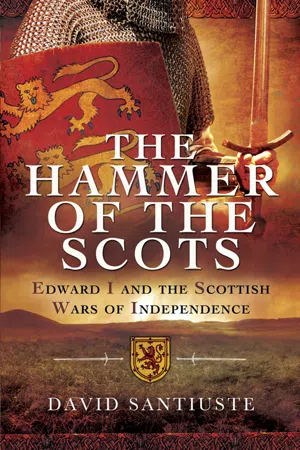
- 240 pages
- English
- ePUB (mobile friendly)
- Available on iOS & Android
eBook - ePub
About this book
Information
Chapter 1
Setting the Scene
The king of England sits straight-backed on his horse, surrounded by a mass of armed men. His snow-white hair is concealed by a helmet, upon which is mounted a gleaming circlet. He surveys his enemy’s dispositions with a cold eye, exuding arrogance and disdain. King Edward gives the word, and the royal army advances towards the Scottish host. When the troops in the van seem about to close with the enemy, however, they suddenly come to a halt. The king’s attendants look on aghast as the soldiers cheerfully greet the Scots, and then abruptly change sides.
‘Irish’, spits the king, with a brief shake of his head, but he remains unperturbed. He gives the impression, like a chess grandmaster, that he has anticipated his enemy’s moves. But the Scottish commander, Sir William Wallace, has further surprises in store. Even King Edward winces, albeit almost imperceptibly, as the Scots use fire-arrows to set light to carefully prepared lines of pitch, engulfing the next wave of Edward’s soldiers in flames. Those who survive are brutally cut down, as the Scots counter the English attack with a ferocious assault of their own.
Sensing the entire English army is ready to break and run, Wallace signals his cavalry to enter the fray. But now it is Wallace’s turn to look on with horror as his horsemen leave the field: the noble leaders of the cavalry have been bribed to take no part in the battle. King Edward allows himself a grim smile of satisfaction. Then, with the threat of the Scottish cavalry neutralised, he calls for his archers to unleash their arrows.
In the king’s mind, checkmate is near, but one of his subordinates has the temerity to question his order: ‘I beg pardon, Sire, but won’t we hit our own troops?’
‘Yes,’ retorts King Edward, ‘but we’ll hit theirs as well.’
Watching as the archers carry out their bloody work, fighting off a brief cough that betrays his failing health, he also orders that his hidden reserves should be committed to the struggle.
Now supremely confident of success, he instructs one of his officers to ‘bring us news of our victory’ – and also to bring him Wallace, whether dead or alive. Then he turns back to his personal bodyguard: a mysterious figure, dressed all in black, who will soon be revealed as another traitor to Wallace’s cause. ‘Shall we retire?’ Edward enquires briskly, in his clipped tones. But it is clear this is a command, not a question.
* * * *
Many readers will have recognised this abridged description of Edward I in the film Braveheart, as portrayed by the late Patrick MacGoohan, commanding his troops at the battle of Falkirk. Braveheart, as is well known, has perpetuated a number of historical inaccuracies and is full of anachronisms. Nevertheless, the characterisation of Edward in the film – stubborn, unfeeling, cruel and duplicitous, yet also fiercely intelligent, resourceful and undeniably formidable – is one that can be traced in many other places. All of these elements can be found in medieval sources (although naturally there is a variety of emphasis within the different accounts), as well as in the work of many modern historians.
Braveheart has also helped to ensure that Edward’s Scottish wars remain the most famous aspect of his career – although this, too, is not entirely due to Mel Gibson. While Edward has gained a number of soubriquets over the years – including ‘the English Justinian’ (after the Roman/Byzantine emperor who was famous for his laws) and ‘Longshanks’ (a contemporary nickname which requires no explanation) – the most enduring is the one inscribed on his austere black marble tomb at Westminster Abbey: Edwardus Primus Scottorum Malleus hic est – ‘Here is Edward I: the Hammer of the Scots.’
It must be stressed, however, that Edward’s Scottish wars form only a part, albeit a significant one, of his long, dramatic story. In the year 1286, when Scottish affairs first loomed large on his agenda, Edward was already in his forties. He had been king of England for thirteen years, and had established a substantial reputation. At this time the English kings still held significant lands in south-west France – they were dukes of Aquitaine, often referred to as Gascony – and Edward was respected throughout Europe as a soldier and statesman. This chapter provides a brief insight into Edward’s earlier life, with a particular focus on his military career, before moving on to examine his early relations with Scotland.
* * * *
Edward was born in 1239, the eldest son of King Henry III of England and his queen, Eleanor of Provence. Little is known about Edward’s childhood, although by the time he reached adolescence it was clear that his character was very different from his father’s. The difference was particularly marked in their respective attitudes towards war and violence. Henry was no saint (notwithstanding his dedicated patronage of Westminster Abbey), but he did not relish military activity, whereas his son was evidently keen to acquire and demonstrate the skills of a warrior.
The first indication of Edward’s martial vocation came in the year 1253, when he was just fourteen years of age. A rebellion broke out in Gascony, and Henry III sought to raise an army in order to quell the revolt there. Desperate to raise funds for the approaching war, Henry resorted to an expedient, demanding the traditional levy to pay for the knighting of his eldest son. Edward might well have imagined, therefore, that he would be expected to join the campaign. But when Henry set out for France in the late summer, Edward was left behind in England. His dubbing as a knight, it might be added, had also been delayed. As the chronicler Matthew Paris tells the story, Edward watched the departing ships in anguish, sobbing uncontrollably, until their sails could no longer be seen on the horizon.1
Henry’s Gascon war was one of his more successful endeavours. Edward did join his father in the following year, and may have gained his first glimpse of warfare as the royal army reduced the last of the rebel strongholds. But Henry’s achievements in Gascony were largely based on diplomacy, and it was for this purpose that Edward had been summoned to southern France. The Gascon rebels had received Spanish support from King Alfonso X of Castile, who possessed a distant claim to the duchy of Aquitaine, but Henry and Alfonso were able to come to terms. Alfonso’s price was a marriage alliance: it was agreed that Edward would marry Alfonso’s half-sister Eleanor. This matter was out of his control, although the fifteen-year-old Edward gallantly praised his bride-to-be, making reference to reports of her beauty and other accomplishments. The marriage duly took place on 1 November at Burgos, where Edward was now also knighted by Alfonso.
The marriage of Edward and Eleanor (then aged just thirteen) would last for thirty-six years. Despite the couple’s youth, Eleanor fell pregnant within the first year of marriage, although the child did not survive. It is one of the tragedies of Edward’s life that so few of his many children lived to be adults (even given the prevailing rates of infant mortality), and no further children were born until the 1260s. Nevertheless, along with marriage and knighthood, the next few years would bring other responsibilities; these included a carefully supervised experience of administration and lordship in Gascony. But Edward was still a young man, who attracted other young men to his side, and he remained eager to test himself in combat. His late teens and early twenties did not provide an opportunity to engage in real war, but he became an enthusiastic participant in tournaments.
By the end of the Middle Ages tournaments had become showy spectacles (although they could still be dangerous): they were courtly rituals, involving complex allegories and featuring lavish settings and costumes. Some of these elements were also present in the thirteenth century, but at that time tournaments had fewer rules, and the chaotic mêlées that ensued were often bloody encounters. Edward made his début in 1256, at the age of seventeen, in a specially arranged tournament from which he fortunately emerged unscathed. In the early 1260s Edward made two trips across the channel to take part in tournaments in France, where chronicles suggest that he and his followers endured a more difficult time.2 Edward suffered some minor injuries, as well as several defeats, though we might imagine that he emerged from this experience a tougher (albeit somewhat chastened) young man.
The behaviour of Edward and his young companions sometimes aroused disquiet, but amidst some examples of youthful high spirits, and perhaps even outright thuggery,3 it seems clear that Edward was keen to identify himself with the prevailing ideals of chivalry: the warrior code of the medieval aristocracy. Chivalry is an evocative word, but it is not easy to define – perhaps not least because medieval people often held differing views about the subject. Modern scholars sometimes prefer to concentrate on isolated aspects – the traditions of courtly love, for example, or the ethics of war – but all of these must be situated within a larger whole. The most effective modern definition of chivalry remains that of the late Sir Maurice Keen, who described it as ‘an ethos, in which martial, aristocratic and Christian elements were fused together’.4
With Keen’s definition of chivalry in mind, it is evident that the most obvious of the prized chivalric virtues, prowess, was not enough in itself; the ideals of chivalry could also inspire other qualities, notably commitment to a cause, commitment to others (including people of both sexes) and generosity of spirit. Chivalry, of course, was a code of honour. Yet, as is the case in all ‘honour societies’, a strong emphasis on respect and reputation could sometimes induce irascible, arrogant behaviour. Moreover, as we shall see, exhortations to ‘chivalrous’ men to defend the weak did not always protect defenceless people from unspeakable horrors. Another modern writer has written eloquently of the ‘ambivalent force of chivalry’ during the Middle Ages,5 and it is perhaps unsurprising that it played a similarly ambivalent role in the life of Edward I, a man who has provoked so much debate and curiosity – both in his own time and in ours.
* * * *
The later years of the reign of Henry III were marred by dissension in England, at the very heart of his realm. Dissatisfaction with various aspects of his rule, notably his patronage of the queen’s relatives, led to demands for reform. The opposition found an effective leader in Simon de Montfort, earl of Leicester – a charismatic and determined figure, albeit somewhat egotistical. Edward’s relationship with his father was often difficult, and for a time Edward fell under the influence of Montfort (who was, incidentally, his uncle by marriage). When civil war broke out, however, in the mid-1260s, Edward fought hard on Henry’s behalf. He took part in his first battle on 14 May 1264 at Lewes, yet this would prove to be another humbling experience. Edward led his own division in a successful cavalry charge, but he then allowed his men to indulge themselves in pursuit of the enemy. By the time his cavalry returned to the battlefield, the royal army had already been defeated.
Edward subsequently endured a period of captivity (as did his wife), while Montfort acted as de facto ruler of England on King Henry’s behalf. But Edward was able to effect a daring escape from Gloucester with the help of some devoted companions. On 4 August 1265, by which time he was twenty-six, he led the army that defeated and killed Montfort at Evesham. As is often the case in civil wars (when loyalties are uncertain and both sides eager to settle the matter), Edward’s tactics employed speed and guile. In order to ensure that Montfort could not escape from Evesham, for example, Edward advanced under banners that had been captured from Montfort’s son (who had been expected to bring reinforcements to his father). Montfort therefore found himself trapped and outnumbered, and he was specifically targeted for elimination: one medieval writer referred to ‘the murder of Evesham, for battle it was none’.6
It is unlikely that Edward’s use of subterfuge would have unduly worried his contemporaries. Medieval authors, especially those concerned with chivalric values, often adopted an ambiguous attitude towards the ruse de guerre; many accounts do show a sneaking admiration for the use of cunning in warfare. However, some contemporary writers appear to have believed that Edward was too ready to break his word, and this was more damaging to his reputation than his use of military guile. In taking flight from Gloucester, for instance, Edward had broken his sworn promise that he would not try to escape. The author of the Song of Lewes compared Edward to a leopard (leopardus), because he combined the merits of a lion with the flaws of a panther; the lion (leo) was widely admired for its pride and ferocity, whereas the panther (pardus) was thought to have a deceitful and unreliable character.7
Despite the criticisms of some contemporary writers, the Lord Edward (as he was then known) had emerged as a person of substance. By the mid-1260s he had proved himself in warfare, in spite of some disquiet about his methods, and there are also some indications of growing wisdom; the battle of Evesham was not quite the end of the civil war, and it is possible that Edward’s reputation began to improve as a result of his subsequent attempts to bring about reconciliation. One former rebel, for example, John de Vescy, would become one of Edward’s most devoted servants. Doubtless there were some who began to look forward to Edward’s coronation as king, although his father remained in robust health. Henry III was now in his early sixties, but he would reign for several more years. In the meantime Edward sought a new purpose. Eventually he found an outlet for his talents and restless energy as a crusader.
Most readers will be aware that the medieval Crusades were holy wars, which were thought to bring rewards in the next life. Originally conceived in the later eleventh century as wars against Islam, with the city of Jerusalem as the primary target, they were later unleashed against pagans and some considered heretics. Edward’s was a traditional form of Crusade, in that it was directed against the Muslims. After what must have seemed like endless difficulties and delays (Edward ‘took the cross’ in 1268), he finally set out from England in August 1270. He himself would surely have seen this as the most significant moment of his career so far; at this time the Crusade was still widely thought of as the highest calling available to a European noble warrior. Moreover, Edward was following in the footsteps of a celebrated ancestor, Richard the Lionheart, with whom he quickly began to be compared. This, it might have been argued, was truly chivalry in action.
Edward was accompanied on his great adventure by his wife, as well as by several other characters who would go on to become important figures during his kingship, including the Savoyard knight Otto de Grandson. When Edward set out, his intention was to join Louis IX of France, who had been persuaded to launch an attack on the North African city of Tunis, but the French king’s death from illness brought an end to this aspect of the Crusade. Edward therefore decided to push on to the Holy Land, arriving at the port of Acre in May 1271. In the wake of the spectacularly successful First Crusade, the Latin kingdom of Jerusalem had been established. The Muslims had retaken Jerusalem in the 1180s, but the ‘kings of Jerusalem’ maintained a precarious hold on other parts of the Holy Land. Now Edward hoped to help save what was left of the crusader kingdom, although in truth, with a force of less than a thousand men, he was never likely to make the decisive impact he craved.
Edward remained in the Holy Land for around a year, during which time he engaged in limited operations against the Muslims, although the crusader state was now in a desperate position. In May 1272 the titular king of Jerusalem, Hugh de Lusignan, agreed a longterm truce with the famous Muslim Sultan Baybars. Edward, disgusted, began to make preparations to leave. But Edward had been identified as a determined enemy of Islam, and an assassin was despatched, armed with a poisoned dagger, to take him by surprise and kill him. The assassin gained access to Edward’s personal apartments and attacked. But in a dramatic display of personal prowess, Edward was somehow able to overpower the assassin, killing him with his own weapon. We might imagine a brief moment of relief, before it became clear that Edward had been wounded in the struggle. It is said that Edward’s wife Eleanor was the first to react, saving his life by sucking the poison out of the wound.
There is more than one version of the tale of Edward and the assassin (in another account it is Otto de Grandson who saves Edward’s life), and it has taken on a legendary quality.8 Even so, it must also be said that Edward and Eleanor were clearly devoted to each other. In an age when the marriages of great men and ...
Table of contents
- Front Cover
- Title Page
- Copyright Page
- Contents
- Preface
- A Note on Money
- Maps
- Genealogical Tables
- List of Plates
- Chapter 1 Setting the Scene
- Chapter 2 To Reduce the King and Kingdom of Scotland to His Rule
- Chapter 3 The Bodies Fell Like Autumn Leaves
- Chapter 4 He Lifted Up His Head
- Chapter 5 The Road to Falkirk
- Chapter 6 The Days Were Long and Fine
- Chapter 7 To Annoy His Enemies
- Chapter 8 All This Scottish War
- Chapter 9 Burn, Kill and Raise the Dragon
- Epilogue
- Abbreviations
- Notes
- Bibliography
Trusted by 375,005 students
Access to over 1.5 million titles for a fair monthly price.
Study more efficiently using our study tools.
Frequently asked questions
Yes, you can cancel anytime from the Subscription tab in your account settings on the Perlego website. Your subscription will stay active until the end of your current billing period. Learn how to cancel your subscription
No, books cannot be downloaded as external files, such as PDFs, for use outside of Perlego. However, you can download books within the Perlego app for offline reading on mobile or tablet. Learn how to download books offline
Perlego offers two plans: Essential and Complete
- Essential is ideal for learners and professionals who enjoy exploring a wide range of subjects. Access the Essential Library with 800,000+ trusted titles and best-sellers across business, personal growth, and the humanities. Includes unlimited reading time and Standard Read Aloud voice.
- Complete: Perfect for advanced learners and researchers needing full, unrestricted access. Unlock 1.5M+ books across hundreds of subjects, including academic and specialized titles. The Complete Plan also includes advanced features like Premium Read Aloud and Research Assistant.
We are an online textbook subscription service, where you can get access to an entire online library for less than the price of a single book per month. With over 1.5 million books across 990+ topics, we’ve got you covered! Learn about our mission
Look out for the read-aloud symbol on your next book to see if you can listen to it. The read-aloud tool reads text aloud for you, highlighting the text as it is being read. You can pause it, speed it up and slow it down. Learn more about Read Aloud
Yes! You can use the Perlego app on both iOS and Android devices to read anytime, anywhere — even offline. Perfect for commutes or when you’re on the go.
Please note we cannot support devices running on iOS 13 and Android 7 or earlier. Learn more about using the app
Please note we cannot support devices running on iOS 13 and Android 7 or earlier. Learn more about using the app
Yes, you can access The Hammer of the Scots by David Santiuste in PDF and/or ePUB format, as well as other popular books in History & Historical Biographies. We have over 1.5 million books available in our catalogue for you to explore.