- 224 pages
- English
- ePUB (mobile friendly)
- Available on iOS & Android
eBook - ePub
About this book
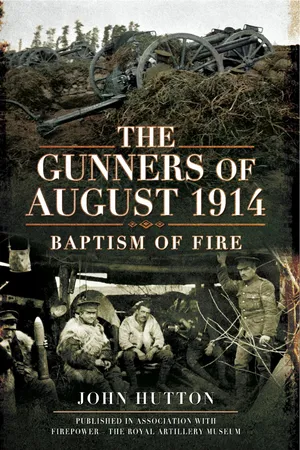
The Great War will always be synonymous with trench warfare and the mass slaughter inflicted by machine guns on the helpless but gallant infantry. There is a good reason for this view as the machine guns took a terrible toll, and the infantry's experiences continue to fascinate and appal people today. But one aspect of the fighting that gets insufficient attention is the artillery. Histories of the major battles often reduce the role of the big guns to a few paragraphs, and this has created a seriously distorted impression of the reality of the fighting. A better balance needs to be struck, and that is the intention of John Hutton's new book on the gunners of 1914.He tells the story of the war as the gunners themselves saw it, focusing on the first few months of warfare which were fundamental to the conduct of the campaign. The gunners may not have always shared the trench experiences of the infantry in the front line, but they were in the thick of the action, and success or failure depended on them. The personal testimonies of those who served with and supported the guns provide a vital insight into the colossal tragedy and drama of the war from the artilleryman's point of view.
Information
Chapter 1
Mobilisation
‘Everyone in good spirits and full of optimism. Germany has bitten off more than she can chew.’
Captain Mackie, 30th Brigade
Ammunition Column, 5 August 1914
In the late summer of 1914 the Great Powers of Europe finally stumbled into the war that had, for the best part of a decade, threatened to engulf them. The assassination on 28 June of the heir to the crumbling Austro-Hungarian Empire in Sarajevo by Gavrilo Princip, which appeared to most people in Britain as a deeply obscure act of political terrorism, lit a series of fuses that would explode with ferocious violence in August.
The British Army had at least contemplated the possibility of fighting a major war against Germany. Planning for such a campaign had been under way for several years as part of the Entente Cordiale. A small force of up to six infantry divisions and some cavalry would take up position on the left flank of the French Army as it advanced to meet the German enemy. Some of this planning percolated down the ranks. Driver Ryder, of E Battery, Royal Horse Artillery (RHA), recounted an eerie occasion in 1913 when the entire battery was paraded in front of its commanding officer, Major Forman, for a briefing: ‘He had a board and an easel. On it he had chalked a map of France. He said perhaps not in my lifetime but definitely in yours we will have war with Germany. And he pointed to a place on the map in France.’ When E Battery deployed to France the following year, Driver Ryder was astounded to find that ‘the train took us to the same place in France as Major Forman had pointed to on his map’.
The growing military tension on the continent towards the end of July led to Britain’s military forces being put on a heightened state of alert. On 28 July Winston Churchill, the First Lord of the Admiralty, ordered the First Fleet to proceed to its preliminary war station at Scapa Flow. The Navy had, fortuitously, already been brought up to full war strength for the Review at Spithead a few days before. The next day, army officers and other ranks were recalled from leave and furlough and the coastal defences were manned.
On this day, 29 July, Rory Macleod, a young lieutenant serving at the Curragh with 80th Battery, 15th Brigade, Royal Field Artillery (RFA), wrote home to his father: ‘We are ready to mobilize at a moment’s notice. All officers on leave have been recalled and no more leave is to be granted. We have been studying the mobilisation regulations so that everything will go off smoothly.’ In fact, for several days beforehand, Britain had been firmly in the grip of a feverish, frantic, patriotic hysteria. A young bank worker, E.C. Powell, arrived in London from a trip to the country on the eve of war to find London in absolute turmoil: ‘A vast procession jammed the road from side to side, everyone waving fags and singing patriotic songs.’
Osbert Sitwell, who would endure four bitter years of fighting with the cavalry on the Western Front, writing after the Armistice was signed, famously described these noisy crowds of August as ‘cheering for their own death’. Enormous crowds began to gather in all of Britain’s towns and cities. Outside the Houses of Parliament and in front of Buckingham Palace they gave voice to their support for war. In Newcastle upon Tyne the mood was, according to James MacKay, a young Methodist minister, a little more sober. On 3 August he had travelled with friends up the railway line along the Tyne Valley to Stocksfield, a few miles from the city centre: ‘At every railway station on the way up a military guard is stationed. The whole community is alive with uniformed men. Several train loads of soldiers passed us on their way to the city.’
Two days later, as the reality of war began to sink in, the seriousness of the situation was apparent on Tyneside and elsewhere:
Great excitement and sorrow prevails in the city. All the volunteers have been called out as well as reservists. Soldiers have been leaving the city in great numbers all day. Went down to the town to see if I could see any soldiers. The sights were heartrending. Women weeping everywhere. There are no great demonstrations of enthusiasm. Everyone feels the awfulness of the situation and a becoming gravity prevails.
This mood of gravity was also shared by those being mobilised for war. Major John Mowbray, who would go to France as part of the artillery staff of the 2nd Division, wrote in a letter home from Aldershot on 4 August: ‘We’ve had a black time of anxiety these two or three days. There is, of course, general animation here but I fear that people at home will be in for an anxious time. It will be a much more serious affair than we grasp in our moments of enthusiasm.’
On 2 August the British Government cancelled the orders for the annual Territorial Army training camps so that the Territorial forces could, if necessary, also be put on a war footing. This required them to be centred on their regimental depots. The War Office also cancelled the orders for annual army manoeuvres in order to ensure that the regular army was similarly prepared.
The British Army began its full-scale mobilisation for war at 4pm on 4 August 1914. Earlier that day two German cavalry divisions had crossed the frontier into neutral Belgium. Britain was the last of the major powers to mobilise. In the House of Commons the depressed but resigned Prime Minster Herbert Asquith set out the justification for going to war to tumultuous cheers from all sides:
I do not think any nation ever entered into a great conflict – and this is one of the greatest that history will ever know – with a clearer conscience or stronger conviction that it is fighting not for aggression, not for the maintenance of its own selfish ends, but in the defence of principles the maintenance of which is vital to the civilisation of the world. We have got a great duty to perform; we have got a great truth to fulfil; and I am confident that Parliament and the country will enable us to do it.
James MacKay had, in fact, been a witness to the careful and thorough planning that had gone into the possibility that Britain might one day have to fight a major continental war. The War Offce plan for mobilisation, first published in 1912, was by now being put into speedy effect. The plan – known as the War Book – was a detailed encyclopaedia setting out the transition from peace to war time conditions. It identified in meticulous detail the means by which Britain would be ready to deploy an expeditionary force of up to six infantry divisions and a cavalry force to fight alongside the French against the expected common enemy, Germany. It involved an unprecedented marshalling of national resources – men, animals and equipment. Nothing had been left out. The railways, for example, came under government control in order to facilitate the movement of troops across the country, and the War Office was given extensive powers to requisition private property for army use. Each reservist had an identity document telling them exactly what to do now the war had begun. The document merely had to be presented at any rail ticket office and a travel warrant would be issued. Post offices, which would be required to stay open twenty-four hours a day, would hand over 3 shillings for expenses. The plans would proceed like clockwork.
In addition to preparing detailed mobilisation plans, for more than a decade the War Office had been focused on bringing the equipment of the British Army into the new modern age of warfare. Nowhere was this more necessary than in the case of the artillery. In the years leading up to the outbreak of the First World War, the artillery had been substantially re-equipped and reorganised after the humiliating inadequacies exposed by the fighting in South Africa during the Boer War. At the start of the Boer War the artillery was equipped with the ancient 12-pounder breech-loading light field gun with no on-carriage recoil system. It benefited from a rifled barrel that improved its accuracy and was fitted with a breech-loading mechanism to speed up its rate of fire, but the absence of any on-carriage recoil system meant that every time the gun was fired it had to be re-laid onto its target. It was no match for its Boer counterpart. The Boers were using the newly manufactured Krupp’s quick-firing guns which were far superior in every department to the guns in use with the British Army. These Krupp’s guns incorporated all of the latest developments in artillery science and technology. They reflected the principal design features of the new generation of artillery weapons that had been pioneered by the French in 1897 with their revolutionary quick-firing 75mm gun. They made full use of built-in recoil systems and new breech mechanisms that allowed the guns to maintain a very high rate of effective fire. They would transform the concept of artillery.
Given the clear weapons superiority enjoyed by the Boers, the Director General of Ordnance General Sir Henry Brackenbury was forced into ordering 105 15-pounder quick-firing guns from Krupp’s arch rival, Erhardt of Dusseldorf, ushering in a new dawn of modern gunnery in the British Army. The purchase of the German guns met the immediate needs of the artillery, but national pride required a British quick-firing gun to be designed and procured as quickly as possible. As soon as the Boer War ended, the War Office formed a committee to draw up specifications for a series of new guns for the artillery. These would be British in design and manufacture. The result was the adoption in 1904 of the 13-pounder quick-firing gun for the RHA and a new 18-pounder quick-firing gun for the RFA. Both were highly effective weapons and a huge improvement on what had gone before.
The 13-pounder was of 3-inch calibre (76mm) and could fire its 12.5lb shrapnel shell a distance of about 6,000 yards. By the time war was declared in 1914, there were 245 of these guns available. The 18-pounder gun fired a larger shrapnel shell (3.4-inch or 84mm) a distance of around 6,500 yards. The shells had a powder-burning fuse set by hand which would detonate above and in front of the intended target, sending nearly 400 red-hot steel balls flying through the air. Firing this kind of ammunition, the 13- and 18-pounder guns were effectively a kind of giant long-range shotgun.
Both of these new quick-firing guns used a simple pole-trail carriage which had the effect of limiting the elevation of the gun. Given the prevailing orthodoxy surrounding the use of artillery and the preference for direct fire tactics, this was not considered to be a problem by the army. As the war progressed and lessons were learned about the benefits of indirect fire, the guns would be designed to fire higher and further. In 1914, however, the 18-pounder was probably the best gun of its class in service with any of the belligerent armies. Well handled, this gun could fire 20 rounds a minute. By 1914 1,126 of these guns had been manufactured. However, only 600 or so guns were based in the UK and therefore immediately available for use.
The third new gun to enter service at about this time was the 1909 4.5-inch howitzer. Although not the most accurate gun in its class, it was a brilliantly designed rugged weapon and once the teething problems with the breech mechanism were resolved it would remain in service with the army until 1944. It fired a 4.5-inch (114mm) 35lb high explosive shell to a maximum distance of 7,300 yards. At the beginning of the war British high explosive shells used Lyddite as their filling – a substance named after the artillery training ranges at Lydd on the south coast. These shells were fitted with a direct action fuse that burst on impact. The principal design feature of the howitzer was its absolutely critical ability to fire at angles of up to 45 degrees, dropping shells almost vertically onto targets that were otherwise protected from direct fire either by fortifications or by the lie of the land. By 1914 192 of these guns were in use with the artillery, and 108 of them equipped the British Expeditionary Force.
The British field artillery – particularly the 18-pounder and the 4.5-inch howitzer – would prove to be highly effective weapons of modern war. Over the course of the war modifications were made to improve the range of these guns. They were certainly not perfect, but their defects were of secondary importance. There were problems with the recuperators, which proved to be overly sensitive and liable to break down, and the original springs were all replaced by air recuperators. There was also a lack of traverse, which became particularly apparent with the advent of the tank, as the gun needed to follow a moving target. But the basic design of these field guns was proven to be sound and they passed every test set for them on the Western Front.
The Royal Regiment of Artillery was, however, still in transition from the old era of gunnery to the new. In short, there were simply not enough of these new quick-firing guns to equip the whole of the regular army. A doctrine of ‘make do’ prevailed. Some of the regular batteries and all of the Territorial Army batteries were equipped with older, less effective weapons. The most prominent of these older guns was the 15-pounder gun purchased from Erhardt, and an even older 15-pounder breech-loading gun. The Erhardt gun was a good weapon. It had a comparable range to the new 18-pounder but maintenance and repair were highly problematic. Parts were not interchangeable and the original wheels had proved not strong enough for use in difficult field conditions and had been replaced by British standard artillery wheels. The 15-pounder breech-loading gun, which was the main equipment for the Territorials, was an altogether different beast – a halfway house between the old pre-quick-firing guns and the new modern weapons. It was a conversion from an 1883 design and suffered from a lack of range and other problems. It would prove to be wholly unsuited to the needs of the campaign. Early in 1915 one senior general, Sir Ivor Maxse, commented that the gun was ‘absolutely worthless and cannot be put in the line at all’. They were quickly withdrawn from service and used largely as training guns. In fact, there had been a long-running argument within the army about the wisdom of equipping the Territorials with any artillery at all. Eventually, once the decision to do so had been made, an uneasy peace reigned, despite a certain lack of grace on the part of the Regiment. Territorial gunners were allowed to wear the Royal Artillery cap badge but with a blank scroll under the gun, where the regular gunners proudly bore their battle honour ‘Ubique’ (‘Everywhere’).
The Territorials faced other problems with their equipment. It was not just the 15-pounders that were out of date – so too were its howitzers and medium calibre guns. The Territorial artillery had been issued with the 4.7-inch quick-firing field gun. This weapon had been originally introduced in 1888 for naval and coastal defence purposes and would probably have remained in this role were it not for the urgent need for heavier guns during the Boer War. To meet this need some of the naval 4.7-inch guns were taken from warships and mounted on basic field carriages. They proved highly effective in the conditions that prevailed in South Africa. In France, however, they would prove to be highly unpopular with the gunners. They were difficult to operate and manoeuvre – they had no on-carriage traverse, for example, and were barely stable when fired. They too would eventually be withdrawn from service on the Western Front as soon as alternatives became available.
These guns were all designed to provide support to the soldiers in the field. In 1914 an infantry division was organised into four brigades of artillery, each with eighteen guns divided into three six-gun batteries. Each artillery brigade was commanded by a lieutenant colonel with an adjutant, an orderly officer and a small staff. Three of these brigades were equipped with the 18-pounder quick-firing field guns, while the fourth had the 4.5-inch howitzer. Each brigade of artillery had a signal section attached to it, which was capable of establishing line communications (wireless communications were not yet developed) to only two batteries at one time. The theory was that the brigade commander would always be close to the other battery. In total, the BEF would leave for France with fewer than 350 light, medium and heavy guns.
There was one immediate gap in capability: at the very beginning of the war the artillery deployed to France without any dedicated anti-aircraft weapons. The army possessed a mere thirty anti-aircraft guns in total, of which most were 1lb pom-poms, a light and largely ineffective weapon. They were deployed on the home front to protect the likely targets of German Zeppelins and would only be shipped out to France later. Dealing with the new threat from the air would eventually require a completely new approach and new equipment.
Heavy artillery was traditionally considered as useful only in conditions of siege warfare where the enemy had conveniently withdrawn behind the walls of a fortress that could be pounded with big naval guns loaded on trains. The Boer War had clearly shown the need for a more mobile form of heavy support artillery and in 1914 the frst of these new weapons was introduced into the army. This was the 60-pounder, designed by the Elswick Ordnance Company in Newcastle upon Tyne. It had a 5-inch calibre (127mm) and a range of over 10,000 yards. The top carriage, cradle and gun could all be disconnected and the whole assembly pulled back across the trail for transportation, distributing the weight more evenly between the two gun wheels and the wheels of a separate limber that supported the trail end. In this way the gun could still be pulled by horses. Later versions of this gun would be designed with heavy traction wheels enabling it to be hauled by heavy tractors. A heavy battery of four 60-pounders completed the divisional complement of guns. The Territorial heavy artillery was made up of obsolescent 5-inch howitzers that had frst seen action in the Nile Campaign of 1897–98. These had a limited range and would also soon be withdrawn from service and replaced by more modern weapons.
The Cavalry Division was less well provided for in terms of artillery. It had only two brigades of horse artillery with twelve 15-pounder guns each. The theory was that a reduced level of artillery firepower compared to the infantry was sufficient given the highly mobile nature of the cavalry force.
The artillery of each division was commanded by a Commander, Royal Artillery (CRA). He held the rank of brigadier general and was supported in his role by a Brigade Major, Royal Artillery (BMRA). Both of these roles had only just come into existence and in consequence there was little experience or precedent for handling artillery at divisional level. This was not made easier by the fact that the CRA had no dedicated communications link to his brigades. Instead he had to make do with whatever left-over resources the divisional signals company might be able to lend him, or rely on other forms of less effective communication – runner...
Table of contents
- Front Cover
- Title Page
- Copyright Page
- Contents
- Preface
- Maps
- Chapter 1 Mobilisation
- Chapter 2 The Gunners Arrive
- Chapter 3 Advance to Contact
- Chapter 4 Mons and the Start of the Retreat
- Chapter 5 Le Cateau – the Stopping Blow
- Chapter 6 The Marne and the Aisne
- Chapter 7 The Landing at Zeebrugge
- Chapter 8 The Race to the Sea and First Contact at Ypres
- Chapter 9 Ypres – Breaking Point
- Chapter 10 Winter
- Chapter 11 The Shortage of Munitions
- References
Trusted by 375,005 students
Access to over 1.5 million titles for a fair monthly price.
Study more efficiently using our study tools.
Frequently asked questions
Yes, you can cancel anytime from the Subscription tab in your account settings on the Perlego website. Your subscription will stay active until the end of your current billing period. Learn how to cancel your subscription
No, books cannot be downloaded as external files, such as PDFs, for use outside of Perlego. However, you can download books within the Perlego app for offline reading on mobile or tablet. Learn how to download books offline
Perlego offers two plans: Essential and Complete
- Essential is ideal for learners and professionals who enjoy exploring a wide range of subjects. Access the Essential Library with 800,000+ trusted titles and best-sellers across business, personal growth, and the humanities. Includes unlimited reading time and Standard Read Aloud voice.
- Complete: Perfect for advanced learners and researchers needing full, unrestricted access. Unlock 1.5M+ books across hundreds of subjects, including academic and specialized titles. The Complete Plan also includes advanced features like Premium Read Aloud and Research Assistant.
We are an online textbook subscription service, where you can get access to an entire online library for less than the price of a single book per month. With over 1.5 million books across 990+ topics, we’ve got you covered! Learn about our mission
Look out for the read-aloud symbol on your next book to see if you can listen to it. The read-aloud tool reads text aloud for you, highlighting the text as it is being read. You can pause it, speed it up and slow it down. Learn more about Read Aloud
Yes! You can use the Perlego app on both iOS and Android devices to read anytime, anywhere — even offline. Perfect for commutes or when you’re on the go.
Please note we cannot support devices running on iOS 13 and Android 7 or earlier. Learn more about using the app
Please note we cannot support devices running on iOS 13 and Android 7 or earlier. Learn more about using the app
Yes, you can access The Gunners of August 1914 by John Hutton in PDF and/or ePUB format, as well as other popular books in History & Military Biographies. We have over 1.5 million books available in our catalogue for you to explore.