- 192 pages
- English
- ePUB (mobile friendly)
- Available on iOS & Android
eBook - ePub
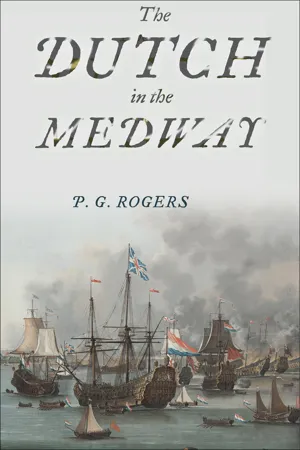
The Dutch in the Medway
About this book
The daring raid on the Medway in June 1667, when the Dutch navigated the treacherous shoals and sandbanks of the Thames estuary and the Medway in order to attack King Charles's ships laid up below Chatham, was one of the worst defeats in the Royal Navy's history, and a serious blow to the pride of the English crown. Perhaps the greatest humiliation was the removal by the Dutch of the flagshipRoyal Charles, towed down river after the raid and taken back to Holland. Her stern piece resides in the Rijksmuseum in Amsterdam to this day. The raid, intended to bring to an end English procrastination at the peace negotiations in Breda, was to cause simmering resentment and lead eventually to the Third Dutch War. As Pepys wrote in his diary on 29 July 1667, "Thus in all things, in wisdom, courage, force, knowledge of our own streams, and success, the Dutch have the best of us, and do end the war with victory on their side." P G Roger's account of the raid, and its significance within the Second Anglo-Dutch War between Britain and the United Provinces of the Netherlands, is vividly told and he sheds much interesting light on the English navy of Pepys's day. His particular knowledge of the Medway and the topography of Gillingham and Chatham also enables him to describe the manoeuvres at a level of detail that has not been replicated. This edition of a classic work will delight a whole new generation of readers.
Information
CHAPTER XI
Retrospect
IN VIEW OF the risks involved in the operation, the Dutch losses in ships and men during the Medway raid were remarkably slight. Their losses in ships amounted to only nine, or possibly ten, fireships. Four of these were lost on Wednesday 12 June, during the action at the chain in Gillingham Reach, and a further five the following day in the attack on the ships at Upnor. Previously, during the engagement at Sheerness, another fireship had been employed by the Dutch, and Edward Gregory, who witnessed the action, stated in a letter to Pepys that this fireship ‘burnt and drove into the harbour’,1 so it seems very probable that it too was lost.
It is impossible to say with any accuracy what the Dutch losses were in killed, wounded and captured. De Ruyter stated in his log-book that the total Dutch losses during the operations on 12 and 13 June were ‘only about thirty’; but other estimates vary from fifty2 to one hundred and fifty.3 Even if the last figure is accepted, it represents a very small loss in the light of what the Dutch achieved. In the attack on Sheerness they suffered, it would seem, no casualties at all. During the engagement at the chain, too, their losses were not great, because of the poor opposition which they encountered. Most of their casualties occurred during the fierce cannonade on Thursday 13 June, when they attacked the Royal James, Royal Oak, and Loyal London at Upnor; and the losses they then sustained no doubt powerfully influenced their decision to go no higher up the river, but to withdraw.
The English loss in ships was not catastrophic, but serious and shameful in the light of the circumstances. The Royal Charles and Unity were captured by the Dutch; the Royal James, Royal Oak, and Loyal London burnt down to the water-line by them; the Matthias, Charles V, and Sancta Maria set on fire and destroyed. In addition to these losses the English themselves had sunk five fireships (Dolphin, Barbados Merchant, Unicorn, John and Sarah, Constant John); two ketches (Edward and Eve, Hind); and one dogger (Fortune) at the Mussel Bank in an endeavour to hinder the Dutch. The latter set fire to the upper works of these vessels during their withdrawal, so that they ultimately became a total loss. At the chain the English had sunk the Marmaduke and the Norway Merchant; and another smaller vessel there, a horse-boat called the Prosperous was burnt by the Dutch. At Sheerness the Crown and Brill had likewise been destroyed by the Dutch.
Apart from the above vessels which were lost, others were damaged or put temporarily out of action as a result of the decision taken on Wednesday 12 June to scuttle the men-of-war lying above Upnor lest the Dutch should continue their advance and capture or destroy them. Most of these ships were taken to the sides of the river and sunk in shallow water, but were afterwards (with one exception, the Vanguard) recovered and put into service again.
It is difficult to estimate the number of Englishmen killed, wounded and captured during the Medway action, since no exact totals seem to have been compiled or, at least, to have been preserved. Edward Gregory stated that one man had been killed and another wounded during the attack on Sheerness Fort, before the majority of the garrison fled; and it is probable that these were indeed the only casualties. During the action at the chain on Wednesday, when the Dutch met more opposition, there must have been a number of killed and wounded on the English side; and certainly prisoners were taken by the Dutch from the Unity and Charles V. It was probably during the engagement on Wednesday that most of the English casualties were sustained; for on Thursday, at Upnor, the main opposition to the Dutch came from Upnor Castle and the guns on the opposite shore of the river, and there is no mention of any casualties among the men serving the guns.
There is likewise no record of casualties on board the Royal James, Royal Oak, and Loyal London, with the exception of Captain Douglas. The inference is that the men detailed to defend these vessels must, like the garrison of Sheerness Fort, have deserted their posts. In the absence of precise figures it is difficult to make even a rough estimate of the English losses during the Medway action; but if the fifty to seventy prisoners which the Dutch claim to have taken are included, the total losses including killed and wounded may have been a hundred to a hundred and fifty. A correspondent of Lord Conway, on 15 June, stated that ‘above 500 men’ had been lost during the engagement in the Medway,1 but he gave no authority for this figure, and it may have been a guess. Because of the general lack of opposition by the English at close quarters, the presumption must be that their losses during the fighting were well below five hundred.
One of the few redeeming features of the Medway disaster from the English point of view was the very slight loss of life, if not of property, sustained by civilians. None appears to have been killed on the Isle of Sheppey or at Gillingham, and although during the fierce engagement at Upnor on 13 June one civilian died, this was entirely accidental. He happened to be lying on a hill above Upnor watching the action when he was hit by a stray bullet which killed him.
Some two weeks after the Dutch raid, on 30 June 1667, Pepys visited Chatham Dockyard and was afterwards rowed down the river to Gillingham. In his diary that day he referred to the chivalrous conduct of the Dutch during their operations, and observed:
It seems very remarkable to me, and of great honour to the Dutch, that those of them that did go on shore to Gillingham, though they went in fear of their lives, and were some of them killed, and notwithstanding their provocation at Scelling [i.e. Terschelling], yet killed none of our people nor plundered their houses, but did take some things of easy carriage and left the rest, and not a house burned; and, which is to our eternal disgrace, that what my Lord Douglas’s men, who come after them, found there, they plundered and took all away: and the watermen that carried us did further tell us, that our own soldiers are far more terrible to those people of the country towns than the Dutch themselves.
One of the duties which devolved on Pepys as Clerk of the Acts was to ascertain, after the Dutch raid in the Medway, the total material loss which the State had sustained in regard to ships and stores. He wrote to James Norman, Clerk of the Survey at Chatham, for this information, and received in reply on 17 August 1667 a detailed account of the damage which had been done, and the financial loss which it represented.1
Norman said he would not try to estimate the value of the Royal Charles, Royal James, Royal Oak, and Loyal London, since he thought Pepys himself was in a better position to do this. However, Norman estimated various items on board those ships, such as cables and small cordage, which had been destroyed, at £1,000 at least. He considered that it would cost about £400 to repair the Vanguard, which had been scuttled by the dockyard officials; and he put the value of the Dolphin, Constant John, Unicorn, John and Sarah, and Barbados Merchant, sunk at the Mussel Bank, at £4,100, for in his view those vessels were probably ‘utterly lost’. The Hind, Edward and Eve, and Fortune, sunk at the same place, he thought might be recovered, and he estimated the cost of repairs to them at £500.
He estimated the value of the Unity, captured by the Dutch, at £900, that of the Matthias, destroyed, at £800, and the Charles V, also destroyed, at £550. The Marmaduke, sunk by the English near to the chain, had, Norman declared, only just been refitted and was ‘the best wreck in the river’; and so he put her value at £1,000. He estimated the value of the Norway Merchant, which had likewise been sunk by the English at the chain, even higher, at £1,400; for, he said, she had been fitted out and victualled for a voyage. He valued the Sancta Maria, burnt by the Dutch, at £600, the Helverson (Hilversum)2 at £200 if she should be refloated and repaired, but at £1,200 if she proved a total loss, finally, Norman valued the Prosperous, a small boat used for transporting horses, which had been burnt near the chain, at £150.
He next considered the various ships which had been scuttled on Wednesday 12 June as a panic measure, and stated that though they were ‘safe and well as to the main’ they had nevertheless suffered damage to their upper works which he reckoned would cost £900 to repair.
Having dealt with the ships, Norman turned next to Sheerness Fort and Dockyard, where he estimated the total loss in buildings and stores at £3,000. The chain at Gillingham represented, in his view, a loss of £150, and its various appurtenances—a crane, stages, and cables run over it to strengthen it—which had been lost or destroyed, a further £400. Moreover, Norman said, a sum of £2,200 had been spent at Chatham in payment of wages to seamen and riggers and other men, purely as a consequence of the Dutch raid, and he himself had paid out £1,900 as compensation for loss of clothes, and to meet other contingencies arising from the raid. Lastly, he estimated that victuals to the value of £1,040 had been lost.
All together the sums enumerated by Norman amounted to nearly £22,000—but it must be remembered that he had not included the value of the Royal Charles and the three men-of-war burnt at Upnor. Nor did he (and he explicitly mentioned this) include in his valuation guns, powder, shot, and other material lost or destroyed, for which the Ordnance Commissioners were responsible. However, even if these omissions are borne in mind, it still remains a fact that the material damage suffered as a result of the Medway raid was relatively slight, when the magnitude of the operation is taken into account. If the Dutch had been able to continue their attack, and destroy or capture the remaining ships in the river, also to destroy the dockyard installations at Chatham, the story would, of course, have been different. But as it was, although the material loss sustained was certainly not negligible, it was not as important in its repercussions as the psychological effect of the English defeat on the morale of the nation.
Norman had estimated the cost of repairs to some of the sunken ships on the assumption that they might be successfully salvaged; but this expectation proved to be unduly optimistic. On 191 July the officials of Chatham Dockyard informed the Navy Board that in their opinion it would be worth while removing the Royal James, Royal Oak, and Loyal London to the Thames, there to be rebuilt. On 15 September the Royal James and Loyal London were accordingly taken into the Thames, and the former was put in dry-dock at Woolwich, the latter at Deptford. The estimate finally made of the cost of rebuilding the Royal James was £9,800, and this was considered unwarrantable, so that in April 1669 plans were being considered that the ship should be used as a hulk. She was spared this last indignity, however, and was broken up at Chatham in August 1670. The Loyal London fared better, was rebuilt, and launched at Deptford on 25 July 1670; but the Royal Oak, which had long since been written off as a total loss, was still laid up as a wreck in the Medway in May 1671.
The work of recovering the men-of-war which had been scuttled above Upnor was carried out successfully during the weeks following the Dutch withdrawal, and by the end of Januar...
Table of contents
- Cover
- Title
- Copyright
- Contents
- LIST OF ILLUSTRATIONS
- NEW FOREWORD
- PREFACE
- MAPS
- I THE PISMIRES OF THE WORLD
- II THE ENGLISH AND DUTCH AFFAIRS
- III THE NAVY RIPT AND RANSACKT
- IV PLAGUE, FIRE, AND WAR
- V THE BEST PLENIPOTENTIARY FOR PEACE
- VI GREAT BUSINESS IN HAND
- VII THE GLORIOUS ARMS OF THEIR HIGH MIGHTINESSES
- VIII SAD AND TROUBLESOME TIMES
- IX FRUITS OF VICTORY
- X VAE VICTIS
- XI RETROSPECT
- POSTSCRIPT
- SOURCES
- Plate section
Trusted by 375,005 students
Access to over 1.5 million titles for a fair monthly price.
Study more efficiently using our study tools.
Frequently asked questions
Yes, you can cancel anytime from the Subscription tab in your account settings on the Perlego website. Your subscription will stay active until the end of your current billing period. Learn how to cancel your subscription
No, books cannot be downloaded as external files, such as PDFs, for use outside of Perlego. However, you can download books within the Perlego app for offline reading on mobile or tablet. Learn how to download books offline
Perlego offers two plans: Essential and Complete
- Essential is ideal for learners and professionals who enjoy exploring a wide range of subjects. Access the Essential Library with 800,000+ trusted titles and best-sellers across business, personal growth, and the humanities. Includes unlimited reading time and Standard Read Aloud voice.
- Complete: Perfect for advanced learners and researchers needing full, unrestricted access. Unlock 1.5M+ books across hundreds of subjects, including academic and specialized titles. The Complete Plan also includes advanced features like Premium Read Aloud and Research Assistant.
We are an online textbook subscription service, where you can get access to an entire online library for less than the price of a single book per month. With over 1.5 million books across 990+ topics, we’ve got you covered! Learn about our mission
Look out for the read-aloud symbol on your next book to see if you can listen to it. The read-aloud tool reads text aloud for you, highlighting the text as it is being read. You can pause it, speed it up and slow it down. Learn more about Read Aloud
Yes! You can use the Perlego app on both iOS and Android devices to read anytime, anywhere — even offline. Perfect for commutes or when you’re on the go.
Please note we cannot support devices running on iOS 13 and Android 7 or earlier. Learn more about using the app
Please note we cannot support devices running on iOS 13 and Android 7 or earlier. Learn more about using the app
Yes, you can access The Dutch in the Medway by P. G. Rogers in PDF and/or ePUB format, as well as other popular books in History & Military & Maritime History. We have over 1.5 million books available in our catalogue for you to explore.