A deep dive into the genesis, development, and occupation of the Hindenburg Line, as well as detailed guides to the actions and battles in each sector.
When the Hindenburg Line, Germany's legendary defence system, was pierced at Cambrai in November 1917, the British were so pleased and delighted that church bells were rung. But that initial elation was followed by disappointment when the Germans used "defence-in-depth" and "elastic-defence" to retake the Hindenburg defences.
This book examines the reasons for the German's decision to fall back to a strong defence line while their Navy starved Britain into submission, and the "burnt earth" policy of devastation in the area evacuated. The design and layout of the Hindenburg Line, and the Battles for its possession in 1917 and 1918, are given: with numerous maps covering different sectors and the struggles for each village and farm, together with the part played by many British Regiments. The maps contain information on how to find all remaining vestiges of both German and British defences in the region, most of which are rarely visited and many of which have not been seen by British eyes for many years.
No book since the Great War has examined this area in such detail, nor has any single account contained so much for the battlefield visitor to see. The sites of individual acts of bravery, including the winning of many Victoria Crosses are featured, and existing locations of battle lines, headquarters, artillery observation and machine gun posts are also included, together with an absorbing narrative which also guides the armchair reader.
- 192 pages
- English
- ePUB (mobile friendly)
- Available on iOS & Android
eBook - ePub
The Hindenburg Line
About this book
Trusted by 375,005 students
Access to over 1 million titles for a fair monthly price.
Study more efficiently using our study tools.
Information
CONTENTS
Acknowledgements
Series Editor’s Introduction
Introduction
Advice to travellers
Chapter 1. The situation in the winter of 1916/17 and German plans for a withdrawal to a new defence line
Chapter 2. Siting and construction of the Hindenburg Line (Siegfriedstellung)
Chapter 3. British attacks at Arras, Bullecourt and Cambrai in 1917, the German Spring Offensive of March 1918 and the final British assault on the Hindenburg Line
Chapter 4. Sectioned guide to the location of the Hindenburg Line and actions and battles in each sector:
A. TILLOY AND NEUVILLE-VITASSE
B. MONCHY AND ROEUX
C. BULLECOURT AND FONTAINE
D. VITRY-EN-ARTOIS AND SAILLY-EN-OSTRAVENT
E. DURY AND CAGNICOURT
F. QUÉANT AND LAGNICOURT
G. MARQUION AND OISY-LE-VERGER
H. MOEVRES AND INCHY
I. HAVRINCOURT
J. BOURLON AND FLESQUIÈRES
K. GOUZEAUCOURT AND RIBECOURT
L. EPEHY AND VILLERS GUISLAIN
M. BANTEAUX AND MASNIERES
N. BONY AND VENDHUILE
O. BELLICOURT AND BELLENGLISE
P. ST QUENTIN AND FAYET
Q. VILLERS OUTRÈAUX AND LESDAIN
R. JONCOURT AND BEAUREVOIR
S. THE REAR AREAS
Further Reading
References
Index
ACKNOWLEDGEMENTS
I am greatly indebted to a large number of people who have provided help, information, advice, tea and sympathy in the preparation of this book. To the Imperial War Museum and many regimental museums and county record offices I owe a debt of gratitude for the chance to delve into their archives, especially Maggie Magnuson and the ladies of the Royal Engineers Library, Chatham, and various public libraries, particularly those of Saffron Walden and Cambridge. Brian Morgan of Great Chesterford has been very helpful in the production of maps, and Aleks Deseyne of Wondelgem has provided some contemporary photographs. Trevor Pidgeon and Paul Hanson of the Western Front Association have, as ever, been very helpful with the supply of trench maps for field visits. Many thanks to Comte de Francqueville at La Folie and to Baron de Valicourt at Flesquières for access and hospitality, and many other kind farmers and landowners. A special debt is owed to Pierre Capelle of Trescault for his unrivalled local knowledge, freely shared, and for time given in traipsing through woods and fields and sharing bottles of beer at lunchtime; also to Mireille for some excellent French food and hospitality. Nothing would be possible without Jennifer, who has provided encouragement and patience.
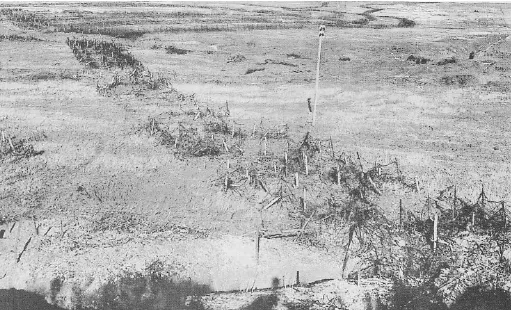
The Hindenburg Line: thick belts of wire defending a tunnel at Bellicourt. Gaps in the wire have been created by the British barrage, 1918.
SERIES INTRODUCTION
This book is the first of the Battleground Europe series to look at what the British called the Hindenburg Line. Most visitors to the battlefields today concentrate first and foremost on the Somme and then on the Ypres Salient. The area south of Armentières, where the great British offensive battles on the Western Front of 1915 were largely fought, and the area to the south of Arras to the Somme have suffered similar neglect.
The third area which sees few visitors to is the east of Arras and around Cambrai and St Quentin. Peter Oldham’s book puts this right, by providing a vade mecum to the great series of defences to which the Germans withdrew in the early months of 1917. The Battle of Arras has been overshadowed by Third Ypres for reasons that are far from apparent. Cambrai is heard of but rarely studied; whilst the various offensives of 1918, German and allied, seem to be studied but not visited on the ground. Perhaps this is because it is an area that has not been well covered in the literature (though books such as the masterly Kaiser’s Battle, by Martin Middlebrook and Jonathon Nicholl’s Cheerful Sacrifice should have rectified that). Certainly it cannot be for lack of remnants of that period – there are great numbers of concrete fortifications still remaining. Perhaps it is because there has not been a detailed enough book on the subject.
If that is the case then this book must go a long way to satisfying this need. Peter Oldham looks at the area, dividing it into manageable sections and explains its importance. He does this with the aid of clear maps, which enables visitors to orientate themselves and to follow the events that took place there over eighty and more years ago. Remaining bunkers are frequently put into the context of the battle so that it is possible to follow some of the actions which took place around them, to understand their importance and in many cases to be looking at a structure whose capture or defence earned a heroic man – or men – the Victoria Cross.
Besides all of this Mr Oldham explains the genesis, development and occupation of the Line, as well as the battles which took place there. For many years it has been unfashionable to consider that Britain and her Dominions could possibly be winning a war on military merit. This book goes a long way to proving that this was the case; and at the same time makes it clear that this was a most notable achievement.
It is quite certain that this book will bring many visitors to see this part of the Great War Battlefield. It might be a little late, but at long last the men who fought and died here have now got a worthy guide to their exploits. Those who lie in the cemeteries around Cambrai and St Quentin or whose names are commemorated on the various memorials are quite likely to have more visitors thanks to this book; visitors who will be rather more aware of what and when it was that they suffered the supreme price.
It is to be expected that this is just the first of a number of books in the Battleground Europe series about the battles and events on and around the Hindenburg Line. Doubtless this book will whet the appetite of the reader for such works.
Nigel Cave
Ely Place, London
Ely Place, London
INTRODUCTION
On the morning of 6 February 1917, pilot Lieutenant Peters and his observer, Lieutenant Balfour, of 70 Squadron R.F.C. were flying their Sop with at a height of 4,000 metres (13,000 feet) on a reconnaissance mission over St. Quentin. Visibility was good, and below them they noticed that the town was being organised for defence. On landing they presented a report on their findings:
‘There appears to be a complete system of trenches around the town. On the south east corner of the town there is a short line about 3/4-1 mile running up through Itancourt. On the north side, running east of the canal, is a fairly continuous line with strongpoints at about 1/4 mile intervals. Between Bellicourt and Bellenglise the line of trenches is very broken.’
This report confirmed earlier gleanings of information from intelligence sources but was the first real proof of enemy activity in this area since the previous autumn, when defence work to the north, around Quèant, had been noticed but not much importance had been attached to this. Other reconnaissance flights followed and the British began to build a picture of what lay before them: the strongest system of scientifically designed defences that the world had then seen. The search for further knowledge and details increased as the British planners tried to understand the nature of the defences and the way in which they might be used. Trench raids were carried out by the infantry to gain information, prisoners were interrogated and escaped civilians, some repatriated through Switzerland, were quizzed. The R.F.C. were given the task of identifying the whole system and flew countless sorties, taking many thousands of photographs whilst also carrying out bombing raids on the transport lines.
Even when they had a good idea of the amount of work put in by the Germans, the British had no reason to suspect that their intention was to evacuate the ground which they had so stubbornly defended during the Battle of the Somme. Unaware of the political and military thoughts behind the decision the British were taken by surprise by the German initiative.
The 1917 Battles of Arras, Bullecourt and Cambrai were to show that there was a limit to the ground the Germans were willing to cede and any ground won would have to be fiercely fought for. Falling back onto the position in the autumn of 1918, with their plans and hopes dashed and fatigued after four years of warfare, the Germans were to make one last stand to prevent the British and French reaching the Fatherland.
During the course of the several battles in and around the Hindenburg Line both sides developed and improved tactics of attack and defence: necessity was the mother of invention and tank warfare, unregistered artillery bombardments, shell proof protection, elastic defence and the use of storm troops to infiltrate defences were all perfected.
The Hindenburg Line was also to become as strong in the minds of the British public as it was on the ground, being given almost mythical status in the newspapers. Church bells rang when the line was pierced at Cambrai in 1917 and the crossing of the St. Quentin Canal by the 46th Division in September 1918 was seen as a master stroke which presaged the end of the war.
Visitors to the area today are likely to find, at first sight, little or nothing to tell them that the land was once a maze of trenches too wide for a tank to cross, with hundreds of mined dug-outs and acres and acres of barbed wire. Even the permanent constructions: thick reinforced concrete shelters and pill boxes for machine-guns, command posts and artillery crews can be difficult to find, often being identifiable only as a patch of coarse grass and weeds in a ploughed field, for the defences were generally built at trench level with the roof hidden by a thin layer of soil. Some vestiges are obvi...
Table of contents
- Cover
- Half Title
- Series
- Title Page
- Copyright
- Contents
Frequently asked questions
Yes, you can cancel anytime from the Subscription tab in your account settings on the Perlego website. Your subscription will stay active until the end of your current billing period. Learn how to cancel your subscription
No, books cannot be downloaded as external files, such as PDFs, for use outside of Perlego. However, you can download books within the Perlego app for offline reading on mobile or tablet. Learn how to download books offline
Perlego offers two plans: Essential and Complete
- Essential is ideal for learners and professionals who enjoy exploring a wide range of subjects. Access the Essential Library with 800,000+ trusted titles and best-sellers across business, personal growth, and the humanities. Includes unlimited reading time and Standard Read Aloud voice.
- Complete: Perfect for advanced learners and researchers needing full, unrestricted access. Unlock 1.4M+ books across hundreds of subjects, including academic and specialized titles. The Complete Plan also includes advanced features like Premium Read Aloud and Research Assistant.
We are an online textbook subscription service, where you can get access to an entire online library for less than the price of a single book per month. With over 1 million books across 990+ topics, we’ve got you covered! Learn about our mission
Look out for the read-aloud symbol on your next book to see if you can listen to it. The read-aloud tool reads text aloud for you, highlighting the text as it is being read. You can pause it, speed it up and slow it down. Learn more about Read Aloud
Yes! You can use the Perlego app on both iOS and Android devices to read anytime, anywhere — even offline. Perfect for commutes or when you’re on the go.
Please note we cannot support devices running on iOS 13 and Android 7 or earlier. Learn more about using the app
Please note we cannot support devices running on iOS 13 and Android 7 or earlier. Learn more about using the app
Yes, you can access The Hindenburg Line by Peter Oldham in PDF and/or ePUB format, as well as other popular books in History & World War I. We have over one million books available in our catalogue for you to explore.