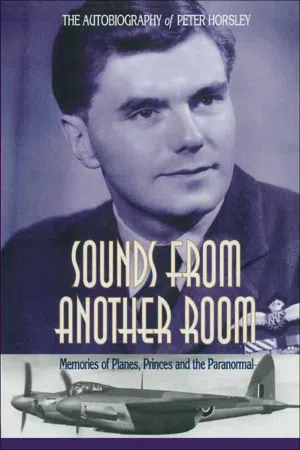
The distinguished RAF commander recounts his life of service and adventure from WWII to the Royal Household and encounters with unexplained phenomena.
A decorated war hero and longtime associate of the Royal Family, Sir Peter Horsley led a uniquely fascinating life. In
Sounds from Another Room, he chronicles the many formative—and transformative—experiences that shaped it.
Horsley joined the Royal Air Force shortly after the outbreak of World War II. Shot down over the English Channel during the Normandy invasion, he not only survived but continued to serve in the RAF throughout the war and for decades afterward. Horsley also spent seven years as equerry to His Royal Highness Prince Philip.
It was at Philip's request that Horsley investigated numerous UFO sightings. He offers a candid account of that work, including a mysterious encounter with a Mr. Janus, who exhibited telepathic abilities and an intimate knowledge of extraterrestrial life.
- 256 pages
- English
- ePUB (mobile friendly)
- Available on iOS & Android
eBook - ePub
About this book
Information
Contents
| Acknowledgements | |
| Foreword | |
| 1. | The Clinic |
| 2. | A Miserable Start |
| 3. | Escape to Sea |
| 4. | The Royal Air Force |
| 5. | Before The Storm |
| 6. | The Storm |
| 7. | Voices |
| 8. | The Road Ahead |
| 9. | A Stately Room |
| 10. | Visitors |
| 11. | The Corridors of Power |
| 12. | Caught in a Web |
| 13. | The Beginning of the End |
| Index |
Acknowledgements
The author wishes to acknowledge the help of his wife, Annie, with the editing; his secretary, Mary Churcher, for all the many hours of typing; Leo Cooper of Pen & Sword Books Limited for all his kindness and patience; Sir Ranulph Fiennes and Bloomsbury Publishing Limited for their generous agreement for the use of the extract from The Feather Men; This England Magazine for their permission to reproduce the poem by John Magee; David Higham Associates for permission to publish John Pudney’s poem ‘Breakfast’, and finally his lucky stars for having lived through it all.
Foreword
Long introductions are tedious to reader and writer alike so this Foreword is short. My story is not the traditional saga of some minor military figure; it recounts a number of separate events, each true and of such intensity at the time that they altered the pattern of my life thereafter, like coral polyps shaping a reef.
I like to compare it to a house whose main rooms are the events I shall describe and the corridors between but the passage of time. The rooms themselves are of such variety they might have been designed by different architects and with each furnished in the style of its immediate tenants.
There is a mystery about the house, for on occasions there would appear to be a house within a house, one living in the present, the other in a parallel time and dimension. The whispers and sounds of the other occupants sometimes break through from the recesses of a distant and unknown room, though message and messengers remain tantalizingly elusive.
Both style and time may at times seem confusing but there is a reason for this. Orphaned early, I was a lonely child, often thrown back on my own resources and imagination. With no one close enough to whom I could reveal my innermost secrets, I became a compulsive scribbler, and remain one. So the book is a mixture of what I actually wrote at the time and what I have written since, from diaries and notes. For example, my school diaries are written exactly as they were at the time and ‘The Storm’ was written shortly after the event.
Just ten years ago I was involved in a very serious accident which, at the time, seemed to have been caused by some quite inexplicable malfunction of my car. As I lay at the roadside, not far from death, the whole story of my life passed in front of me, like a film that was madly out of control.
A most remarkable explanation of the cause of that accident was later provided by Sir Ranulph Fiennes in his book The Feather Men. It appears that I was the innocent tool of a terrorist gang who had decided to use my car as a murder weapon. A former officer in the Special Air Service, Sir Ranulph is very familiar with the shadowy world of terrorism and I have no reason to challenge the facts as he gives them, even though several questions remain unanswered. As it was this extraordinary and devastating experience which triggered the idea behind this book of mine, he has very kindly allowed me to reproduce that story as my opening chapter.
1
The Clinic*
It happened a long time ago in a far off desert country. The four sons of Sheik Amar Bin Issa were killed in an ambush in the South Yemen by British forces. The Sheik swore an oath of revenge on his sons’ killers.
‘The Clinic’ were a European gang of ruthless hired assassins who banded together to kill for money. The Sheik finally met the leader of the gang in Dubai and took out a contract on his sons’ killers – a million dollars down payment, and a further million dollars for each of four films proving the assassinations; one stipulation of the contract was that the deaths were to appear accidental, arousing no suspicions of murder in the minds of relations or friends.
‘The Feather Men’ were a British group – feather because their touch was light. They took into their grasp crimes which were beyond the powers of the ordinary police. The Feather Men relentlessly pursued the IRA in Northern Ireland, moving silently against those members who had escaped the hands of the law through lack of evidence. They also took under their wing the families of the SAS [Special Air Service] and established a body of watchdogs to look after their interests. The Feather Men were controlled by a committee† of senior establishment figures under the chairmanship of Colonel Tommy Macintosh.
So far the Clinic had fulfilled half their contract by ‘arranging’ the deaths of Superintendent John Milling, a former Marine, and a police officer in the Omani Police Air Wing in a helicopter ‘air accident’ by tampering with the pilot’s collective control lever. After an unequal aerodynamic battle, the helicopter plunged into the sea, killing John Milling. They had then settled the fate of Major Mike Kealy, Special Air Service, who died of ‘exposure’ in a climbing accident in the Brecon Beacons. He was leading a batch of SAS trainees on a forced march in atrocious weather conditions when he became separated from his charges. Kealy was then ambushed by the gang who drugged him and left him to die on the mountain in the cold and swirling fog. Later on they would deal with Corporal ‘Mac’, the last of the four, and even attacked Ranulph Fiennes himself close to his Exmoor Farm. He was only rescued by the intervention of the Feather Men who had been watching the gang as they circled his farm.
The Clinic now turned their attention to Major Michael Marman. They had broken into Marman’s Clapham home while he was out shopping and had photographed his diary. During their escape, however, they were recognized by a member of the Feather Men who had been watching their unlawful activities for some time. Mike Marman was immediately warned that he was on the Clinic’s hit list as a former member of the Sultan of Oman’s Armed Forces. The Feather Men meanwhile arranged for John Smythe, an active watchdog, and a team of local volunteers to mount a round-the-clock surveillance of Marman.
The Clinic had then to decide how to dispose of Major Marman. After considerable argument between members of the gang, it was decided to dispatch him in a road accident. Meier, the technical member, had already perfected the ‘Boston brakes’ method in America. This involved fitting a sophisticated device to the brakes of a lead car, controlled by radio from a following car and steering it into the victim’s vehicle travelling in the opposite direction. It had worked before in the States and Meier saw no reason why it should not work again.
While Meier’s technical skill was undeniable, the gang recruited another member, Jake, a genius with cars and unethical devices. The gang leased an old disused airstrip in Kent and began to assemble the necessary tools and equipment to modify the brakes of the lead car. The plan began to take shape. First, Marman had to be caught alone on an open road. ‘It is lucky,’ said Meier, ‘that Marman’s car is a very small Citroen 2CV which will crack open like an egg when it is hit.’ A day well ahead was chosen, after a study of Marman’s diary and maps, Tuesday, 11 November, when Marman was due to visit an old friend, General Robin Brockbank, at Steeple Langford in Wiltshire. ‘He should be driving back after lunch along the A303 at about 3.15 pm in time to reach his house in Clapham just before dark. If we allow him an average speed of fifty-five miles per hour, he will be,’ said Meier pointing to the map, ‘somewhere along this dual carriageway between Winterbourne Stoke and Popham. If this plan does not work the first time, we will continue to look for a suitable time and place until it does.’
‘All we need now,’ Meier continued, ‘is to find a driver who is scheduled to head west on that same stretch at about 3.30 p.m. – that should not be too difficult, since the A303 is the main arterial road between London and Plymouth. What sort of person uses that route?’ Meier asked and then answered the question himself, ‘A representative of a company with offices in both places.’ ‘Do you remember,’ Meier went on ‘that Hovercraft we bought from M L Slingsby last year for that smuggling job? I have discovered that the Holding Company owns a subsidiary, M L Engineering, in Plymouth and after a lot of research, I have also found out that M L Holdings are having a main board meeting in Plymouth on the morning of 12 November. I have looked at a number of alternative companies and for one reason or another have discounted them. Here is a list of four nonexecutive directors who will attend the meeting. I have picked out the most likely candidate, Sir Peter Horsley, who lives at Houghton, near Stockbridge, and is likely to use the A303 on his journey to Plymouth, so Jake and I will pay him a little visit.’
Shortly after this meeting Jake and Meier quietly broke into Sir Peter’s office above a garage close to the house in the dead of night. They found his diary open on his desk and it took only a few minutes to photograph the relevant pages before they left again, making sure that there were no traces of their visit. On the way out they passed an open garage. They went in and found a large saloon car and Jake made a quick inspection of it, a BMW 728i automatic, registration 3545 PH, Michelin XV tyres. This was undoubtedly the ideal car for their purposes.
The two returned to the disused airstrip and the next day they purchased a second-hand BMW 728i and two target practice cars; Jake fitted the control system to the BMW and rehearsals began in earnest. It was decided that Meier and Jake should follow the BMW and De Villiers, another member of the gang, would follow Marman’s 2CV. All was now set. They perfected the equipment and procedures just two days before the target date.
On the night of Monday, 10 November, five members of the gang assembled outside Sir Peter’s secluded Victorian house in the village of Houghton. Three remained on watch while Jake and Meier began the work of fixing the apparatus to the BMW’s braking system, making sure that it could be easily detached after the accident. It took a little time but eventually they were satisfied with their work. Meier knew from experience that once he had taken over the control of Horsley’s car, he could steer it as he pleased. If Horsley survived the crash, all he could say was that his car had not obeyed his steering instruction and had gone out of control; he would have no reason to suspect that his brakes had been tampered with.
Meier and Jake positioned themselves in the lane outside Horsley’s house on Tuesday morning ready to follow him when he left for Plymouth. Their victim came out of his house at exactly 2.30 p.m. and, unaware of the drama to be played ahead, got into his car and drove away. Meier and Jake slotted in behind him at a comfortable distance and followed him discreetly on to the A303.
Smythe, who had followed Marman to Steeple Langford and then, after lunch, down the A303, soon became aware of a white Ford Escort driven by De Villiers that siphoned in behind Marman’s small Citroen. Before Meier and Jake reached the Amesbury roundabout, the voice of De Villiers broke in on the CB radio: ‘2CV making a steady seventy miles per hour. Has just passed the A360 turn-off.’ Meier consulted the calculator and reckoned that Marman would be driving down the dual carriageway in about three minutes. The Volvo accelerated to a position just behind Horsley and Meier turned his special radio equipment to the ‘on’ position. De Villiers’ voice came over again. ‘One car behind me otherwise clear ahead. Activate the brake device any time now.’ Meier took over Horsley’s car and the gyrations began; he steered the BMW across the centre of the reservation into the path of Marman’s approaching car and then accelerated past the disappearing BMW. Jake pulled up about five hundred yards further on and they both got out of the Volvo in time to see the death throes of the two cars. They then drove off to make the rendezvous in Andover with De Villiers.
De Villiers had in the meantime watched Horsley being taken off in the ambulance and waited for the two wrecked cars to be transported to a garage close to Amesbury before driving on to Andover to meet the rest of the gang. That night two members of The Clinic broke into the garage and quickly removed all the apparatus from Horsley’s car.
The police arrived the following morning and their limited inspections revealed nothing technically wrong with either of the two cars. They did not have the slightest suspicion that they had been duped.
* This chapter is taken from The Feather Men by Ranulph Fiennes (Bloomsbury Publishing Limited)
† It was this committee that approached Ranulph Fiennes to write their story.
2
A Miserable Start
On entering the front door of my house I
was faced by the hall, dark and threatening
with odd pieces of furniture scattered
around in an appalling muddle.
I was born in 1921 in one of the grander houses in West Hartlepool to a wealthy family of timber merchants and ship owners. West Hartlepool may not be very well known today but a hundred years ago it was a town of some importance. Durham was once described as a lump of coal with a million and a half people clinging to it; in the last century t...
Table of contents
- Cover
- Half Title
- Full Title
- Copyright Page
- Dedication
- Contents
Trusted by 375,005 students
Access to over 1.5 million titles for a fair monthly price.
Study more efficiently using our study tools.
Frequently asked questions
Yes, you can cancel anytime from the Subscription tab in your account settings on the Perlego website. Your subscription will stay active until the end of your current billing period. Learn how to cancel your subscription
No, books cannot be downloaded as external files, such as PDFs, for use outside of Perlego. However, you can download books within the Perlego app for offline reading on mobile or tablet. Learn how to download books offline
Perlego offers two plans: Essential and Complete
- Essential is ideal for learners and professionals who enjoy exploring a wide range of subjects. Access the Essential Library with 800,000+ trusted titles and best-sellers across business, personal growth, and the humanities. Includes unlimited reading time and Standard Read Aloud voice.
- Complete: Perfect for advanced learners and researchers needing full, unrestricted access. Unlock 1.5M+ books across hundreds of subjects, including academic and specialized titles. The Complete Plan also includes advanced features like Premium Read Aloud and Research Assistant.
We are an online textbook subscription service, where you can get access to an entire online library for less than the price of a single book per month. With over 1.5 million books across 990+ topics, we’ve got you covered! Learn about our mission
Look out for the read-aloud symbol on your next book to see if you can listen to it. The read-aloud tool reads text aloud for you, highlighting the text as it is being read. You can pause it, speed it up and slow it down. Learn more about Read Aloud
Yes! You can use the Perlego app on both iOS and Android devices to read anytime, anywhere — even offline. Perfect for commutes or when you’re on the go.
Please note we cannot support devices running on iOS 13 and Android 7 or earlier. Learn more about using the app
Please note we cannot support devices running on iOS 13 and Android 7 or earlier. Learn more about using the app
Yes, you can access Sounds From Another Room by Peter Horsley in PDF and/or ePUB format, as well as other popular books in History & Historical Biographies. We have over 1.5 million books available in our catalogue for you to explore.