"An invaluable eye-witness account of life at the lower levels of the German Army during the First World War."—HistoryOfWar.org
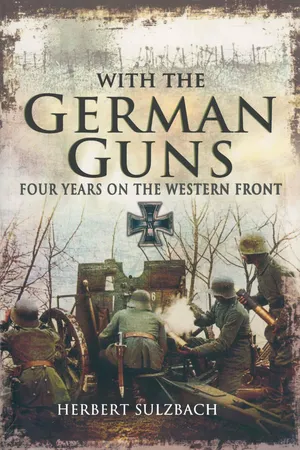
At once harrowing and lighthearted, Herbert Sulzbach's exceptional diary has been highly praised since its original publication in Germany in 1935. With the reprint of this classic account of trench warfare, it records the pride and exhilaration of what to him was the fight for a just cause. It is one of the very few available records of an ordinary German soldier during the First World War.
"One of the most notable books on the Great War. It is a book which finely expressed the true soldierly spirit on its highest level; the combination of a high sense of duty, courage, fairness and chivalry."—Sir Basil Liddell Hart
"Herbert Sulzbach's first person diary focuses on four years of trench warfare and is a valuable contribution to the overall individual story of the First World War, more so than many other such accounts perhaps, as the author was German."—
OCAD Militaria Collectors Resources
"A first-class personal account of Herbert Sulzbach's war seen through his diaries. There is much insight into both his and the German soldier's attitude to war and events . . . a very readable narrative and adds to the library of sources that are invaluable to counter the legions of postmodern re-evaluations of the German soldier."—
Battlefield Guide
- 256 pages
- English
- ePUB (mobile friendly)
- Available on iOS & Android
eBook - ePub
About this book
Trusted by 375,005 students
Access to over 1.5 million titles for a fair monthly price.
Study more efficiently using our study tools.
Information
CONTENTS
Foreword
Translator’s Note
Prologue
I 1914
II 1915
III 1916
IV 1917
V 1918
The St Quentin Offensive
VI 1918
The Assault on the Chemin des Dames
VII 1918
The Third German Offensive at Rheims
VIII 1918
The Foch Counter-Offensive
IX 1918
The End
Foreword
HERBERT SULZBACH
A MEMOIR
by
Terence Prittie
IN the 1930s a novel was published called Bretherton. Khaki or Field Grey? It told the story of a British officer in the First World War, who was passed through the lines in German uniform in place of a dead German who was his double, served with the latter’s Prussian regiment, returned by plane through the lines, and was eventually killed on his second spy-mission with the Kaiser’s army. On his first, he had identified completely with an enemy whom he could no longer regard as such, and his last thoughts when dying fluctuated between the dual loyalties and personalities which had become interwoven.
Herbert Sulzbach’s story has this in common with that of the mythical Bretherton. He served in the First World War as a German citizen, totally loyal to his German Fatherland. He served in the Second World War in the British Army, against Nazi Germany, and is—as far as I know—the only man in the country who was commissioned in World War I by Kaiser Wilhelm II and in World War II by King George VI. Yet he remained, although this may sound paradoxical, as loyal as before to his true fatherland, the Germany which has outlived conquerors and tyrannies. In putting on khaki in place of field-grey, he believed that he had one immediate, overriding duty; in his own words it was ‘to help to destroy Hitler’. He had, in addition, a longer-term aim—to work for the reconciliation of two nations which he loved and to which he felt that he belonged. He was able to begin doing this even before the end of the war.
So much for the broad outline of his life. There have been a great many significant episodes in it. Here are some, at least, of its relevant details:
He was born in February, 1894, into a wealthy and respected Jewish family of Frankfurt-on-Main. His grandfather, Rudolf, was the founder in 1855 of the Sulzbach private bank (Bankhaus Gebrüder Sulzbach), one of the founders of the Deutsche Bank— today one of the ‘Big Three’ German commercial banks—as well as a partner in a number of other major industrial undertakings. He was offered a title of nobility by Kaiser Wilhelm II, but refused it. Herbert’s father, Emil, inherited the family business which was recently taken over by the banking firm of Oppenheim. He died in 1932, on the eve of the Nazi seizure of power. Frankfurt named a street ‘Emil Sulzbach-Straße’ in gratitude for his contribution to Frankfurt’s cultural life.
Herbert Sulzbach volunteered for military service at the outbreak of war in 1914 and was accepted in the 63rd (Frankfurt) Field Artillery Regiment on 8 August. Four weeks later he was on his way to the Western Front. He was to stay there, but for one short spell of service against the Russians, for the next four years.
He won the Iron Cross, second class, in the Battle of the Somme in 1916, and the Iron Cross, first class, after the bloody battle of Villers-Cotterets in 1918. He received the ‘Frontkämpfer Ehrenkreuz’ (Front-line Cross of Merit) from Field Marshal Paul von Hindenburg, later to become President of the 1919–33 Weimar Republic. Among his war-mementoes is a letter from Field-Marshal Ludendorff, with photograph, thanking him for his zeal in discovering the wreckage of his dead stepson’s aeroplane. Years later, in 1935, his own wartime diaries were published under the title of Zwei lebende Mauern (Two Living Walls). The book received enthusiastic reviews, even from Nazi newspapers and journals—whose editors must surely have been unaware that the author came from a Jewish family and therefore a supposed and proclaimed enemy of the German race. The Berlin publishers, Bernard and Graefe, included Two Living Walls in a prospectus of three specially recommended books. Ironically, the other two were profusely illustrated short biographies of Hitler and Mussolini.
Only two years after his book was published, Herbert Sulzbach had to leave Germany. Nazi persecution of the Jews was already under way, and it would have been dangerous, even suicidal, for him to have stayed on. Indeed, his name may already have been on the Nazi Black List—the so-called ‘Fahndungsliste’ drawn up by the Central Security Office of the Reich (Reichssicherheits-Hauptamt). Certainly his name appears as No. 147 of the British section of the Black List, found at the end of the war and published in The Last Ditch (p. 194), a book written by David Lampe. In 1932 Herbert Sulzbach had written a letter bitterly critical of the Nazis to the Berlin paper Der Tag. A man who alleged that he was a member of the paper’s staff, but who was too cowardly to sign his name, wrote back in brutal and vicious terms. In his letter was the sinister and significant sentence: ‘Your name has been noted down.’ In any case, Herbert Sulzbach was never a man to mince his words or hide his feelings.
He had to leave, and he chose to go to Britain. One reason— in spite of having fought for four years against the British, he had an admiration and even a feeling of affection for them and their country. And, a more mundane consideration, he had built up a firm in a Berlin suburb, making fancy paper for box coverings and book-bindings and doing a busy trade with Britain. A branch of the firm was opened in Slough, offering at least the chance of a living.
In 1938 he returned to Berlin to fetch his wife, Beate, niece of Prof Otto Klemperer, the great conductor, and her sister—a highly risky undertaking. At Bremerhaven, where he landed, he had to stand waiting while a passport official checked his name against the list held below desk-level, but found nothing. He brought the two women, both Jewish, safely to Britian but to a life which was to be far from easy. First, the Slough branch of his firm failed. He was deprived of his German nationality by Nazi decree, thus becoming stateless, and was unable to recover assets left in Germany. Then, with the outbreak of the Second World War, he became, technically, an enemy alien. He and his wife had to leave their home in North London and were interned on the Isle of Man—in spite of his having volunteered for service in the British Army. Life on the Isle of Man, with Nazis and anti-Nazis gathered in together, must have been nightmarish. Perhaps the only fortunate circumstance was that neither Herbert nor Beate was in their home when it was flattened by a Luftwaffe bomb during a raid in November, 1940. But the loss of their small home, coming after the loss of country, possessions and livelihood, could hardly have seemed an unmitigated blessing at the time.
Just before this, Herbert Sulzbach had in fact been accepted for military service; his desperate efforts to volunteer had at last been taken at face value. He joined the Pioneer Corps as a private and spent much of the next four years building defences against possible German landings from sea or air—a strange contrast indeed to his four years of fighting on the Western Front from 1914 to 1918! As the chances of German landings became ever more remote, his work became increasingly unrewarding. With ever larger numbers of Germans being taken prisoner-of-war, he decided to offer his services as an interpreter; and at the end of 1944 he was transferred to the interpreters Pool’ and posted as a staff sergeant to Comrie P.O.W. camp in Scotland in January, 1945. At the age of over 50, the most productive period of his life had begun.
He made it his business to talk and reason with the 4,000 men in his charge. Many of them were red-hot Nazis; quite a few were members of the Nazi fighting-elite, the ‘Waffen S.S.’, an organization proscribed as criminal by the Nuremberg War-Crimes Tribunal after the war. The task which he undertook was daunting; he discharged it with immense and infectious enthusiasm, with great patience and with an absolute belief in the virtues of the democratic way of life which he made it his duty to explain. His success at Comrie was aptly illustrated by what took place on Armistice Day, November 11, 1945. A day or two earlier he explained to the German prisoners the meaning of ‘poppy day’, read them John McCrae’s poem In Flanders Fields, and proposed in these words how they should celebrate the occasion:
If you agree with my proposal, parade on November 11 on your parade ground and salute the dead of all nations—your comrades, your former enemies, all murdered fighters for freedom who laid down their lives in German concentration-camps—and make the following vow:‘Never again shall such murder take place! It is the last time that we will allow ourselves to be deceived and betrayed. It is not true that we Germans are a superior race; we have no right to believe that we are better than others. We are all equal before God, whatever our race or religion. Endless misery has come to us, and we have realized where arrogance leads … In this minute of silence, at 11 a.m. on this November 11,1945, we swear to return to Germany as good Europeans, and to take part as long as we live in the reconciliation of all people and the maintenance of peace …!’
Out of the 4,000 German P.O.W.’s only about a dozen stayed, like Ajax, sulking in their huts. On a raw November morning the remainder stood to attention on the football field, while the ‘Last Post’ was played. Herbert Sulzbach’s own comment: ‘Nazism could be fought, and beaten as early as 1945.’
Already commissioned Lieutenant, he moved on early in 1946 to Featherstone Park Camp in Northumberland, where he was promoted Captain in March. He helped to organize a camp newspaper, radio service, orchestra, theatre, art gallery; he worked away with redoubled vigour on the political re-education of the prisoners. An article in the Manchester Guardian in May paid tribute to his achievement—the paper’s correspondent noted that a German-Jewish refugee, who might have been treated with disdain, was ‘universally liked and trusted. I have seen some of the letters received in his daily post-bag from former prisoners who have been released to Germany, and have therefore nothing to gain by courting his favour. They leave one in no doubt whatever as to his influence as an apostle of democratic thought and as a political confessor.’
A succinct comment came from Major Herbert Christiansen of the S.S. in a letter written years later—‘We were all the more astonished that you did not exclude us members of the S.S.» who should inevitably have been your enemies to the death.’ Equally revealing was the ‘conversion’ of the high-ranking S.S. officer (Standartenführer), Günther d’Alquen, a man who had in 1938— 39 published a ‘death sentence’ and an ‘obituary’ on Czechoslovakia in the paper of the S.S. Führer, Heinrich Himmler, Schwarze Korps. D’Alquen, who had been a dedicated Nazi, told Sulzbach: ‘You have cured me of certain preconceptions.’ Many hundreds of other Germans could have said the same.
The Featherstone Park Camp newspaper Die Zeit am Tyne (Time on the Tyne) was to publish a farewell message from Herbert Sulzbach, when he left towards the middle of 1948. The camp was already due to be closed down and its inmates repatriated. The farewell message paid tribute to the editors of the paper, who had already returned one by one to Germany. It pointed out that during the two years of the paper’s life not a single sentence had been censored; Germans, who had mostly forgotten, were given the chance of learning what freedom of the press meant. The farewell message concluded with an appeal to all German prisoners to go home believing in tolerance, rejecting bitterness, determined to restore Germany to a position of real greatness, as a centre of thought and knowledge in the heart of Europe. Three thousand ex-prisoners, in fact, wrote letters of thanks after they had returned home, a strange and unique fan-mail for Herbert Sulzbach.
Twelve years later he founded a ‘Featherstone Park Group’ in Düsseldorf, and for a very good reason. In the intervening years the Federal German Republic had established outstandingly good relations with two out of the three Western Powers with special responsibilities in Germany: the United States and France. This was in large part the result of the efforts of the Adenauer governments in Bonn, and of Konrad Adenauer’s personal belief that the solid backing of the U.S.A. was indispensible and that Franco-German friendship was a necessary basis for the creation of a new, united Europe. Britain was left on the sidelines; Adenauer did not regard Anglo-German friendship as a priority, while the British people—slow to anger, but slow to forgive or forget—were in no hurry to take the initiative. The essential purpose of the ‘Featherstone Park Group’ was to foster Anglo-German relations on a personal level, by mobilizing the feelings of sympathy, even of gratitude to Britain of ...
Table of contents
- Cover
- Half Title
- Title
- Copyright
- Contents
Frequently asked questions
Yes, you can cancel anytime from the Subscription tab in your account settings on the Perlego website. Your subscription will stay active until the end of your current billing period. Learn how to cancel your subscription
No, books cannot be downloaded as external files, such as PDFs, for use outside of Perlego. However, you can download books within the Perlego app for offline reading on mobile or tablet. Learn how to download books offline
Perlego offers two plans: Essential and Complete
- Essential is ideal for learners and professionals who enjoy exploring a wide range of subjects. Access the Essential Library with 800,000+ trusted titles and best-sellers across business, personal growth, and the humanities. Includes unlimited reading time and Standard Read Aloud voice.
- Complete: Perfect for advanced learners and researchers needing full, unrestricted access. Unlock 1.5M+ books across hundreds of subjects, including academic and specialized titles. The Complete Plan also includes advanced features like Premium Read Aloud and Research Assistant.
We are an online textbook subscription service, where you can get access to an entire online library for less than the price of a single book per month. With over 1.5 million books across 990+ topics, we’ve got you covered! Learn about our mission
Look out for the read-aloud symbol on your next book to see if you can listen to it. The read-aloud tool reads text aloud for you, highlighting the text as it is being read. You can pause it, speed it up and slow it down. Learn more about Read Aloud
Yes! You can use the Perlego app on both iOS and Android devices to read anytime, anywhere — even offline. Perfect for commutes or when you’re on the go.
Please note we cannot support devices running on iOS 13 and Android 7 or earlier. Learn more about using the app
Please note we cannot support devices running on iOS 13 and Android 7 or earlier. Learn more about using the app
Yes, you can access With the German Guns by Herbert Sulzbach in PDF and/or ePUB format, as well as other popular books in History & Social Science Biographies. We have over 1.5 million books available in our catalogue for you to explore.