- 160 pages
- English
- ePUB (mobile friendly)
- Available on iOS & Android
eBook - ePub
About this book
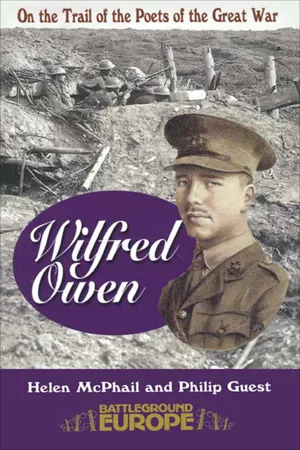
This is a guide to the battlefields that inspired the young and sensitive poet, whose poems are probably the twentieth century's best-known literary expressions of experience of war. Detailed maps, military diaries, photographs and modern roads guide the visitor through the battlefields. Owen's letters are used extensively, together with his poetry, linking specific places events, vividly describing the suffering of the trench.
Information
CONTENTS
Introduction by the Series Editor
Introduction
Biographical table
Chapter 1 The Unlikely Origins of an Officer
Chapter 2 The Real Thing
Chapter 3 ‘A Damned Fine Poet’
Chapter 4 Back to the Front Line
Chapter 5 The Canal at Ors
Bibliography
General Index
Poems
INTRODUCTION BY SERIES EDITOR
This is the first in a new type of Battleground Europe book – a look at an individual. Much has been written about the War Poets and other significant literary figures whose work was moulded to a considerable extent by their service in the ‘war to end all wars’. However, not so much has been written about their war service, and more particularly that of the unit in which they served. This books fills that gap, and places Owen’s writings firmly in the context of his war service. The traveller to the Western Front will be able to trace his routes, find some of his locations and visit the graves of many of his friends. The narrative outlines the battles and events that were to be reflected in his poetry; the authors do not make the mistake of assuming that his emotions were uniquely a consequence of what happened in the war but give enough information to be able to refer back to the formative memories of childhood and peacetime.
The War Poets have shaped the thinking of much of the population about the Great War – generations, now, of school pupils have studied them as part of one examination syllabus or another, as well as their having a wider, adult appeal. There has been a danger of having history ‘written by War Poet’, one of the consequences, possibly, of the fashionable trend of imbuing contemporary accounts with greater historical significance than is justified. Of course these accounts are important; of course these men, and the experiences they underwent, are a vital part of the historical legacy of the war. But they are only a part, and should not be overestimated in their significance. After all, ninety nine percent and more did not write War Poetry, and Owen’s writings, amongst others, were not all fashionable until the 1930s. I am reminded of a cartoon that portrays two soldiers in a trench, with shells and bullets flying all over the place. One says to the other words to the effect of, ‘Of course I should not be here at all. I am not a poet.’
That said, Owen’s poetry speaks to the emotions and it is founded on heart-rending experiences – not all of which he hated. This book, based as it is on the expertise of two people with great knowledge and feeling for Owen, places him firmly in his context and at the same time should ensure that many will come to some of the out-of-the-way places where Owen was in France and pay tribute not only to his memory but also to that of his fellow citizens who fell alongside him.
Nigel Cave,
Ely Place, London
Ely Place, London
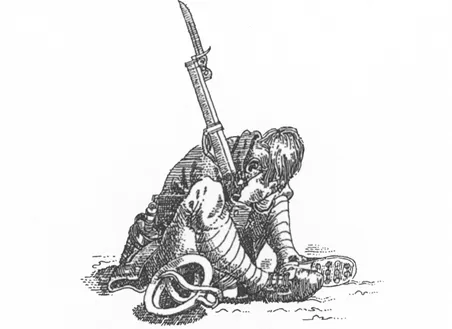
DULICE ET DECORUM EST
Bent double, like old under sacks,
Knock-kneed, coughing like hags, we cursed through shdge,
Till on the hawnting flares we turned our backs
And towards our distant rest began to tindge.
Men marched asleep. Many had lost their boots
But limped on, blood-shod. All went lame; all blind;
Drunk with fatigue; deaf even, to the hoots
Of tried, gas shells that dropped behind.
Knock-kneed, coughing like hags, we cursed through shdge,
Till on the hawnting flares we turned our backs
And towards our distant rest began to tindge.
Men marched asleep. Many had lost their boots
But limped on, blood-shod. All went lame; all blind;
Drunk with fatigue; deaf even, to the hoots
Of tried, gas shells that dropped behind.
Gas! Gas! Quick, boys! – An ecstasy of Fumbling,
Fitting the clumsy helmets just in tune:
But someone still was yelling out and stumbling
And floundering like a man in fire or line.…
Dim through the misty pances and thick green hight,
As under a green sea, I saw him drowning.
Fitting the clumsy helmets just in tune:
But someone still was yelling out and stumbling
And floundering like a man in fire or line.…
Dim through the misty pances and thick green hight,
As under a green sea, I saw him drowning.
In all my dreams, befor my helpless, sight,
He plunges at me, guttering, choking drowning.
He plunges at me, guttering, choking drowning.
If in some smothering dreams you, too could face
Behind the, wagon that we flung him in,
And watch the white eyes writhing in his face,
His hanging face, like a davil’s sick of sin;
If you, could hear, at every jolt, the blood
Come gagling from the froth corrupted lungs,
Obscenas cancer, bitter as the cud
Of wle, incurable sores on innocent tongues,–
My friend, you would not tell with such high zest
To children ardent for some desperate glory,
Behind the, wagon that we flung him in,
And watch the white eyes writhing in his face,
His hanging face, like a davil’s sick of sin;
If you, could hear, at every jolt, the blood
Come gagling from the froth corrupted lungs,
Obscenas cancer, bitter as the cud
Of wle, incurable sores on innocent tongues,–
My friend, you would not tell with such high zest
To children ardent for some desperate glory,
The old Lie: DULCE ET DECORUM EST
PRO PATRIA MORI.
INTRODUCTION
The poetry that came out of direct experience of the First World War is an unfailing source of literary interest, personal perception and creative understanding. It is also a source of straightforward information – about morale and relationships as well as events and reactions. Just as military reputations change over time, the pattern of literary taste and popularity, between what was best known in 1918 and what is widely admired (and taught in schools) many years later, develops and alters. The recognition of Wilfred Owen’s poetry as an essential voice of 1914–18 is one aspect among many that reflect modern attitudes to humanity and warfare.
The account in these pages is based firmly on Owen’s letters as well as his poetry, and on military sources – battalion diaries, regimental histories, trench maps, etc. Unlike many correspondents in the front line, Owen wrote vividly and honestly about what he saw and felt, and although his front-line experience was brief compared to the war years of many other officers, his personal reactions and emotion underlie his skill with the English language to recreate the past for us. Information is given at the end of each chapter on its specific relevant sources, but the book as a whole could not have been written without constant reference to the letters and poems. Details appear at the end of the book about these and other sources, and those who wish to investigate Owen’s life and work in greater depth will find plenty of further bibliographical detail in the material listed.
Thanks are due to a number of people who have helped and encouraged the production of this book. We are grateful to Messrs. Chatto & Windus for permission to quote from The Poems of Wilfred Owen, edited by Jon Stallworthy (1985), and to the Owen Estate and Oxford University Press for permission to quote from The Collected Letters of Wilfred Owen, edited by John Bell and Jon Stallworthy (1985).
Illustrations: Birkenhead Leisure, Birkenhead Library Services (pp.13, 120); M. Jules Delva, Ors (p.78); the family of John Foulkes (pp.87, 112, 116); Paul Gavin (p.21); the Imperial War Museum (pp.86, 108–109); David Jones (pp.7, 13, 122); the Manchester Museum Committee of the King’s Regiment (pp.46, 47, 93); The Ordnance Survey (p.50); Julian Putkowski (p.26); the Dean and Chapter of Ripon Cathedral (p.73); the family of Paul Seret (pp:55, 58, 99); Shrewsbury Abbey (p.15); Shropshire Records & Research (p.15); This England Books for pictures from ‘The Register of the Victoria Cross’ (pp.80, 113); Yorkshire Film Archive (p.72).
Biographical Table
| 1891 | 8 Dec. | Tom Owen marries Susan Shaw |
| 1893 | 18 March | Birth of Wilfred Owen, Plas Wilmot, Oswestry |
| 1895 | 30 May | Birth of Mary Owen |
| 1897 | 5 Sept. | Birth of Harold Owen |
| 1897 | The family moves to Birkenhead | |
| 1900 | 24 July | Birth of Colin Owen |
| 1906 | The family moves to Shrewsbury | |
| 1911 | Wilfred Owen becomes lay assistant at Dunsden | |
| 1913 | Feb. Leaves Dunsden, returns home, ill | |
| S... |
Table of contents
- Cover
- Half Title
- Series
- Title Page
- Copyright
- Contents
Trusted by 375,005 students
Access to over 1.5 million titles for a fair monthly price.
Study more efficiently using our study tools.
Frequently asked questions
Yes, you can cancel anytime from the Subscription tab in your account settings on the Perlego website. Your subscription will stay active until the end of your current billing period. Learn how to cancel your subscription
No, books cannot be downloaded as external files, such as PDFs, for use outside of Perlego. However, you can download books within the Perlego app for offline reading on mobile or tablet. Learn how to download books offline
Perlego offers two plans: Essential and Complete
- Essential is ideal for learners and professionals who enjoy exploring a wide range of subjects. Access the Essential Library with 800,000+ trusted titles and best-sellers across business, personal growth, and the humanities. Includes unlimited reading time and Standard Read Aloud voice.
- Complete: Perfect for advanced learners and researchers needing full, unrestricted access. Unlock 1.5M+ books across hundreds of subjects, including academic and specialized titles. The Complete Plan also includes advanced features like Premium Read Aloud and Research Assistant.
We are an online textbook subscription service, where you can get access to an entire online library for less than the price of a single book per month. With over 1.5 million books across 990+ topics, we’ve got you covered! Learn about our mission
Look out for the read-aloud symbol on your next book to see if you can listen to it. The read-aloud tool reads text aloud for you, highlighting the text as it is being read. You can pause it, speed it up and slow it down. Learn more about Read Aloud
Yes! You can use the Perlego app on both iOS and Android devices to read anytime, anywhere — even offline. Perfect for commutes or when you’re on the go.
Please note we cannot support devices running on iOS 13 and Android 7 or earlier. Learn more about using the app
Please note we cannot support devices running on iOS 13 and Android 7 or earlier. Learn more about using the app
Yes, you can access Wilfred Owen by Helen McPhail,Philip Guest in PDF and/or ePUB format, as well as other popular books in History & Military & Maritime History. We have over 1.5 million books available in our catalogue for you to explore.