"Meticulously researched and beautifully illustrated . . . indispensable to anyone interested in the era." —Tasha Alexander,
New York Times–bestselling author of the Lady Emily series
What did a Victorian lady wear for a walk in the park? How did she style her hair for an evening at the theater? And what products might she have used to soothe a sunburn or treat an unsightly blemish?
USA Today-bestselling author Mimi Matthews answers these questions and more as she takes readers on a decade-by-decade journey through Victorian fashion and beauty history.
Women's clothing changed dramatically during the course of the Victorian era. Necklines rose, waistlines dropped, and Gothic severity gave way to flounces and frills. Sleeves ballooned up and skirts billowed out. The crinoline morphed into the bustle and steam-molded corsets cinched women's waists ever tighter. As fashion evolved, so too did trends in ladies' hair care and cosmetics. An era which began by prizing natural, barefaced beauty ended with women purchasing lip and cheek rouge, false hairpieces and pomades, and fashionable perfumes.
Using research from nineteenth-century beauty books, fashion magazines, and lady's journals, the author of the Parish Orphans of Devon series brings Victorian fashion into modern day focus—and offers a glimpse of the social issues that influenced women's clothing and the outrage that was a frequent response to those bold females who used fashion and beauty to assert their individuality and independence.
"An elegant resource that I will be reaching for again and again."—Deanna Raybourn,
New York Times-bestselling author of the Veronica Speedwell novels
- 168 pages
- English
- ePUB (mobile friendly)
- Available on iOS & Android
eBook - ePub
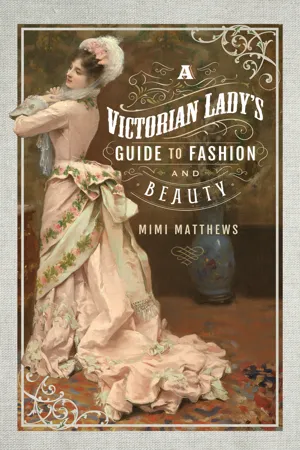
A Victorian Lady's Guide to Fashion and Beauty
About this book
Information
PART I
Fashion
Chapter 1
The 1840s
‘Although the present styles of toilette partake of the purest elegance, they are divested of all unnecessary and gorgeous decorations.’
Blackwood’s Lady’s Magazine, 1843.
The 1840s ushered in a decade of women’s gowns designed in what some nineteenth century historians describe as the ‘Victorian Gothic’ style.1 Gone were the sloping shoulders and enormous gigot sleeves (also known as leg-o’-mutton sleeves) which characterized the romantic silhouettes of the late 1820s and early to mid-1830s. In their place were pointed bodices, dome-shaped skirts, and long, tight sleeves which made it impossible for a lady to raise her arms above her head.
These were fashions designed for women who were expected to be dependent on those around them. Though a young and eventually transformative queen had ascended the British throne in 1837, ordinary women of the 1840s had very little freedom of their own. They were constrained not only by their clothing, but by the suffocating rules of society. This was especially true for those ladies of the middle and upper classes. For most of them, marriage and children were the ultimate goal. Work outside the home was discouraged, as was participation in competitive sports like golf or tennis.
Instead, women engaged in more restrained and ladylike pursuits such as needlework, painting, or playing the piano. They wrote letters, volunteered for charitable causes, and went shopping or for walks. Those women who wished for more strenuous exercise—and had the means to afford it—could also go horseback riding, garbed in riding costumes that were as restrictive and cumbersome as the rest of their clothing.
The 1840s Silhouette
At the beginning of the decade, women’s dresses were angular and severe. Gowns were set low on the shoulder with sleeves worn long and tight to the arm. Some sleeves of this type featured a small frill, cap-piece, or puff near the shoulder. The bishop style of sleeve was also considered quite fashionable. It was pleated at the shoulder and became fuller as it extended down to the wrist where it was gathered into a cuff.

Dresses of the early 1840s had low set shoulders and long, tight-fitting sleeves. (Women’s Morning and Dinner Dresses, 1840. Thomas J. Watson Library, Metropolitan Museum of Art.)
Bodices of the 1840s were long and tight-fitting, coming to a distinct point at the waist. They generally fastened at the back with buttons, laces, or hooks, making it difficult for a lady to dress and undress without assistance. In ladies’ magazine of the day, a bodice was often referred to as a corsage. At the time, it was an accepted practice to call various elements of a woman’s dress by the French name. Thus, a bodice became a corsage, a waistcoat became a gilet, and heart-shaped necklines were described as being cut en coeur or ‘of the heart’.2
Some bodices had loosely folded, ruched, or plaited fabric down the front in a fan or V-shape. Others were accented with a ribbon sash or a narrow belt made of velvet. An 1842 edition of Godey’s Lady’s Book reports that velvet belts were generally ‘of a darker tint than the dress’ and were secured in front with either a loop-bow, a brooch, or ‘a small elegant buckle’.
Skirts were fairly plain, but as the decade progressed they began to grow larger. Much of their increase in size was owed to a new method of setting the skirts, called gauging. An 1841 edition of the Ladies’ Cabinet of Fashion, Music, and Romance claims that gauging was ‘highly advantageous to the shape.’ It consisted of:
‘The top of the skirt, not quite half a quarter in depth, being gauged so as to sit flat round the hips; this mode of confining the excessive fullness of the skirt, at once displays and forms the shape in much more graceful manner than the present mode of setting it on.’
To accommodate the fuller style of skirt, a bustle was introduced. Unlike the more dramatic wire cage bustles of the late Victorian era, the 1840s bustle was simply a padding of wool. This bustle pad was tied on round the waist and placed on the back of the hips, serving to give large skirts an even more pronounced dome-shape.
Another innovation of the early 1840s was the dress with two interchangeable bodices. This allowed a lady to have one bodice for daywear and one for eveningwear. Evening bodices were more revealing than day bodices. They were generally cut wide and low off the shoulder. For modesty, many ladies chose to cover the exposed portion of their skin with a lace bertha collar. A bertha was a wide, flat, round collar that covered the neck and shoulders. Berthas were also worn with day dresses and could be made of the same material as a woman’s gown.
In evening dress, sleeves were short or elbow-length. For daywear, short sleeves were fairly uncommon until 1842 when, as the Court, Lady’s Magazine, Monthly Critic and Museum reports:
‘We have decidedly triumphed over our natural antipathy to short sleeves, for we wear them at all times now … although there is not much sublimity in either short or long sleeves, yet after the long war, that we waged against the former, except in ball costume it seems rather ridiculous to see them so generally.’
Ball dresses of the early 1840s were made of crepe, tulle, or organdie, with under-skirts of silk or satin. The 1841 edition of the Ladies’ Cabinet of Fashion, Music, and Romance reports:
‘Those that we have seen had the corsages pointed at bottom, cut low, and draped round the top. The sleeves were very short, and either terminated by bouillons or ruches, and the skirt raised at the right side in front, and at the left at the back by a knot of ribbon or a gold agraffe.’
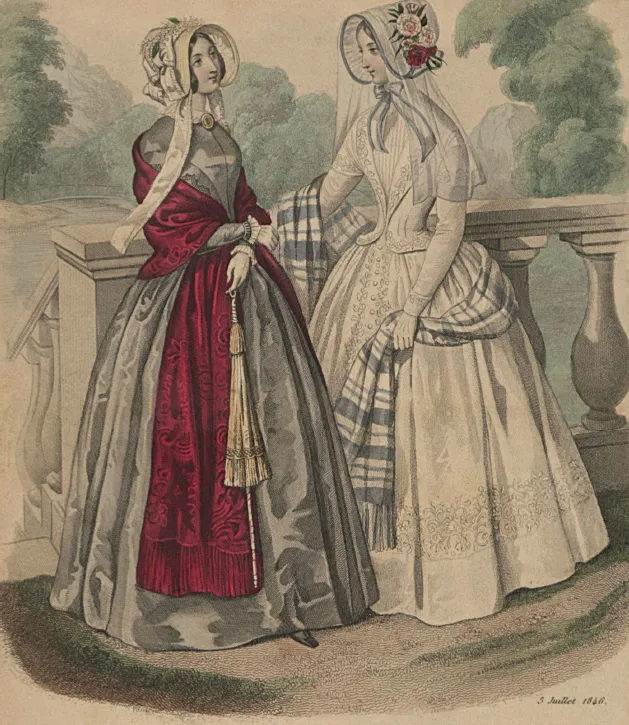
Gauging at the waist resulted in fuller, dome-shaped skirts. (La Mode, July 1846. Thomas J. Watson Library, Metropolitan Museum of Art)
Though light fabrics like crepe and organdie remained fashionable for ball gowns, it was in the 1840s that the rich, heavy fabrics that we now associate with the Victorian era were beginning to come into fashion. According to an 1843 edition of Godey’s Lady’s Book, new materials for dresses included:
‘Silks with a very narrow satin stripe – shaded or changeable satins – double levantines – or thick twilled silks – Scotch plaid velvets – oriental velvets – gros de Tours – embroidered India muslins – and very rich white Thibets damasked with satin flowers.’
The use of luxurious fabrics even extended to those dresses worn for lounging around at home. For example, the 1844 edition of Godey’s Lady’s Book includes a fashion plate depicting a morning dress made of white cashmere ‘trimmed with a facing of pink’ and worn with a ‘cap of light spotted lace, decorated with roses.’
By the mid-1840s, the Gothic silhouette was at last beginning to soften. The focus of women’s fashion shifted downward toward the skirts where the voluminous fabric was embellished with elaborate trimmings, including lace, fringe, flounces, scallops, frogging, and ornamental buttons and bows. Meanwhile, rounded waists were gradually becoming more acceptable, though pointed waists still prevailed in the most fashionable gowns.
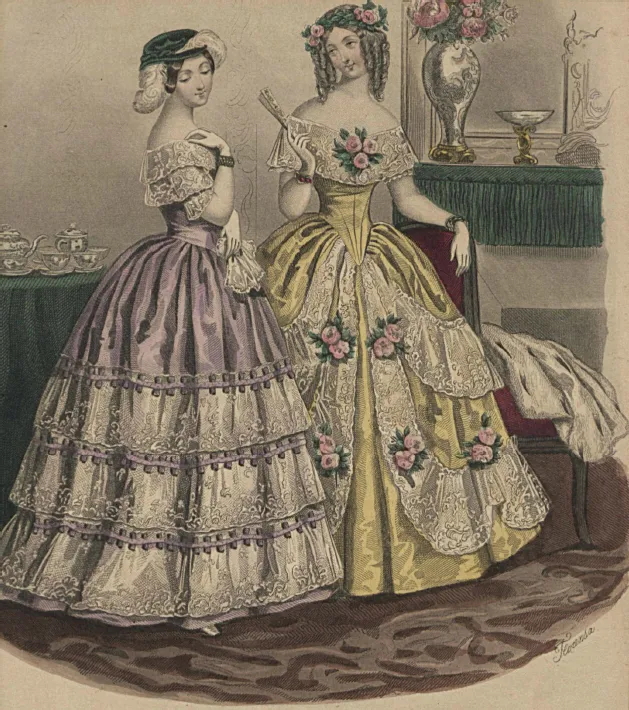
For eveningwear, necklines were low, sleeves were short, and skirts were often trimmed with lace and flowers. (La Mode, 1847. Thomas J. Watson Library, Metropolitan Museum of Art)
For eveningwear, necklines were low and cut either straight across or en coeur, with a slight dip at the centre. Sleeves were short and, along with necklines, were often trimmed with lace or tulle. At the same time, skirts were becoming increasingly elaborate. An 1846 edition of the New Monthly Belle Assemblée describes the current styles in skirts for evening dress, stating:
‘Some satin robes, made with double skirts, have the upper one trimmed with lace. Some of the most novel of these dresses have the lace very broad, and looped on one side by a bouquet of flowers, or an ornament of jewelry.’
This did not mean that plain dresses had fallen out of favour. For daywear, simpler gowns with subdued flounces and trimmings were still quite popular. They were also much more affordable since the cost of trimmings – such as lace, ribbons, and fringe – could add up to a tidy sum.
As the decade came to a close, long, tight sleeves began to loosen into a funnel or bell shape, foreshadowing the much larger pagoda sleeves that would appear in the 1850s. Skirts, which had become markedly fuller with each passing year, now required so much fabric that the material could no longer be gauged to the waist. Instead, it was once again pleated and gathered.
The overall silhouette was a far cry from the romantic 1830s, but the angular severity of the Victorian Gothic gown was at last showing glimpses – especially in the sleeves and the skirts – of what women’s fashion would bring in the coming decades.
Undergarments: Corsets and Petticoats
The severe silhouette of the 1840s owed much to sturdy undergarments. These generally included a loose, knee-length cotton or linen chemise with short sleeves, a pair of cotton or linen drawers, a corset and corset cover, a bustle pad and several stiffened petticoats. The corset and petticoats were, perhaps, the most significant of these undergarments in terms of creating an 1840s shape. Without them, a woman could never hope to achieve the pronounced, hourglass figure so coveted in fashion of the time.
Corsets of the 1840s were gradually evolving from the longline, corded stays with shoulder straps that many ladies wore in the early nineteenth century to the shorter, more waist-constricting corsets worn by women in the 1850s and 1860s. Unlike the earlier stays, these corsets were often strapless and extended from the bosom to the hip. They were typically made of boned cotton or silk with laces in the back and a busk made of wood, whalebone, or steel inserted down the centre front to provide additional support.
As the century progressed, the wooden or whalebone busk at the front of the corset was replaced with a divided busk of steel which was set with a row of hooks and eyes. This allowed ladies a modicum of independence. They could now take their corset on and off without calling for the assistance of a maid or helpful family member.
Petticoats of the 1840s were another invaluable underpinning. Some were decorative satin, crepe, or tulle, made to be seen when an overskirt was drawn up or back. Others were strictly for shape and support. These were usually made of starched cotton or linen and could be quilted or corded to provide additional structure. Some stiffened petticoats were made out of horsehair and linen. These were called crinolines after the French words for horsehair (crin) and linen (lin). Crinolines would remain a popular—and sometimes controversial—undergarment for many decades to come.
Millinery: Poke Bonnets, Capotes, and Lace Matron’s Caps
A Victorian lady never ventured outdoors without first putting on her bonnet. In the 1840s, poke bonnets were quite fashionable. Designed with a small crown and a wide, rounded brim that projected forward over the face, poke bonnets were often made of straw and trimmed with crepe, gauze, silk ribbons, feathers, or flowers. A soft-crowned style of bonnet, known as the capote, was also very much in fashion. Capotes were low and close fitting with rigid, round brims. They could be made from a range of materials, including straw, crepe, and velvet, and were frequently trimmed with lace, gauze, feathers, and flowers. In addition to trimmings on the outside, both poke bonnets and capotes were also sometimes trimmed on the interior brim with quilled lace, tulle, or small tufts of flowers.
When at home, Victorian matrons and spinsters donned caps made of delicate lace, fine muslin, or knit or crocheted cotton. Some caps had long lappets falling down on either side. Some were ornamented with ribbons or flowers. For December of 1846, the New Monthly Belle Assemblée reports:
‘The prettiest caps for very youthful matrons are of a very small size; they are composed of rows of blond or lace, each divided by a very small wreath of red clematis: this style of garniture has the effect of the hair being strewed with flowers.’
Unmarried young ladies were discouraged from wearing lace caps indoors. However, if they were over the age of twenty-seven and still unwed, they were considered to have entered the realm of spinsterhood, thus making a demure lace cap appropriate for indoor wear.
Footwear: ...
Table of contents
- Cover
- Dedication
- Title
- Copyright
- Contents
- Acknowledgments
- Introduction
- PART I Fashion
- Part II: Fashion Etiquette; or What to Wear and When to Wear It
- Part III: Beauty
- The End of an Era
- Sources
- Notes
Trusted by 375,005 students
Access to over 1.5 million titles for a fair monthly price.
Study more efficiently using our study tools.
Frequently asked questions
Yes, you can cancel anytime from the Subscription tab in your account settings on the Perlego website. Your subscription will stay active until the end of your current billing period. Learn how to cancel your subscription
No, books cannot be downloaded as external files, such as PDFs, for use outside of Perlego. However, you can download books within the Perlego app for offline reading on mobile or tablet. Learn how to download books offline
Perlego offers two plans: Essential and Complete
- Essential is ideal for learners and professionals who enjoy exploring a wide range of subjects. Access the Essential Library with 800,000+ trusted titles and best-sellers across business, personal growth, and the humanities. Includes unlimited reading time and Standard Read Aloud voice.
- Complete: Perfect for advanced learners and researchers needing full, unrestricted access. Unlock 1.5M+ books across hundreds of subjects, including academic and specialized titles. The Complete Plan also includes advanced features like Premium Read Aloud and Research Assistant.
We are an online textbook subscription service, where you can get access to an entire online library for less than the price of a single book per month. With over 1.5 million books across 990+ topics, we’ve got you covered! Learn about our mission
Look out for the read-aloud symbol on your next book to see if you can listen to it. The read-aloud tool reads text aloud for you, highlighting the text as it is being read. You can pause it, speed it up and slow it down. Learn more about Read Aloud
Yes! You can use the Perlego app on both iOS and Android devices to read anytime, anywhere — even offline. Perfect for commutes or when you’re on the go.
Please note we cannot support devices running on iOS 13 and Android 7 or earlier. Learn more about using the app
Please note we cannot support devices running on iOS 13 and Android 7 or earlier. Learn more about using the app
Yes, you can access A Victorian Lady's Guide to Fashion and Beauty by Mimi Matthews in PDF and/or ePUB format, as well as other popular books in History & Fashion Design. We have over 1.5 million books available in our catalogue for you to explore.