- 352 pages
- English
- ePUB (mobile friendly)
- Available on iOS & Android
eBook - ePub
The Secret War
About this book
A look at the scientists and technicians whose hard work off the battlefield assisted the Allied Forces in winning World War II.
Based on the BBC television documentary series of the same name, this book offers a behind-the-scenes look at the fight by the "back room" scientists and technicians of the Second World War, including the battles against the Luftwaffe navigational beams, the V-1 and V-2 flying bombs, the development of radar, the battle against the U-boats, countering the magnetic mine, and the breaking of the codes produced by the Enigma machines.
Based on the BBC television documentary series of the same name, this book offers a behind-the-scenes look at the fight by the "back room" scientists and technicians of the Second World War, including the battles against the Luftwaffe navigational beams, the V-1 and V-2 flying bombs, the development of radar, the battle against the U-boats, countering the magnetic mine, and the breaking of the codes produced by the Enigma machines.
Trusted by 375,005 students
Access to over 1 million titles for a fair monthly price.
Study more efficiently using our study tools.
Information
CONTENTS
Introduction – A Letter from Oslo
1 The Battle of the Beams
2 Radar
3 Terror Weapons
4 The Battle of the Atlantic
5 Misfortunes of War
6 Enigma
Notes
Picture Credits
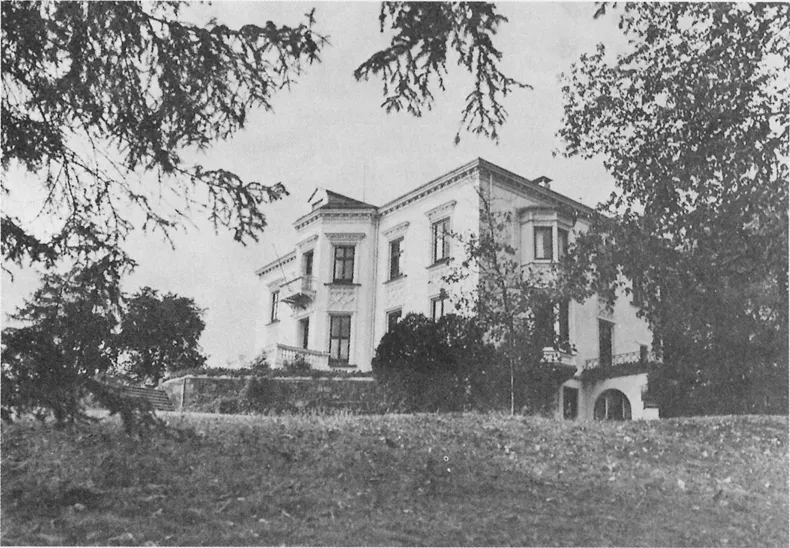
The British Consulate in Oslo.
INTRODUCTION: A LETTER FROM OSLO
On 19 September 1939 in a speech in Danzig Hitler boasted of fearsome secret weapons against which Germany’s enemies would be defenceless. Confirmation of the development of at least some of that arsenal was soon to come from a most unexpected source – Germany – in what must rate as one of the most incredible windfalls even in the long history of espionage. In the small hours of 5 November 1939 a parcel was left on a window-ledge of the British Consulate in Oslo, in what was still neutral Norway. Addressed to the Naval Attaché, it contained several pages of German typescript and a small electronic device which, when examined in London by Dr R. V. Jones, of Air Ministry Scientific Intelligence, proved to be an early proximity fuse for an anti-aircraft shell and was clearly included to authenticate the much more important typescript. Subsequently known as the Oslo Report, this set out the scope of German military scientific research, including such highly classified information as the identity of Peenemunde as an important research centre.
The Junkers 88, the Luftwaffe’s new secret wonder plane, the correspondent stated, was to be used as a high-speed dive bomber – a fact unknown in Britain. He detailed German radar developments and confirmed that radar had been instrumental in directing fighters to a squadron of Wellington bombers that had been decimated on a raid on Wilhelmshaven. He explained the working of a German night-bomber radio aid, which later became known as the Y-Geräte and which was to figure in the soon-to-be-fought Battle of the Beams. The report also significantly outlined German rocket development.
The letter was simply signed ‘A German scientist who wishes you well’. His identity has never been established, but he must have been highly placed. In London many sceptics rejected the authenticity of the document, and others claimed it to be a plant – a propaganda exercise to undermine moral. Jones did not subscribe to these views, considering the document to be genuine; indeed, he later said that ‘during the few quiet moments of the war I used to turn up the Oslo Report to see what was coming next’.
The Oslo Report was a clear warning that the war was to be a struggle as much between scientists as fighting men – a war which Britain, uncharacteristically, was well placed to fight. This was due in no small measure to the decision taken in 1938 to compile a register of some 5000 scientists. Thus highly capable men from universities and industry were ready to form the nucleus of a formidable army that was to wage a strange electronic war of secrets.
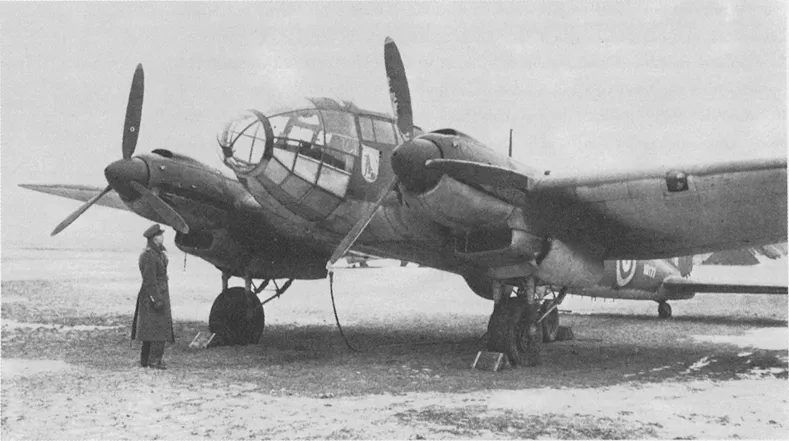
This He 111, forced down early in the war comparatively undamaged, was repaired and test-flown by the RAF. Although it carries RAF markings, it still retains the unit emblem of its late owners – Kampfgeschwader 26. It was possibly from this machine that RAF Intelligence Officers salvaged the scrap of paper which gave the first clue to ‘Knickebein’ whose aerials can be seen underneath the fuselage just to the left of the roundel.
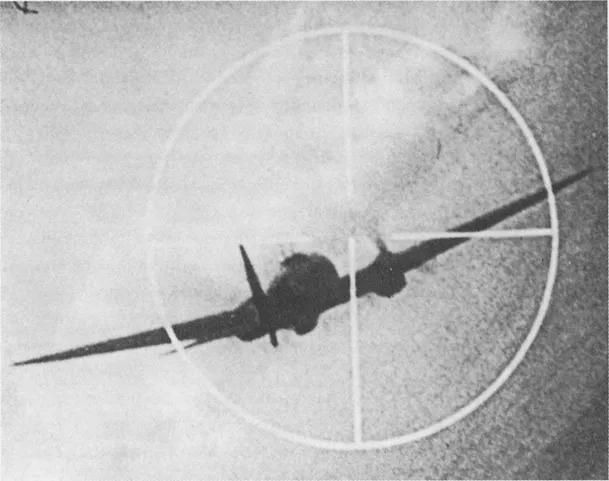
A fighter pilot’s view of an He 111. Like most German bombers in 1940, the Heinkel’s defensive armament was inadequate against Spitfires and Hurricanes. Although still handicapped then by lack of airborne radar, RAF night fighters nevertheless shot down several bombers on visual interception.
1. THE BATTLE OF THE BEAMS
In the early months of 1940, the German Air Force, the Luftwaffe, began to fly night bombers over the blacked-out towns and countryside of Britain: not the massed formations that had been feared but single aircraft which appeared to be probing night defences – which incidentally were at that time practically non-existent. However, one night in March 1940 one of these nocturnal wanderers, plotted by ground radar, was intercepted by a night fighter which made a lucky visual contact and shot it down.
The crashed aircraft, a Heinkel 111, bore the marking ‘1H + AC’ which identified its unit as Kampfgeschwader (Bomber Group) 26. It was, as a matter of routine, examined by RAF Technical Intelligence Officers; the examination must have been thorough, for salvaged from the wreckage was a scrap of paper which seemed to have been an aide-mémoire for the navigator. In translation it read:
‘Navigational aid: Radio Beacons working on Beacon Plan A. Additionally from 0600 hours Beacon Dühnen. Light Beacon after dark. Radio Beacon Knickebein from 0600 hours on 315°.’1†
The importance of the fragment was the reference to ‘Radio Beacon Knickebein’ – it was the first time that this code-name had been mentioned and the fact that it was given a bearing indicated some sort of directional beam.
By coincidence, soon after that another Heinkel 111 was shot down with the identical markings 1H + AC – it must have been a replacement aircraft for KG26’s earlier loss. This too carried compromising literature – a diary kept by one of the aircrew, which had an entry:
‘5.3.40. Two thirds of the Staffel [Squadron] on leave. In afternoon studied about Knickebein, collapsible boats, etc.’1
‘Knickebein’ literally means ‘crooked leg’, although it is also the name of a magic raven in a German fairy story. Clearly it was necessary to find out more about this secret device. An obvious and time-honoured method of discovering one’s enemy’s secrets is in the interrogation of prisoners.
Many German aircrew prisoners of war were to some extent victims of their own propaganda; they had been led to believe that if they were captured they would be either shot out of hand or, at the very least, tortured. They were not therefore prepared for the highly skilled and civilised interrogation which they received from Squadron Leader Felkin of Air Intelligence 1(k) at Trent Park, Cockfosters, north of London. During the course of one interrogation, Squadron Leader Felkin questioned a prisoner about Knickebein: the man hedged, then conceded that ‘it was like “X-Geräte”’, adding that a shortwave beam was used, ‘which would not be more than a kilometre wide over London’.1
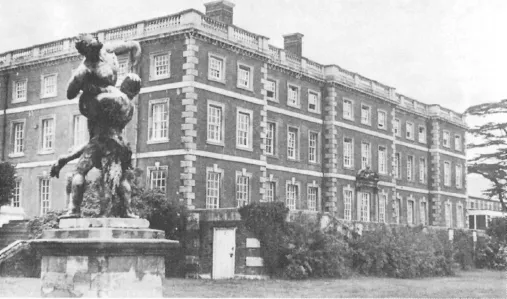
Trent Park, the main interrogation centre for captured Luftwaffe aircrew. Today it is a Teachers’ Training College.
This was not the first time that prisoners had made reference to ‘X-Geräte’ although it was the first time it had been coupled with Knickebein. An earlier Intelligence report dated 4 March 1940 stated:
‘The X-Geräte is a bombing apparatus involving an application of pulse radio technique [with]… a system of intersecting radio beams from German transmitters, so that a small area of intersection occurs in which the characteristic signals of two stations combine and give a signal which might even be made to operate the bomb release gear automatically.’1
The evidence had been passed to Dr (now Professor) R. V. Jones, of Air Scientific Intelligence, who after considering the available information felt that, although far from conclusive, there was a strong enough case for him to include it in his report, ‘Indications of New German Weapons to be used against England’:
‘It is possible that they have developed a system of intersecting beams, so that they can locate a target such as London with sufficient accuracy for… indiscriminate bombing. No information is available concerning the wavelength to be employed, but the accuracy of location expected by the Germans is something like a half metre† over London from the Western frontier of Germany. Efforts are still being made to determine the probable wavelengths so that counter measures can be employed.’2
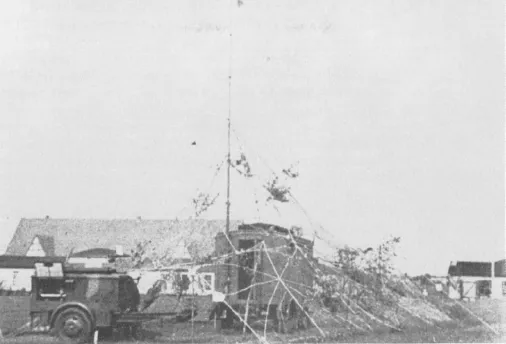
A German field radio station. The Luftwaffe relied heavily on radio communications, especially in occupied countries where telephone lines were unreliable or nonexistent. Enigma was used to encode the signals.
The report had been written on 23 May. The German Air Force had already begun to raid Britain at night and it was thought by Air Intelligence that the bombers might well be using a beam system such as had been outlined in Jones’s report, but it was at that time very difficult to obtain further information about Knickebein. The Germans had by now occupied the Low Countries and most of France; Dunkirk was only days away. It was hardly the ideal time for the recruitment of agents. However, the next vital clue in the Knickebein puzzle was to come from the Germans themselves.
The speed of the German advance had meant that the forward units of the Luftwaffe, already using bases in Northern France in preparation for the expected invasion of Britain, could only keep in touch with their headquarters by radio. Orders were transmitted in the supposedly unbreakable Enigma Code: one such message was sent on 5 June to the Chief Signals Officer of Fliegerkorps IV and, as the five-letter groups were being decoded by the Luftwaffe cipher clerks, the intercepted signal was also being processed at Bletchley Park, England.
The story of the penetrating of the Enigma code forms the subject of chapter 6; sufficient for the moment to say it was broken and the message to Fliegerkorps IV, one of the earliest decodes, was sent to Group Captain Blandy of the RAF ‘Y’ Service, the department of Air Intelligence responsible for the monitoring of Luftwaffe radio traffic.
The decoded message read:
‘Knickebein, Kleve, is established [or confirmed: the German is ambiguous here] at a point 53°24′ North and 1° West.’ (‘Knickebein, Kleve, ist auf punkt 53 grad 24 minuten Nord und ein grad West eingerichtet.’)1
This meant nothing to anyone else in the Air Ministry, but Group Captain Blandy luckily passed it to Dr Jones. It was the vital clue for which he had been waiting. ‘Knickebein’ he already knew as the codename of a suspected beam system; Kleve is the German spelling of Cleves (the town from which Anne of Cleves came), which was significantly the westernmost point in Germany, and therefore a likely site for a beam transmitter intended to cover England. 53°24′ North 1° West is in England; it is a point in open country near Retford, roughly where the Great North Road, the old A1, crosses the 1° West Meridian.
Jones concluded that the simplest interpretation was that a navigational aircraft had been out and located where the beam was on that particular occasion. The beam position may well have been intended for Sheffield and a reconnaissance aircraft had established that it was off target, hence the reason for sending the message in the first place. By way of confirmation, it had been established that Fliegerkorps IV’s bomber units were KG4 and KG27, equipped with Heinkel 111s, and their aircraft were known to have been over England on the night of 5 June, the date of the original Enigma message. (Before Jones had seen the decode, incidentally, others at the Air Ministry had taken it to mean that an illicit radio beacon was being operated near the Great North Road: a search party found nothing there or in the surrounding farms, which were also searched, much to the disappointment of the local police who had hoped to catch a German spy red-handed.)
In a report, Jones summarised this new Intelligence:
‘…that the Germans possessed some method of establishing intersections over England, known as Knickebein; and that such intersections could be observed by means of equipment carried in Heinkel 111s. Moreover the accuracy of intersection was 1 minute, or roughly 1 mile square…. It is impossible [he concluded] to rate this independent contribution too highly.’1
The meeting with Group Captain Blandy had been in the morning of 12 June 1940. That afternoon, Jones had another appointment: this one with Professor F. A. Lindemann, his old Oxford tutor, now Scientific Adviser to the Prime Minister, Winston Churchill.
Lindemann had not seen the Enigma intercept so it was something of a co...
Table of contents
- Cover
- Half Title Page
- Title Page
- Copyright Page
- Contents
Frequently asked questions
Yes, you can cancel anytime from the Subscription tab in your account settings on the Perlego website. Your subscription will stay active until the end of your current billing period. Learn how to cancel your subscription
No, books cannot be downloaded as external files, such as PDFs, for use outside of Perlego. However, you can download books within the Perlego app for offline reading on mobile or tablet. Learn how to download books offline
Perlego offers two plans: Essential and Complete
- Essential is ideal for learners and professionals who enjoy exploring a wide range of subjects. Access the Essential Library with 800,000+ trusted titles and best-sellers across business, personal growth, and the humanities. Includes unlimited reading time and Standard Read Aloud voice.
- Complete: Perfect for advanced learners and researchers needing full, unrestricted access. Unlock 1.4M+ books across hundreds of subjects, including academic and specialized titles. The Complete Plan also includes advanced features like Premium Read Aloud and Research Assistant.
We are an online textbook subscription service, where you can get access to an entire online library for less than the price of a single book per month. With over 1 million books across 990+ topics, we’ve got you covered! Learn about our mission
Look out for the read-aloud symbol on your next book to see if you can listen to it. The read-aloud tool reads text aloud for you, highlighting the text as it is being read. You can pause it, speed it up and slow it down. Learn more about Read Aloud
Yes! You can use the Perlego app on both iOS and Android devices to read anytime, anywhere — even offline. Perfect for commutes or when you’re on the go.
Please note we cannot support devices running on iOS 13 and Android 7 or earlier. Learn more about using the app
Please note we cannot support devices running on iOS 13 and Android 7 or earlier. Learn more about using the app
Yes, you can access The Secret War by Brian Johnson in PDF and/or ePUB format, as well as other popular books in History & World War II. We have over one million books available in our catalogue for you to explore.