eBook - ePub
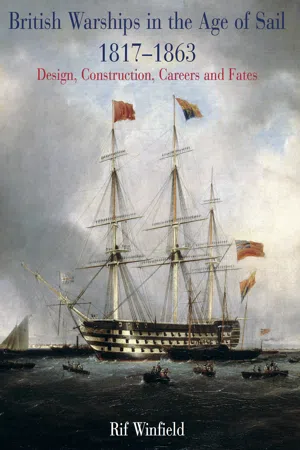
British Warships in the Age of Sail, 1817–1863
Design, Construction, Careers and Fates
- 414 pages
- English
- ePUB (mobile friendly)
- Available on iOS & Android
eBook - ePub
About this book
The publication of this book sees the completion of a monumental work listing the technical details and career histories of every significant British warship between 1603 and 1863. Following three earlier volumes, this one carries forward the story from the post-Napoleonic War reorganisation of the Royal Navy's rating system to the end of sail as the principal mode of propulsion. Although apparently well documented, this is a period of great complexity in the procurement and naval architecture of ships. The introduction of steam radically altered the design of vessels under construction and was later retro-fitted to others, while many 'names' lived a ghostly existence on the Navy List: ships ordered but not started, and in some cases having their intended draughts altered more than once before being cancelled entirely.This book meticulously sorts out and clarifies these confusions a major contribution in itself but for the first time it also provides outline service histories for an era that is largely neglected. Like its companion volumes, the book is organised by Rate, classification and class, with significant technical and building data, followed by a concise summary of the careers of each ship in every class. With its unique depth of information, this is a work of the utmost importance to every naval historian and general reader interested in the navy of the sailing era and the formative years of the steam navy that supplanted it.
Information
1 First Rates of 104 guns and above
The prestige ships of the British (or any) Navy were the three-deckers, carefully and lavishly built, always in Royal Dockyards and requiring many years work. Rarely commissioned in peace-time, and preserved with expensive overhauls (‘refits’) and rebuilding, the few First Rates served as flagships for the main fleets in the Channel and Mediterranean, but their great strength made them the strongest units of the line of battle. Nevertheless they were difficult to handle, drew much water, and the pre-war vessels had such low freeboard to their gunports that in anything of a lively sea their lower decks were liable to flooding in battle. Only with the 120-gun Caledonia – the first of a numerous class of capital ship – did fine sailing qualities become compatible with superior firepower, and this success led the new controller (Byam Martin) to determine that all future three-deckers should follow this model.
(A) Vessels in service or on order on 1 January 1817
At the close of 1816 there had been nine First Rates in existence – five of 120 guns, two of 112 guns and two of 100 guns; another five were under construction as follows:

This situation was altered by the changes in the rating system which came into effect in January 1817, although the 120-gun ships were unaffected. While the Ville de Paris and San Josef remained as 112-gun ships, the still-building Princess Charlotte and London (most materials for their frames had been assembled) were altered from 112 guns to 110, the Royal George and Queen Charlotte from 100 guns to 108, and the Trafalgar to 106 guns. Most significantly, all the remaining fourteen Second Rates (see Chapter 2) were now re-classed as First Rates, which thus encompassed all twenty-eight of the Navy’s three-deckers – the Ocean (1805) was now classed as 110 guns, the Impregnable (1810) as 106 guns, and the Saint George (1762), Victory (1765), Barfleur (1768), Royal Sovereign (1786), Glory (1788), Prince (1788), Prince of Wales (1794), Neptune (1797), Temeraire (1798), Dreadnought (1801), Boyne (1810) and Union (1811) all as 104 guns. The Neptune and Temeraire were in need of repairs (the former was BU in 1818, while the latter was reduced to harbour service since 1813).
ROYAL GEORGE Class 104 guns. Originally built as the Britannia, this ship was ordered in 1751 to be built strictly to the 1745 Establishment dimensions, but allowing some variations in the design from those specified in the Establishment; on 21 May 1757 this was amended to have her built instead to the draught of the Royal George, the Woolwich-built vessel (which foundered 29 August 1782 at Spithead). She had been renamed in 1812 to allow the name Britannia to be allotted to a new Caledonia-class 120-gun ship.
Dimensions & tons: 178ft 0in, 144ft 6½in x 51ft 10in x 21ft 6in. 2,06558/94bm.
Men: 850. Guns: (originally) LD 28 x 42pdrs; MD 28 x 24pdrs; UD 28 x 12pdrs; QD 12 x 6pdrs; Fc 4 x 6pdrs. Britannia’s 42pdrs were replaced before 1793 by 32pdrs, and her 6pdrs by 12pdrs by AO 3.6.1790; in the 1790s she fitted 12 x 32pdr carronades in place of all 12pdrs except 2 each on QD and Fc.
Saint George Portsmouth Dyd [M/Shipwright Pierson Lock to 12.1755, Edward Allin to 5.1762, completed by Thomas Bucknall]
As built: 178ft 0in, 145ft 2in x 52ft 0½in x 21ft 6in. 2,09126/94bm. Draught 13ft 6in/18ft 6in.
Ord: 28.3.1751. K: 1.7.1751. L: 19.10.1762.
First cost: £41,729.7.1d (with extra charges up to 1764, total £45,844.2.8d).
Underwent Small Repair at Portsmouth (for £6,371.11.11d) 4–8.1772. Fitted at Portsmouth for Channel service (for £15,597.16.0d) 6.1778–4.1779.
Commissioned 8.1779 as Britannia under Capt. Charles Morice Pole, as flagship of Vice-Adm. George Darby 4.1779 then 6.1779 Rear-Adm. Sir John Lockhart Ross. Coppered at Portsmouth 1.1780; in 9.1780 under Capt. James Bradby, then 4.1782 Capt. Benjamin Hill; paid off into Ordinary 2.1783. Between Middling and Great Repair at Portsmouth (for £35,573) 5.1788–9.1790. Recommissioned 1.1793 under Capt. John Holloway (–1796), as flagship of Vice-Adm. William Hotham; sailed for the Mediterranean 11.5.1793; in action off Genoa 14.3.1795, then off Hyères 13.7.1795. In 1.1796 under Capt. Shuldham Peard, then 5.1796 Capt. Thomas Foley, as flagship of Vice-Adm. Hyde Parker and in 1797 of Vice-Adm. Charles Thompson; at Battle of St Vincent 14.2.1797 (1 wounded). In 3.1797 under Sir Charles Knowles, and ?6.1797 Capt. Edward Marsh; paid off 12.1797 Convalescence ship 1800. Between Small and Middling Repair at Portsmouth (for £21,739) 6.1801–1.1802. Recommissioned 4.1803 under Capt. Lord (William Carnegie, Earl of) Northesk; at blockade of Brest. In 6.1804 under Capt. Charles Bullen, as flagship of the now Rear-Adm. Northesk. In Windward column at Battle of Trafalgar 21.10.1805; had 10 killed, 42 wounded. Laid up in the Hamoaze 1806. Renamed Princess Royal 6.1.1812 then Saint George 18.1.1812. In Ordinary at Plymouth 1813, and fitted as a prison ship at Plymouth 10–12.1813; recommissioned in that role under Lieut John Cawkit 1814. Fitted as a flagship and receiving ship at Plymouth 3–6.1815; recommissioned 3.1815 under Capt. James Nash, as flagship of Adm. Sir John Duckworth at Plymouth; paid off 12.1815. Renamed Barfleur 2.6.1819. BU completed at Plymouth 25.2.1825.
VICTORY Class 104 guns. Design by Thomas Slade, produced 6 June 1759, approved to build 7 July 1759. The classic 100-gun ship, with an increase of 8ft in length over the 1745 Establishment, which enabled Slade’s only First Rate to mount extra guns on the LD and UD (and consequently fewer on the QD and Fc).
Dimensions & tons: 186ft 0in, 151ft 3⅝in x 51ft 10in (50ft 6in mld.) x 21ft 6in. 2,16222/94bm.
Men: 850 (later 837; 650 in peacetime) – reduced to 738 while Second Rate. Guns: originally LD 30 x 42pdrs (replaced by 32pdrs from 5.1778 to 4.1779, and again from 28.4.1803); MD 28 x 24pdrs; UD 30 x 12pdrs; QD 10 x 6pdrs; Fc 2 x 6pdrs. All 6pdrs were replaced by 12pdrs in 1782, and these in turn were variously augmented or replaced by assorted carronades during active service. As Second Rate 98-gun from 11.1807 to 2.1817, carried LD 28 x 32pdrs; MD 30 x 18pdrs; UD 30 x 12pdrs; QD 4 x 12pdrs + 8 x 32pdr carronades; Fc 2 x 12pdrs + 2 x 32pdr carronades.
Victory Chatham Dyd [M/Shipwright John Lock to 4.1762, completed by Edward Allin]
As built: Dimensions quoted are always those of design (above), but ship actually measured 2,142bm.
Ord: 13.12.1758. K: 23.7.1759. Named 30.10.1760. L (floated out): 7.5.1765. In Ordinary at Chatham until 1778. Fitted 1765 to 1769. Fitted for sea 2–4.1778.
First cost: £57,748.1.7d to build, plus £5,426.1.5d fitting (to 1769); total £63,174.3.0d. Fitting for sea (1778) £13,296.
Commissioned 12.3.1778 under Sir John Lindsay; sailed from Chatham 13.4.1778. From 5.1778 under Rear-Adm. John Campbell and Capt. Jonathan Faulkner as flagship of Adm. Augustus Keppel, and led fleet at Battle of Ushant 27.7.1778. Paid off at Portsmouth after wartime service 2.1783. Recommissioned 10.1787 under Capt. Charles Hope; paid off at Portsmouth 12.1787. Large Repair there (for £37,523) 12.1787– 4.1788, then refitted (for £6,451) to 1789. Recommissioned 5.1790 under Capt. John Knight (–12.1795), as flagship of Alexander Hood, for Spanish Armament; paid off 1.1791. Recommissioned 1.1791 as flagship of Commodore (Rear-Adm. 2.1793) Sir Hyde Parker; paid off 9.1791. Recommissioned 12.1792, still under Knight and as Parker’s flagship; sailed 22.5.1793 for the Mediterranean; off Toulon 1793; Corsica operations 1794, then home; sailed for the Mediterranean 23.5.1795; in 7.1795 flagship of Rear-Adm. Robert Man; in action off Hyères 13.7.1795; in 10.1795 flagship of Vice-Adm. Robert Linzee. In 12.1795 under Capt. George Gray (–3.1797), as flagship of Adm. Sir John Jervis. In 4.1797 under Capt. Thomas Sotheby, then 6.1797 Capt. William Cuming; paid off 11.1797. Fitted as a hospital ship at Chatham 12.1797; recommissioned 12.1797 under Lieut John Rickman, as hospital ship at Chatham; paid off 10.1799. Middling Repair (later Large Repair) at Chatham (for £70,933) 2.1800–4.1803; recommissioned 4.1803 under Capt. Samuel Sutton; flagship of Vice-Adm. Lord Horatio Nelson 18–20.5.1803; sailed 25.5.1803 for the Mediterranean; took 40-gun L’Impatiente 29.5.1803. In 7.1803 under Capt. Thomas Masterman Hardy (–1.1806), as Nelson’s flagship again; chase to West Indies, then led Weather Column at Battle of Trafalgar 21.10.1805, losing 57 dead (including Nelson), 102 wounded; paid off at Chatham 1.1806. Repairs and refit at Chatham (for £9,936) 3–5.1806; recommissioned as a Second Rate 1.1808 under Capt. John Searle; from 3.1808 flagship of Rear-Adm. Sir James Saumarez (–12.1808). From 3.1808 under Capt. Philip Dumaresque (–12.1812); evacuation of Corunna 1809; Saumarez’s flagship again 4–12.1809, 3–12.1810, 4–11.1811 and 4–10.1812 (also flagship of Rear-Adm. Sir Joseph Yorke 12.1810–3.1811); paid off 11.1812. Large Repair at Portsmouth (for £79,772) 3.1814–1.1816. In Ordinary at Portsmouth 1813– 23; guard ship 6.1823–1.1824; Port Admiral’s flagship 1.1824– 4.1830; paid off into Ordinary 4.1830.
BARFLEUR Class 104-guns (originally 98-gun Second Rate). Sir Thomas Slade design, approved 1 March 1762, based on ex-First Rate Royal William. Of the four ships originally built to this design, the Princess Royal had been broken up in 1807, and the Formidable in 1813, while the Prince George had been re-classed as a sheer hulk (see below).
Dimensions & tons: 177ft 6in, 144ft 0¾in x 50ft 3in x 21ft 0in. 1,93487/94bm.
Men: 750 (738 from 1794). Guns: LD 28 x 32pdrs; MD 30 x 18pdrs; UD 30 x 12pdrs; QD none (8 x 12pdrs from about 1790); Fc 2 x 9pdrs (12pdrs from about 1790).
Barfleur Chatham Dyd [M/Shipwright Edward Allin to 7.1767, completed by Joseph Harris]
As built: 177ft 8in, 144ft 0½in x 50ft 5in x 21ft 0in. 1,94747/94bm. Draught 14ft 3in/17ft 1in.
Ord: 19.10.1761. (named 15.11.1761) K: 22.11.1762. L: 30.7.1768. C: 1.1771 (as guard ship).
First cost: £49,222.3.1d.
Commissioned 10.1770 as guard ship at Portsmouth. Refitted as a guard ship there 4.1772 (and similarly in each of next four years); Royal Review at Spithead 22.6.1773. In dockyard hands 1777–79; Small Repair, fitted and coppered there (for £24,397.4.5d) 7.1779–5.1780; recommissioned 2.1780; sailed for West Indies 29.11.1780; sailed for England 26.4.1783 and paid off. Great Repair at Portsmouth (for £31,829.11.8d) 6.1785–10.1786; recommissioned 10.1787; paid off 9.1791. Middling to Great Repair and fitted at Portsmouth (for £51,400) 9.1792–1.1794; recommissioned 12.1793 under Capt. Cuthbert Collingwood, as flagship of Rear-Adm. George Bowyer; at Battle of Glorious First of June off Ushant 1.6.1794, losing 9 killed and 25 wounded. In 8.1794 under Capt. John Elphinston, as flagship of Rear-Adm....
Table of contents
- Front Cover
- Title Page
- Copyright Page
- Contents
- Preface
- Bibliography
- Chronology of the Navy 1817 to 1863
- Battles and Campaigns
- Glossary and Abbreviations
- Chapter 1 First Rates of 104 guns and above
- Chapter 2 Second Rates of 80 to 101 guns
- Chapter 3 Third Rates
- Chapter 4 Fourth Rates (largely frigates)
- Chapter 5 Fifth Rates (frigates)
- Chapter 6 Sixth Rates (later corvettes)
- Chapter 7 Ship Sloops 198
- Chapter 8 Brigs Sloops (and other brigs)
- Chapter 9 Cutters and Schooners
- Chapter 10 Miscellaneous Sailing Vessels
- Chapter 11 Steam Paddle Vessels
- Chapter 12 Screw Sloops
- Chapter 13 Screw Gunvessels and Gunboats
- Chapter 14 Miscellaneous Screw Vessels
- Postscript –The First Ironclads
- A The Wooden Steam Battlefleet
- B Principal Officers of the Navy
- C Annual Expenditure on the Navy and Manning Levels
- D Dockyard Launchings 1817 to 1869
Trusted by 375,005 students
Access to over 1.5 million titles for a fair monthly price.
Study more efficiently using our study tools.
Frequently asked questions
Yes, you can cancel anytime from the Subscription tab in your account settings on the Perlego website. Your subscription will stay active until the end of your current billing period. Learn how to cancel your subscription
No, books cannot be downloaded as external files, such as PDFs, for use outside of Perlego. However, you can download books within the Perlego app for offline reading on mobile or tablet. Learn how to download books offline
Perlego offers two plans: Essential and Complete
- Essential is ideal for learners and professionals who enjoy exploring a wide range of subjects. Access the Essential Library with 800,000+ trusted titles and best-sellers across business, personal growth, and the humanities. Includes unlimited reading time and Standard Read Aloud voice.
- Complete: Perfect for advanced learners and researchers needing full, unrestricted access. Unlock 1.5M+ books across hundreds of subjects, including academic and specialized titles. The Complete Plan also includes advanced features like Premium Read Aloud and Research Assistant.
We are an online textbook subscription service, where you can get access to an entire online library for less than the price of a single book per month. With over 1.5 million books across 990+ topics, we’ve got you covered! Learn about our mission
Look out for the read-aloud symbol on your next book to see if you can listen to it. The read-aloud tool reads text aloud for you, highlighting the text as it is being read. You can pause it, speed it up and slow it down. Learn more about Read Aloud
Yes! You can use the Perlego app on both iOS and Android devices to read anytime, anywhere — even offline. Perfect for commutes or when you’re on the go.
Please note we cannot support devices running on iOS 13 and Android 7 or earlier. Learn more about using the app
Please note we cannot support devices running on iOS 13 and Android 7 or earlier. Learn more about using the app
Yes, you can access British Warships in the Age of Sail, 1817–1863 by Rif Winfield in PDF and/or ePUB format, as well as other popular books in History & British History. We have over 1.5 million books available in our catalogue for you to explore.