- 224 pages
- English
- ePUB (mobile friendly)
- Available on iOS & Android
eBook - ePub
About this book
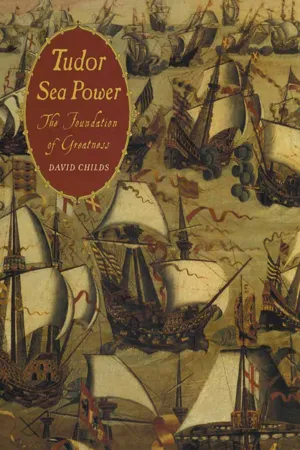
In the sixteenth century England turned from being an insignifcant part of an offshore island into a nation respected and feared in Europe. This was not achieved through empire building, conquest, large armies, treaties, marriage alliances, trade or any of the other traditional means of exercising power. Indeed England was successful in few of these. Instead she based her power and eventual supremacy on the creation of a standing professional navy which firstly would control her coasts and those of her rivals, and then threaten their trade around the world. This emergence of a sea-power brought with it revolutionary ship designs and new weapon-fits, all with the object of making English warships feared on the seas in which they sailed. Along with this came the absorption of new navigational skills and a breed of sailor who fought for his living. Indeed, the English were able to harness the avarice of the merchant and the ferocity of the pirate to the needs of the state to create seamen who feared God and little else. Men schooled as corsairs rose to command the state's navy and their background and self-belief defeated all who came against them. This is their story; the story of how seizing command of the sea with violent intent led to the birth of the greatest seaborne empire the world has ever seen.
Information
Contents
Acknowledgements
Introduction: The Birth of Greatness
| Chapter 1 | Background: Father to the Man |
Chapter 2 | Ship Types |
Chapter 3 | Building the Fleet |
Chapter 4 | Arming the Fleet |
Chapter 5 | Feeding the Fleet |
Chapter 6 | Command and Control and the Company |
Chapter 7 | A Sailor’s Life |
Chapter 8 | Pilotage, Navigation and Seamanship |
Chapter 9 | Havens and Harbours |
Chapter 10 | Plunder, Piracy and Professionalism |
Chapter 11 | The Fighting Fleet |
Chapter 12 | Shore Support |
Chapter 13 | The Legacy |
References
Bibliography
Appendices:
1 Chronology
2 The Ships of the Tudor Navy
3 A Ship’s Company
4 Gun Drills for Breech-Loading and Muzzle-Loading Guns
5 Keeping it in the Family: The Tudor and Howard Lord Admirals
6 Officials of the Navy Royal
7 Visiting the Tudor Navy
Index
Acknowledgements
First of all I must express my appreciation to Rob Gardiner for commissioning this work, which has given me many months of pleasure, and to Fiona Little, who has spent, I am sure, a less pleasurable time as my copy-editor, examining my text in great detail and pointing out and correcting my many editorial errors, thereby creating what is, I believe, a better read. After such scrutiny any errors that remain are very much of my own making.
In the course of my research the assistance of the Mary Rose Trust has been invaluable. In particular I would like to express my thanks to Rear Admiral John Lippiett, the Chief Executive, for freeing up his staff; Dr Mark Jones and Andy Elkerton, for their technical advice; Christopher Dobbs and Alexzandra Hildred, for their archaeological guidance; Peter Crossman for the provision of illustrations and drawings; and to Sue Judge, Sally Tyrrell and Helen Twiss for their easing of my path. Jenny Wraight provided much support from the Royal Naval Library, while the Chart Depot, also at Portsmouth Dockyard, gave much technical help. The charts in the text were drafted by Simon Williams, who is just starting out on what I hope will be an enjoyable academic career.
Above all, I am indebted to my wife, Jane, for her encouragement and indulgence and in letting me off the many domestic chores that I should have been undertaking rather than sitting in front of my PC.
Introduction
The Birth of Greatness
It takes three years to build a ship: it takes three hundred
to create a tradition. The evacuation goes on.
Admiral A B C Cunningham, 1942, talking about the
evacuation of Crete
Fighting to lift the remains of the Allied army from the beaches of Crete, while all the time haemorrhaging warships through persistent German air attack, those who heard the stirring words of Admiral Cunningham, the Commander-in-Chief, Mediterranean, would have cast their minds back to another time when England was fighting for her dear life, smiled grimly, gritted their teeth and willingly turned their faces once more to meet the foe. The names that their admiral’s words would have brought to mind would have been Effingham, Grenville, Ralegh and Drake, and the incident, above all others, that would have sprung to their minds would have been the defeat of the Spanish Armada.
It could be argued that the tradition of which they were a part, and to which, by their efforts, they were adding, was not born in the sixteenth century, but was itself created 300 years later by adoring writers such as Corbett, and poets of the likes of Noyes, Kipling, Tennyson and Newbold, who made saints out of England’s sea dogs and in doing so gave rise to legend. A legend based on the fact that a small nation summoned up the spirit to defend itself against enemies far larger, stronger, wealthier and advanced than it was itself. A legend that cast a lighthouse ray on what lay at the heart of the tradition which was the defence against invasion provided by England’s wooden walls. Spain launched three armadas against England, in 1588, 1596 and 1597; their failure created a sense of English inviolability that served her well for centuries and made many think that even the winds and waves obeyed her. Elizabeth’s speech at Tilbury in 1588 would have been very much at the forefront of Churchill’s thinking when he penned his ‘fight them on the beaches’ speech in 1940.
The sea hides its history. The waves that roll along the route on which the Spanish Armada sailed offer no clues as to what has passed before or lies beneath. There are no Tudor seascapes that inform of that time as well as a Fountains Abbey, a Hampton Court or Hardwick Hall; no ambassador’s acerbic wit, courier’s clever comment or poet’s pen informs of the goings-on at sea, on whose surface no royal adulterers or favourites achieved a scandalous longevity or a brutal brevity; the sea was governed by no contentious Bible or prayer book, for it kept its own unwritten laws and obeyed them without needing to gibe when the political or spiritual wind changed direction. Its laws largely unwritten and its codes of conduct unscripted, it became a power the mastering of which was passed on to subsequent generations by lore, example and achievement and the myths that arose from them. These tended to be strongest among those who followed the life afloat, and so the contribution of her seamen to her survival registers but little space in most general histories of Tudor England. Yet without the infant navy the nation would have become insignificantly, not triumphantly, Protestant, another Denmark or Sweden, not a global empire. It was the creation of naval, not royal, supremacy that was to make England the nation it became, with its fighting fleet the greatest jewel in its imperial crown and the foundations of its greatness.
This all began in an age of massive change, during which the nation endeavoured not to tear itself apart. During this time the naval tapestry grew continually, without much change to the pattern whoever the master weaver was and whatever spiritual influence distracted attention from the task. Its warp was made from the following skeins:
1. The creation of a full-time navy;
2. The development of ship design to counter the threat of both galleys and galleons;
3. The move from a coastal to an ocean-capable fleet;
4. The provision of specialised ship weaponry;
5. The recognition of naval warfare as a separate skill from land fighting;
6. The acknowledgement of sea experience as a qualification for high command;
7. The command of the Channel;
8. The legitimisation of plunder as a weapon of war.
Its weft was the work of those who imposed their will upon the world in which they voyaged. The motifs thus created can be identified clearly at any position along that century-sized canvas, even when it became frayed or faded through neglect or incompetence. When displayed it showed that the Tudors had created a dazzling and lasting work of art on which to lay their lusty infant Navy Royal – a navy which, after a long century of growth, commanded an international admiration, envy and respect which no other part of English life could equal. Yet the English spared scarce a glance at this fine tapestry in which they were wrapped, warm, safe and secure.

Map of the British Isles presented to Henry VIII in 1537: its limitations show well why each ship’s master preferred to sail with charts they had drawn themselves from their own observations. (British Library)
Chapter One
Background: Father to the Man
… Suppose that you have seen
The well-appointed king at Dover pier
Embark his royalty, and his brave fleet
With silken streamers the young Phoebus fanning.
Play with your fancies, and in them behold
Upon the hempen tackle ship-boys climbing;
Hear the shrill whistle, which doth order give
To sounds confused; behold the threaden sails,
Borne with th’invisible and creeping wind,
Draw the huge bottoms through the furrowed sea,
Breasting the lofty surge. O do but think
You stand upon the ravage and behold
A city on th’inconstant billows dancing –
For so appears this fleet majestical…
Shakespeare, Henry V
To deny the Tudor infancy of the Royal Navy is not to see the father in the child. Of course, the Tudor navy did not rise up from its cradle and, like the infant Hercules, reach out and strangle the twin serpents of France and Spain. Like any infant, it could not venture too far or for too long from its mother’s breast; like every child, it did not understand the sophistication of tactics and strategy; it felt safest in its own front yard, but it was here that it learned the skills that would one day mean it could cross oceans without fear. It was a prolonged period of growth, but it was a continuous one, bar a few setbacks such as any child might suffer. It is true that its behaviour was sometimes delinquent, but frequently it was that loutish behaviour that won it, albeit secretly, the admiration of its parent monarch whose proud creation it was. Generally, it put its infancy to good use: it learned its capabilities and limitations and how to improve them; it became aware of its enemies and learned to best them; it suffered hunger and thirst and learned how to overcome them; it went short of money and learned how to fund itself; it got to know of a world beyond its horizons and learned how to master it. It passed into Stuart adolescence a healthy and likely lad. Those who study its early days of growth are witness to the birth of greatness.
The medieval English were not a seafaring people. This is surprising given the nation’s setting, bounded on three sides by rich and variable seas. However, the land was not too desolate, nor the governance too despotic, to drive people to seek their sustenance far from its shores. More rugged or harsher terrains, such as that of Spain or Scotland, gave rise to fishermen w...
Table of contents
- Cover
- Half Title Page
- Title Page
- Copyright Page
- Contents
Trusted by 375,005 students
Access to over 1.5 million titles for a fair monthly price.
Study more efficiently using our study tools.
Frequently asked questions
Yes, you can cancel anytime from the Subscription tab in your account settings on the Perlego website. Your subscription will stay active until the end of your current billing period. Learn how to cancel your subscription
No, books cannot be downloaded as external files, such as PDFs, for use outside of Perlego. However, you can download books within the Perlego app for offline reading on mobile or tablet. Learn how to download books offline
Perlego offers two plans: Essential and Complete
- Essential is ideal for learners and professionals who enjoy exploring a wide range of subjects. Access the Essential Library with 800,000+ trusted titles and best-sellers across business, personal growth, and the humanities. Includes unlimited reading time and Standard Read Aloud voice.
- Complete: Perfect for advanced learners and researchers needing full, unrestricted access. Unlock 1.5M+ books across hundreds of subjects, including academic and specialized titles. The Complete Plan also includes advanced features like Premium Read Aloud and Research Assistant.
We are an online textbook subscription service, where you can get access to an entire online library for less than the price of a single book per month. With over 1.5 million books across 990+ topics, we’ve got you covered! Learn about our mission
Look out for the read-aloud symbol on your next book to see if you can listen to it. The read-aloud tool reads text aloud for you, highlighting the text as it is being read. You can pause it, speed it up and slow it down. Learn more about Read Aloud
Yes! You can use the Perlego app on both iOS and Android devices to read anytime, anywhere — even offline. Perfect for commutes or when you’re on the go.
Please note we cannot support devices running on iOS 13 and Android 7 or earlier. Learn more about using the app
Please note we cannot support devices running on iOS 13 and Android 7 or earlier. Learn more about using the app
Yes, you can access Tudor Sea Power by David Childs in PDF and/or ePUB format, as well as other popular books in History & Ancient History. We have over 1.5 million books available in our catalogue for you to explore.