- 224 pages
- English
- ePUB (mobile friendly)
- Available on iOS & Android
eBook - ePub
About this book
The Roman Navy was remarkable for its size, reach and longevity. As significant as the Royal Navy was to the British Empire in the nineteenth century, the Roman Navy was crucial to the extraordinary expansion of Imperial power and for its maintenance over a period of more than 800 years. The fabric and organisation of this maritime force is at the core of this new book.At the height of its power the Roman Navy was, at least in numerical terms, the largest maritime force ever to have existed. It employed tens of thousands of sailors and maintained and fought fleets of ships larger than any forces since. In these pages the author looks at all the aspects of the Navy in turn. Shipbuilding, rigs and fittings, and shipboard weaponry are covered as are all the principal ship from the earliest types to the very last. The command structure is outlined, as are all aspects of the crews lives, their recruitment, terms of service, training and uniforms. Life onboard, food and drink, discipline, religion and superstition are described, while seamanship and navigation are dealt with along with bases and shore establishments. Operations feature prominently, the allied and enemy navies compared, and specimen battles employed to explain fighting tactics.All these aspects changed and developed hugely over the great span of the Roman empire but this fascinating book brings this complex story together in one brilliant volume.
Information
CONTENTS
Preface
I INTRODUCTION
1 A Brief History of the Roman Navy
Chronology of Naval Affairs
II THE SHIPS
2 Shipbuilding
3 Shipboard Weapons
4 Types of Ship – The Republic
5 Types of Ship – The Empire
III COMMAND STRUCTURE
6 Organisation of the Fleets
7 The Command Structure
8 Shipboard and Other Ranks
IV THE CREWS
9 Recruitment
10 Terms of Service
11 Training
12 Uniforms and weapons
V SERVICE LIFE
13 Food and drink
14 On Board Ship
15 Religion and Superstition
VI SEAMANSHIP
16 Navigation
17 Ship Performance
18 Bases and Shore Establishments
VII OPERATIONS
19 Strategy and Deployment
20 Scouting and Intelligence
21 Blockades
VIII TACTICS
22 Battle Tactics
23 The Periplous Battle
24 The Diekplous Battle
25 The Influence of Topography
26 The Static Battle
Principal Roman Naval Actions
IX ALLIED NAVIES
27 Rhodes
28 Pergamum and Syracuse
29 Marseilles and Judaea
X ENEMY NAVIES
30 Carthage, Taranto, the Pirates
31 Hellenistic Navies
32 The Barbarians
APPENDIX MODELLING NOTES
Modelling Roman Ships
Modelling Techniques
Building a Quinquereme
References and Notes
Index
PREFACE
THE ROMAN NAVY or, more accurately, the naval forces of the Roman state, is more often than not consigned to little more than a couple of paragraphs in many accounts of Roman military endeavour. In fact, it was for over 800 years an integral part of the armed forces of that Roman state and became the world’s first ‘super-power’ navy. It was the instrument by which Rome achieved domination of the western Mediterranean, which enabled her expansion into the lands surrounding it and the foundation of her empire; it was naval forces that enabled the Romans to intervene and eventually to dominate the Eastern Mediterranean and the lands of the near east. It was a naval campaign and a sea battle that established and secured power for the first of the emperors of Rome; it was the navy’s domination that enabled trade and the economy of the empire to grow and to flourish, free from the scourge of piracy and to an extent not equalled until the twentieth century. Finally, it was the loss of that domination that was a vital factor in the disintegration and ending of the Western Roman Empire. Cicero’s dictum that ‘The master of the sea must inevitably be master of the empire’ (M. Tullius Cicero, 106–43 BC, Epistolae ad Atticus 10.8.4, existimat enim qui mare teneat eum necesse [esse] rerum potiri) has proved to be true in every Europe-wide war since. At its height, during the Punic Wars, the navy accounted for fully a third of the total Roman military effort and during imperial times it averaged rather more than a tenth of it.
Surviving evidence relating to the service is sparse and fragmentary but there is overall a body of information about the Roman navy, seafaring and shipping in the ancient world and aspects of Roman life which can be searched to extract a picture of the Roman navy as a whole. In seeking to arrive at a detailed picture of the service, parallel evidence will also have to be relied upon, as will therefore, the argument that it would be unreasonable as well as illogical to suppose that entirely separate arrangements, systems or methods had been employed just for the navy. For example, while on the one hand it seems likely that the army’s standard issue sword, the gladius hispaniensis, was also used by the marines of the navy, on the other it seems that the navy adopted a short pike for use in boarding which finds no parallel with the army. Conclusions should not, however, be reached without consideration of the appropriateness of an item. So, for example again, it is well known that the Roman legionary wore sturdy, ventilated boots (caligae) studded with hobnails, but this footwear would have been impractical for a marine, as the hobnails would lack grip on a wooden deck and would quickly rip the surfaces to shreds. One can thus posit that a marine’s boot, although similar, would have substituted a leather or rope sole; the army’s boot is proven, the marine’s surmised, but well within the technology of the time but there are no surviving examples.
There is some evidence, however, such as inscriptions, wall and pottery paintings, statuary and literary references, that directly relate to the navy. As an example, a votive altar set up by Valerius Valens, in which he describes himself as Praefect[us] Classis Mis[enensis] (CIL X.3336/ILS 3765), prefect of the fleet at Misenum, shows that the post existed in the early third century AD, the date of the altar. There are other traces, too, on the monumental scale; at Carthage, for example, there are the remains of the basins that formed the once great military and mercantile harbours, including the base of an excavated ship shed on the area now known as Admiralty Island. Syracuse has some remains of city walls from ancient times as well as the great Euryalus fortress, the world’s first artillery fort. In Rome the Capitoline Museum houses the plaque erected to celebrate Duilius’ naval victory at Mylae in 260 BC. At Ostia, by the Marine Gate, the funerary monument of C. Cartilius Poplicola (first century BC) commemorating his military achievements in life is crowned by a representation of a warship of trireme configuration; almost opposite this is a model in marble of a ship’s ram. There are smaller artefacts, such as bricks bearing stamps of the fleets that had them made, metal diplomas awarded to men upon their retirement from the service and inscriptions and reliefs on monuments and stelae in many museums, as well as wall paintings, such as those from Pompeii.
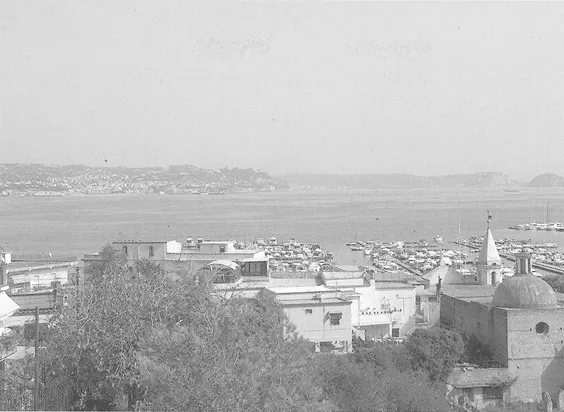
The view from Baia (Baiae) to Pozzuoli (Puteoli). Tiberius’ philosopher, Thrasyllus taunted Gaius (Caligula) that he could no more become emperor than ride a chariot between them. When he did become emperor, Gaius ordered the nearby Misene fleet to gather every ship that they could find to bridge the distance of some 2 miles (3 km); they built a pontoon bridge from some 2,000 ships, 10 feet (3 m) wide to join them, with ‘islands’ every thousand paces upon which ‘villages’ were constructed. Gaius duly rode his chariot across, accompanied by cavalry and infantry, returning across on the following day. (Author’s photograph)
Although having had great numbers of ships and men, the Republican navy did not have the great naval bases of later Imperial times and thus little trace remains of it. The Imperial navy did, however, and archaeological excavations have been carried out at many of them, although there is sometimes little to distinguish the remains as distinctly ‘naval’ as opposed to military. Thus a military hospital unearthed at Xanten (Vetera, Belgium) could serve both the Rhine fleet and local garrisons. One location known to be of naval significance is, of course, Misenum, much of which is now a pleasant, modern holiday town; but there are visible remains of masonry and moles and the base of the temple of the Augustales, the priests of the cult of the emperors, can be...
Table of contents
- Cover
- Half Title
- Title Page
- Copyright Page
- Contents
Trusted by 375,005 students
Access to over 1.5 million titles for a fair monthly price.
Study more efficiently using our study tools.
Frequently asked questions
Yes, you can cancel anytime from the Subscription tab in your account settings on the Perlego website. Your subscription will stay active until the end of your current billing period. Learn how to cancel your subscription
No, books cannot be downloaded as external files, such as PDFs, for use outside of Perlego. However, you can download books within the Perlego app for offline reading on mobile or tablet. Learn how to download books offline
Perlego offers two plans: Essential and Complete
- Essential is ideal for learners and professionals who enjoy exploring a wide range of subjects. Access the Essential Library with 800,000+ trusted titles and best-sellers across business, personal growth, and the humanities. Includes unlimited reading time and Standard Read Aloud voice.
- Complete: Perfect for advanced learners and researchers needing full, unrestricted access. Unlock 1.5M+ books across hundreds of subjects, including academic and specialized titles. The Complete Plan also includes advanced features like Premium Read Aloud and Research Assistant.
We are an online textbook subscription service, where you can get access to an entire online library for less than the price of a single book per month. With over 1.5 million books across 990+ topics, we’ve got you covered! Learn about our mission
Look out for the read-aloud symbol on your next book to see if you can listen to it. The read-aloud tool reads text aloud for you, highlighting the text as it is being read. You can pause it, speed it up and slow it down. Learn more about Read Aloud
Yes! You can use the Perlego app on both iOS and Android devices to read anytime, anywhere — even offline. Perfect for commutes or when you’re on the go.
Please note we cannot support devices running on iOS 13 and Android 7 or earlier. Learn more about using the app
Please note we cannot support devices running on iOS 13 and Android 7 or earlier. Learn more about using the app
Yes, you can access The Roman Navy by Michael Pitassi in PDF and/or ePUB format, as well as other popular books in History & Military & Maritime History. We have over 1.5 million books available in our catalogue for you to explore.